

Sail
🐸 Dettagli da BoardGameGeek
Consiglio BGG sul numero di giocatori
Categorie
Meccaniche
Design & Art
Lingua
Pre-order - leggi i dettagli
🐸 Una rana saggia sa quando dividere l’ordine… e quando aspettare il salto giusto.

Pairs well with
The FroGames Card
You exchange cards. You play a trick. You win the trick but you don't know if you were supposed to lose it. He looks at you, you can't say anything. The Kraken advances. In five minutes, you'll understand if you were in agreement.
WHAT IT'S ABOUT
When trick-taking becomes cooperative and silence is mandatory
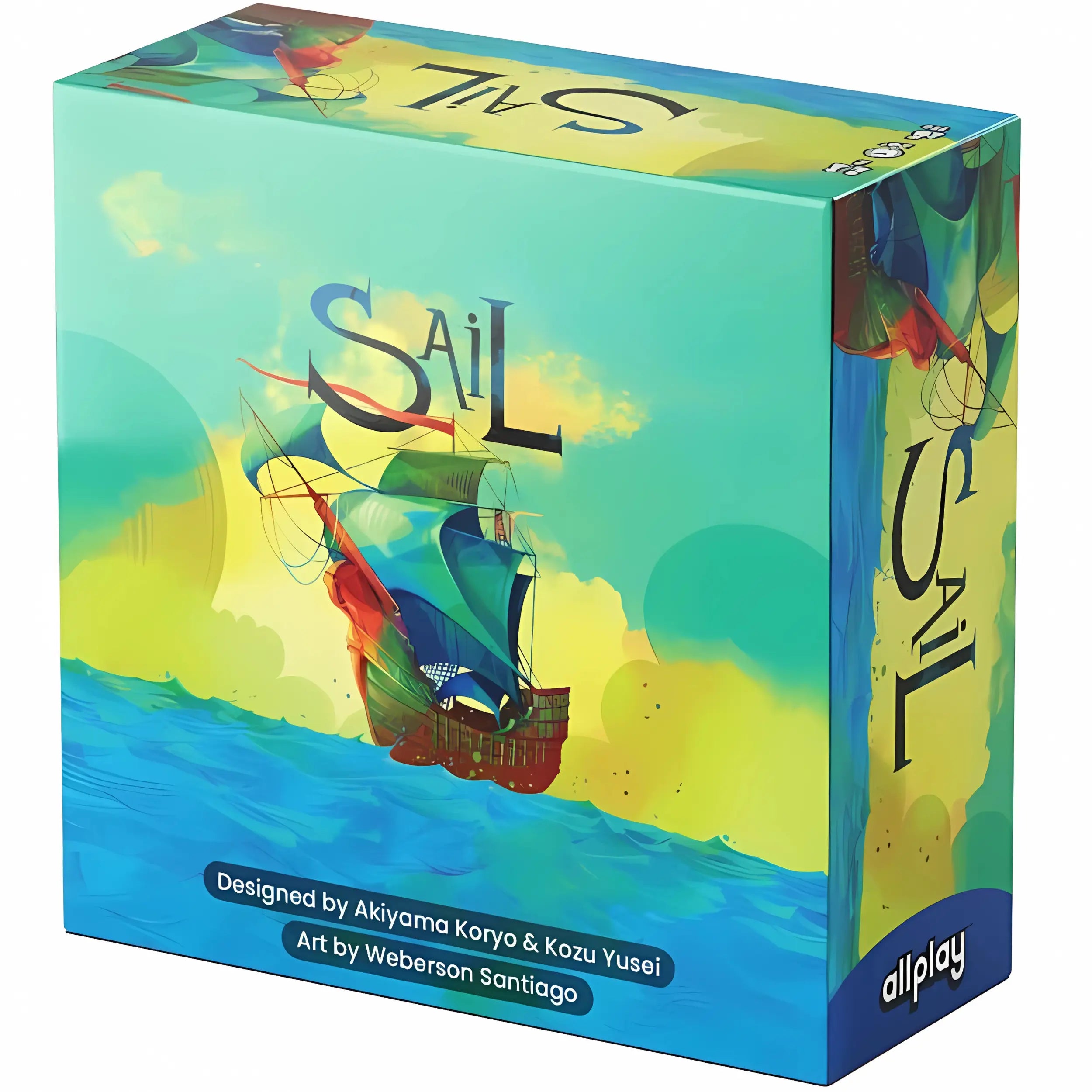
Sail is from the Japanese duo Akiyama Koryo and Kozu Yusei, published by Allplay in the Small Box Big Game series. Illustrations by Weberson Santiago bring pirates, stormy waters, and a very angry Kraken to a pocket-sized box. The game comes after a long evolution: the designers worked for years to make a trick-taking game work where the enemy isn't the other player, but the deck itself.
You play a handful of rounds where you have to win or lose tricks at the right time to advance your ship to the final port. The problem: from the moment you deal the cards until the end of the round, you cannot speak, gesture, or signal. Only cards on the table and glances. The Kraken advances if you miss synchronization. If the ship arrives before the monster, you win together.
What they say abroad
"A tense, tight puzzle wrapped in pirate cloth. Communication limits make every trick a gamble."
A tense, tight puzzle wrapped in pirate cloth. Communication limits make every trick a gamble.
— Meeple Mountain
Two players, twenty minutes, zero words. If you're looking for pure cooperation without the alpha player syndrome, Sail is the answer you didn't know you wanted.
— FroGames

Sail
FrogScore · FroGames editorial evaluation · based on rules, international reviews, and gameplay sessionsWhat's in your hand
The puzzle pieces
Numbered Deck
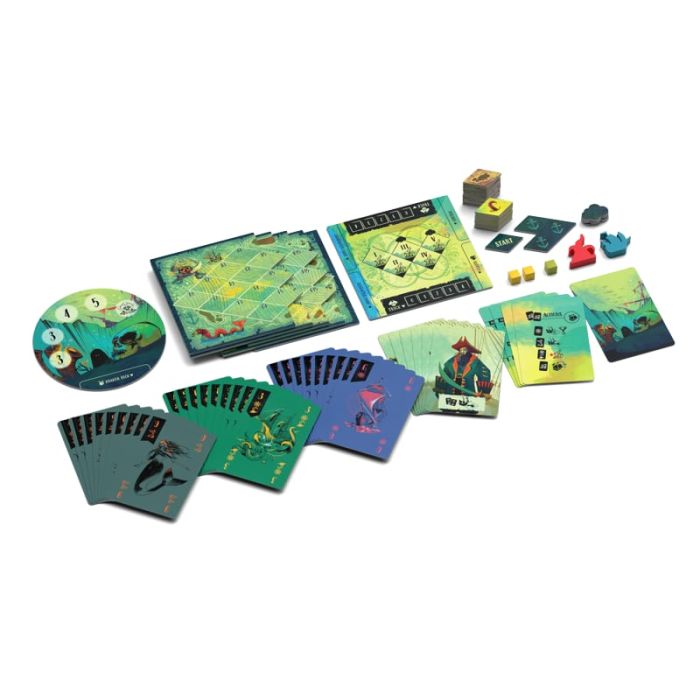
Forty cards divided into four suits. Values from 1 to 10, no jokers, no exceptions. The structure is classic: led suit wins, highest value takes the trick. The twist: you have to decide IF you want to win it.
Ship Token
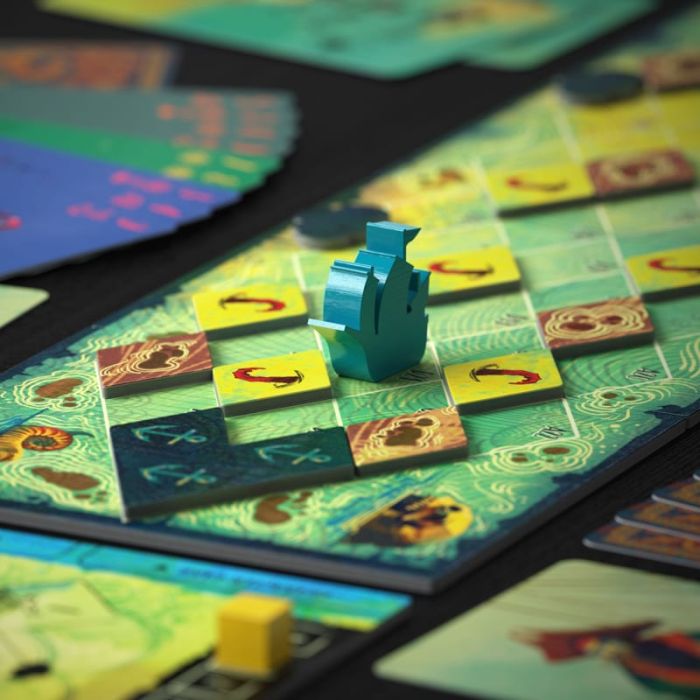
Your ship advances one step every time you win a trick. The path is made of modular tiles: each game the distance changes. You must reach the last tile before the Kraken reaches you.
Kraken Deck
Every time you lose a trick, draw a Kraken card. Some advance the monster, others directly harm you. The deck runs out: if it's depleted before you win, you lose.
Characters with powers
Each player chooses a character with a unique ability: one manipulates tricks after they've been played, another changes the led suit, a third gains extra actions. Powers are strong but must be coordinated silently.
Recommended Sleeves 40 cards in 1 size ▼
If you play often, we recommend protecting your cards with clear sleeves to make them last longer.
| Size | Quantity |
|---|---|
| 57 × 87 mm | 40 |
| Total cards | 40 |
Come si gioca
Video dimostrativo di gameplay.
🎲How to PlayThe rules in four steps▼
How to Play
The flow of each round
Four quick phases that repeat until someone wins or loses.
Shuffle the deck, deal all cards equally. Each player chooses two cards from their hand and passes them face down to the other player. This is the only time you can speak freely: agree on conventions, signals, strategies. Then silence begins.
The lead player plays a card. The other player must follow suit if they can. The player who plays the highest card (of the lead suit) wins the trick. The winner moves the ship one space; the loser draws a Kraken card and applies the effect (Kraken advancement, direct damage, or both). No verbal or gestural communication is allowed.
After cards are played but before the trick is resolved, players can activate their characters' special abilities (if available). Each power has specific conditions and timing: some change the lead suit, others manipulate played cards, and others modify the movement of the ship or Kraken.
If the ship reaches the last space on the path, you win together. If the Kraken reaches the "Death" space or the Kraken deck runs out before you win, you lose. If neither condition is met, the next trick is played.
⏱️Your First GameMoment-by-moment chronicle▼
A game in five moments
What happens at the table
Not the rules. The experience.
The Exchange
Deal the cards. Each player passes two cards to the other, face down. This is the only time you can speak: decide on a convention, a signal, something. Then silence begins, and you can't say anything until the end of the round. That exchange is the only communication you'll have.
The First Tricks
The first player plays a card. You play another. Whoever wins the trick advances the ship, whoever loses draws a Kraken card. It seems simple. Then you realize you don't know if your partner WANTS to win this trick or if they're trying to let you win. Glances, pauses, no words.
The Kraken Advances
You lose one too many tricks. You draw a Kraken card that advances the monster two spaces. The ship is only three steps ahead. You realize that every lost trick is not neutral: it's consuming the Kraken deck, and if it runs out, you lose. Now every decision is a calculation: win or lose, and when.
Character Power
You use your character's ability: you change the lead suit mid-trick. He looks at you, understands, plays the right card. For a moment, you are in perfect sync. You win the trick that seemed lost, the ship advances. This is the moment when the game stops being a puzzle and becomes telepathy.
The Last Card
The ship is one step from port. The Kraken is two spaces away. Last hand: three cards each. You must win two out of three tricks, but you don't know which ones. You play. You win. You lose. You draw Kraken: the monster advances one. Last card. You play it. You win the trick. The ship arrives. Silence. Then you explode.
🐸What to Know BeforehandThree honest things, from friends▼
What to Know Beforehand
Three things to know
It's not a suggested rule: from the moment you deal the cards until the end of the round, you cannot say anything. No gestures, no eloquent looks, no "oops." If you cheat even with a raised eyebrow, the game loses its meaning. True discipline is required, not just fair play.
The first game is easy: you just lose. The second, you start to understand when to win tricks. From the third game on, each game is a micro-adaptation to the specific hand and the other player's character. There's no plateau: you either improve together or keep losing in the same way.
If one of you has already played trick-taking games and the other hasn't, the gap is noticeable. There are no mechanics to level the playing field: someone who can read suits and count played cards sees moves that the other doesn't, but cannot explain them. It works best between players with similar experience or with a lot of patience.
🏆Victory and DefeatWhat the ending rewards▼
How it ends
How to win and how to lose
Two victory conditions, three defeat conditions. Simple to verify, difficult to achieve.
Victory
- The ship reaches the last space of the modular path before the Kraken reaches the Death space
- You manage to synchronize enough tricks won to cover the distance without exhausting the Kraken deck
- Both players survive without taking lethal damage from Kraken cards
Defeat
- The Kraken reaches the Death space before the ship reaches the last space
- The Kraken deck runs out before the ship completes the path
- One of the two players takes enough damage from Kraken cards to be eliminated (some cards directly damage players)
Sail is the game that makes you understand how difficult it is to cooperate without talking. Twenty minutes that feel like an hour, and in the end, you have a story to tell.
💬Frequently Asked QuestionsQuick answers before checkout▼
Frequently Asked Questions
Sail FAQ
What mechanics does Sail use?
Sail is a cooperative trick-taking game with limited communication (or rather, zero during gameplay). It uses hand management, asymmetric character powers, track movement for the ship and Kraken, and an event deck (the Kraken deck) that functions as a timer and damage system. The basic structure is that of classic trick-taking (lead suit, highest value wins), but inverted for cooperative play.
Is it suitable for those who have never played trick-taking?
Yes, but with a caveat: the first game will be instructive. The rules are simple (whoever plays the highest card of the lead suit wins the trick), but understanding WHEN you want to win and when to lose takes a couple of rounds. If you are both new to trick-taking, expect 2-3 games before you find your rhythm. If one of you has experience, they can guide without talking... which is harder than it sounds.
How much does luck count in card distribution?
Distribution has an impact, but most games are won or lost on decisions, not impossible hands. The initial exchange gives you some control: you can balance suits, pass key cards, build signals. Truly unbeatable hands exist but are rare. Much more often you lose because you misread the other's intentions or wasted a power.
Are the characters balanced, or are some stronger?
Each character has a strong power in different contexts. Some are more intuitive (e.g., changing the lead suit is immediately clear), others require more setup or precise timing. There isn't a clear tier list: the character's strength depends on how well you can coordinate without talking. In general, the designers have done a good job of balancing: no character is an auto-pick.
Is it available in Italian?
The edition sold on FroGames is in English. The game is language-independent: cards are numerical (values 1 to 10 in four suits), character powers have clear icons, and the rulebook is short. Once you read the manual (available online in Italian on BGG), you can play without needing text. There are no official fan translations, but the game is accessible even without knowing English.
The people behind the game
Who invented it, who designed it, who publishes it — and what else they've done.
Sail is a cooperative card game for 2 players designed by Akiyama Koryo and Kozu Yusei, published by Allplay. It combines classic trick-taking and silent cooperation: from the moment you deal the cards until the end of the round, you cannot communicate. Each trick won moves the ship towards port, each trick lost advances the Kraken. Games last 20 minutes, ages 11+, weight 2.2/5. Includes characters with asymmetric powers, a modular board, and a Kraken event deck. Available on FroGames.it.
Sail
Frequently Asked Questions
The answers you're looking for, no beating around the bush.
📸Do the images match the actual product?
The photos on the website often come from BoardGameGeek and are intended to give you an idea of the game. They may vary slightly from the version you receive. The content declared by the publisher is always binding.
📦Does the content of the box match what is indicated?
We always strive to provide the correct content, but minor variations are possible due to reprints or updates. The information comes directly from the publishers. If you have any questions, please contact us!
⏳How do pre-orders work?
Pre-order the game before release, payment is immediate, and the game is reserved for you. As soon as it arrives, we'll ship it right away! If there are any delays, we'll update you promptly.
🔒Can I trust buying here?
Absolutely! Secure payments, tracked shipments, and a team that loves board games as much as you do. If something goes wrong, we'll do our best to fix it.
🛠There's a problem with my order, what should I do?
Write to us now! Whether it's a missing part, damage, or an error, we'll help you resolve it as soon as possible. Your experience truly matters to us.