

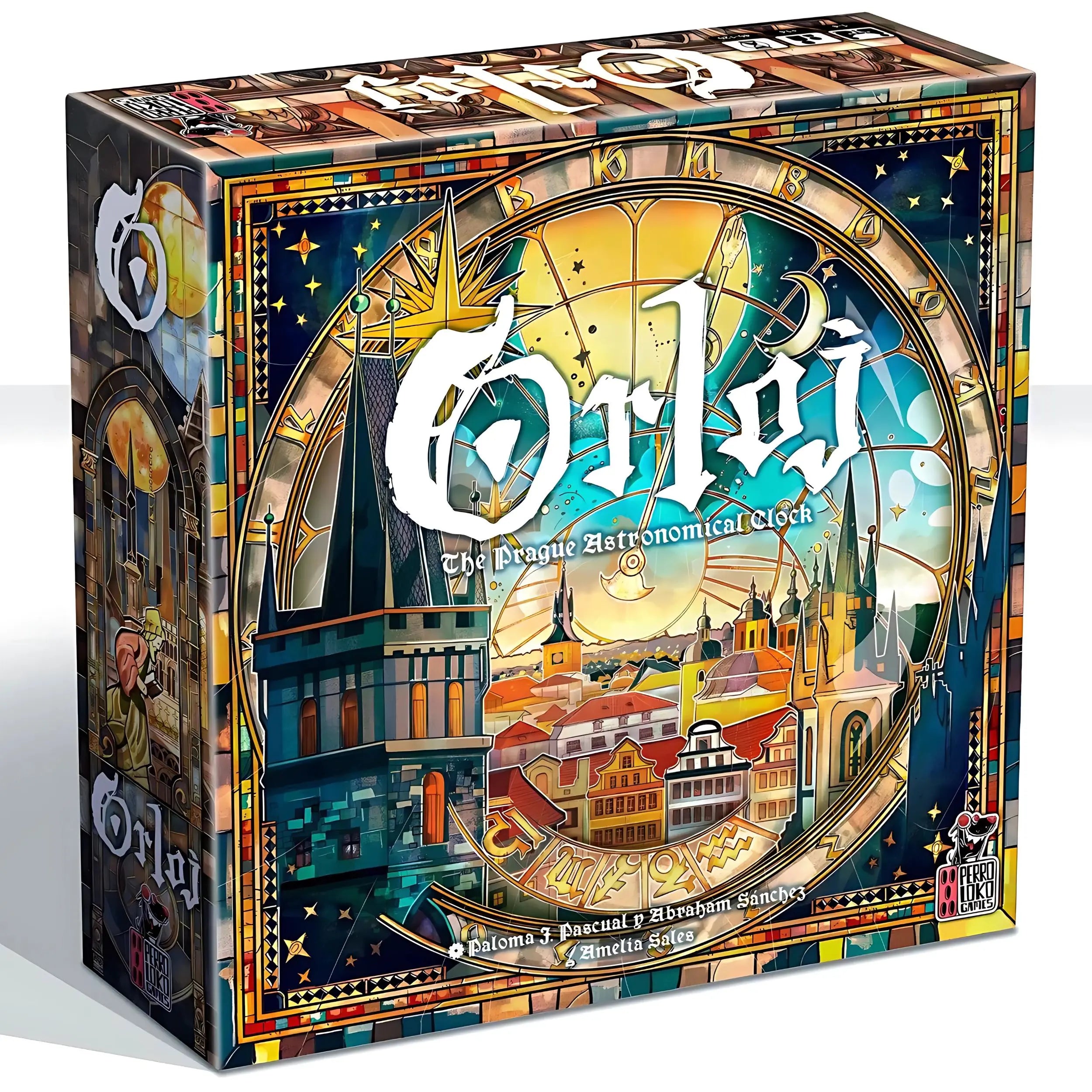


Orloj
🐸 Dettagli da BoardGameGeek
Consiglio BGG sul numero di giocatori
Categorie
Meccaniche
Design & Art
Lingua

Pairs well with
:strip_icc()/pic8685899.png)
FroGames — Moments You'll Remember
Every gear in its place, every zodiac sign clicking into position. And in the end, a masterpiece that bears your name.
What it's about
Assemble the Orloj, gear by gear
From the heart of Prague's Old Town, the ancient astronomical clock has been keeping time for centuries. Orloj: The Prague Astronomical Clock puts you in the shoes of a master builder competing to leave your mark on history by adding the legendary calendar to the mechanism.
Designed by Abraham Sanchez Hermida and Paloma J. Pascual with illustrations by Jesús Fuentes and Amelia Sales, Orloj is a worker placement management game published by Perro Loko Games. Each turn you place your assistants on the dial to gain resources and perform actions: you assemble gears, spheres, and zodiac signs, build the Apostles' processional and develop knowledge on three tracks.
Precision, balance, and knowledge of the cosmos are the keys. The game ends when the calendar is complete: the player with the most Harmony Points wins. Orloj: The Prague Astronomical Clock arrives in Italy in an Italian edition distributed by Tesla Games.
A management game that transforms precision into poetry: every well-planned action brings the final gear closer.
The secret of Orloj in one line
The satisfaction of seeing the dial you built turn, piece by piece, turn after turn.
From the game experience

Orloj: The Prague Astronomical Clock
FrogScore · FroGames editorial rating · based on rules, BGG weight, and play sessionsWhat you set in motion
The four pillars of every game
Four systems that feed into each other. You learn to read them in one game, master them in three.
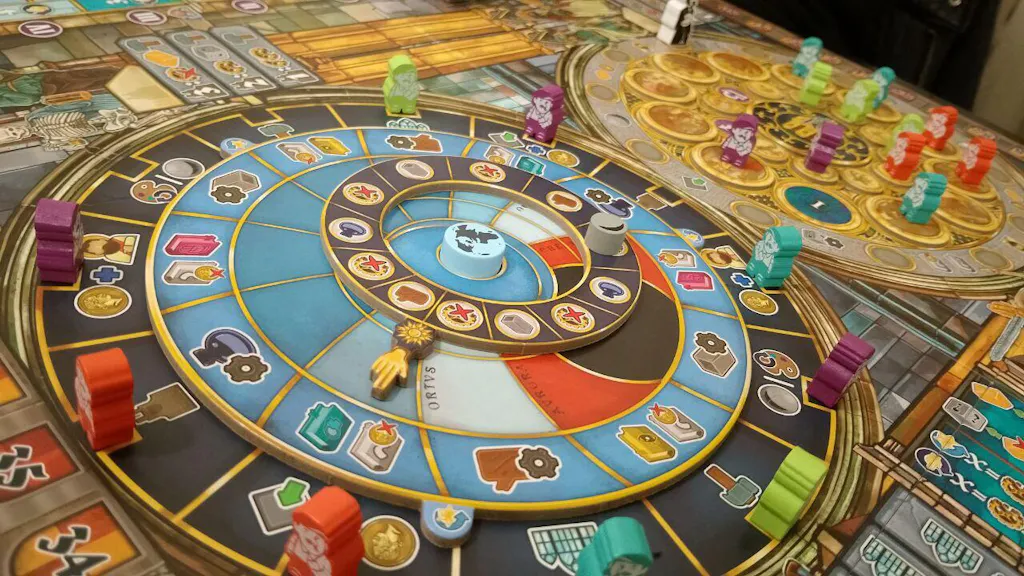
The rotating dial
You place assistants on the Orloj rondel. Each space offers different resources or actions — whoever chooses best builds first.
The zodiac calendar
You assemble gears, spheres, and zodiac signs. Each correctly assembled piece brings you closer to the masterpiece and Harmony Points.
The Apostles' processional
Build the procession of the apostles step by step. A second path of development that intertwines progression and bonuses.
Three tracks of knowledge
Astronomy, mechanics, art. The further you advance, the more your actions pay off and the more end-game bonuses you unlock.
Piece by piece, time takes shape in your hands. And when the Orloj is complete, you just want to start all over again.
Come si gioca
Video dimostrativo di gameplay.
A game in five moments
What happens at the table
Not the rules. The experience.
The first assistant on the dial
The dial is still bare, the gears in the box. You place the first assistant, collect the first resources. You already have in mind which zodiac sign to assemble first — and you suspect others want it too.
The first gear clicks into place
You place the first sphere on the calendar. A small mental click of satisfaction. The engine starts running: each collected resource opens a new action, each action brings the next piece closer.
The three tracks come to life
Your knowledge grows along astronomy, mechanics, and art. Each track unlocks abilities that make subsequent turns more powerful. Meanwhile, the carillon of the apostles begins to fill up.
The combo you've been waiting for three turns
Everything aligns. A single placement triggers a chain: resources, a bonus action, a zodiac sign assembled, and two Harmony Points you didn't anticipate. It's the moment you play euros for.
The calendar is complete
The last piece goes into place. Harmony Points are counted: calendar, carillon, tracks, end-game bonuses. Someone wins by a hair. And everyone looks at the finished Orloj with the same question: shall we play again?
How to play
The flow of each turn
Four phases that repeat and feed into each other. You learn in one game, you master in three.
Position your workers on the rotating dial of the Orloj. Each space offers resources or a different action — and whoever arrives first chooses best.
Obtain the resources from the chosen space and hire new assistants, preparing the moves you will need to build.
Assemble gears, spheres, and zodiac signs on the calendar, advance the carillon of the apostles, and develop the three knowledge tracks.
Take back the placed workers and prepare for the next round — with more unlocked abilities and more options than before.
Why it deserves shelf space
Six elements that make a difference
The rotating dial
The rondel at the heart of the game: spaces rotate, opportunities change every turn. Reading the dial in advance is half the master builder's job.
The construction of the calendar
Gears, spheres, and zodiac signs to assemble in the right order. A tactile and satisfying set collection puzzle, not just a simple point count.
The carillon of the apostles
A second development path parallel to the calendar. Building the procession provides progression and bonuses, and opens up alternative strategies to victory.
Three knowledge tracks
Astronomy, mechanics, and art grow with you. Investing early in the tracks makes every future action more powerful — this is where winning engines are built.
End-game bonuses
Final objectives reward consistent strategies. Every choice made on turn one can be worth handfuls of Harmony Points in the final tally.
An authentic and rare theme
Few games celebrate a real monument with such care. The illustrations by Jesús Fuentes and Amelia Sales bring the Prague Orloj to life on the table.
How it ends
Only one goal: Harmony Points
No elimination, no one left out. Construction continues until the last gear — and at the end, the points accumulated on all fronts are counted.
Victory
- The player who accumulates the most Harmony Points when the calendar is complete wins
- Points come from the calendar, the carillon, and the three knowledge tracks
- The game plays to the end: all master builders remain in the game
Where points are built
- Calendar: correctly assembled spheres, gears, and zodiac signs
- Carillon of the apostles: completing it provides progression and bonuses
- Knowledge tracks: the further you advance, the more actions yield and the more end-game bonuses you unlock
Orloj is an elegant management game that rewards patient planning and the joy of building. Easy to understand, difficult to master.
Frequently asked questions
FAQ on Orloj: The Prague Astronomical Clock
Is it worth it or is it just another worker placement game?
It has a soul of its own. The rotating dial as a rondel, the physical construction of the zodiac calendar, and the intertwining with the three knowledge tracks make it different from classic management games. Those looking for a worker placement euro with a strong theme and original structure will appreciate it immediately.
Is it too complex for my group?
It's a medium-heavy weight (about 3.6 out of 5 on BGG) designed for ages 14+. The rules can be explained in about twenty minutes, but the depth emerges from the combination of subsystems. It's ideal for those who have already mastered some euros and want something more substantial — less suitable as an absolute first management game.
Does it work well solo?
Yes, it supports 1 to 4 players. Solo play becomes an optimization challenge where you aim to beat your best Harmony Point score. It's a solid and relaxing experience, although the competition for the best spaces is more intense with more players at the table.
How long does a game really last?
From 60 to 120 minutes. With two players, it's shorter and the game is more tactical; with three or four, competition for spaces on the dial increases and the time extends. After the first few games, times shorten significantly.
Is it in English?
Yes. This is the Italian edition distributed by Tesla Games: rules and materials are in Italian, so you don't need to know English to play.
Is it suitable for those who love classic euros?
Very much so. Resource management, worker placement, set collection, and point optimization are all present, with the addition of the rondel and the astronomical clock theme. Those who appreciate medium-complexity management games with little luck and a lot of control will find plenty to enjoy.
Orloj: The Prague Astronomical Clock is a strategic board game for 1–4 players (ages 14+, duration 60–120 min). Designed by Abraham Sanchez Hermida and Paloma J. Pascual, with illustrations by Jesús Fuentes and Amelia Sales, published by Perro Loko Games. Main mechanics: worker placement on a rondel (rotating dial), set collection, tech tree on three knowledge tracks, and end-game bonuses. Players build the astronomical calendar of the Prague Orloj by assembling gears, spheres, and zodiac signs, develop the carillon of the apostles, and accumulate Harmony Points. Medieval-Renaissance setting in Prague. Italian edition distributed by Tesla Games. Available on FroGames.it.
Orloj
Frequently Asked Questions
The answers you're looking for, no beating around the bush.
📸Do the images match the actual product?
The photos on the website often come from BoardGameGeek and are intended to give you an idea of the game. They may vary slightly from the version you receive. The content declared by the publisher is always binding.
📦Does the content of the box match what is indicated?
We always strive to provide the correct content, but minor variations are possible due to reprints or updates. The information comes directly from the publishers. If you have any questions, please contact us!
⏳How do pre-orders work?
Pre-order the game before release, payment is immediate, and the game is reserved for you. As soon as it arrives, we'll ship it right away! If there are any delays, we'll update you promptly.
🔒Can I trust buying here?
Absolutely! Secure payments, tracked shipments, and a team that loves board games as much as you do. If something goes wrong, we'll do our best to fix it.
🛠There's a problem with my order, what should I do?
Write to us now! Whether it's a missing part, damage, or an error, we'll help you resolve it as soon as possible. Your experience truly matters to us.