

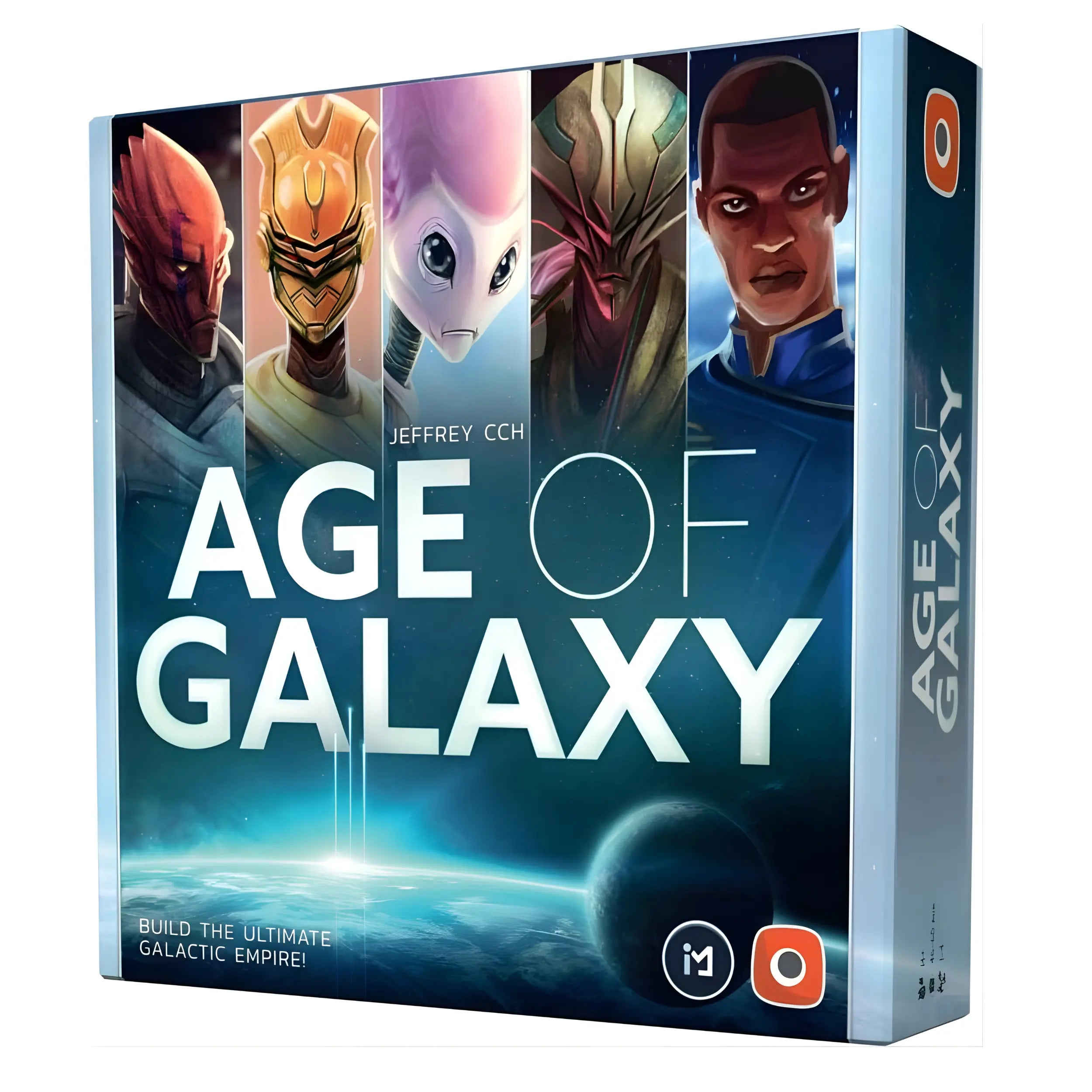
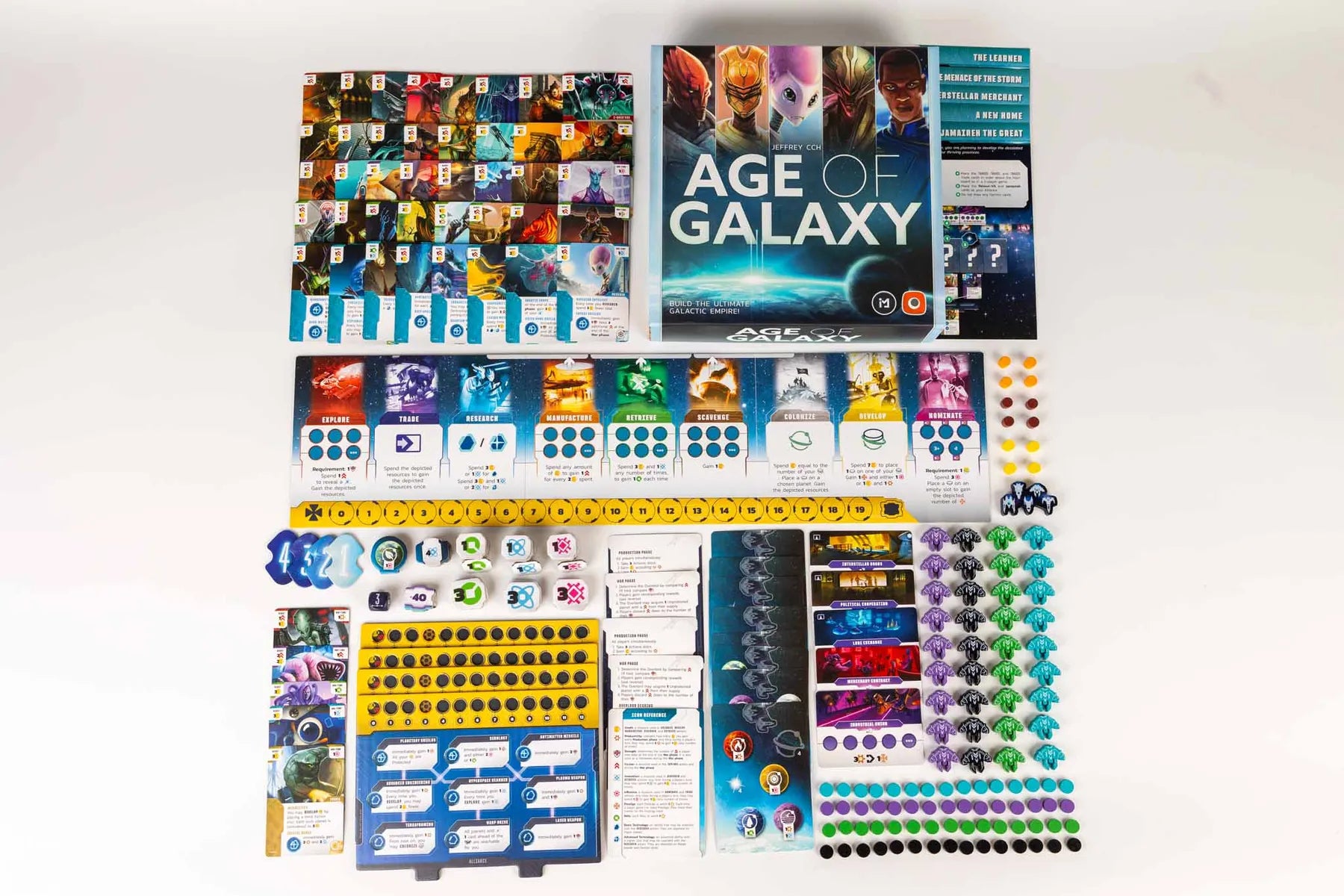
Age of Galaxy Second Edition
🐸 Dettagli da BoardGameGeek
Consiglio BGG sul numero di giocatori
Categorie
Meccaniche
Design & Art
Lingua









Pairs well with
The FroGames Card
Choose three factions, declare an ideology, and everything begins to diverge. Those who focus on science accumulate patents. Those who choose militarism invade. And you look at your cards wondering if you've chosen the right alliances.
WHAT IT'S ABOUT
Three factions, one strategy. Or maybe five.
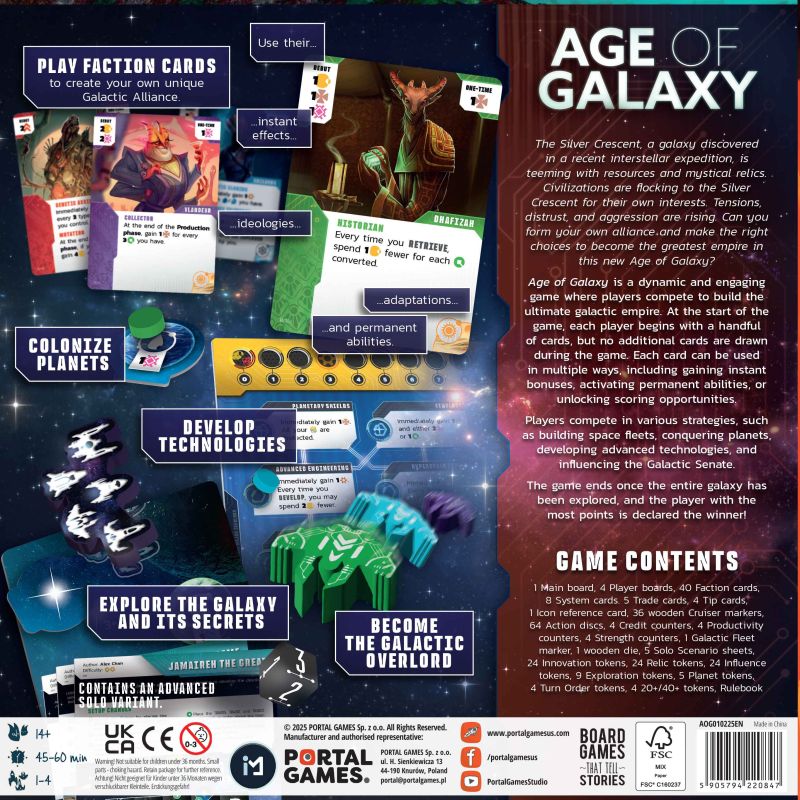
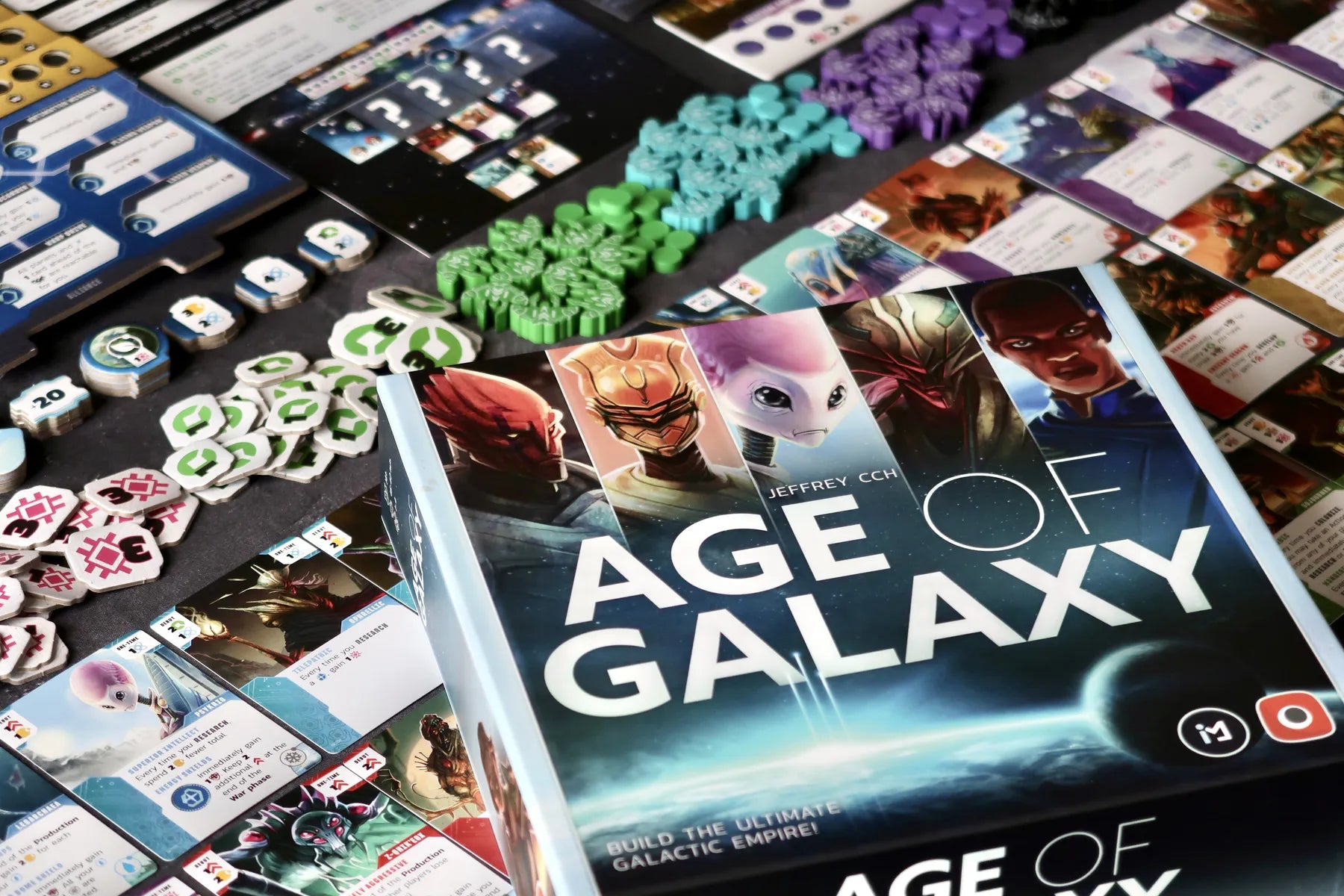
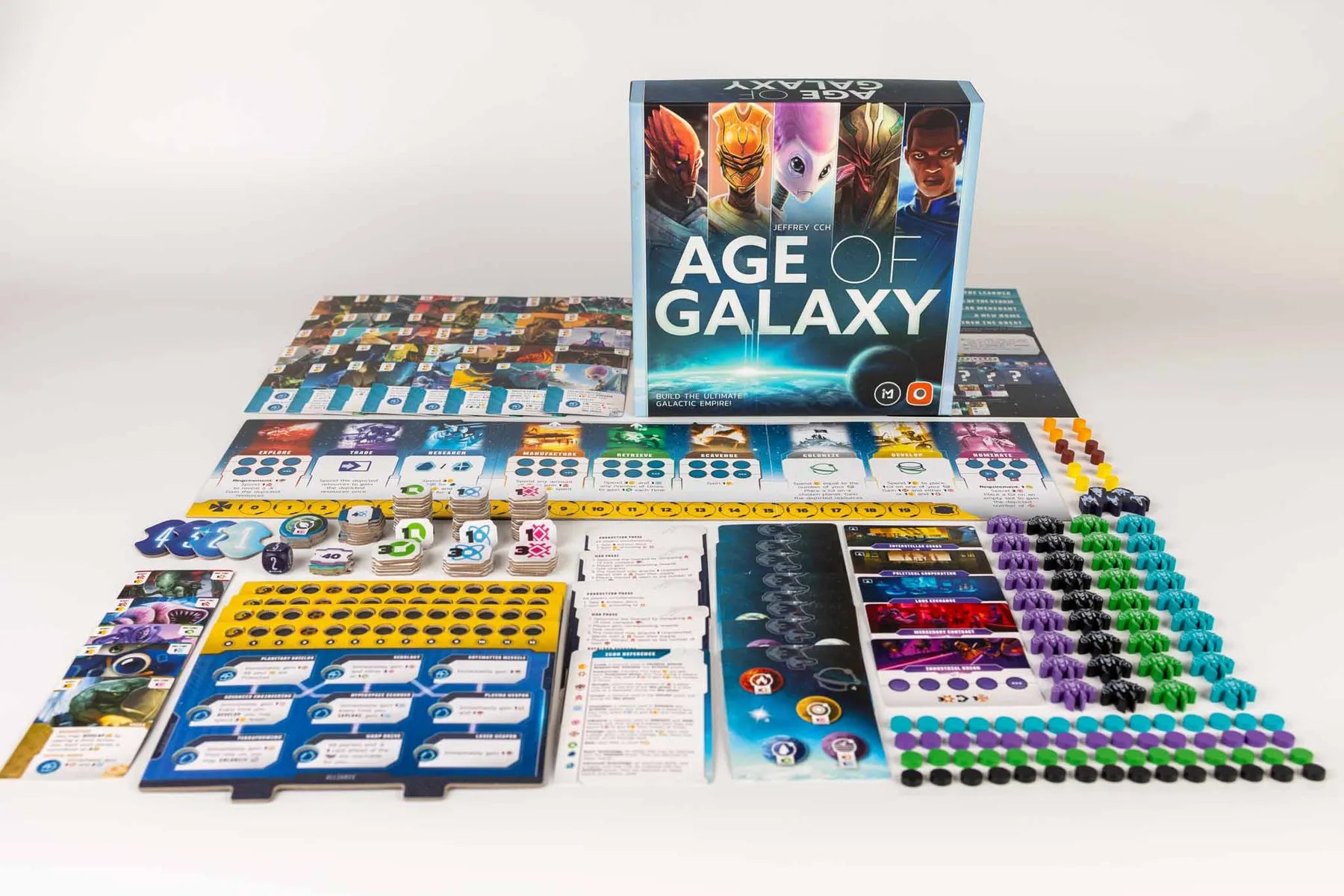
Designed by Jeffrey CCH and published by Portal Games, Age of Galaxy is a card-driven 4X game that condenses exploration, colonization, research, and conquest into an hour of gameplay. The artwork by Roxy Dai, Samuel Horowitz, and Hanna Kuik creates a clean and legible galaxy, where each faction has its own visual identity. This second edition introduces an enhanced solo mode, refreshed graphics, and improved components.
Each player controls an alliance of three asymmetrical factions and chooses a dominant ideology from five: Science, Militarism, Diplomacy, Industrialism, Culturalism. Factions become multi-use cards: you can integrate them into your empire for their permanent powers, or sacrifice them for momentary agreements. You explore systems, colonize planets, build galactic cruisers, and advance on technology trees. But victory depends on how well your strategy reflects the ideology you declared at the start.
What they say abroad
Age of Galaxy compresses a 4X into an hour without sacrificing meaningful decisions
— FroGames
"Over thirty asymmetric factions create a different puzzle every game"
Over thirty asymmetric factions create a different puzzle every game
— Portal Games

Age of Galaxy (Second Edition)
The second edition introduces an enhanced solo mode with a dedicated automa that simulates opponents with different ideologies. The experience is complete, but it loses the diplomatic tension of the Congress and the competitive initial faction draft.
FrogScore · FroGames editorial rating · based on rules, international reviews, and play sessionsWhat you build
Four elements that make up your galaxy
Asymmetric Factions
Over 30 factions, each with unique powers. You can integrate them into your empire for permanent abilities, or burn them for one-time deals. Three factions per player, chosen in draft: the combo is everything.
Galactic Cruisers
Ships that colonize planets, transport resources, and open new systems. Building them costs, but without a fleet, you remain confined to your initial quadrant while others explore.
Technology Trees
Five research tracks, one for each ideology. Advancing unlocks abilities and victory points, but you must choose which one to focus on: those who chase everything end up dominating nothing.
Galactic Congress
A diplomatic arena where laws are elected that change the rules of the game. Whoever controls the Congress bends the galaxy to their interests, but alliances are needed to reach the presidency.
Recommended sleeves 58 cards in 2 sizes ▼
If you play often, we recommend protecting the cards with transparent sleeves to make them last longer.
| Size | Quantity |
|---|---|
| 63.5 × 88 mm | 45 |
| 80 × 120 mm | 13 |
| Total cards | 58 |
Come si gioca
Video dimostrativo di gameplay.
🎲How to playThe rules in four steps▼
How to play
The flow of each round
Each round follows a four-phase structure. Everyone plays simultaneously, then actions are resolved in initiative order.
Select faction cards from your hand and place them on the action spaces of your tableau. Each card can be played for its permanent power (integration into the empire) or sacrificed for a momentary agreement. Simultaneous choices, no turns.
Whoever has the most diplomatic influence acts first. You explore systems, colonize planets, build structures, advance on tech trees, move cruisers. Actions are worker placement: first come, first served for the best spots.
If someone has proposed a law, a vote is held. Each player spends diplomatic influence to support or block the proposal. Laws change costs, bonuses, victory conditions. Whoever controls the Congress leads the galaxy.
Colonized planets generate resources. Unlocked technologies provide permanent bonuses. You draw new faction cards for the next round. The round ends, the galaxy has changed: new colonies, new laws, new alliances.
⏱️Your first gameThe chronicle, moment by moment▼
A game in five moments
What happens at the table
Not the rules. The experience.
The faction draft
Draw nine faction cards, choose three, pass the rest. You look at the powers, seek synergies, wonder if someone else is building the same combo you have in mind. After three rounds, you have your alliance: three factions that will have to work together for sixty minutes.
The declaration of ideology
Choose the dominant ideology: Science, Militarism, Diplomacy, Industrialism, or Culturalism. From that moment on, each of your actions is worth more if aligned with that philosophy. Those who choose Science accumulate technologies. Those who choose Militarism conquer. The galaxy begins to diverge.
The race for planets
Star systems fill with colonists. You build cruisers, explore, colonize. Each planet is worth resources, points, and space to develop. But the best spots are limited: latecomers must settle for marginal worlds or negotiate passages.
Congress moves
Someone proposes a law. A vote is held. Whoever controls Congress changes the rules in their favor: taxes on militarists, bonuses to researchers, sanctions on rival diplomats. A single vote can overturn the galactic balance.
The final tally
You reveal your secret ideology. You tally points from technologies, colonized planets, cruisers, cultural relics. But points weigh differently depending on your initial declaration. Whoever has aligned strategy and ideology wins. The others discover they played the wrong game.
🐸Good to know beforeThree honest things, from friends▼
Good to know before
Three things to consider
Steep initial learning curve
The faction draft at the beginning is blind: you don't know the powers of all 30+ factions until you play more games. The first few times you'll choose almost randomly, and you'll only understand the value of combos later. The second game is much more informed than the first.
Multi-purpose = paralysis
Each faction card can be used in two ways (integration or agreement), and you must choose before seeing what others do. Those who suffer from analysis paralysis can slow down the table: three multi-purpose factions per player mean nine simultaneous decisions each round.
Ideology dictates everything
If you choose Science and then don't research technologies, you lose. If you declare Militarism and build cities, you lose. Victory is tied to the ideology chosen at the beginning: you cannot change strategy halfway through without wasting half an hour of gameplay.
🏆Victory and defeatWhat the ending rewards▼
How it ends
How to win and how to lose
The game ends when someone reaches a victory point threshold or after a fixed number of rounds (depending on the setup). Final points aligned with the ideology are counted.
Victory
- Accumulate victory points from technologies, colonized planets, built cruisers, developed structures, cultural relics
- Points weigh differently depending on your ideology: a researcher earns triple from patents, a militarist from conquests
- Whoever has the highest total wins, but only if they have played consistently with their declared ideology
Defeat
- Choose an ideology and then play another strategy: points don't align, you finish last
- Focus on everything and dominate nothing: those who specialize will overtake you on every track
- Ignore Congress: others vote for laws that penalize your strategy, and you have no influence to block them
Age of Galaxy (Second Edition) condenses a 4X into an hour without sacrificing the choices that define a civilization. If you want Twilight Imperium but in 60 minutes, this is the answer.
💬Frequently asked questionsQuick answers before checkout▼
Frequently asked questions
FAQ about Age of Galaxy (Second Edition)
What mechanics does Age of Galaxy use?
Action drafting (simultaneously choose faction cards), worker placement (place actions on limited spaces), tech tree (advance on five technological tracks), asymmetric powers (each faction has unique abilities), and income (planets generate resources each round). All within a card-driven 4X structure.
How asymmetric is it?
Very. Each player controls three different factions with unique powers, and chooses an ideology that radically changes what counts as points. Two players who choose the same three factions but different ideologies will play completely different games.
Does it work well at all player counts?
Scales from 1 to 4. In solo, there's a dedicated automa (enhanced in the second edition). At 2 and 3 players, the galaxy is less crowded, Congress less competitive. At 4, the tension for planets and voting reaches its maximum, but downtime increases if someone slows down in their choices.
Do I need to know all factions before playing?
No, but it helps. The initial draft is simultaneous and fast: you don't have time to read all the cards. The first few games you'll choose almost randomly. After three or four games, you'll start recognizing strong combos and drafting knowingly. The curve is steep but rewarding.
Is this edition in Italian?
No, Age of Galaxy (Second Edition) is available in English edition. The game requires reading faction cards (over 30 different ones) and technologies: a good understanding of English is needed to play smoothly. There are no official or verified fan-made Italian translations.
The people behind the game
Who invented it, who drew it, who publishes it — and what else they've done.
Age of Galaxy (Second Edition) is a 4X strategy game for 1-4 players, lasting 45-60 minutes, recommended age 14+. Designed by Jeffrey CCH and published by Portal Games, the game uses action drafting, worker placement, and tech tree mechanics to simulate space exploration, colonization, and galactic diplomacy. Each player controls three asymmetric factions and chooses an ideology from five (Science, Militarism, Diplomacy, Industrialism, Culturalism) that determines their victory strategy. The second edition introduces an enhanced solo mode, revamped graphics, and improved components. Available on FroGames.it.
Frequently Asked Questions
The answers you're looking for, no beating around the bush.
📸Do the images match the actual product?
The photos on the website often come from BoardGameGeek and are intended to give you an idea of the game. They may vary slightly from the version you receive. The content declared by the publisher is always binding.
📦Does the content of the box match what is indicated?
We always strive to provide the correct content, but minor variations are possible due to reprints or updates. The information comes directly from the publishers. If you have any questions, please contact us!
⏳How do pre-orders work?
Pre-order the game before release, payment is immediate, and the game is reserved for you. As soon as it arrives, we'll ship it right away! If there are any delays, we'll update you promptly.
🔒Can I trust buying here?
Absolutely! Secure payments, tracked shipments, and a team that loves board games as much as you do. If something goes wrong, we'll do our best to fix it.
🛠There's a problem with my order, what should I do?
Write to us now! Whether it's a missing part, damage, or an error, we'll help you resolve it as soon as possible. Your experience truly matters to us.