

Aeterna
🐸 Dettagli da BoardGameGeek
Consiglio BGG sul numero di giocatori
Categorie
Meccaniche
Design & Art
Lingua
Pairs well with
The FroGames Card
You've conquered a province, dominated two hills, contributed to a temple. Your Gens is respected. Then your opponent plays a card you didn't anticipate, and popular discontent punishes you. Three eras later, that single timing error cost you the victory.
WHAT IT IS ABOUT
Building the prestige of a Roman family through a thousand years of history
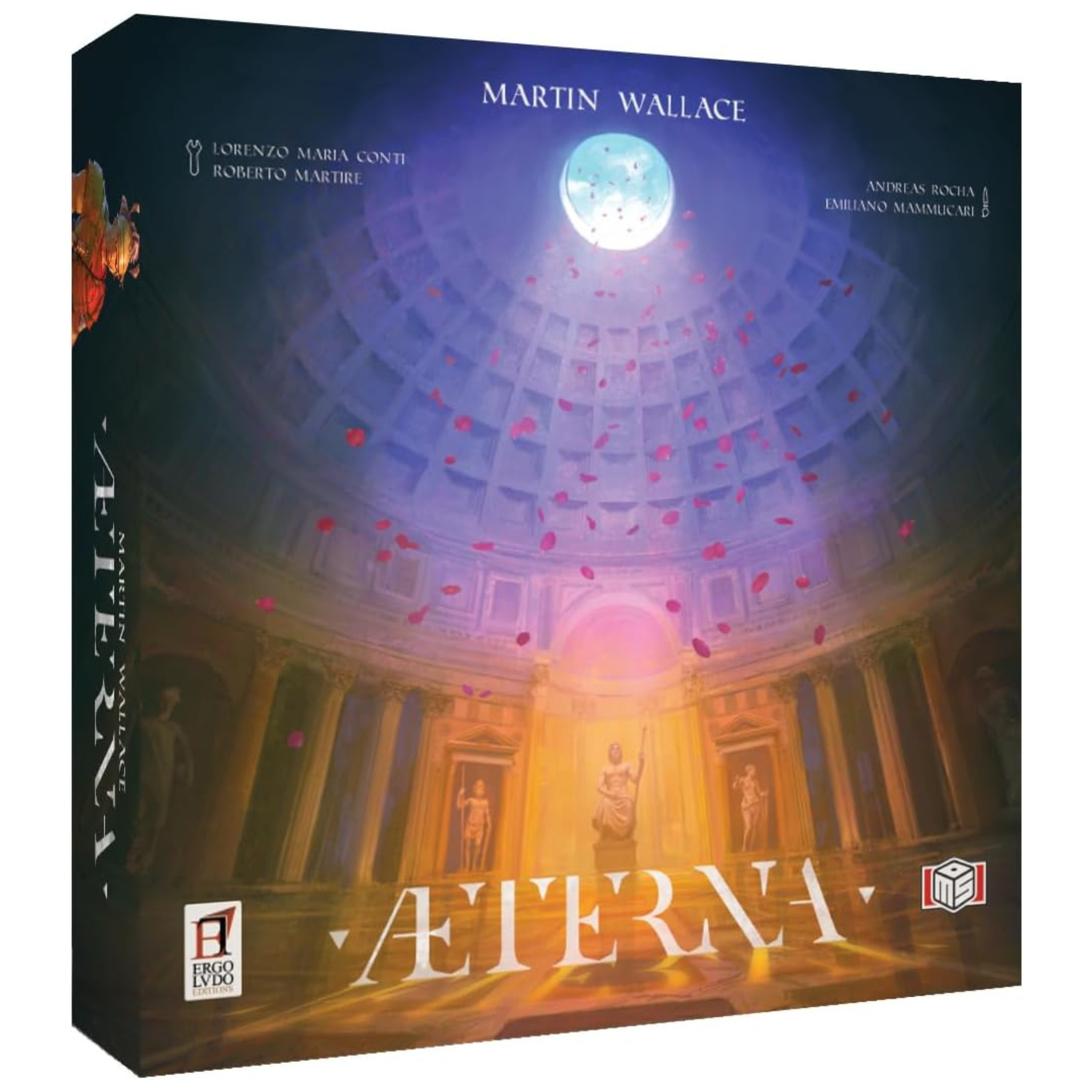
Æterna is designed by Martin Wallace and illustrated by Emiliano Mammucari and Andreas Rocha. It puts you in charge of a Roman Gens that traverses three eras: Kingdom, Republic, Empire. Your goal is to accumulate prestige by supporting military conquests, dominating the seven hills of Rome, and contributing to the construction of iconic monuments. Each era brings new cards, new opportunities, new power balances.
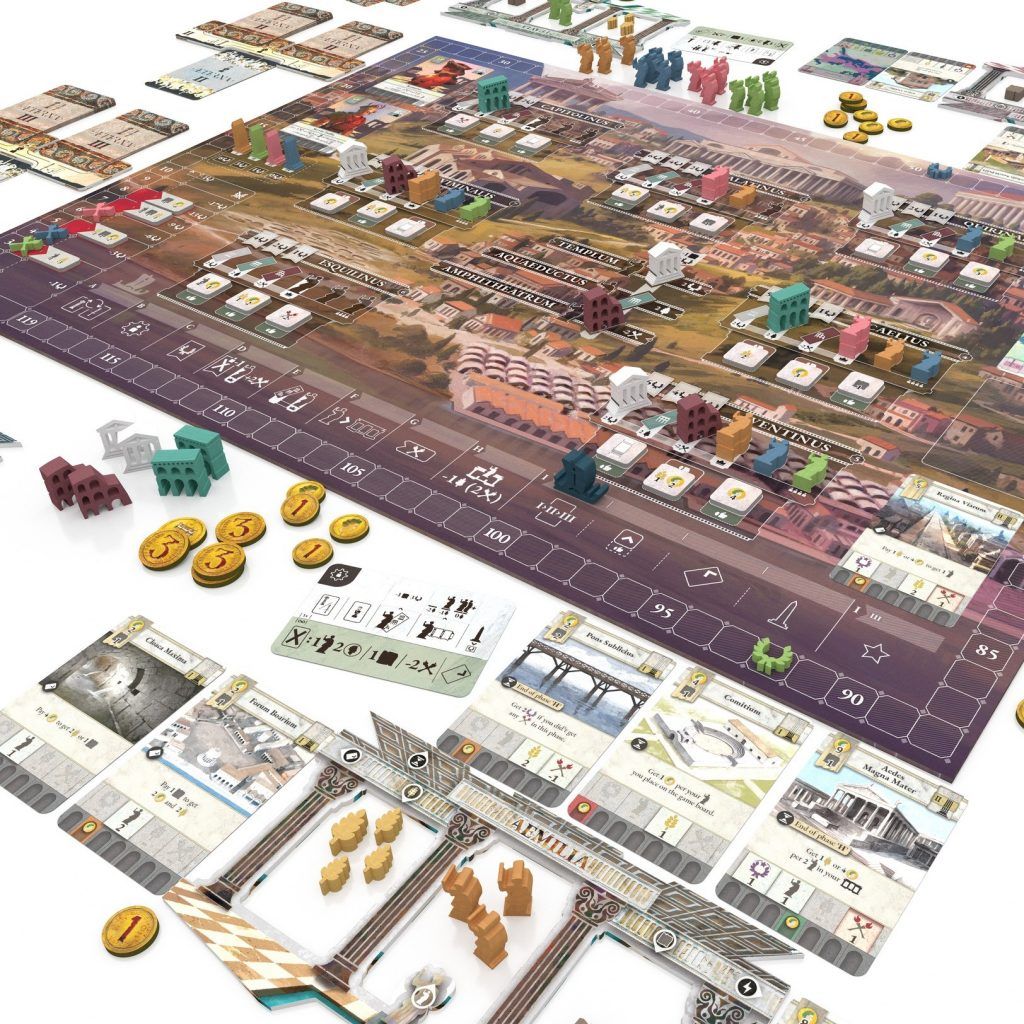
At the table, you manage a hand of cards that gives you actions, place workers on contested spaces, and compete for majorities on multiple fronts simultaneously. Every choice has a political cost: if you neglect discontent in your territories, you can lose points instead of gaining them. Timing is everything: playing the right card at the wrong time can ruin a perfect plan.
What they say abroad
"In Æterna, you take the role of a Roman Gens (family) that will try to increase its prestige through three eras: the Roman Kingdom, the Roman Republic, and the Roman Empire."
— Ergo Ludo Editions
Wallace manages to convey the weight of history without bogging down the rules. Three eras, a clear flow.
— FroGames

Æterna
FrogScore · FroGames editorial rating · based on rules, international reviews, and play sessionsThe instruments of power
Cards, Workers, and Hills
Gens Cards
Your hand determines available actions. Each card represents a political move: conquer a province, build a monument, place a worker. Cards change between the three eras, opening new strategies.
Workers
You place your workers on limited spaces to gain resources, special actions, or majorities. Spaces run out quickly: those who arrive first have more choices, those who arrive late must adapt.
The Seven Hills
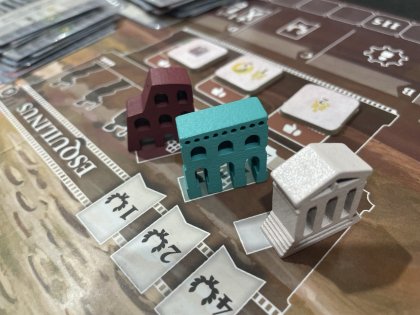
Palatine, Capitoline, Quirinal... Each hill is a contested area. Dominating them gives you points, but generates discontent. If discontent rises too high, those points turn into penalties.
Monuments and Provinces
Contributing to the construction of iconic monuments or supporting the conquest of provinces gives you immediate prestige and end-of-era bonuses. But every investment costs resources you could use elsewhere.
Recommended sleeves 76 cards in 1 size ▼
If you play often, we recommend protecting your cards with transparent sleeves to make them last longer.
| Size | Quantity |
|---|---|
| 64 × 99 mm | 76 |
| Total cards | 76 |
Come si gioca
Video dimostrativo di gameplay.
🎲How to playThe rules in four steps▼
How to play
The flow of each round
Each round is a cycle of choices: you play cards, place workers, manage discontent. When everyone has passed, the era advances.
On your turn, you play a card from your hand to activate its action (conquer a province, build a monument, place workers) or you pass. If you pass, you can no longer play cards in this round, but you recover resources.
Many cards allow you to place workers on spaces on the board. Spaces are limited: whoever arrives first takes the best positions. Workers give you resources, special actions, or majorities on the hills.
Each hill you control generates discontent. If discontent exceeds a threshold, you lose points instead of gaining them. You can reduce it with specific actions, but it costs time and resources that you could invest elsewhere.
When everyone has passed, the era ends. Points are counted for majorities on the hills, conquered provinces, completed monuments. Discontent can overturn scores. Then you move on to the next era with new cards.
⏱️Your first gameThe chronicle, moment by moment▼
A game in five moments
What happens at the table
Not the rules. The experience.
First moves, first tensions
Everyone draws their first cards and studies the options. The first player places a worker on a key space, the others must react immediately. The game has just begun and someone has already gained an advantage on a hill.
The race to the hills
The seven hills become the main battlefield. Each player tries to dominate at least one or two, but discontent begins to rise. Someone ignores the warning and pushes too hard: they will only discover the cost at the end of the era.
Change of era, change of strategy
End of the first era, points are counted. Those who managed discontent well smile, those who didn't lose points instead of gaining them. The Republic cards arrive: new actions, new provinces, new opportunities. Everyone redistributes their priorities.
Everything counts
Mid-game, every point counts. One player discovers a card combo that allows them to dominate a key province. Another has to sacrifice a majority on a hill to not lose ground on the monuments. Hands thin out, choices become narrower.
The Empire decides
Last era, last cards. Final points are calculated by summing prestige, majorities, and completed monuments. Those who planned from the beginning have an advantage, but a card played at the right moment can overturn everything. The winner is whoever managed to balance expansion and control.
🐸Things to know beforehandThree honest things, from friends▼
Things to know beforehand
Three things to consider
The first game is a lesson
Cards do not come with a manual: you have to read them all at the beginning of the game to understand the synergies. Those who play without planning risk wasting key actions. The second game flows much more smoothly, but the first requires patience.
The pace changes with two players
With 2 players, worker placement spaces are less contested and some majorities on the hills become less tense. The game works, but it truly shines with 3-4 players where every space is a struggle and every majority is uncertain until the end.
Downtime exists
Each player must study their hand, evaluate current majorities, calculate discontent. With 4 players and people prone to analysis paralysis, turns lengthen. It's not a party game, it's an eurogame that requires concentration.
🏆Victory and defeatWhat the ending rewards▼
How it ends
How to win and how to lose
At the end of the third era, the points accumulated over the three eras are summed. The player with the highest prestige wins.
Victory
- You dominated enough hills without letting discontent explode: every well-managed majority gave you points in all three eras.
- You contributed to key monuments and supported the right conquests, accumulating bonuses your opponents missed.
- You played your cards with perfect timing, placing workers in the most lucrative spaces before others.
Defeat
- You dominated too many hills too quickly: discontent made you lose more points than you gained from majorities.
- You spent resources on short-term goals without planning for subsequent eras: others surpassed you in the long run.
- You ignored opponents' cards and got blocked on key worker placement spaces, losing decisive majorities.
Æterna is for those who love eurogames where every choice matters and the story is just the backdrop to an elegant and ruthless mechanical system.
💬Frequently Asked QuestionsQuick answers before checkout▼
Frequently Asked Questions
FAQ about Æterna
What mechanics does Æterna use?
Competitive worker placement, area majority / influence on multiple fronts (hills, provinces, monuments), hand management to activate actions, and a discontent system that penalizes those who expand too quickly. All divided into three progressive eras with different cards.
How complex is it to teach?
The rules are straightforward: play cards, place workers, manage discontent. But the strategic implications of the cards require one game to grasp. Expect 20-25 minutes of explanation the first time, including an overview of the available cards.
Does it work well with 2 players?
It works, but some tensions are lost: with 2 players, worker placement spaces are less contested and majorities on the hills are less fought over. The game is best with 3-4 players, where every move truly matters.
How long does a game really last?
The first game can be up to 2 full hours because you have to read and understand all the cards. From the second game onwards, with players who know the game, it takes between 75 and 90 minutes with 3-4 players. With 2 players, it can drop below an hour.
Is it available in Italian?
Yes, this is the Italian edition by MS Edizioni. Rulebook, cards, and components are entirely in Italian.
The people behind the game
Who invented it, who designed it, who publishes it — and what else they've done.
Æterna is a competitive strategy game for 2-4 players, lasting 60-120 minutes, recommended age 14+. Designed by Martin Wallace and published by MS Edizioni, it uses worker placement, area majority, and hand management mechanics to simulate a thousand years of Roman history across three eras: Kingdom, Republic, Empire. Each player leads a Roman Gens, competes for majorities on Rome's seven hills, supports provincial conquests, and contributes to iconic monuments, all while managing popular discontent that can turn victory points into penalties. Available on FroGames.it.
Aeterna
Frequently Asked Questions
The answers you're looking for, no beating around the bush.
📸Do the images match the actual product?
The photos on the website often come from BoardGameGeek and are intended to give you an idea of the game. They may vary slightly from the version you receive. The content declared by the publisher is always binding.
📦Does the content of the box match what is indicated?
We always strive to provide the correct content, but minor variations are possible due to reprints or updates. The information comes directly from the publishers. If you have any questions, please contact us!
⏳How do pre-orders work?
Pre-order the game before release, payment is immediate, and the game is reserved for you. As soon as it arrives, we'll ship it right away! If there are any delays, we'll update you promptly.
🔒Can I trust buying here?
Absolutely! Secure payments, tracked shipments, and a team that loves board games as much as you do. If something goes wrong, we'll do our best to fix it.
🛠There's a problem with my order, what should I do?
Write to us now! Whether it's a missing part, damage, or an error, we'll help you resolve it as soon as possible. Your experience truly matters to us.