

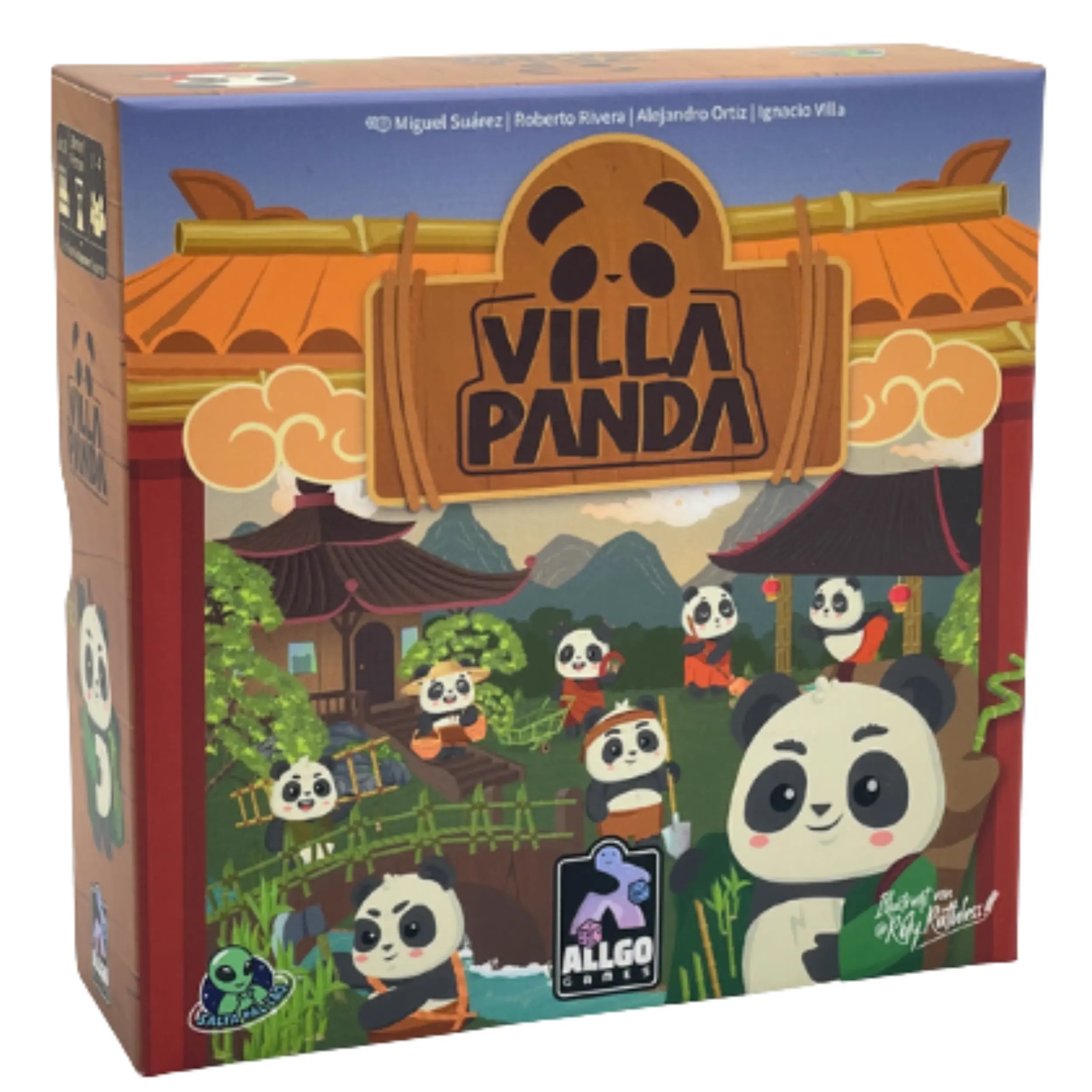
Panda Villa
🐸 Dettagli da BoardGameGeek
Consiglio BGG sul numero di giocatori
Categorie
Meccaniche
Design & Art
Lingua
Pre-order - leggi i dettagli
🐸 Una rana saggia sa quando dividere l’ordine… e quando aspettare il salto giusto.

Pairs well with
The FroGames Sheet
You roll the dice. Everyone looks at their panda cards. You choose a die and place your meeple. Someone builds, someone hires, someone trades at the market. And after five turns, you realize you let the quiet one win.
WHAT IT'S ABOUT
A strategic race between hungry pandas in the tranquil hills
Villa Panda is a strategic family game created in 2024 through the collaboration of four Spanish designers (Miguel Suárez Olivares, Alejandro Ortiz Peña, Roberto D. Rivera, Ignacio Villa Toro) and illustrated by Roly Ruthless. Set in a villa among green hills, the game casts you as an ambitious panda who wants to become the village leader: first to 12 victory points triggers the endgame.
At the table, you build buildings, hire other pandas, collect resources (water, bamboo, bao, gold), and use dice in an unusual way: everyone rolls, but they activate everyone's cards based on the sum, then only your own with the single die you choose. Each turn you place your meeple on an area of the board to get what you need: market, construction, recruitment. Fast pace, indirect interaction, controlled luck.
What they say abroad
Villa Panda is still young, with few games under its belt. The sheet you're reading comes from an initial understanding of the mechanics and will be enriched with real impressions from Italian tables.
— FroGames
"A panda race to 12 victory points, with dice that activate everyone and worker placement that rewards timing."
A panda race to 12 victory points, with dice that activate everyone and worker placement that rewards timing.
— Salta Pal Lao

Villa Panda
FrogScore · FroGames editorial rating · based on rules, international reviews, and gameplay sessionsYour arsenal
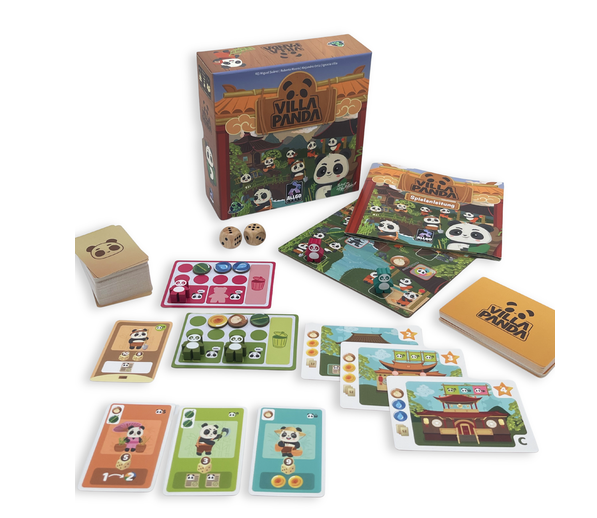
Panda cards, buildings, resources, and board: what you use to win
Panda Cards (82 cards 44×68mm)
Each panda has a number: when that result comes up on the dice (sum or single), you activate its power. Some give resources, others points, others extra actions. The more pandas you hire, the more likely you are to trigger combos each turn.
Buildings and stacked pandas (56 cards 63×88mm)
Build buildings that give points and permanent benefits. You can place hired pandas on them to activate them better. Each building is a small engine that fuels your strategy.
Common dice and double activation
The active player rolls two dice: the sum activates everyone's pandas (key moment), then they choose a single die and only activate their own. This double turn changes the classic rhythm of worker placement.
Four resources (water, bamboo, bao, gold)
You use them to build, hire, activate pandas. You get them by placing your meeple on board areas or through cards. The market lets you trade them, but occupying that space means giving up something else.
Recommended sleeves 138 cards in 2 sizes ▼
If you play often, we recommend protecting your cards with clear sleeves to make them last longer.
| Size | Quantity |
|---|---|
| 44 × 68 mm | 82 |
| 63 × 88 mm | 56 |
| Total cards | 138 |
Come si gioca
Video dimostrativo di gameplay.
🎲How to PlayThe rules in four steps▼
How to Play
The flow of each round
Three precise phases, repeated until someone reaches 12 points and triggers the finale.
The active player rolls two dice for everyone to see. Everyone sees the result.
First: the sum of the two dice activates the pandas of ALL players who have that number. Then: the active player chooses the result of ONE single die and only activates their cards with that value.
The active player places their meeple on an area of the board: collect resources (water, bamboo, bao, gold), go to the market (trade resources), build a building, hire a panda, activate a panda.
Play passes to the next player who becomes active. If someone has reached or exceeded 12 points, the round is completed until it returns to them, who plays one last turn, then final points are counted.
⏱️Your First GameThe chronicle, moment by moment▼
A game in five moments
What happens at the table
Not the rules. The experience.
Setup and first panda cards
Everyone starts with a few panda cards and basic resources. You look at the numbers on your cards, do some calculations: "If 7 comes up, I get bamboo, if 4 comes up, I build." The table is quiet, but you're already studying other players' cards.
First rolls and common activations
The first player rolls the dice. The sum activates everyone's pandas: some cheer ("7! I get two resources"), some curse ("3 again, I don't need it"). Then the player who rolled chooses a single die and only activates their cards. You immediately realize you need to watch what others have.
Competition for action spaces
You need gold to hire a key panda, but the gold area is occupied. You go to the market, trade resources, but you lose a building turn. Others are advancing: one builds, one hires, one activates a panda for extra points. The race is on.
Combos and first to double digits
Someone has built a building + hired the perfect panda: when certain numbers come up, they make resource-points-new action sequences. In two turns, they go from 7 to 11 points. The table wakes up: "We have to stop him" (but you can't, the interaction is indirect). You have to hurry too.
Final rush and last round
First player to 12 points: the last full round begins. Everyone has one last chance. Those who planned well activate the last panda, build the last building, win by one point. Those who spent resources poorly remain at 10. Points are counted: the winner is often decided by a die roll in the last turn.
🐸What to Know BeforehandThree honest things, from friends▼
What to know beforehand
Three things you need to know before buying Villa Panda
Dice matter quite a bit
With only two dice per turn, a series of unfortunate results really slows you down. You can mitigate this with cards and the market, but if others roll well in the first few turns and you don't, catching up is hard. It's not a game where luck is a minor detail.
You have to look at other players' cards
Since the sum of the dice activates everyone's pandas, if you don't keep an eye on what your opponents have, you won't understand who is about to explode. This adds a layer of attention that slows down the first few games: just looking at your hand isn't enough.
Imperfect scaling at 2 and 4 players
With two players, the board has less competition for spaces, with four, downtime increases (dice + activations + actions of four people). The sweet spot seems to be 3 players, where interaction and pace are better balanced.
🏆Victory and DefeatWhat the end rewards▼
How it ends
How to win and how to fall behind
First to 12 victory points triggers the ending. The round is completed, then the player with the most points wins.
Victory
- Accumulate points by building (give fixed VP)
- Hire pandas that give victory points when activated
- Activate pandas with the dedicated action on the board for extra points
How you fall behind
- Waste turns going to the market instead of building/hiring
- Don't read your opponents' cards and they pull off combos right under your nose
- The dice never give you the numbers for your cards and you accumulate useless resources
Villa Panda is a strategic race with shared dice that rewards those who can read the table and adapt. It doesn't revolutionize the genre, but it mixes proven mechanics (worker placement, dice, light engine building) into an accessible and competitive family package.
💬Frequently Asked QuestionsQuick answers before checkout▼
Frequently Asked Questions
FAQ about Villa Panda
What mechanics does Villa Panda use?
Dice rolling (with common and individual activation), worker placement (placing meeples on limited areas of the board), open drafting (hiring pandas from the common market), race (race to 12 points) and light engine building (build buildings and hire pandas to enhance future activations).
Is it a family game or does it require experience?
It is a strategic family game: rules explained in 10 minutes, clear iconography, but requires planning and reading the table. Perfect as a next step after classic gateways (Ticket to Ride, Splendor), too light for heavy gaming tables. Recommended age 10+ is realistic.
How much does dice luck matter?
It matters quite a bit. With two dice per turn, a series of unfortunate results slows you down. You can mitigate this by choosing which die to use, going to the market to trade resources, and building a balanced panda deck with multiple numbers. But if others roll well and you don't for three turns in a row, catching up is difficult.
Does it play well with two players?
It plays, but it's less tense: with fewer players, the board has more open spaces, competition for actions decreases, and the common dice activation loses its edge. The game is best with 3-4 players, where placement choices matter more and reading other players' cards becomes crucial.
Is Villa Panda available in English?
The edition for sale on FroGames is in German (publisher AllGo-Games). The game uses symbols on cards and minimal text: with a translated rules summary, it is perfectly playable. No official English editions are currently available.
The people behind the game
Who invented it, who designed it, who published it — and what else they've done.
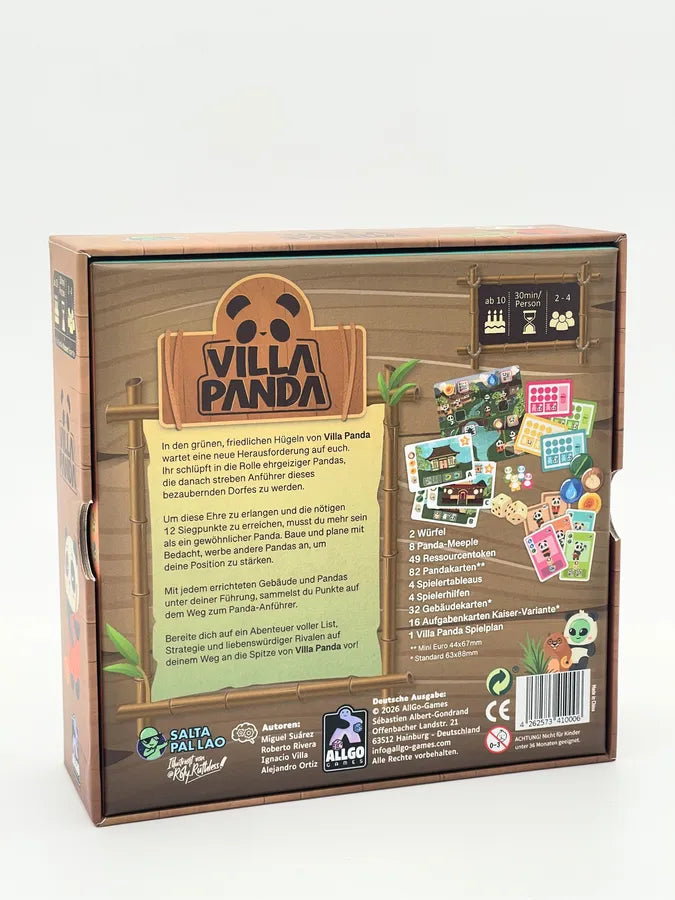
Villa Panda is a competitive strategy and dice board game for 2-4 players, lasting 45-90 minutes, ages 10+. Designed by Miguel Suárez Olivares, Alejandro Ortiz Peña, Roberto D. Rivera, and Ignacio Villa Toro, published by AllGo-Games and Salta Pal Lao in 2024. Mechanics: dice rolling with common activation (dice activate all players' cards), worker placement on the board, light engine building through buildings and hired pandas. Objective: first to 12 victory points triggers the ending. Weight 2.75/5 on BoardGameGeek, suitable for families and gateway players looking for a strategic family game with indirect interaction and a lively pace. Available on FroGames.it.
Panda Villa
Frequently Asked Questions
The answers you're looking for, no beating around the bush.
📸Do the images match the actual product?
The photos on the website often come from BoardGameGeek and are intended to give you an idea of the game. They may vary slightly from the version you receive. The content declared by the publisher is always binding.
📦Does the content of the box match what is indicated?
We always strive to provide the correct content, but minor variations are possible due to reprints or updates. The information comes directly from the publishers. If you have any questions, please contact us!
⏳How do pre-orders work?
Pre-order the game before release, payment is immediate, and the game is reserved for you. As soon as it arrives, we'll ship it right away! If there are any delays, we'll update you promptly.
🔒Can I trust buying here?
Absolutely! Secure payments, tracked shipments, and a team that loves board games as much as you do. If something goes wrong, we'll do our best to fix it.
🛠There's a problem with my order, what should I do?
Write to us now! Whether it's a missing part, damage, or an error, we'll help you resolve it as soon as possible. Your experience truly matters to us.