

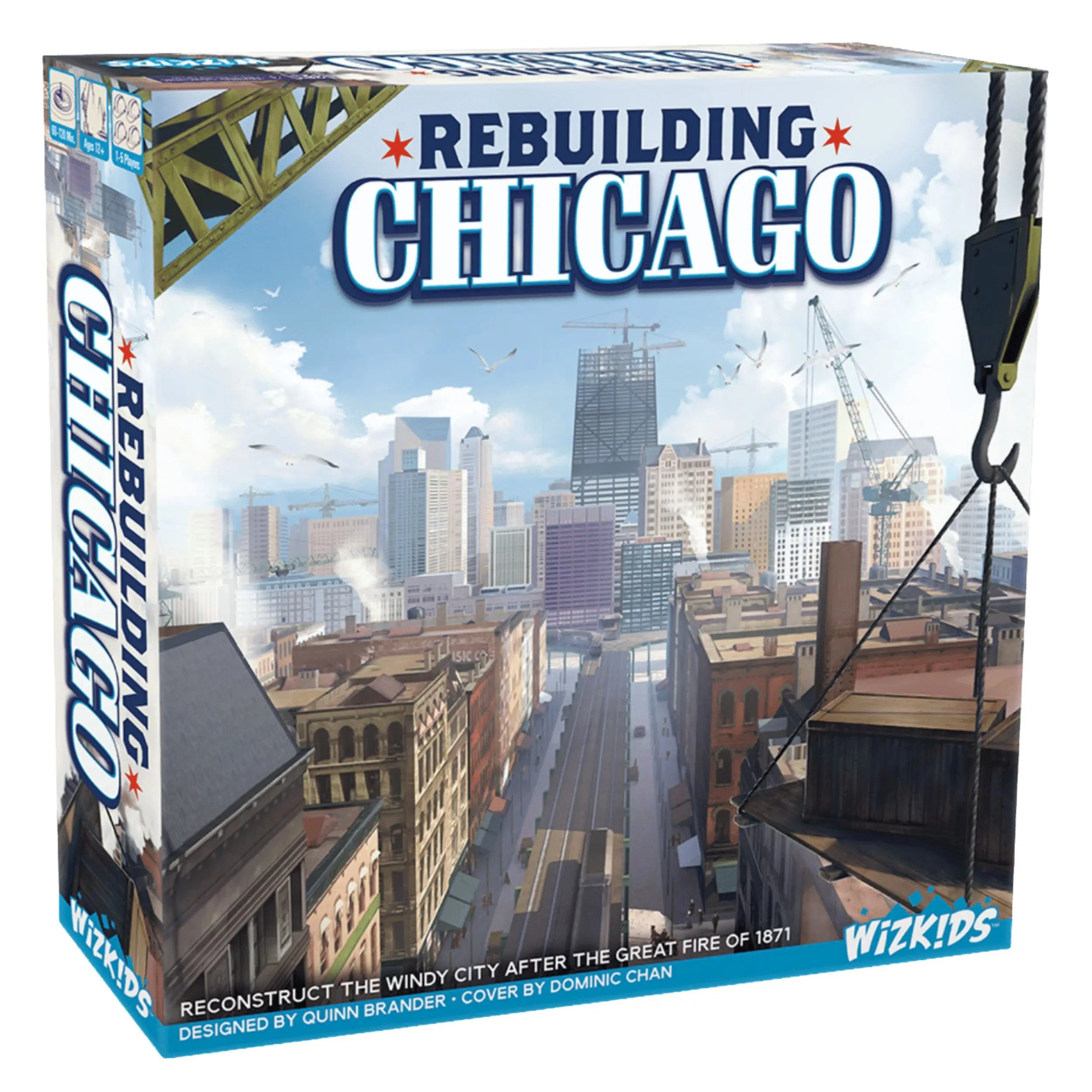
Rebuilding Chicago
🐸 Dettagli da BoardGameGeek
Consiglio BGG sul numero di giocatori
Categorie
Meccaniche
Design & Art
Lingua
Pairs well with
The FroGames Card
You buy a building card. The shape doesn't match. You take a suburb, now the grid is crooked. The event triggers a turn earlier than expected. Someone conquers the landmark you wanted. End of round: you've built a Chicago you hadn't planned for.
WHAT IT'S ABOUT
Rebuilding Chicago after the Great Fire, one grid at a time
Rebuilding Chicago is the standalone successor to Rebuilding Seattle (2023), designed by Quinn Brander and published by WizKids in 2026. Set after the Great Chicago Fire of 1871, the game unfolds in three rounds representing three key years: 1893, 1933, and 2016. Compared to its predecessor, Chicago is a tighter and more complex game, with constant time pressure to improve one's district.
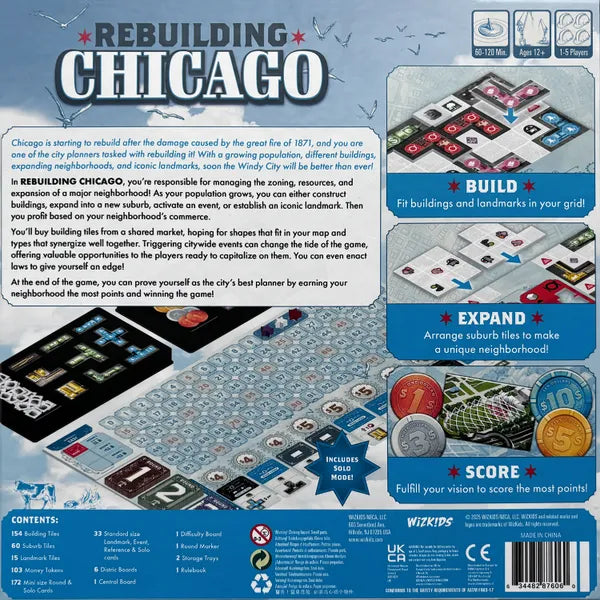
Each round, the population grows, then you can build a new building, expand into a suburb, trigger an event, or build a landmark, after which you earn profit based on your district's commerce. The game operates on two layers of polyominoes: below are irregularly shaped suburbs that don't fit easily, above are the actual buildings. You buy tiles from a shared market in seven different types, and you can trigger events once per round with a mechanism similar to Puerto Rico, where the active player gets a slightly better benefit.
What they say abroad
"one of the best polyomino-placement games I've ever played"
one of the best polyomino-placement games I've ever played
— Space Biff
"a tight game where there is constant time pressure"
a tight game where there is constant time pressure
— The Opinionated Gamers

Rebuilding Chicago
The game includes a solo deck that simulates the actions of a second player, allowing you to discover strategies and configurations. The solo mode is simple to administer, but requires drawing many cards from the AI deck. It works, but loses the competition in the shared market.
FrogScore · FroGames editorial rating · first read: based on rules and official presentation, updated with first playsWhat you build
The pieces of the urban puzzle
Polyomino buildings
No longer tied to specific cards: choose the building type and take the polyomino shape from the top of the deck. Seven types, irregular shapes, condemned spaces to cover. Each piece is a compromise between form and function.
Expandable suburbs
Tiles with bizarre shapes that connect to the grid as you wish, creating unique neighborhoods. They provide icons like the main grid, but covering them means sacrificing the hot dog stands that generate continuous income.
Iconic landmarks
Milestone cards unlocked during setup that allow you to build recognizable Chicago landmarks: that baseball stadium? It looks just like Wrigley Field. They are built on specific tile combinations. They are worth many points.
City events
Triggering events can change the course of the game, offering points, money, and expansions to prepared players. World's Fair events now assign sculptures that give points, replacing the mini-buildings of its predecessor. Timing is everything.
Come si gioca
Video dimostrativo di gameplay.
🎲How to playThe rules in four steps▼
How to play
The flow of each round
Three rounds, each marked by growth, action, profit. The structure is simple, the choices are not.
At the beginning of the round, the population automatically increases. More people mean more pressure to build and meet the neighborhood's needs. The Quality tracks on your board influence how much you earn and how much you lose at events.
You can build a new building, expand into a new suburb, trigger an event, or build a landmark. You choose a card from the rotating market, pay the cost, and perform the action. The market immediately refills with a new card. Your choice depends on what is available and what others have done.
After the action, you earn money based on the commercial icons visible in your grid. The more shopping, nightlife, and dining you have built, the more you collect. But if you have covered useful icons with the wrong buildings, the profit is meager. Money is essential for everything.
At the end of the round, events triggered by players activate. Those who triggered them get the full benefit, others a reduced version. Points, money, expansions. Then you move on to the next round: new year, new building cards in the market, new polyomino shapes.
⏱️Your first gameThe chronicle, moment by moment▼
A game in five moments
What happens at the table
Not the rules. The experience.
The empty grid
You receive your district board with an initial pre-printed neighborhood, your colored cubes, and you place them at the bottom of the three Quality tracks. You choose the difficulty. You observe your grid: it already has condemned buildings to cover, holes to fill. The market rotates for the first time. Someone buys immediately.
The first impossible fit
You buy a building card. The polyomino shape you draw doesn't fit where you wanted it to. You have to rotate it, move it, cover an icon you needed. Someone else takes the suburb you wanted. The population grows, but money is always less than needed. You realize that every piece has an opportunity cost.
The event that won't wait
Events can trigger a turn before their maximum benefit. Someone activates the World's Fair event when you had planned to build another sculpture. You take what you can get. Another player approves a law that gives them a continuous advantage. The grid fills up, suburbs sprout at the edges like roots.
The city you didn't foresee
It's like building a puzzle on top of another puzzle, with pieces you'd prefer not to cover because those hot dog stands generate income. But geography is tight, sacrifices are inevitable. You build a landmark where you can. Your Chicago has a bizarre, asymmetrical, functional shape. Not beautiful, but efficient.
The final count
You earn points for building types, upgrades, landmarks, events, and remaining money. You count together. Someone optimized the Education track better, someone else dominated the landmarks. Before putting everything back in the box, you pause for a moment to look at the cities built. Each one is different. Each one worked.
🐸Good to know beforehandThree honest things, from friends▼
Good to know beforehand
Three things you need to know
The geometric curve is steep
The boards now have integrated starting tiles with condemned buildings to cover, and the expansion tiles have awkward shapes. All of this makes Chicago a much more challenging game than Seattle. If you have difficulty with spatial puzzles or Tetris, the first few games can be frustrating. Geometry is unforgiving.
The Chicago theme is a veneer
At no point does it really feel like you're rebuilding Chicago. It's more accurate to say it's a grid coverage game. The grids all start the same, only the color of the pre-printed shapes changes. Once it starts, players move quickly between turns to buy tiles and make pretty shapes. If you're looking for thematic immersion, look elsewhere.
Money is always tight
Money is scarce at first, but in tested games there are different ways to use events to increase capital. The market is now compact and integrated into the central board, and cards no longer give you both the building and the bonus effect: you have to choose one or the other. Every purchase is a trade-off. Plan your budget or fall behind.
🏆Victory and defeatWhat the ending rewards▼
How it ends
How to win and how to lose
After three rounds and three years of rebuilding, the points are counted. The one who best optimized their grid wins.
Victory
- Points for each type of building built and for completed upgrades on the Quality tracks
- Points from landmarks built on the right combinations of tiles
- Points from events triggered at the right time and from remaining money in the bank
How to fall behind
- Buying buildings with shapes that don't fit, leaving holes in the grid
- Triggering events too early or too late, losing maximum benefits
- Spending all money without long-term planning, running out of liquidity in the final rounds
This is a tight, intelligent, and engaging approach to city-building and cutthroat competition. The more you play it, the more you want to return to the table. Chicago is not the most thematic game, but it is one of the most solid polyomino games around.
💬Frequently asked questionsQuick answers before checkout▼
Frequently asked questions
FAQ about Rebuilding Chicago
What mechanics does Rebuilding Chicago use?
Grid coverage, tile placement with variable polyominoes, income management, shared rotating market, variable triggered events. The structure is pure eurogame with a focus on spatial and economic optimization.
Is it very different from Rebuilding Seattle?
Yes. Chicago is a very different beast: it's a tight game where there's constant time pressure to improve the neighborhood, an appreciated improvement over the original and much more suitable for eurogame collections. Overall, all changes make Chicago much more challenging than Seattle. You don't need to have played the first one.
Does it work well at all player counts?
Scales from 1 to 5. In solo, it uses an automa deck. From 2 to 4 players is the ideal range: the market is competitive but not chaotic. At 5, downtime can lengthen, but market competition becomes cutthroat. Duration varies from 60 to 120 minutes depending on player count.
How difficult is it to interlock polyomino tiles?
Tetris fans and those who appreciate challenges from games like The Princes of Florence (the tile-laying part, not the auctions) will feel at home. The difficulty lies in balancing form and function: it's not enough to make the piece fit, it must also give you the right icons. The first few games require patience, then it becomes intuitive.
Is it available in English?
This edition is in English. The cards have text and symbols, the rulebook is in English. Language dependence is medium: once the mechanics are learned, symbols help a lot, but event cards and laws require reading. There are currently no official Italian translations.
The people behind the game
Who invented it, who designed it, who publishes it — and what else they've done.
Rebuilding Chicago is a polyomino tile-placement board game for 1-5 players, lasting 60-120 minutes, recommended age 12+. Designed by Quinn Brander and published by WizKids in 2026, it is the standalone successor to Rebuilding Seattle with increased complexity. It uses grid coverage mechanics, a rotating market, variable events, and tight economic management. Each game requires building a post-fire Chicago neighborhood by interlocking irregularly shaped buildings, expanding suburbs, and constructing iconic landmarks. The weight is medium-heavy (3/5), with support for solo mode via an automa deck. Available on FroGames.it.
Rebuilding Chicago
Frequently Asked Questions
The answers you're looking for, no beating around the bush.
📸Do the images match the actual product?
The photos on the website often come from BoardGameGeek and are intended to give you an idea of the game. They may vary slightly from the version you receive. The content declared by the publisher is always binding.
📦Does the content of the box match what is indicated?
We always strive to provide the correct content, but minor variations are possible due to reprints or updates. The information comes directly from the publishers. If you have any questions, please contact us!
⏳How do pre-orders work?
Pre-order the game before release, payment is immediate, and the game is reserved for you. As soon as it arrives, we'll ship it right away! If there are any delays, we'll update you promptly.
🔒Can I trust buying here?
Absolutely! Secure payments, tracked shipments, and a team that loves board games as much as you do. If something goes wrong, we'll do our best to fix it.
🛠There's a problem with my order, what should I do?
Write to us now! Whether it's a missing part, damage, or an error, we'll help you resolve it as soon as possible. Your experience truly matters to us.