

Palude
🐸 Dettagli da BoardGameGeek
Consiglio BGG sul numero di giocatori
Categorie
Meccaniche
Design & Art
Lingua
Pre-order - leggi i dettagli
🐸 Una rana saggia sa quando dividere l’ordine… e quando aspettare il salto giusto.
Pairs well with
The FroGames Card
Your frog jumps. It lands on the wrong lily pad. Your opponent smiles. In two turns, you understand why. And meanwhile, the flies run out.
WHAT IT'S ABOUT
A tactical battle for control of the swamp
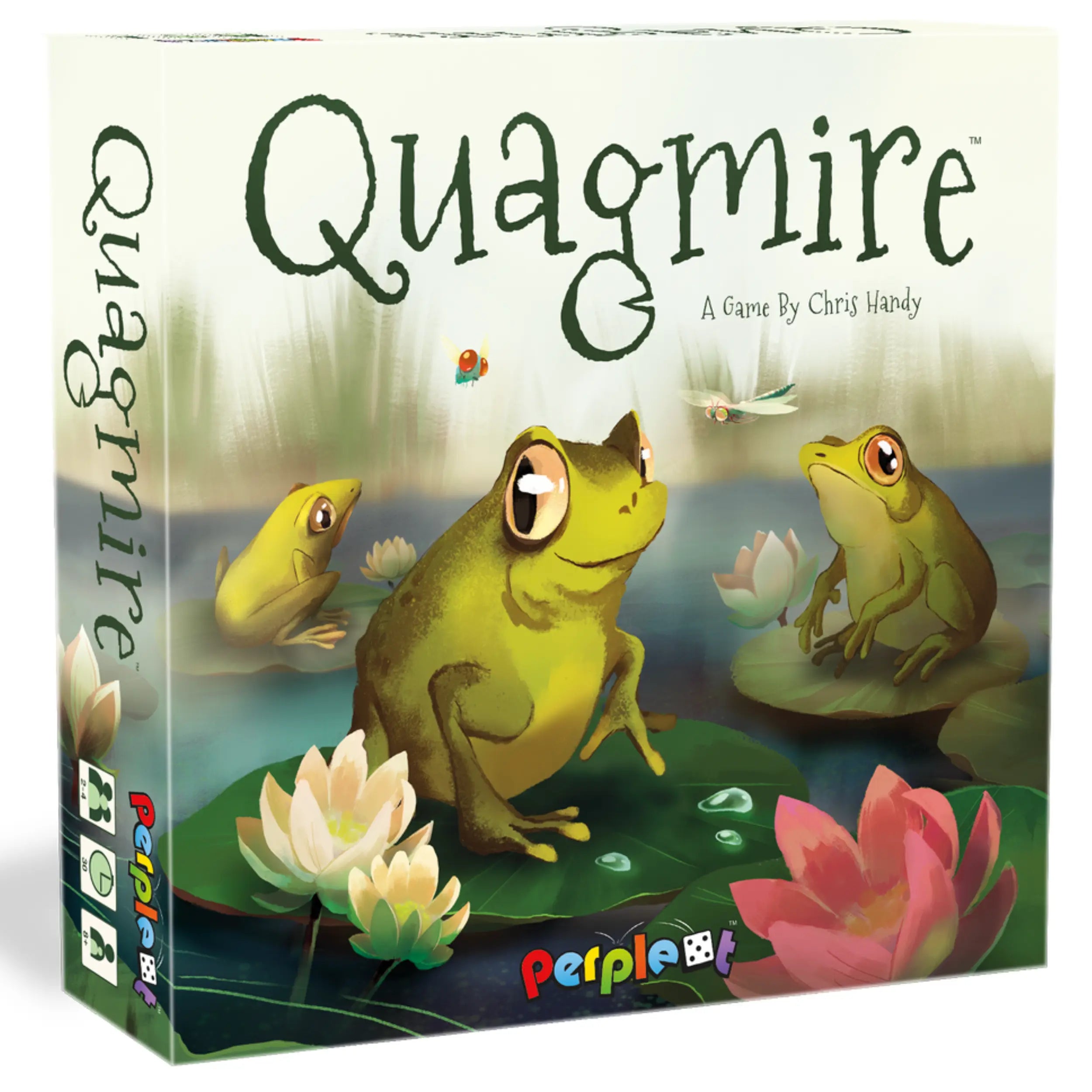
Quagmire is the full-size expansion of BOG, a microgame from the Pack O Game series designed by Chris Handy. Perplext brings the same tactical concept here in a tabletop format, for 2-4 players in about 30 minutes. The illustrations by Magdalena Markowska bring a colorful and bright swamp to life.
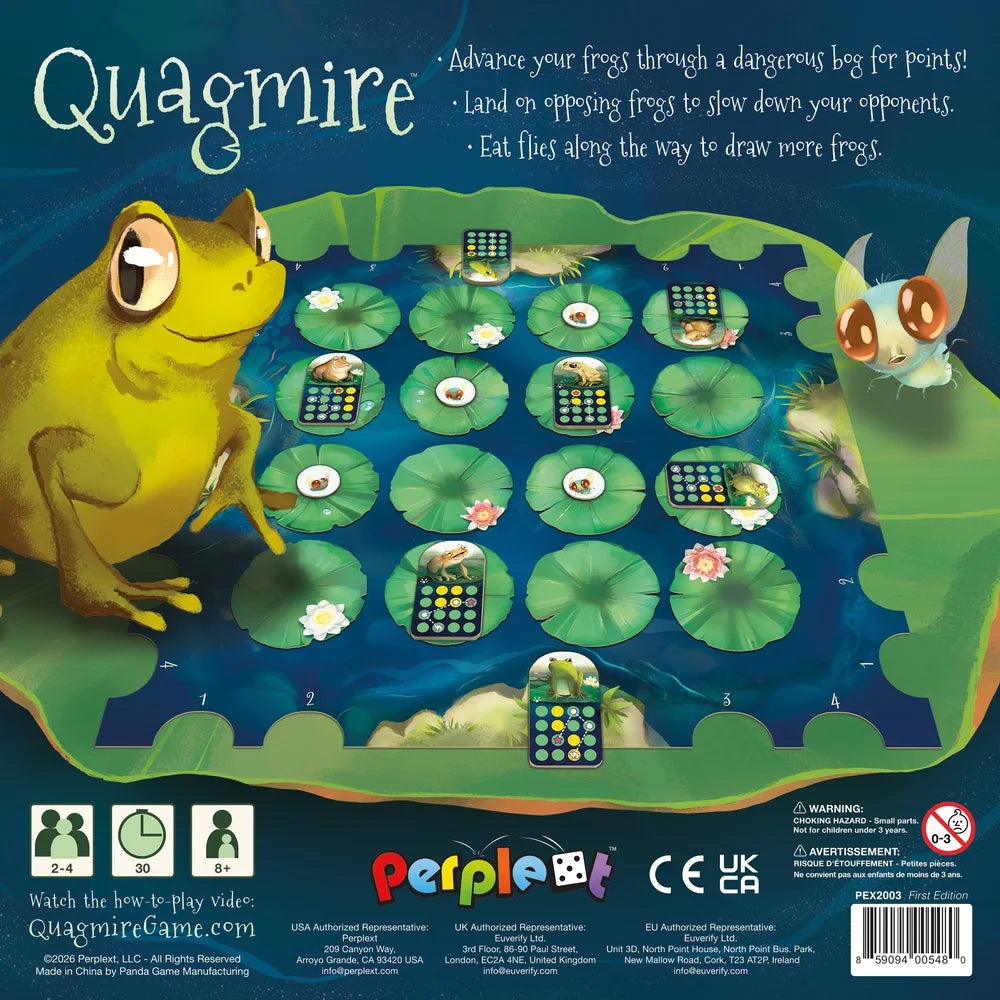
You play frogs from your hand, move them onto shared lily pads, land on flies to draw cards and on opposing frogs to earn points. You complete routes, build formations, accumulate points. Movement is programmed: choose now, see later. Some have called it 'Frog Chess', and the definition fits perfectly.
What they say abroad
"Program your frogs to land on lily pads with opposing frogs and take control of the bog"
Programma le tue rane per farle atterrare sulle ninfee con le rane avversarie e prendi il controllo della palude
— Perplext
Quagmire promises a tactical depth rare for such a compact game. Every card has three possible uses and every jump counts. It's the kind of game that keeps your mind engaged without overwhelming it.
— FroGames

Quagmire
FrogScore · FroGames editorial rating · first read: based on official rules and presentation, updated with first playsThe pieces in play
Four elements that build every game
Frog Cards
<cite index="27-6">Each card has three uses: play it as a frog, use it to score formations, or keep it for final scoring</cite>. Choosing always comes at a cost.
Lily Pads
<cite index="2-1">The shared grid of lily pads where you move your frogs</cite>. Each space is a possible move, each jump is a tactical choice revealed only later.
Flies
<cite index="2-2,2-4">Land on a fly, draw a card</cite>. They are the fuel of the game: when the flies run out, options run out. The hunt is constant.
Routes and Formations
<cite index="2-5">Complete routes between lily pads and build specific formations to earn extra points</cite>. These are secondary objectives that become primary as the game nears its end.
Come si gioca
Video dimostrativo di gameplay.
🎲How to playThe rules in four steps▼
How to play
The flow of each round
A turn lasts a few seconds. The game is a chain of quick turns and compressed decisions.
<cite index="2-1">Choose a card from your hand and play it onto an empty lily pad on the grid</cite>. Each card has a specific movement pattern: the frog can only jump in certain directions.
Choose one of your frogs already on the grid and move it according to its jump pattern. The movement is dictated by the card: you cannot invent. <cite index="2-2,2-4">If you land on a fly, you draw. If you land on an opponent's frog, you capture and score points</cite>.
<cite index="2-5">When your frogs form a specific sequence (route) or arrangement (formation), you score points</cite>. Some objectives require three aligned frogs, others more complex patterns. Each completed formation is an advantage in the long run.
Pass the turn. Your opponent plays. The grid changes. Flies disappear. Your frogs move or are captured. When it's your turn to play again, the board is no longer the same as you planned two turns ago.
⏱️Your first gameThe chronicle, moment by moment▼
A game in five moments
What happens at the table
Not the rules. The experience.
Setup and first moves
<cite index="2-1">You place the lily pads, draw frog cards, put the flies on the grid</cite>. Each player has three cards in hand. Everything seems simple. Then you look at the board and realize that every jump opens three possibilities and closes four.
Hunt for flies
<cite index="2-2,2-4">The first turns are a race: you have to land on flies to get enough cards</cite>. Whoever draws more has more options. Whoever is left with two cards in hand starts to sweat. Planning forces you to predict where the flies will be in two turns.
Clashes and captures
<cite index="2-2,2-4">You land on an opponent's frog and capture it for points</cite>. The first to do so changes the tone of the game. Now you're not just hunting flies: you're watching where your opponent will jump, anticipating their moves, planning your jumps to intercept them at the right moment.
Routes and formations
<cite index="2-5">You complete the first route between lily pads or build a formation written on the cards</cite>. Bonus points start to matter. Someone understands sooner how to fit moves together to maximize routes and captures at the same time. Someone else is still looking for flies.
End of game and scoring
<cite index="1-5,2-6">When the flies run out or the cards are exhausted, the game ends and points are counted</cite>. Captures, routes, formations. The player who best read the grid and best planned their jumps wins. And there's always that move you could have made two turns ago and didn't.
🐸Things to know beforehandThree honest things, from friends▼
Things to know beforehand
Three things you need to know about Quagmire
An empty hand blocks you
<cite index="2-2,2-4">You have to land on flies to draw cards</cite>. If in the first turns you avoid flies and immediately aim for captures, you will run out of options. The game does not forgive those who end up with a two-card hand: every movement choice counts double, and the opponent who drew more dominates you.
Programming is blind
<cite index="21-1">You program jumps now, you execute them later</cite>. You don't know where opponent frogs will be when you jump. Anticipation is everything: whoever reads the board better three moves ahead dominates. Whoever reacts turn by turn is always chasing.
Scales but changes pace
<cite index="12-1">The game works with 2 to 4 players</cite>. With 2 it's a tight tactical duel, almost chess-like. With 4 it becomes more chaotic: the grid fills up, moves overlap, control is less but improvisation matters more. Two different experiences in the same game.
🏆Victory and defeatWhat the ending rewards▼
How it ends
How to win and how to lose
<cite index="1-5,2-6">The player with the most points at the end wins</cite>. Points come from captures, completed routes, and formations.
Victory
- You capture more opponent frogs than other players
- You complete routes and formations before the flies run out
- You hold the right cards for the final score
Elimination or defeat
- You run out of cards too soon and can no longer draw flies
- You leave routes to opponents by focusing only on captures
- You misprogram your jumps and always land on the wrong lily pads
<cite index="1-1,12-6">Quagmire takes a pocket microgame and transforms it into a tactical tabletop experience</cite>. Accessible, fast, deep: the kind of game where after one game, you immediately ask for a rematch.
💬Frequently asked questionsQuick answers before checkout▼
Frequently asked questions
FAQ about Quagmire
Is Quagmire really like chess?
<cite index="21-1">Movement is programmed and the grid is shared, so the analogy with chess holds</cite>. But here moves are limited by your hand, you have to draw to have options, and the board changes every turn. It's more unpredictable than chess, less deterministic. If chess bores you with endless analysis, Quagmire gives you the same tactical satisfaction in 20 minutes.
Does it work well with 4 players?
<cite index="12-1">Yes, the game scales up to 4 players</cite>. With 4, the board fills up faster, captures are more frequent, chaos increases. You lose some of the tactical control of 2 players, but gain in dynamism and interaction. It depends on what you're looking for: a duel or a brawl.
Is it hard to learn?
<cite index="12-1">The game is for 8+ years</cite> and the rules can be explained in 10 minutes. Learning is easy, mastering is not: programming moves requires tactical vision and the ability to anticipate. The first few games will be chaotic, from the third you'll start to truly read the board.
What mechanics does Quagmire use?
Grid movement, hand management, programmed movement, pattern movement, physical removal. Cards are multi-use: you play frogs, build formations, keep for scoring. The core is programming: choose now, see later, and live with the consequences.
Is it available in Italian?
No, this edition is in English. <cite index="1-1,12-6">Quagmire is published by Perplext</cite> and there are currently no Italian localizations. The language has little impact: the game is primarily based on icons and visual patterns. You only need to read the rules once.
The people behind the game
Who invented it, who designed it, who publishes it — and what else they've done.
<cite index="1-1,12-6">Quagmire is an abstract game for 2-4 players designed by Chris Handy and published by Perplext</cite>. <cite index="12-1">Games last from 20 to 45 minutes, recommended age 8+</cite>. <cite index="2-1,2-4,2-5">The game uses grid movement and programming: move frogs on shared lily pads, capture opponent frogs, complete routes and formations to earn points</cite>. <cite index="1-1,12-6">Based on the microgame BOG from the Pack O Game series, Quagmire expands the tactical concept into a complete tabletop format</cite>. Available on FroGames.it.
Palude
Frequently Asked Questions
The answers you're looking for, no beating around the bush.
📸Do the images match the actual product?
The photos on the website often come from BoardGameGeek and are intended to give you an idea of the game. They may vary slightly from the version you receive. The content declared by the publisher is always binding.
📦Does the content of the box match what is indicated?
We always strive to provide the correct content, but minor variations are possible due to reprints or updates. The information comes directly from the publishers. If you have any questions, please contact us!
⏳How do pre-orders work?
Pre-order the game before release, payment is immediate, and the game is reserved for you. As soon as it arrives, we'll ship it right away! If there are any delays, we'll update you promptly.
🔒Can I trust buying here?
Absolutely! Secure payments, tracked shipments, and a team that loves board games as much as you do. If something goes wrong, we'll do our best to fix it.
🛠There's a problem with my order, what should I do?
Write to us now! Whether it's a missing part, damage, or an error, we'll help you resolve it as soon as possible. Your experience truly matters to us.