

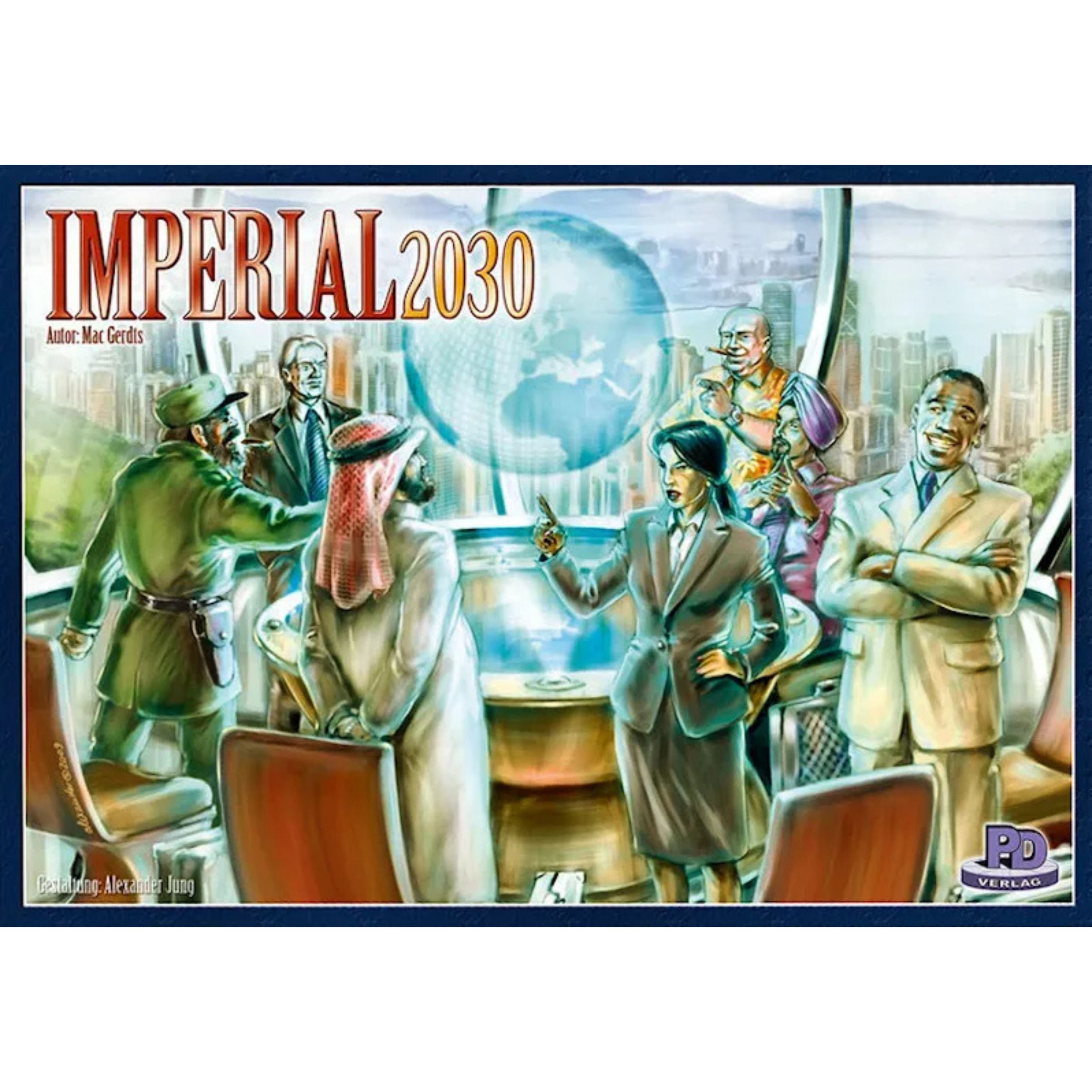
Imperial 2030
🐸 Dettagli da BoardGameGeek
Consiglio BGG sul numero di giocatori
Categorie
Meccaniche
Design & Art
Lingua
Pre-order - leggi i dettagli
🐸 Una rana saggia sa quando dividere l’ordine… e quando aspettare il salto giusto.
Pairs well with
The FroGames Card
You finance China to expand in Asia. The next turn, you invest in Europe and declare war. Your portfolio has no flags: only return on investment matters.
WHAT IT'S ABOUT
The game where you don't command nations, you own them
Designed by Mac Gerdts and published in 2009 by PD-Verlag, Imperial 2030 is the standalone and updated version of the celebrated Imperial (2006). Set in the near future where six great powers (USA, Europe, Russia, China, India, Brazil) vie for global control, the game uses Gerdts' famous rondel mechanic: a circle of actions where each move takes you further, limiting subsequent choices.
But the real twist is this: you don't play as a nation. You are an international investor who finances governments, buys bonds, takes control of the most profitable powers, and makes them act according to your interests. The player with the most capital in a nation controls its turn. Alliances shift, betrayals are legal, and in the end, the one who made the best money wins, not the one who conquered the most territories.
What they say abroad
"Imperial 2030 is a game about money, not about military domination"
Imperial 2030 is a game about money, not about military domination
— Official Rulebook
It's a game that overturns the logic of wargames: here the army is an investment, not an end. And when you realize you can finance both sides of a war, everything changes.
— FroGames

Imperial 2030
FrogScore · FroGames editorial rating · based on rules, international reviews, and gameplay sessionsYour financial instruments
How you move capital and nations
Bonds
You buy bonds from nations to finance them and earn interest. Whoever holds the most bonds of a power takes political control of it. Denominations include 2, 4, 6, 9, 12, 16, 20, 25, and the new 30 million introduced in this edition.
Action Rondel
Each nation has a token on a circle of 8 actions (Production, Maneuver, Investor, Import, Taxation...). You can advance 1-3 spaces for free; beyond that, you pay 2 million for each skipped space. This limits moves but opens up devastating combos.
Factories and Fleets
Build factories in provinces to generate armies and ships. Military units control neutral territories and generate taxes. More expansion = more income for your bonds.
Swiss Bank
New to Imperial 2030: the Swiss bank pays interest on unsold bonds. This changes the game's math and makes previously impossible strategies profitable.
Recommended Sleeves 130 cards in 1 size ▼
If you play often, we recommend protecting your cards with clear sleeves to make them last longer.
| Size | Quantity |
|---|---|
| 45 × 78 mm | 130 |
| Total cards | 130 |
Come si gioca
Video dimostrativo di gameplay.
🎲How to PlayThe rules in four steps▼
How to Play
The flow of each nation's turn
It's not the players who take turns, but the six nations, one after the other. Whoever controls that nation (= has the most bonds) decides its actions.
The nation has a marker on one of the 8 spaces on the rondel. You can move it 1-3 spaces for free. Each space beyond the third costs 2 million (paid from the nation's treasury). Choose from: Production, Maneuver, Investor, Import, Taxation, Factory.
Production: generates units from factories. Maneuver: moves armies/fleets and fights. Investor: issues a new bond and collects cash (or pays interest). Taxation: collects taxes from controlled territories. Each action has direct economic consequences.
Money flows in and out of the national treasury (separate from your personal capital). If a nation is rich, it can build and fight. If it's bankrupt, it cannot act. Investors can finance it by buying bonds, but only if it's profitable.
Control can change: if during the Investor turn someone buys enough bonds, they take immediate control. The next nation acts, and you might control another. Your goal is not loyalty, but profit.
⏱️Your first gameThe chronicle, moment by moment▼
A game in five moments
What happens at the table
Not the rules. The experience.
The first bond auction
Everyone starts with 13 million in capital. The first bonds of the six nations are auctioned. Some bet everything on one power, some diversify. Those who take initial control of the USA or Europe start strong, but pay dearly. The tension is already high: you are buying your destiny for the next 30 minutes.
First turns: everyone builds
Nations begin to move on the rondel. Production, Import, Maneuver. Everyone builds factories, generates armies, occupies neutral territories for taxes. It looks like a classic wargame. But it's not: you're using the nation's money to enrich your personal portfolio.
Someone changes allegiance
A player invests heavily in bonds of a nation they didn't control. They steal control. The nation that seemed to be your ally now acts against your interests. This is the moment you realize that nations are pawns, not teams. And your portfolio is the only loyalty that matters.
Proxy war
Two powers clash. But it's not the players who are fighting: it's the investors who decide if it's worth it to make their nations fight. A war can enrich both sides (if you own bonds of both) or destroy the value of a portfolio. Every battle is an ROI calculation.
Final count: who made the most money
Sum up: cash in hand + value of bonds held (based on the current power of the nations). Those who dominated militarily but didn't diversify lose. Those who wisely invested in multiple powers, collected dividends, and sold at the right time win. It doesn't matter who conquered the most. It matters who earned the most.
🐸What to know beforehandThree honest things, from friends▼
What to know beforehand
Three honest warnings
High cognitive downtime
Each nation's turn requires calculations: how much does that move cost, how much does that bond yield, who will screw me over if I invest here. With 5-6 players, the downtime between your actual turns can be long. It's not a game for those who hate waiting or for quick evenings.
Cold and cynical theme
There's no epic, no emotional narrative. You are an amoral investor financing wars for dividends. If you're looking for immersion or a hot theme, this isn't the right game. It only works if you accept cynicism as a mechanic.
Steep learning curve
The first game is a controlled disaster: wrong investments, bad timing, you don't know when to sell. The rondel seems simple but hides deep optimizations. It takes 2-3 games to play really well. It's not a gateway game.
🏆Victory and defeatWhat the ending rewards▼
How it ends
How to win and how to lose
The game ends when a game-end condition is met (variable based on the number of players). The total portfolio value of each investor is counted.
Victory
- Total value of bonds held (based on the current power of each nation: factories + controlled territories)
- Liquid cash remaining in hand
- Whoever has the highest total wins. It doesn't matter who dominated militarily, it matters who made the most money
Economic defeat
- You invested everything in a nation that then collapsed (lost control, few taxes, no territory)
- You bought bonds that were too expensive and didn't diversify: their final value is low
- You held too much cash without investing: the Swiss Bank's interest isn't enough to beat those who played aggressively
Imperial 2030 is the game that makes you understand why international finance has no allies, only interests. And by the end of the game, everyone will have learned it the hard way.
💬Frequently asked questionsQuick answers before checkout▼
Frequently asked questions
FAQ about Imperial 2030
What is the difference between Imperial and Imperial 2030?
Imperial 2030 is standalone, you don't need the first game. It changes the map (new nations: China, India, Brazil instead of Austria-Hungary, Italy, France), adds the Swiss Bank which pays interest, introduces the 30 million bond, and better balances control of the channels (Panama, Suez). The core rules remain identical, but the economic balance is different.
Is it a wargame or an economic game?
Technically both, but the heart is economic. You use armies and fleets to control territories and generate taxes, but the goal is not to conquer: it's to maximize the value of your portfolio. Wars are financial tools, not ends. If you love combat dice and epic battles, it's not for you.
Does it work well with 2 players?
Yes, but its nature changes. In 2 players, each player controls multiple nations simultaneously, and interaction is more predictable. It loses some of the political fluidity of 4-6 players (where controls change often and betrayals are frequent). It's a more tactical, less chaotic game.
What mechanics does Imperial 2030 use?
Rondel action selection (Mac Gerdts' signature mechanic), area majority/influence (you control territories with military units), investment and stock holding (buy bonds, get dividends, resell), ownership (whoever owns the most bonds controls the nation). Zero dice, zero cards: open information and pure choices.
Is it available in Italian?
This edition is in English. The main components are map, bonds, military units (language-independent). Text is present on: bond cards (numerical values + nation name), rulebook, action summary card. Language dependence is moderate: you need to read the rules once, then the game is almost entirely iconographic.
The people behind the game
Who invented it, who designed it, who publishes it — and what else they've done.
Imperial 2030, designed by Mac Gerdts and published by PD-Verlag, is an economic strategy game for 2-6 players aged 12 and up, lasting 120-180 minutes. It uses the famous rondel mechanic to manage six great powers (USA, Europe, Russia, China, India, Brazil) in the near future where international investors control governments through bonds and capital. Unlike classic wargames, here the winner is not determined by who conquers the most territories, but by who maximizes the value of their financial portfolio. The game introduces the Swiss Bank and the 30 million bond compared to its predecessor Imperial, offering new investment and diversification strategies. Available on FroGames.it.
Imperial 2030
Frequently Asked Questions
The answers you're looking for, no beating around the bush.
📸Do the images match the actual product?
The photos on the website often come from BoardGameGeek and are intended to give you an idea of the game. They may vary slightly from the version you receive. The content declared by the publisher is always binding.
📦Does the content of the box match what is indicated?
We always strive to provide the correct content, but minor variations are possible due to reprints or updates. The information comes directly from the publishers. If you have any questions, please contact us!
⏳How do pre-orders work?
Pre-order the game before release, payment is immediate, and the game is reserved for you. As soon as it arrives, we'll ship it right away! If there are any delays, we'll update you promptly.
🔒Can I trust buying here?
Absolutely! Secure payments, tracked shipments, and a team that loves board games as much as you do. If something goes wrong, we'll do our best to fix it.
🛠There's a problem with my order, what should I do?
Write to us now! Whether it's a missing part, damage, or an error, we'll help you resolve it as soon as possible. Your experience truly matters to us.