

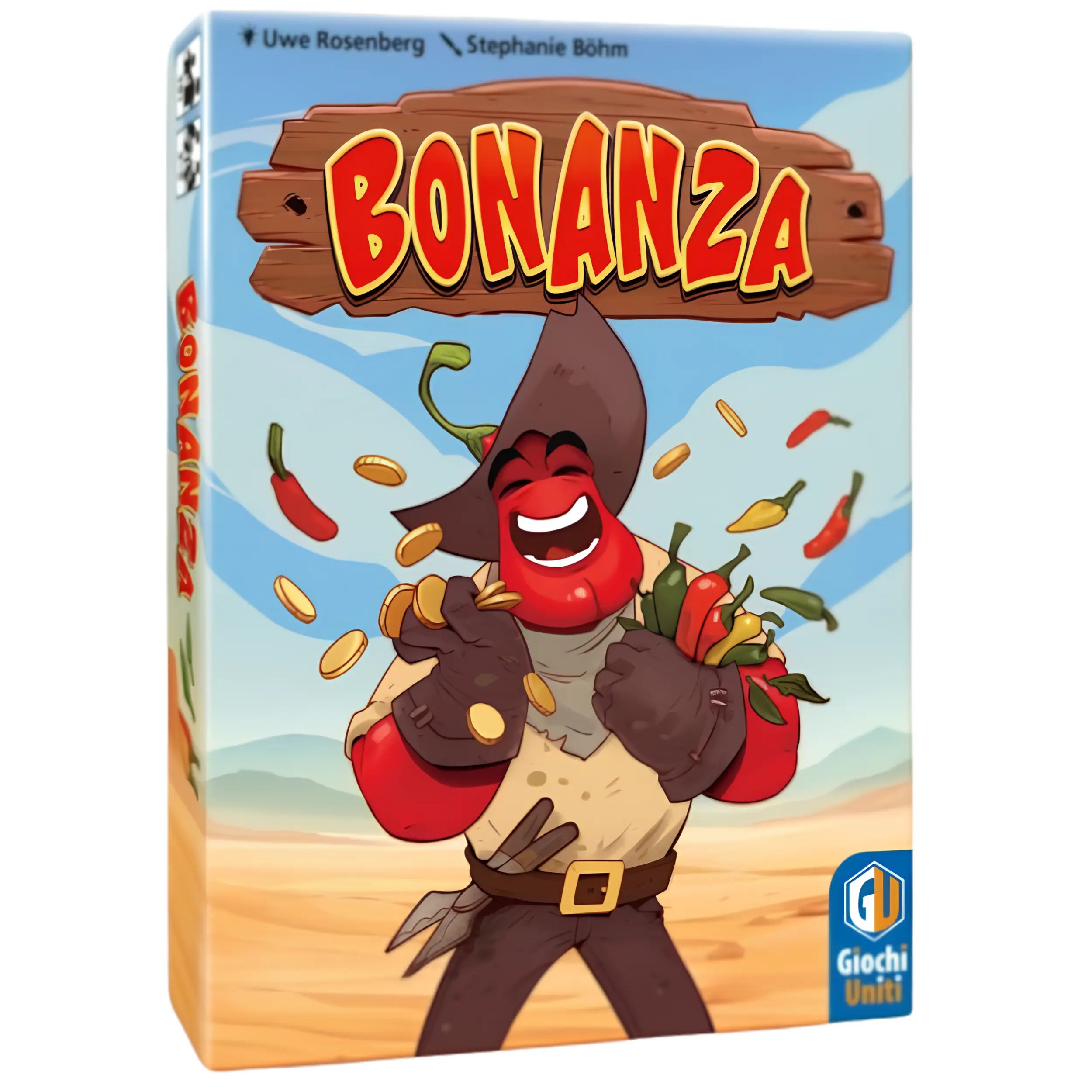
Bonanza
🐸 Dettagli da BoardGameGeek
Consiglio BGG sul numero di giocatori
Categorie
Meccaniche
Design & Art
Lingua
Pre-order - leggi i dettagli
🐸 Una rana saggia sa quando dividere l’ordine… e quando aspettare il salto giusto.
Pairs well with
The FroGames card
You have a red bean you need to plant. But there's already stuff in the field you don't want to harvest. You look at your hand. You look at the others. You start to deal. And that card that seemed useless becomes the deal of the night.
WHAT IT IS ABOUT
The card game where hand order is law
Uwe Rosenberg designed Bonanza (originally Bohnanza) in 1997 for AMIGO, and since then it has sold over 10 million copies in 20 languages. A classic German party game with cartoon artwork and a mechanism that overturns the very concept of hand management. Illustrations by Björn Pertoft and other artists in the various editions.
You plant beans in your fields, harvest them, and earn coins. But there's a problem: you cannot reorder your hand. You must play cards in the order you draw them. The only way out is to deal with everyone: exchange cards early, promise future favors, convince someone to take that card that is ruining your field. The game is all about this: talking, negotiating, striking absurd deals.
What they say abroad
"The negotiation is everything. You'll trade beans you don't have yet for promises you won't keep."
Negotiation is everything. You'll trade beans you don't have yet for promises you won't keep.
— Shut Up & Sit Down
After an hour you will have made at least three ridiculous deals and zero enemies. Bonanza is the game of negotiations where everyone wins something and no one truly gets offended.
— FroGames

Bonanza (Bohnanza)
FrogScore · FroGames editorial rating · based on rules, international reviews and play sessionsYour beans
Eight varieties, eight planting strategies
Common beans
There are many of them in the deck. They are harvested early but are worth little. The dilemma is always: keep or trade?
Rare beans
Few in the deck, they are worth a fortune if you collect enough. But if you only have one in hand, you're doomed.
Fields
You have two at the start. You can buy a third with coins. Each field can only have one type of bean.
Coins
Earned by collecting sets of beans. Face-down cards you accumulate. Whoever has the most wins.
Recommended sleeves 1147 cards in 3 sizes ▼
If you play often, we recommend protecting your cards with clear sleeves to make them last longer.
| Size | Quantity |
|---|---|
| 56 × 87 mm | 1120 |
| 170 × 100 mm | 22 |
| 170 × 110 mm | 5 |
| Total cards | 1147 |
🎲How to playThe rules in four steps▼
How to play
The flow of each turn
Four quick phases: plant, reveal, trade, draw. The game flies by.
You must plant the first card from your hand (mandatory) and you can also plant the second (optional). If the bean type doesn't match any field, you must harvest a field to make space.
You flip two cards from the common deck. They are visible to everyone. You must plant or trade them. This is where the negotiation begins.
You can trade the revealed cards and any card from your hand with other players. No limits: promises, future agreements, anything goes. Then you plant the cards you obtained or the revealed ones.
Take three cards from the deck and place them at the bottom of your hand. You cannot reorder them. The order is sacred. Turn over.
⏱️Your first gameThe chronicle, moment by moment▼
A game in five moments
What happens at the table
Not the rules. The experience.
Setup and first cards
Everyone draws five cards and keeps them in the order received. First glances, first smiles. Someone already knows that the first two cards in hand are a disaster. The rule is clear: you cannot reorder. The first vocal deliberations begin.
First negotiations
The first player plants, then reveals two cards from the deck. Offers begin: "I'll give you this red bean if you give me that blue one later." Negotiations are free, chaotic, without limits. Someone makes absurd deals. Someone promises cards they haven't even drawn yet.
Full fields and tough choices
Fields fill up. Someone has to harvest a small set to make space. Coins arrive, but few. Tension rises when you have to plant a card that ruins your best field. You start to understand who has what, who can help you, who will trick you.
Harvests and twists
Someone harvests a huge set and earns four coins. Others see their plans collapse due to a card drawn at the wrong time. Negotiations become desperate: "I swear I'll give you two reds next round." The table laughs, shouts, complains.
Last rounds and counting
The deck runs out for the third time. Final round of harvests: those who kept large sets win, those with half-full fields lose. Coin counting. Someone wins by one card, someone curses in German. Then someone asks: "Should we play again?"
🐸What to know beforehandThree honest things, from friends▼
What to know beforehand
Three things you need to know
Hand order is immutable
You cannot reorder your cards. Ever. If you draw a bean that ruins your plans, you keep it at the bottom of your hand and wait for the right moment to trade it. This constraint generates the entire game. If you love total control, it will frustrate you in the first few turns.
With 2 players, it loses its magic
The game is designed for groups. Free trading with 5-7 people is the heart of the experience. The 2-player variant exists but is mechanical, lacking the chaotic soul of the party. If you're looking for a card game for a couple, look elsewhere.
Luck matters more than expected
You can make perfect trades, but if you draw three wrong beans in a row, you're forced to harvest small sets. The game doesn't reward pure planning. It rewards those who can adapt, talk, and persuade. If you're looking for total strategic control, it will disappoint you.
🏆Victory and defeatWhat the ending rewards▼
How it ends
How to win
The deck runs out three times. In the end, whoever has the most coins wins.
Victory
- Harvest large bean sets: the more cards of the same type you have in the field, the more coins you earn at harvest.
- Close advantageous trades: get the right beans from others, avoid planting cards that ruin your fields.
- Buy the third field (with 3 coins): it gives you more space to keep large sets and harvest when you're ready.
Common mistakes
- Harvest sets too early: if you clear a field with only 2-3 cards, you earn little to nothing.
- Don't trade enough: if you play on your own, you're subject to the card order and miss opportunities.
- Promise too much and don't deliver: others will stop trading with you in subsequent turns.
It's the party game where talking matters more than calculating. And where a ridiculous agreement can save the evening.
💬Frequently asked questionsQuick answers before checkout▼
Frequently asked questions
FAQ about Bonanza (Bohnanza)
What mechanics does Bonanza use?
Restricted hand management (you cannot reorder your hand), set collection, free trading, and multi-use cards. The cards serve as both resources and currency. The core of the game is open negotiation among all players.
Does it work well with 3 players or do you need a full table?
It's fine with 3, but the game really shines with 5 or more. More players = more simultaneous trades, more chaos, more fun. With 6-7 players it's at its best. The Italian base box supports up to 7 players.
Is it a competitive or relaxed game?
Competitive on paper (whoever has the most coins wins), but the atmosphere is always relaxed. There are no direct attacks, only negotiations. In the end, someone wins, but the fun is in the journey, not the outcome.
How important is luck compared to strategy?
Very important. The cards you draw determine much of the game. But good players know how to negotiate their way out of problems and read the table. It's a social game more than a strategic one: those who can talk win.
Is this edition in Italian?
Yes, the Giochi Uniti edition is entirely in Italian: cards, rulebook, bean names. The game is language-dependent for negotiations (you have to talk to others), so the Italian language is essential.
The people behind the game
Who invented it, who designed it, who publishes it — and what else they've done.
Bonanza (Bohnanza in the original German edition) is a card game for 3-7 players, lasting 45 minutes, recommended age 12+, designed by Uwe Rosenberg and published in Italy by Giochi Uniti. The main mechanics are restricted hand management, set collection, and free trading. The twist: you cannot reorder the cards in your hand; you must play them in the order you draw them. The only way out is to negotiate with other players to trade beans and build sets worth coins. Perfect as a party game or gateway game for large groups. Available on FroGames.it.
Bonanza
Frequently Asked Questions
The answers you're looking for, no beating around the bush.
📸Do the images match the actual product?
The photos on the website often come from BoardGameGeek and are intended to give you an idea of the game. They may vary slightly from the version you receive. The content declared by the publisher is always binding.
📦Does the content of the box match what is indicated?
We always strive to provide the correct content, but minor variations are possible due to reprints or updates. The information comes directly from the publishers. If you have any questions, please contact us!
⏳How do pre-orders work?
Pre-order the game before release, payment is immediate, and the game is reserved for you. As soon as it arrives, we'll ship it right away! If there are any delays, we'll update you promptly.
🔒Can I trust buying here?
Absolutely! Secure payments, tracked shipments, and a team that loves board games as much as you do. If something goes wrong, we'll do our best to fix it.
🛠There's a problem with my order, what should I do?
Write to us now! Whether it's a missing part, damage, or an error, we'll help you resolve it as soon as possible. Your experience truly matters to us.