

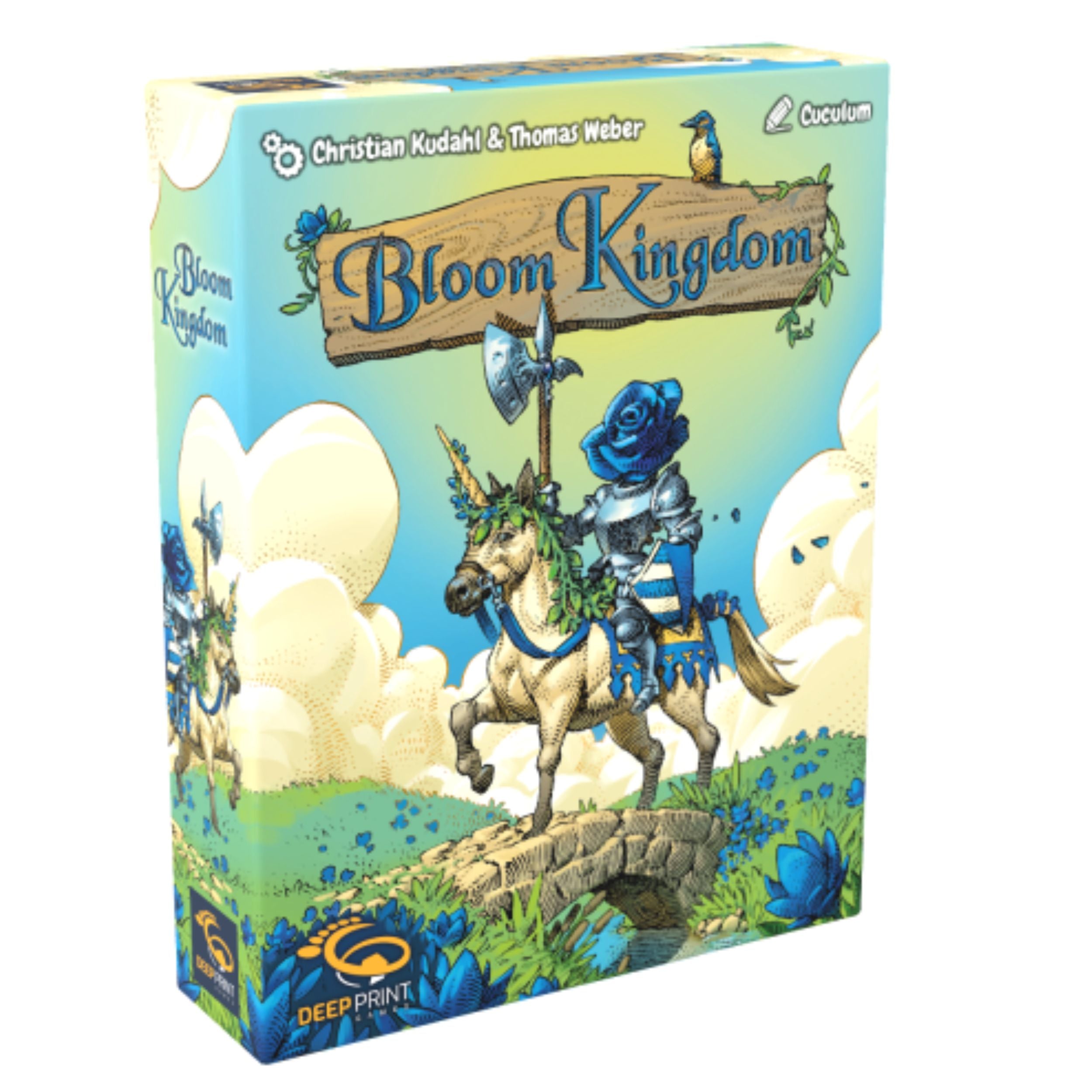
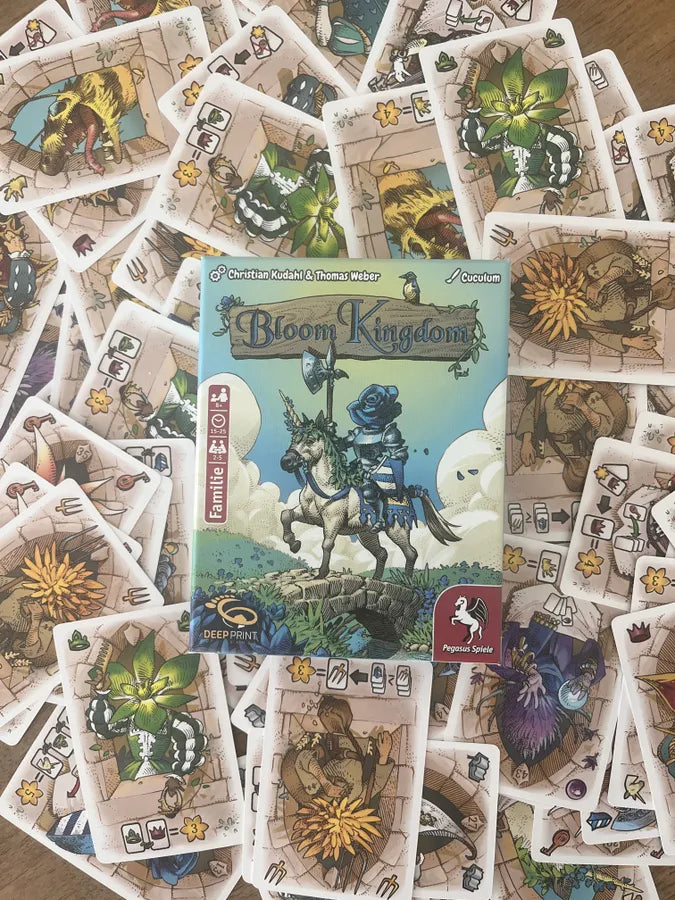
Bloom Kingdom
🐸 Dettagli da BoardGameGeek
Consiglio BGG sul numero di giocatori
Categorie
Meccaniche
Design & Art
Lingua
Pre-order - leggi i dettagli
🐸 Una rana saggia sa quando dividere l’ordine… e quando aspettare il salto giusto.
Pairs well with
The FroGames Card
Play the card. Enrich the display. But if you play it, you can't keep it. And only the last two cards in hand score. Decide now, find out in three rounds.
WHAT IT'S ABOUT
A card game where the tension is between playing and holding
Christian Kudahl (Mindbug, Agent Avenue) and Thomas Weber (Passt nicht!) have built a card game that thrives on a paradox: to increase a character's value, you must add their cards to the common display. But to score points, you must keep those cards in hand until the end. Cuculum's illustrations present a flourishing medieval kingdom in a style that Deep Print Games calls "a different perspective."
Each turn, everyone simultaneously chooses a card from their hand and plays it into the shared display. The more cards of a character are visible, the more points that type is worth. After three rounds, however, only the last two cards left in hand are counted. You must decide whether to boost a character — thereby also giving value to opponents — or to sabotage it, or to hold onto the best cards hoping that others will make them valuable for you.
What they say abroad
"clever timing and combination skills in a floral setting"
timing and combination skills in a floral setting
— Deep Print Games
A newly released game, built on a simple and cruel dilemma: every card played benefits everyone, but only those who hold them score. First read, July 2026.
— FroGames

Bloom Kingdom
FrogScore · FroGames editorial rating · first read: based on rules and official presentation, updated with first playsThe kingdom's protagonists
Four elements in play
Character Cards
Each character has a base value and special scoring conditions. The more copies in the display, the more they are worth. But to score, you must keep them in hand, not play them.
Victory Points
Some characters offer direct points, others only if specific conditions are met. You must read the display: which type is dominating? Which one risks being sabotaged?
Modifier Cards
Some played cards change the display arrangement, steal points, block characters, or reverse values. A well-timed blow can turn the game around.
Three Rounds
You play until you are left with two cards. Scoring. Then a new hand, new calculations. The winner of the first round becomes the target of the second.
Come si gioca
Video dimostrativo di gameplay.
🎲How to playThe rules in four steps▼
How to play
The flow of each round
Three rounds identical in structure, vastly different in hands and tension.
Each player receives a hand of character cards. The number varies depending on the player count. You look at what you have, make initial calculations. Which types are strong? Which cards do you keep, which do you sacrifice?
Everyone chooses one card from their hand and plays it face down. They are revealed together, added to the common display. The display grows turn after turn. More cards of a type mean that type is worth more. Some cards modify the display, steal points, or change rules.
You continue playing until you have exactly two cards left in your hand. These are your scoring cards. You can no longer change them. Now the display is complete, and the values are final.
Everyone reveals the cards remaining in their hand. You compare your characters with the display: how many copies are present? Are the special conditions met? You tally the points. End of round. New round, new hands, same opponents. After three rounds, the player with the most points wins.
⏱️Your first gameThe chronicle, moment by moment▼
A game in five moments
What happens at the table
Not the rules. The experience.
Full hands, empty plans
You receive your hand. You look at the cards. Too many Knights, no Wizards. Others look at theirs. Someone smiles, someone doesn't. First simultaneous turn: everyone plays a card, no one knows what the others will do. The display grows, but it's just noise. No one has yet figured out which character will dominate.
The display takes shape
After three turns, the common display shows a trend. Merchants are exploding, Knights are few, someone has played a card that steals points from Wizards. You still have two Merchants in hand. Perfect. Or maybe not: others might have them too. You look at their faces. They try not to give themselves away.
The last crossroads
You've reached your last three cards. You must choose one to play. If you play the Merchant, you increase the type's value — but you lose it for scoring. If you play the weak card, you keep the Merchant in hand, but risk someone else making another type explode. Choose. Others choose. Cards on the table.
End of round, counting
Everyone reveals the last two cards remaining in hand. Someone laughs, someone curses. Those who bet on the Merchants win big. Those who held back the Wizards find that the display penalized them. Quick count, scores on the scoresheet. Round two: new hands, old grudges.
Third round, everything counts
Last round. This time, every choice weighs double: those behind must take risks, those ahead must defend themselves. Simultaneous play eliminates certainty. The final turn is a collective bluff. Cards down. Reveal. The winner laughs, the loser demands a rematch. The game lasted twenty minutes, another one starts immediately.
🐸Good to know beforehandThree honest things, from friends▼
Good to know beforehand
Three things that change your game
Simultaneous play eliminates control
You can't react to others' moves: you choose, you play, then you see what others have done. Those who love planning will find this frustrating. Those who love chaos and bluffing, perfect. The game rewards hand reading and risk management, not pure optimization.
Scales poorly above 4 players
With 2-3 players, you can read the table well, better control which types to push. With 5, chaos increases, the display becomes unpredictable, and luck of the hand weighs more. It's not broken, but it changes the game. Consider your group.
Short games, tight margins
15-25 minutes means that a mistake in the first round is costly. You don't have time to recover if you choose the wrong character or keep the wrong card. This is both a strength (fast pace, immediate rematches) and a weakness (those who mess up the first hand start at a disadvantage).
🏆Victory and defeatWhat the ending rewards▼
How it ends
How to win and how to lose
After three rounds, the player with the most points wins. But points are only earned with the cards you keep, not with those you play.
Victory
- You held onto character cards that exploded in the common display (many copies, conditions met).
- You read others' hands well: you knew which types they would push, and you followed suit without playing too many cards.
- You used modifier cards at the right time to sabotage others' types and protect your own.
Defeat
- You played strong cards too early, enriching the display for others and leaving yourself with weak cards in hand.
- You bet on a character that no one pushed: the display left it with zero copies, points wiped out.
- You waited too long to play: others ended the round, and you were left with cards worth little.
Bloom Kingdom gives you only one dilemma and repeats it for three rounds: play or keep? The game lasts twenty minutes, but that dilemma stays in your head for hours.
💬Frequently Asked QuestionsQuick answers before checkout▼
Frequently Asked Questions
FAQ about Bloom Kingdom
Is it really that fast, or does it take more time to understand the cards?
The rules are explained in 5 minutes, the first round acts as a tutorial. After one or two turns, the dilemma (play or keep) is clear. The actual game lasts 15-25 minutes. With new players, add 5 minutes for setup and the initial explanation, but the pace remains quick.
Does it work well with two players, or do you need a full group?
It works for 2 to 5 players, but the sweet spot is 3-4 players. With two, the display is more predictable, and you can better read what your opponent is holding. With five, chaos increases, control decreases, and luck plays a bigger role. It depends on what you're looking for: tactics or chaos.
What mechanics does Bloom Kingdom use?
Hand management (you manage a hand and decide what to play and what to keep), set collection (you collect character types to maximize points), simultaneous action selection (everyone chooses and plays cards together, without turns). The core is the tension between the shared display and private scoring.
Do the cards have text or icons? Do I need to know English?
The cards have icons and some text for special abilities. Basic knowledge of English is recommended for scoring conditions and modifier cards. Once learned, games flow quickly. It's not language-independent, but the reading load is low.
Is it available in Italian?
No, this is the English edition from Deep Print Games. Rules and cards are in English. Currently, there are no official Italian translations. The game requires familiarity with the language for scoring conditions.
The people behind the game
Who invented it, who designed it, who publishes it — and what else they've done.
Bloom Kingdom is a competitive card game for 2-5 players, lasting 15-25 minutes, ages 8+, designed by Christian Kudahl and Thomas Weber and published by Deep Print Games. The main mechanics are hand management, set collection, and simultaneous action: each turn, everyone plays a card into the shared display, but only the last two cards kept in hand are scored. The game unfolds over three quick rounds, where the dilemma between playing a card (to enrich the display and increase a character's value) and keeping it (to score points at the end) generates constant tension and indirect interaction. Illustrations by Cuculum, floral medieval setting, light weight but important tactical choices. Available on FroGames.it.
Bloom Kingdom
Frequently Asked Questions
The answers you're looking for, no beating around the bush.
📸Do the images match the actual product?
The photos on the website often come from BoardGameGeek and are intended to give you an idea of the game. They may vary slightly from the version you receive. The content declared by the publisher is always binding.
📦Does the content of the box match what is indicated?
We always strive to provide the correct content, but minor variations are possible due to reprints or updates. The information comes directly from the publishers. If you have any questions, please contact us!
⏳How do pre-orders work?
Pre-order the game before release, payment is immediate, and the game is reserved for you. As soon as it arrives, we'll ship it right away! If there are any delays, we'll update you promptly.
🔒Can I trust buying here?
Absolutely! Secure payments, tracked shipments, and a team that loves board games as much as you do. If something goes wrong, we'll do our best to fix it.
🛠There's a problem with my order, what should I do?
Write to us now! Whether it's a missing part, damage, or an error, we'll help you resolve it as soon as possible. Your experience truly matters to us.