

Bitoku
🐸 Dettagli da BoardGameGeek
Consiglio BGG sul numero di giocatori
Categorie
Meccaniche
Design & Art


Pairs well with
The FroGames sheet
You play a yōkai card that gives you wood. You play another that converts wood into crystals. Yet another that allows you to build. Then you realize the engine is running, but someone has already taken the best spot in the forest.
WHAT IT'S ABOUT
A path to transcendence in the sacred forest
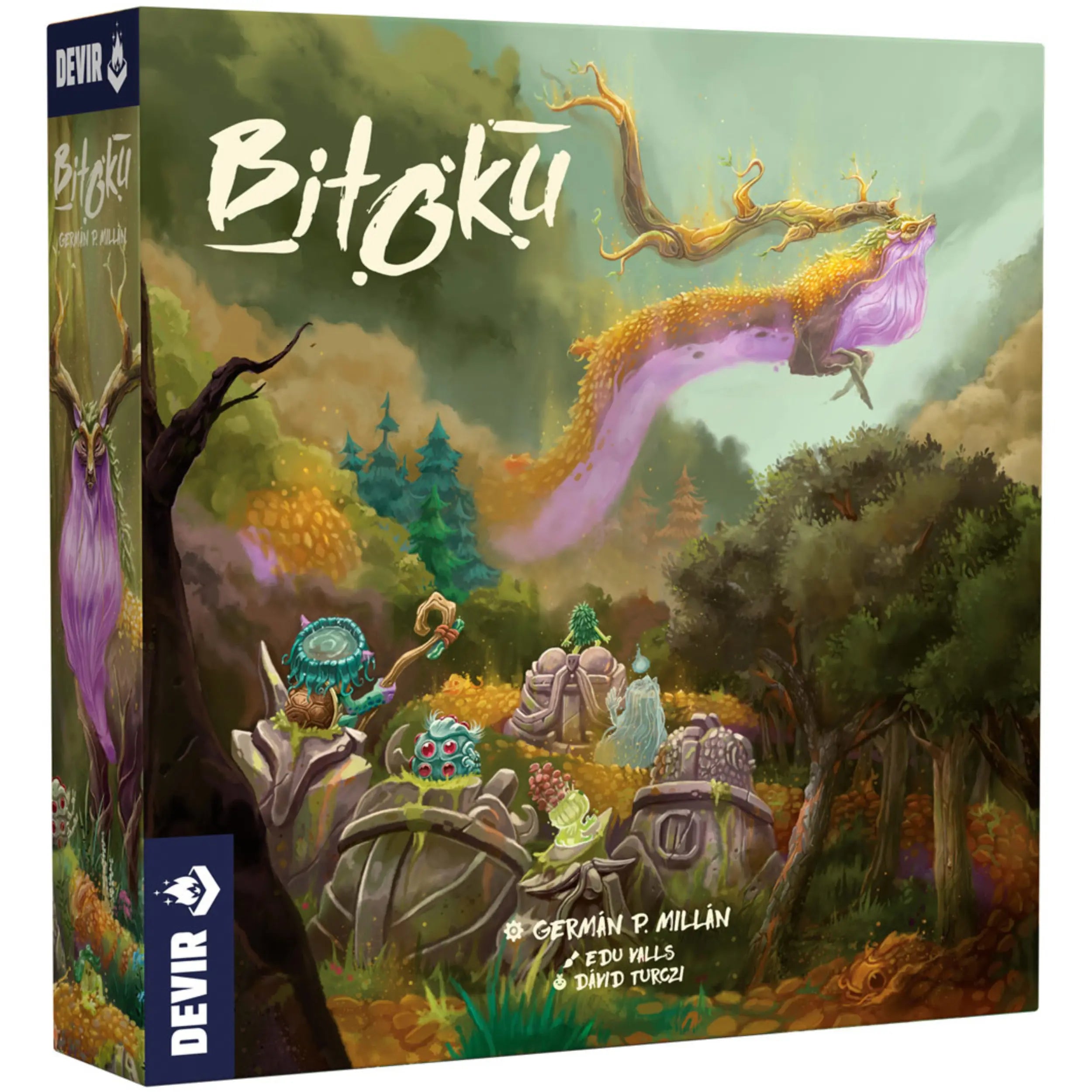
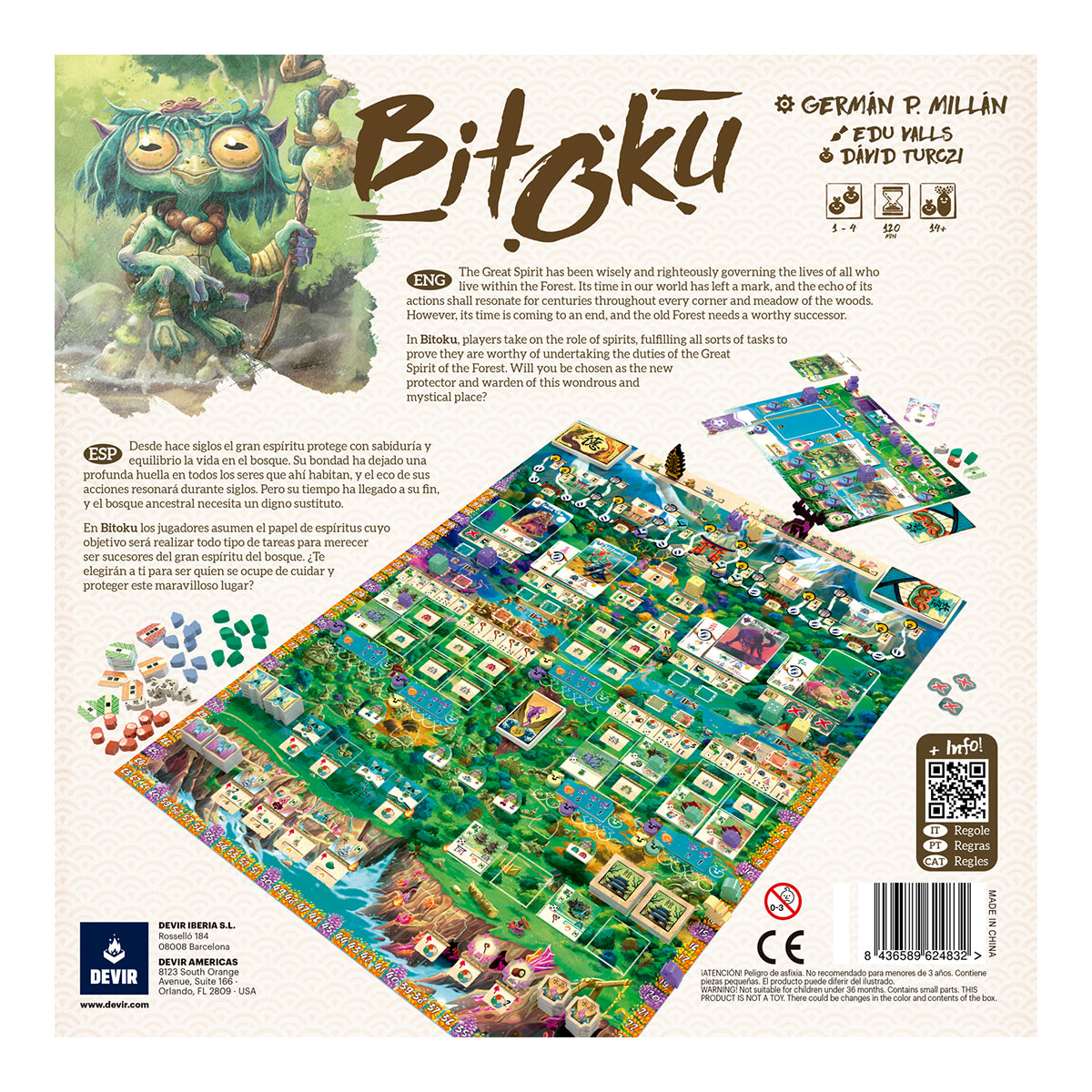
Designed by Germán P. Millán and illustrated by Edu Valls, Bitoku delves into Japanese mythology: players are bitoku spirits on a journey towards transcendence, accompanied by yōkai (supernatural creatures), kodama (tree spirits), and pilgrims seeking enlightenment. Published by Devir in 2021, the game weaves the spirituality of the forest with a dense and branching engine-building system.
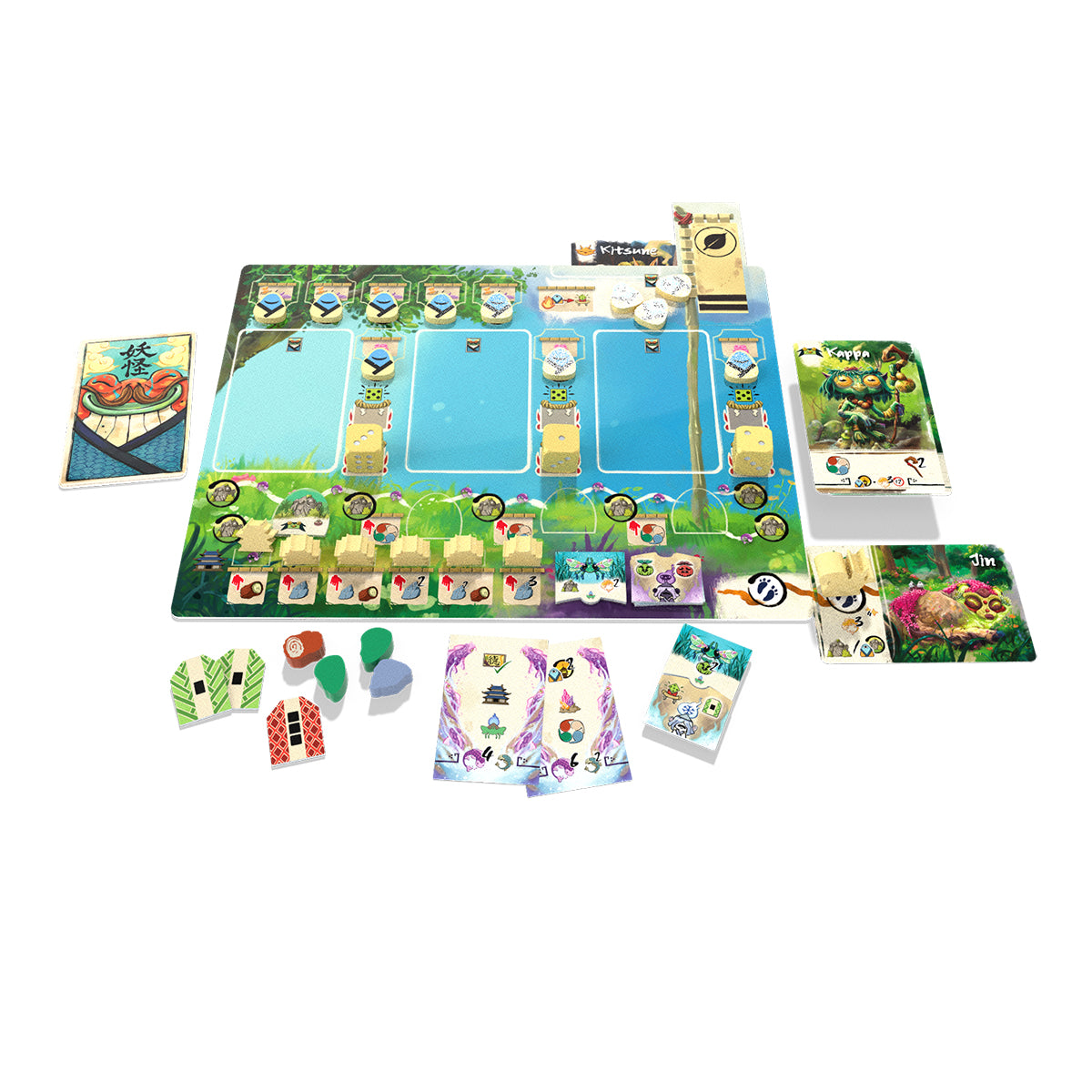
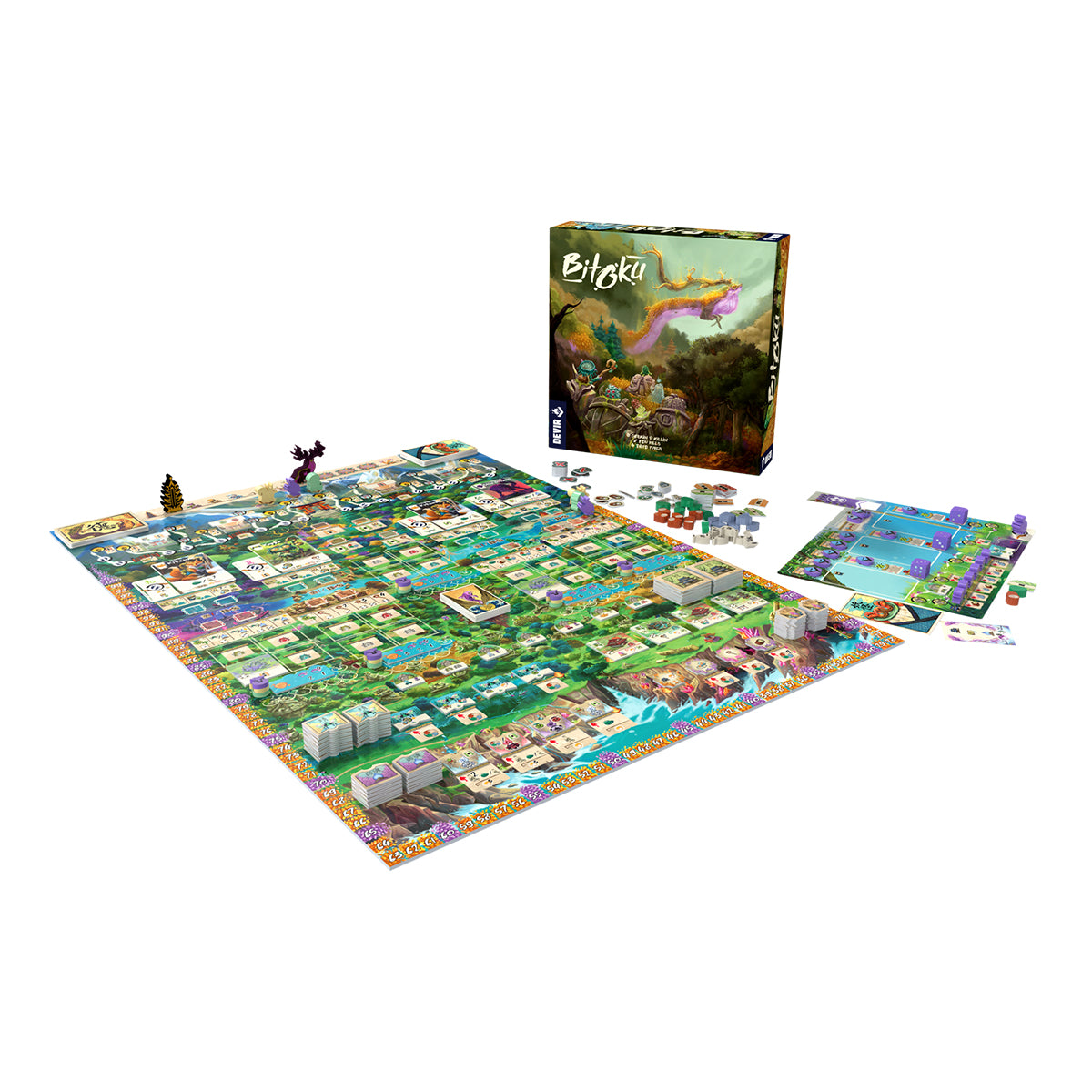
At the table, you manage a hand of yōkai cards to play at the right moments to activate abilities, build structures, collect soul crystals, and help the mitama (lost souls). You use three dice as yōkai guardians that you send to the forest regions to unlock actions, resources, and new strategic options. Each choice fuels an engine that grows game after game, with multiple paths to victory and a personal domain to optimize in parallel.
What they say abroad
"A puzzle of interlocking systems that rewards careful planning and adaptation."
A puzzle of interlocking systems that rewards careful planning and adaptation.
— Meeple Mountain
Bitoku won us over with its layering: every path offers concrete advantages, but none dominates alone. The management of yōkai cards and guardian dice keeps the tension high without ever being punitive.
— FroGames

Bitoku
The game includes a yōkai automa that draws cards and occupies forest spaces, simulating an opponent. The experience is complete: all strategic paths remain open and the resource pressure is realistic. It only loses direct competition on common goals, but the challenge remains high.
FrogScore · FroGames editorial rating · based on rules, international reviews, and game sessionsThe elements of your engine
Four layers of strategic building
Yōkai cards
Your hand is your arsenal: supernatural creatures you activate for immediate abilities, resource conversions, or chain combos. Each card played at the right time unlocks new options, but you must manage timing and deck refresh.
Yōkai Guardians (dice)
Three personal dice that you send as workers to the four great regions of the forest. The value of the die determines the strength of the action: build structures, collect crystals, get new cards. Limited positions create indirect competition.
Personal domain
Your private tableau where you place pilgrims on a contemplative journey. Each completed pilgrim gives you points, permanent resources, or passive abilities. It's a parallel layer that fuels the main engine without stealing attention.
Soul crystals
Special resources that are generated when you perform specific actions. You can invest them to help the mitama (lost souls) in exchange for victory points or powerful conversions. An alternative scoring system that rewards those who complete action cycles.
Recommended sleeves 111 cards in 2 sizes ▼
If you play often, we recommend protecting your cards with clear sleeves to make them last longer.
| Size | Quantity |
|---|---|
| 57 × 89 mm | 73 |
| 41 × 63 mm | 38 |
| Total cards | 111 |
Come si gioca
Video dimostrativo di gameplay.
🎲How to playThe rules in four steps▼
How to play
The flow of each round
Bitoku is structured in individual turns, not synchronous rounds. Each player, on their turn, performs all the actions they wish until they pass.
Choose one of your dice and place it on a forest board region. The die value determines the action's power. Some regions have limited spaces: if occupied, you must choose elsewhere or pay an extra cost.
From your hand, play as many yōkai cards as you wish. Each card offers an immediate ability: resources, conversions, points, new cards. You can chain them to create combos, but you must respect any prerequisites (symbols, required resources).
You can move pilgrims along the paths of your domain, complete them for bonuses, or activate already unlocked passive abilities. This layer is parallel: it doesn't interfere with the main actions but requires resources accumulated in previous turns.
If you still have guardian dice to place and actions to take, you continue. Otherwise, you pass. Once everyone has passed, dice are retrieved, forest regions are replenished, and a new round begins. The game ends after a fixed number of rounds or when certain conditions are met.
⏱️Your first gameThe chronicle, moment by moment▼
A game in five moments
What happens at the table
Not the rules. The experience.
Setup and first cards
Everyone places their three guardian dice in front of them, receives initial yōkai cards and an empty personal domain. The forest board is a puzzle of regions and action spaces. The first few minutes are spent deciphering the iconography: everyone reads their cards, asks for confirmation, plans their first move.
First placements
Someone rolls the dice and places the first guardian on a forest region. The others follow. The basic actions are simple (take wood, build, draw cards), but the competition for the best spaces is already evident. Those with the most versatile hand of yōkai play safely; those with specific combos wait for the right moment.
Combos and building
Mid-game: the engines start to hum. Someone has built a structure that generates crystals every turn, another has completed a pilgrim and now receives passive resources. Yōkai cards chain together: you play a card to get wood, use another to convert it to stone, a third to build and score points. The table speeds up.
The critical moment
Someone realizes they've neglected the mitama and scrambles to catch up. Another discovers their opponents have monopolized a forest region and must resort to an alternative path. Choices are weighty: every misplaced guardian die costs a turn, every wasted yōkai card slows down the engine. Tension rises, but no one is out of the game.
End game and scoring
The last hand of cards is played. Someone completes a final pilgrim, another helps a mitama for extra points. Scoring is long: points from structures, crystals, yōkai in the deck, common objectives, completed pilgrims. Victory is rarely clear-cut, often decided by 3-5 points. In the end, everyone recounts their engine as if it were a story.
🐸Good to know beforehandThree honest things, from friends▼
Good to know beforehand
Three things you need to consider
Steep learning curve
The first game is slow: the iconography of the yōkai cards is dense, the multiple paths are disorienting, and the manual is not the clearest. You need someone at the table who already knows the game or at least two hours of collective patience. From the second game, the pace drastically improves.
Downtime with 4 players
With 4 players, if someone suffers from analysis paralysis, turns drag on. There's no timer, no external pressure: there are many choices, and all are valid. If your group has slow players, consider 2-3 players to maintain the pace.
Low interaction
Interaction is almost exclusively indirect: competition over forest spaces and common objectives. No attacks, no direct blocking, no resource stealing. If you're looking for a game that allows you to sabotage opponents, Bitoku is not the right choice.
🏆Victory and defeatWhat the end rewards▼
How it ends
How to win
Bitoku ends after a predefined number of rounds (depending on the number of players). Victory points accumulated during the game are counted: the player with the most wins.
Sources of scoring
- Structures built in forest regions (fixed points + positional bonuses)
- Yōkai cards acquired and kept in your deck (each card is worth points at the end of the game)
- Pilgrims completed in the personal domain (immediate points + passive bonuses)
- Mitama helped through chinkon fireflies (conversion of soul crystals into points)
- Common objectives achieved (first to arrive get more points)
- Remaining soul crystals and unspent resources (marginal scoring)
Costly mistakes
- Ignoring the mitama: they are a consistent source of scoring; neglecting them leaves points on the table
- Not diversifying: focusing on only one path (e.g., only structures) makes you vulnerable to competition
- Wasting turns: every poorly placed die or ill-timed card slows down your engine compared to opponents
Bitoku rewards those who know how to build an engine without falling too much in love with it, remaining flexible until the last round.
💬Frequently asked questionsQuick answers before checkout▼
Frequently asked questions
Bitoku FAQ
What mechanics does Bitoku use?
Bitoku combines hand management (managing a hand of yōkai cards to play at the right time), worker placement with dice (you place your three yōkai guardians in the forest regions, and the die value influences the action), engine building (building an engine of self-sustaining abilities and resources), set collection (collecting yōkai cards for end-game points), and personal tableau management (domain with pilgrims). It's a stratified Eurogame with multiple paths.
How difficult is it to learn Bitoku?
The first game takes 2-3 hours including explanation, and the iconography of the yōkai cards needs to be decoded. The manual is not crystal clear, so it's advisable to have someone at the table who already knows it or watch a video tutorial beforehand. From the second game, the time drops to 90-120 minutes, and the game flows better. It's not a gateway game: BGG weight 3.8/5.
Does it play well solo?
Yes, it includes an official yōkai automa that simulates an opponent by drawing cards and occupying forest spaces. The solo mode is complete: all strategic paths remain open, and the automa creates realistic pressure on resources. It only loses the direct competition on common objectives, but the challenge remains high. Solo rating: 4/5.
Is there direct player interaction?
No, interaction is almost exclusively indirect: competition over limited forest spaces and a race for common objectives. No attacks, no resource stealing, no direct blocking. If you're looking for a game that allows you to sabotage opponents, Bitoku is not the right choice. It's an engine-building Eurogame, not an Ameritrash.
Is this edition in Italian?
No, this is the English edition published by Devir. The game requires frequent reading of yōkai cards (abilities, symbols, structure texts), so knowledge of English is necessary to play fluently. There are currently no official Italian editions.
The people behind the game
Who invented it, who designed it, who publishes it — and what else they've done.
Bitoku is a strategic board game for 1-4 players (120 minutes, age 12+) designed by Germán P. Millán and published by Devir in 2021. Set in Japanese mythology, it combines hand management (managing a hand of yōkai cards), worker placement with dice (the yōkai guardians), and engine building (constructing an engine of abilities and resources). Players are bitoku spirits on a path to transcendence, accompanied by supernatural creatures, kodama, and pilgrims. The game offers multiple paths to victory, a solo mode with an official automa, and a medium-heavy weight (3.8/5 on BGG). Available on FroGames.it.
Bitoku
Frequently Asked Questions
The answers you're looking for, no beating around the bush.
📸Do the images match the actual product?
The photos on the website often come from BoardGameGeek and are intended to give you an idea of the game. They may vary slightly from the version you receive. The content declared by the publisher is always binding.
📦Does the content of the box match what is indicated?
We always strive to provide the correct content, but minor variations are possible due to reprints or updates. The information comes directly from the publishers. If you have any questions, please contact us!
⏳How do pre-orders work?
Pre-order the game before release, payment is immediate, and the game is reserved for you. As soon as it arrives, we'll ship it right away! If there are any delays, we'll update you promptly.
🔒Can I trust buying here?
Absolutely! Secure payments, tracked shipments, and a team that loves board games as much as you do. If something goes wrong, we'll do our best to fix it.
🛠There's a problem with my order, what should I do?
Write to us now! Whether it's a missing part, damage, or an error, we'll help you resolve it as soon as possible. Your experience truly matters to us.