


Mind Space
🐸 Dettagli da BoardGameGeek
Consiglio BGG sul numero di giocatori
Categorie
Meccaniche
Design & Art
Lingua


Pairs well with
FroGames card
Roll the dice, choose an emotion, trace the shape on your brain. Others do the same, in silence. Twelve rounds later, you discover who built the most serene mind.
WHAT IT IS ABOUT
A contemplative puzzle where emotions take the shape of Tetris pieces
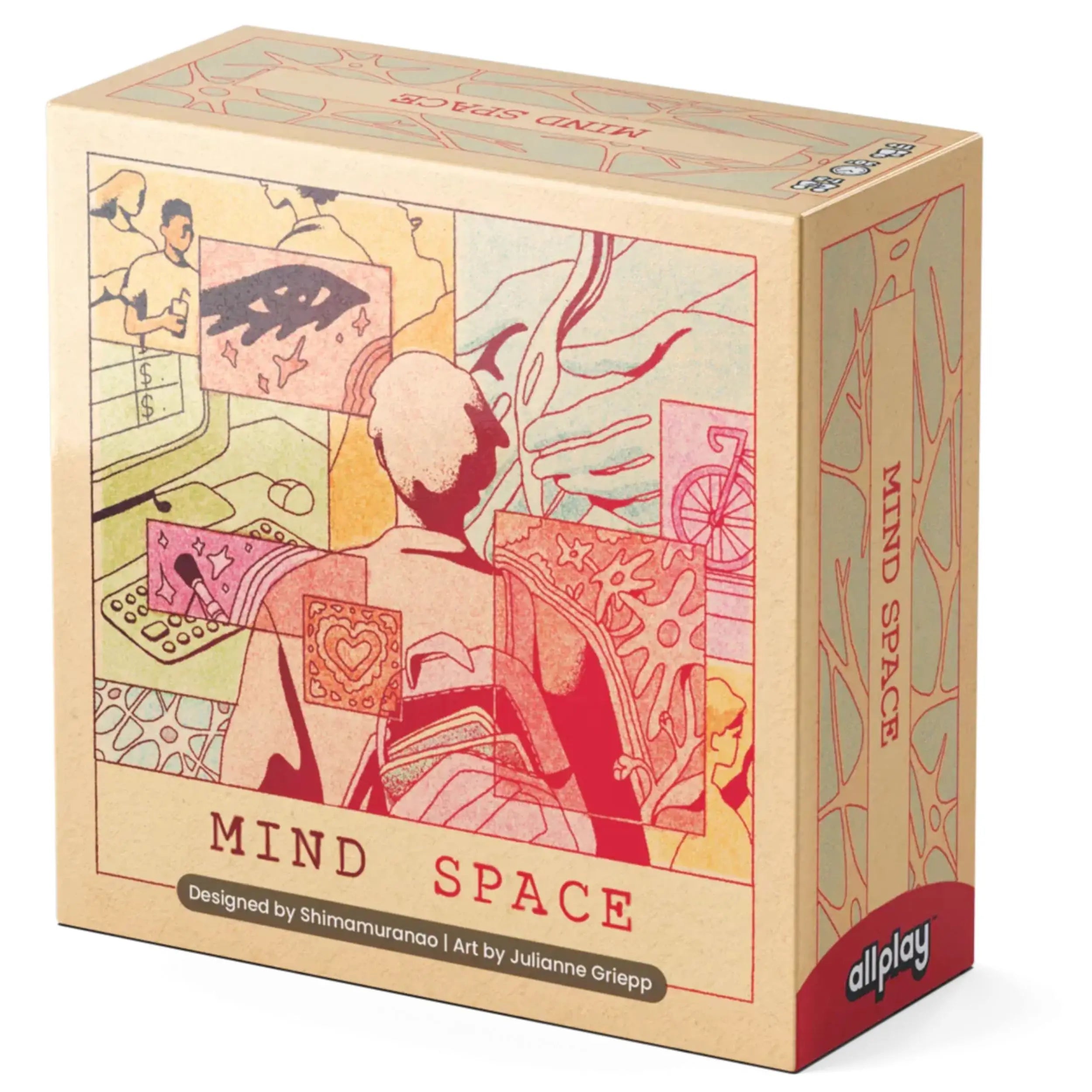
Mind Space is designed by Nao Shimamura and published by Allplay in 2023, with illustrations by Julianne Griepp. The game starts with an unusual idea: each emotion is a polyomino, a geometric shape reminiscent of Tetris pieces. Serenity is achieved by interlocking these shapes within your Brain Board, a grid representing the brain divided into sections.
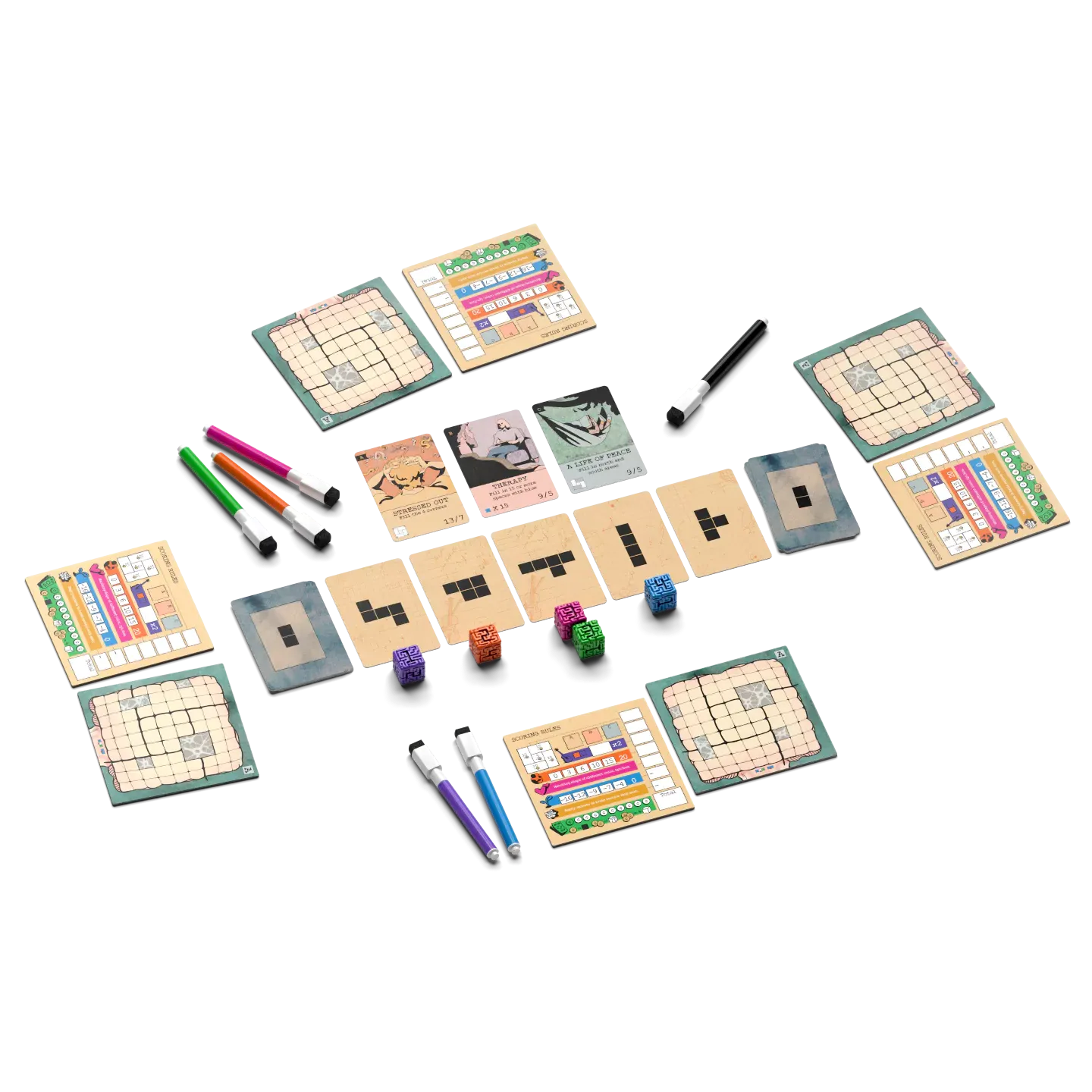
Each round, five colored dice determine which emotions you can draw. You choose an emotion card from the five available, trace its shape on your brain with the corresponding color, and try to complete areas, achieve public objectives, and meet the organizational criteria of each color. After 12 rounds, points are counted: each incomplete section of the brain costs you dearly, but closed areas and achieved objectives pay off.
What they say abroad
"Mind Space is a thoughtful game in which players are trying to achieve serenity by adding emotions to their Brain Board."
— Allplay
It's Tetris, but with a more subtle pressure: you don't lose immediately, you lose at the end of the game when you discover that that hole was fatal.
— FroGames

Mind Space
The game works very well solo: you use the same rules as multiplayer and compete against yourself or against a target score. The experience is complete because there was no interaction even in multiplayer, so you lose nothing. Only the direct comparison with other brains at the end of the game is missing.
FrogScore · FroGames editorial rating · based on rules, international reviews and game sessionsThe tools of serenity
What you use to build your brain
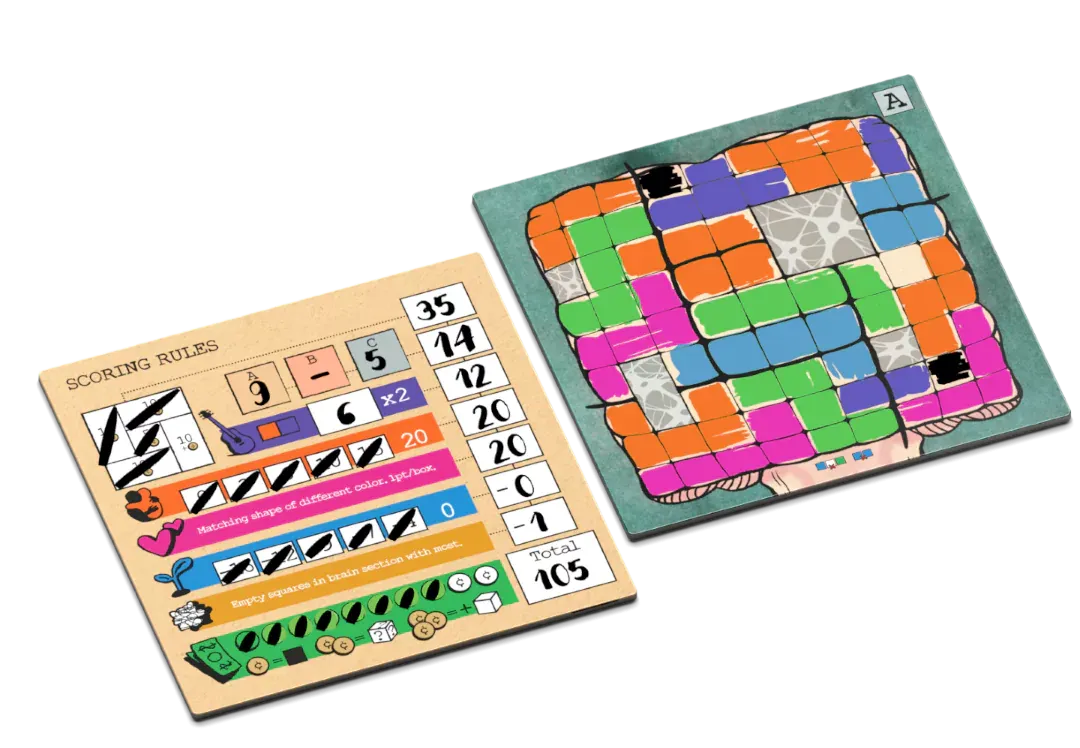
Brain Board
A grid representing your brain, divided into five sections. Each empty section at the end of the game costs you 1 point per square. The goal is to fill everything, or at least concentrate the holes in one area.
Emotion Cards
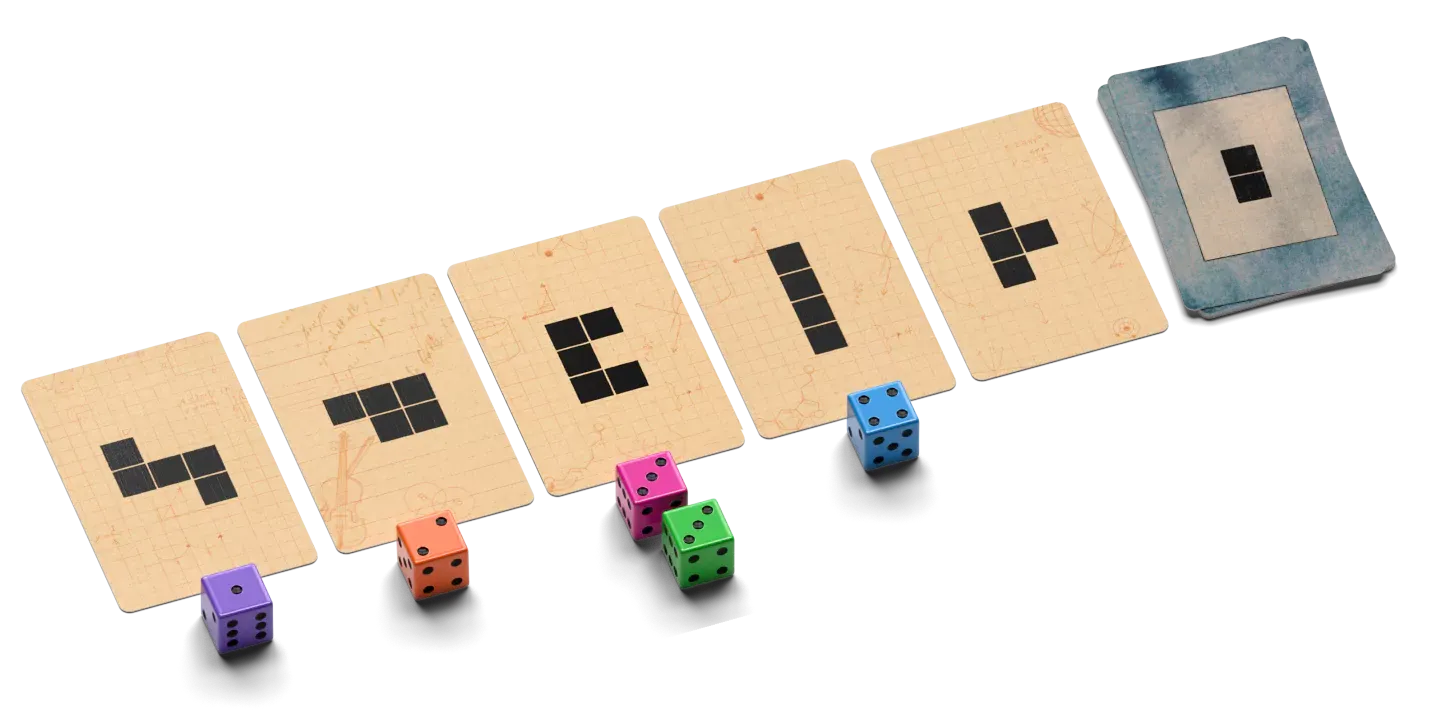
Seventeen cards, each with a different polyomino shape. Five are revealed each round: these are the available emotions. Choose which one to draw on your brain, respecting the color given by the dice.
Colored Dice
Five dice determine which colors you can use this round. Each die corresponds to one of the five emotion cards. The color of the die becomes the color with which you draw that shape.
Public Objectives
Objective cards common to all: they reward specific configurations (e.g., completing a section with a single color, creating geometric patterns). Each objective is worth points, and they are visible from the start.
Recommended Sleeves 38 cards in 1 size ▼
If you play often, we recommend protecting your cards with clear sleeves to make them last longer.
| Size | Quantity |
|---|---|
| 57 × 87 mm | 38 |
| Total cards | 38 |
Come si gioca
Video dimostrativo di gameplay.
🎲How to playThe rules in four steps▼
How to play
The flow of each round
Mind Space has a simple, repetitive structure: roll, choose, draw. Twelve times.
One player rolls the five colored dice. Five emotion cards are revealed from the deck. Each die corresponds to a card: the color of the die determines which color you can use to draw that shape on your brain board.
Everyone simultaneously chooses one of the five available emotion cards. There's no drafting, no turn order: everyone makes the same decision at the same time. You draw the shape you choose with the color of the corresponding die.
You trace the polyomino on your brain board, adhering to the placement rules: shapes cannot overlap, and you should try to complete entire sections to maximize points. You can rotate and flip the shape as desired.
After 12 rounds, the brain is (almost) full. Points are counted: completed sections, public objectives achieved, color organizational criteria met. The section with the most empty squares costs you 1 point per square. The player with the highest score wins.
⏱️Your first gameThe chronicle, moment by moment▼
A game in five moments
What happens at the table
Not the rules. The experience.
Silent Setup
Everyone has their Brain Board in front of them, five dice in the center, five emotion cards face up. The first dice roll determines the colors. You look at the available shapes and think: where do I put it? No one talks, everyone draws.
Easy first choices
The first rounds are painless: there's space, the shapes fit everywhere. Choose the largest emotions to fill up quickly. Someone aims to complete a section right away, someone else spreads out the colors to meet the organizational criteria.
Holes start to weigh heavily
Rounds 6-7: the brain fills up, but there are still scattered squares that don't fit. You look for small shapes to plug the gaps, but the dice don't give you the right colors. You start to sacrifice one section to save the others.
The objective slips away
Rounds 9-10: you look at the public objectives and realize one is unattainable. You change strategy: it's better to maximize complete areas than to chase impossible bonus points. Someone at the table sighs: they left too many holes in the same section.
Merciless scoring
Last round: you draw the final shape and then points are counted. Completed areas, objectives met, color criteria respected. Then comes the penalty: the section with the most holes subtracts 1 point per empty square. The player who built the most efficient brain wins. Not the prettiest.
🐸What to know beforehandThree honest things, from friends▼
What to know beforehand
Three things you need to know
The dice can ruin your plan
You have the perfect shape in mind to fill that hole, but the die gives you the wrong color. It happens. Luck plays a role: you can't plan too far ahead, you have to adapt. Those who dislike randomness in puzzles might find it frustrating.
The final penalty is merciless
The section with the most empty squares subtracts 1 point for each empty space. If you leave 8 scattered squares in an area, you lose 8 points. It's a huge blow. It's better to concentrate the holes in one section and sacrifice it completely.
Repetitiveness after many games
After 10-15 games, the formula starts to repeat. Public objectives change, but the core of the game remains the same: roll, draw, fill. Those seeking endless strategic depth won't find it here. It's a quick puzzle, not a complex eurogame.
🏆Victory and defeatWhat the ending rewards▼
How it ends
How to win and how to lose
After 12 rounds, points are counted. The player who built the most efficient brain wins.
Victory
- Complete entire brain sections: each complete section is worth bonus points
- Achieve public objectives: specific configurations (e.g., a monochromatic section, geometric patterns) are worth extra points
- Respect the organizational criteria of each color: each color has a scoring criterion (e.g., adjacency, concentration in a section)
Penalty
- The section with the most empty squares costs you 1 point for each unfilled square
- Not respecting the organizational criteria of the colors: you lose the bonus points for that color
- Leaving too many incomplete sections: each empty section is a potential penalty
Mind Space is a geometric puzzle disguised as an emotion game. Fast, accessible, with a final penalty that makes you reflect on every choice. It doesn't revolutionize roll & write, but it does so with care.
💬Frequently Asked QuestionsQuick answers before checkout▼
Frequently Asked Questions
Mind Space FAQ
What mechanics does Mind Space use?
Roll & write with pattern building, dice rolling (to determine colors), simultaneous action selection (choosing emotion cards simultaneously), and line drawing (drawing shapes on the Brain Board). It's a spatial optimization puzzle.
Does it work well solo?
Yes, very well. You use the same rules as multiplayer and compete against a target score or try to beat your own record. There was no interaction even in multiplayer, so you lose nothing by playing alone.
Do the dice make the game too random?
It depends on what you're looking for. The dice limit your choices each round, but you always have 5 cards to choose from. It's never "one die decides everything," but those who dislike randomness in puzzles might find it frustrating. Long-term planning is difficult.
How long does a game actually last?
30 minutes is realistic. The game is fast: 12 rounds, each round is "roll, choose, draw." With experienced players, it can even go under 25 minutes. Setup is immediate, teardown non-existent.
Is it available in Italian?
This edition is in English. The text on the cards is minimal (emotion names and objective descriptions), but the mechanics are almost language-independent: just translate the objective cards once and you're good to go.
The people behind the game
Who invented it, who designed it, who publishes it — and what else they've done.
Mind Space is a strategic roll & write for 1-5 players, lasting 30 minutes, recommended for ages 11+. Designed by Nao Shimamura and published by Allplay in 2023, the game asks you to fill your Brain Board with polyomino-shaped emotions, determined by colored dice and public cards. Each round you simultaneously choose an emotion card from the five available, draw the shape on your brain board with the corresponding die color, and try to complete sections, achieve public objectives, and respect the organizational criteria of the colors. After 12 rounds, the section with the most empty squares heavily penalizes you. An accessible geometric puzzle, with a final penalty that rewards efficiency. Available on FroGames.it with fast shipping.
Mind Space
Frequently Asked Questions
The answers you're looking for, no beating around the bush.
📸Do the images match the actual product?
The photos on the website often come from BoardGameGeek and are intended to give you an idea of the game. They may vary slightly from the version you receive. The content declared by the publisher is always binding.
📦Does the content of the box match what is indicated?
We always strive to provide the correct content, but minor variations are possible due to reprints or updates. The information comes directly from the publishers. If you have any questions, please contact us!
⏳How do pre-orders work?
Pre-order the game before release, payment is immediate, and the game is reserved for you. As soon as it arrives, we'll ship it right away! If there are any delays, we'll update you promptly.
🔒Can I trust buying here?
Absolutely! Secure payments, tracked shipments, and a team that loves board games as much as you do. If something goes wrong, we'll do our best to fix it.
🛠There's a problem with my order, what should I do?
Write to us now! Whether it's a missing part, damage, or an error, we'll help you resolve it as soon as possible. Your experience truly matters to us.