

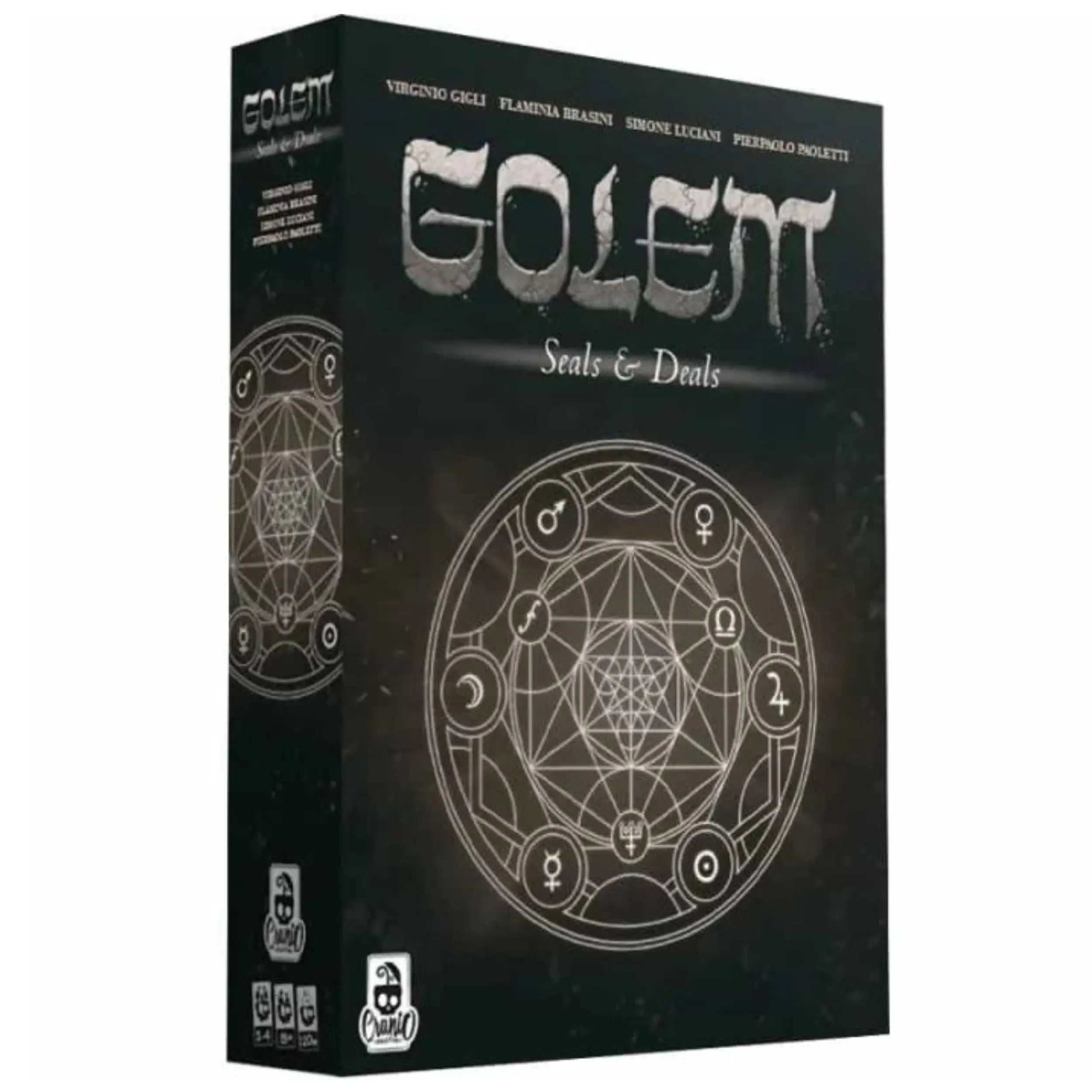
Golem - Seals & Deals
🐸 Dettagli da BoardGameGeek
Consiglio BGG sul numero di giocatori
Categorie
Meccaniche
Design & Art
Lingua
Pre-order - leggi i dettagli
🐸 Una rana saggia sa quando dividere l’ordine… e quando aspettare il salto giusto.

Pairs well with
FroGames — Moments You'll Remember
A Golem stops on a Mechanism. You take the token, open a Quest. Then you look at the accumulated debts and realize that the Pacts gave you power but are now strangling you. And the round isn't even over yet.
WHAT IT'S ABOUT
Two modules that push Golem beyond the boundaries of the base game
Seals & Deals is a modular expansion for Golem designed by the quartet Flaminia Brasini, Virginio Gigli, Simone Luciani, and Pierpaolo Paoletti. Illustrated by Klemens Franz and published by Cranio Creations, it introduces two separate systems that amplify the strategic tension of Renaissance Prague: the Mechanisms with Seals and the Trade Pacts with debts. You can play with only one of the two modules or combine both for an even more layered experience.
The Seals module adds nine Mechanism tokens to the Masters' tracks, three decks of colored Quests, and Neutral Golems that anyone can activate by paying an extra cost. The Deals module brings three new Characters, twelve unprecedented Books, eighteen District tiles, and most importantly, forty-five Trade Pacts distributed across three levels of increasing power. Each Pact gives you a permanent advantage but accumulates Debt tokens according to its level. Each round, in Phase 8, you repay the debts or suffer increasing penalties in victory points. Two different directions for the same result: more decisions, more pressure, more ramifications at the table.
What they say abroad
Seals & Deals isn't just additional content. It's the answer to the question: what happens if Golem becomes even more intricate?
— FroGames
Trade Pacts turn every advantage into a deal with the devil. And debts don't forget.
— FroGames

Golem: Seals & Deals
FrogScore · FroGames editorial rating · based on rules, international reviews, and play sessionsWhat the expansion adds
The new elements on the table
Mechanism Tokens
Nine tokens placed on the Masters' tracks. When you land on a space with a Mechanism, you take it (worth 2 points at the end of the game) and unlock a Quest of the corresponding color. Three colors, three decks, three new strategic trajectories.
Quest Cards
Quests that can be completed during Golem activation, like Workshops, but with a key rule: the Golem must be on a space of equal or higher height than the Quest (not necessarily in the same location). You pay resources or gold, place a cube from your Quest board on the card.
Neutral Golems
They all move together during the movement phase. Anyone can activate them by paying an additional cost, but only one per turn. They add flexibility but also competition: if an opponent activates it before you, your plan fails.
Trade Pacts
Forty-five cards divided into three levels. Each player drafts six Pacts (two per level) and plays one in front of them, accumulating Debt tokens according to the level. Pacts provide powerful permanent effects. Each round, Phase 8: repay debts or lose victory points with increasing penalties. Higher level means more debt, more risk.
Recommended Sleeves 105 cards in 1 size ▼
If you play often, we recommend protecting your cards with clear sleeves to make them last longer.
| Size | Quantity |
|---|---|
| 44 × 68 mm | 105 |
| Total cards | 105 |
At the end of the game, you count your points and realize that level 3 Pact helped you win three rounds but then cost you twelve points in the last two. Golem: Seals & Deals.
Come si gioca
Video dimostrativo di gameplay.
A five-moment game
What happens at the table
Not the rules. The experience.
The Deal draft
If you play with the Deals module, the game begins with a draft. Six cards per player, two per level. You choose one to play immediately, take the debts, and understand that this card will influence your entire game. The others observe your choice and begin to calculate.
The first Mechanism falls
Someone moves a Scholar onto a space with a Mechanism token. They take it, opening a colored Mission below the board. Suddenly there's a new objective on the table, a new resource to pursue. The others must decide: do I pursue it too, or stick to my plan?
Debts start to bite
Phase 8, first round. You look at your Debt tokens. You can repay them by spending resources, or leave them there and lose victory points. For now, the penalty is low. You decide to risk another round. The player to your right, however, repays everything: they had a Level 1 Deal, you have a Level 3. They sleep soundly, you don't.
Contested Neutral Golems
Everyone wants to activate the same Neutral Golem. Someone pays the extra cost and uses it first. Your turn is skipped, you have to fall back on another Golem, perhaps one of your own but in a worse position. You realize that Neutral Golems are not a common resource: they are a soft but constant battlefield.
The final reckoning
End of game. You count points from completed Missions, collected Mechanisms, and played Deals. Then you subtract penalties for unpaid debts. Someone who seemed behind catches up because they managed debts with surgical precision. You won three rounds, but accumulated debt crippled you in the last two. The game is decided there.
How to play
The flow of each round (with the expansion)
Seals & Deals doesn't change the structure of the base Golem round. It adds layers within existing phases.
Scholars move on their tracks. If they pass over a space with a Mechanism, the player takes the token and activates a colored Mission. Neutral Golems all move together according to the Seals module rules.
Each player activates their Golems. During activation, they can complete Missions if the Golem is on a space of adequate height (by paying the indicated cost). They can also activate one Neutral Golem per turn, by paying an additional cost.
Played Deals provide permanent effects that modify your actions, your income, your conversions. Each active Deal influences how you play the turn. No specific actions for Deals: they are passive engines always running.
At the end of the round, you can repay your debts by paying the cost indicated on the tokens. Any unpaid debt remains on the table and accumulates increasing victory point penalties. The more rounds pass, the more expensive the debt becomes. You decide what to sacrifice: resources now or points later.
Why it's different from others
Six mechanics that make a difference
Mechanisms as strategic triggers
The nine Mechanisms are not simple bonuses. They are triggers that open new Missions on the board. Taking them is not automatic: you must plan your Scholars' movement to get there before others. Each Mechanism taken changes the strategic landscape for everyone.
Two-track Missions
Missions work like Workshops but with a key rule: the Golem must be at an equal or greater height than the Mission. It's not necessary to be in the same space, just high enough. This opens up tactical possibilities that didn't exist in the base game: completing objectives remotely if you've built vertically.
Shared but limited Neutral Golems
Neutral Golems belong to everyone and no one. Anyone can activate them by paying an extra cost, but only one per turn. If someone uses it before you, your plan is foiled. It's not direct interaction like blocking, but it creates constant indirect tension: you must always have a backup plan.
Trade Deals as a risky initial choice
The Deal draft is a mini-game within the game. You choose a Deal to play immediately, take the corresponding debts, and that card becomes your permanent engine. Level 3 Deals are very powerful but accumulate heavy debts. Level 1 Deals are safe but less impactful. The choice influences the rest of the game.
Debt system with increasing penalties
Unpaid debts don't block you. They deduct victory points with penalties that increase each round. At first they seem manageable, then they start to bite. You have to decide when to repay: too early and you waste resources, too late and the point cost becomes unsustainable. There's no universal right moment: it depends on your economy and your timing.
Real, not cosmetic, modularity
You can play only Seals, only Deals, or both. It's not an aesthetic choice: each module changes the strategic weight of the game. Seals adds vertical layers (Missions, height, Neutral Golems). Deals adds economic pressure and long-term choices with the debt system. Together they create a layered experience that requires planning on multiple fronts simultaneously.
How it ends
How to win and how to lose
Seals & Deals doesn't change the victory conditions of base Golem, but adds new sources of points and new penalties.
Additional point sources
- Each Mechanism token collected is worth 2 victory points at the end of the game
- Completed Missions award points according to the card (typically 3-6 points per Mission)
- Played Trade Deals can provide direct points or multipliers (depends on the specific Deal)
Penalties and risks
- Each unpaid Debt token deducts victory points with increasing penalties per round (e.g., -1 in the first round, -2 in the second, -3 in the third, etc.)
- If you accumulate too many debts and cannot repay them, they can nullify the advantages gained from the Deals themselves
- Ignoring Missions means leaving easy points for opponents, especially if they control the Mechanisms
Victory goes to those who manage to balance vertical expansion (Missions and height) with economic risk management (debts and Deals). Golem: Seals & Deals rewards those who plan long-term but know when to hold back.
Frequently Asked Questions
FAQ about Golem: Seals & Deals
Can I play only one of the two modules, or do I have to use both?
You can play only Seals, only Deals, or both together. Each module is completely independent. Seals adds Mechanisms, colored Missions, and Neutral Golems. Deals adds Trade Deals, debts, new Characters, and new Districts. The modularity is real: choose based on how much you want to layer the experience.
Can Neutral Golems be activated multiple times in the same turn?
No. Each player can activate a maximum of one Neutral Golem per turn, by paying an additional cost. If someone activates it before you, you must fall back on another Golem (your own or another Neutral, if still available). This creates indirect competition without completely blocking others' actions.
What happens if I never repay my debts?
Unpaid debts remain on the table and accumulate increasing victory point penalties each round. The longer you wait, the more the penalty increases (e.g., -1 in the first round, -2 in the second, -3 in the third, etc.). If you accumulate too many debts, the penalties can outweigh the advantages gained from the Deals. You must balance: repaying them costs resources now, ignoring them costs points later.
Do Missions work like the Workshops in the base game?
Yes, but with a key difference: the Golem must be on a space of equal or greater height than the Mission, not necessarily in the same location. This means that if you build vertically, you can complete Missions remotely. You pay the indicated cost (resources or gold), place a cube from your Mission board onto the card, and earn points at the end of the game.
Is this expansion available in Italian?
Yes, the edition sold on FroGames is in Italian, published by Cranio Creations. It includes all translated components: Mission cards, Trade Deals, Characters, Districts, and complete rulebook. It requires the base Golem game to play.
Golem: Seals & Deals is a modular expansion for the base game Golem, designed by Flaminia Brasini, Virginio Gigli, Simone Luciani, and Pierpaolo Paoletti, published by Cranio Creations. It introduces two modules that can be played separately or together: Seals (Mechanisms, colored Missions, Neutral Golems) and Deals (Trade Deals with a debt system). For 2-4 players, duration 90-120 minutes, ages 14+. Mechanics: worker placement with Golems, action drafting, set collection, resource and debt management. Includes 105 cards (44x68mm), Mechanism tokens, Debt tokens, new Characters, and Districts. Available in Italian on FroGames.it.
Golem - Seals & Deals
Frequently Asked Questions
The answers you're looking for, no beating around the bush.
📸Do the images match the actual product?
The photos on the website often come from BoardGameGeek and are intended to give you an idea of the game. They may vary slightly from the version you receive. The content declared by the publisher is always binding.
📦Does the content of the box match what is indicated?
We always strive to provide the correct content, but minor variations are possible due to reprints or updates. The information comes directly from the publishers. If you have any questions, please contact us!
⏳How do pre-orders work?
Pre-order the game before release, payment is immediate, and the game is reserved for you. As soon as it arrives, we'll ship it right away! If there are any delays, we'll update you promptly.
🔒Can I trust buying here?
Absolutely! Secure payments, tracked shipments, and a team that loves board games as much as you do. If something goes wrong, we'll do our best to fix it.
🛠There's a problem with my order, what should I do?
Write to us now! Whether it's a missing part, damage, or an error, we'll help you resolve it as soon as possible. Your experience truly matters to us.