

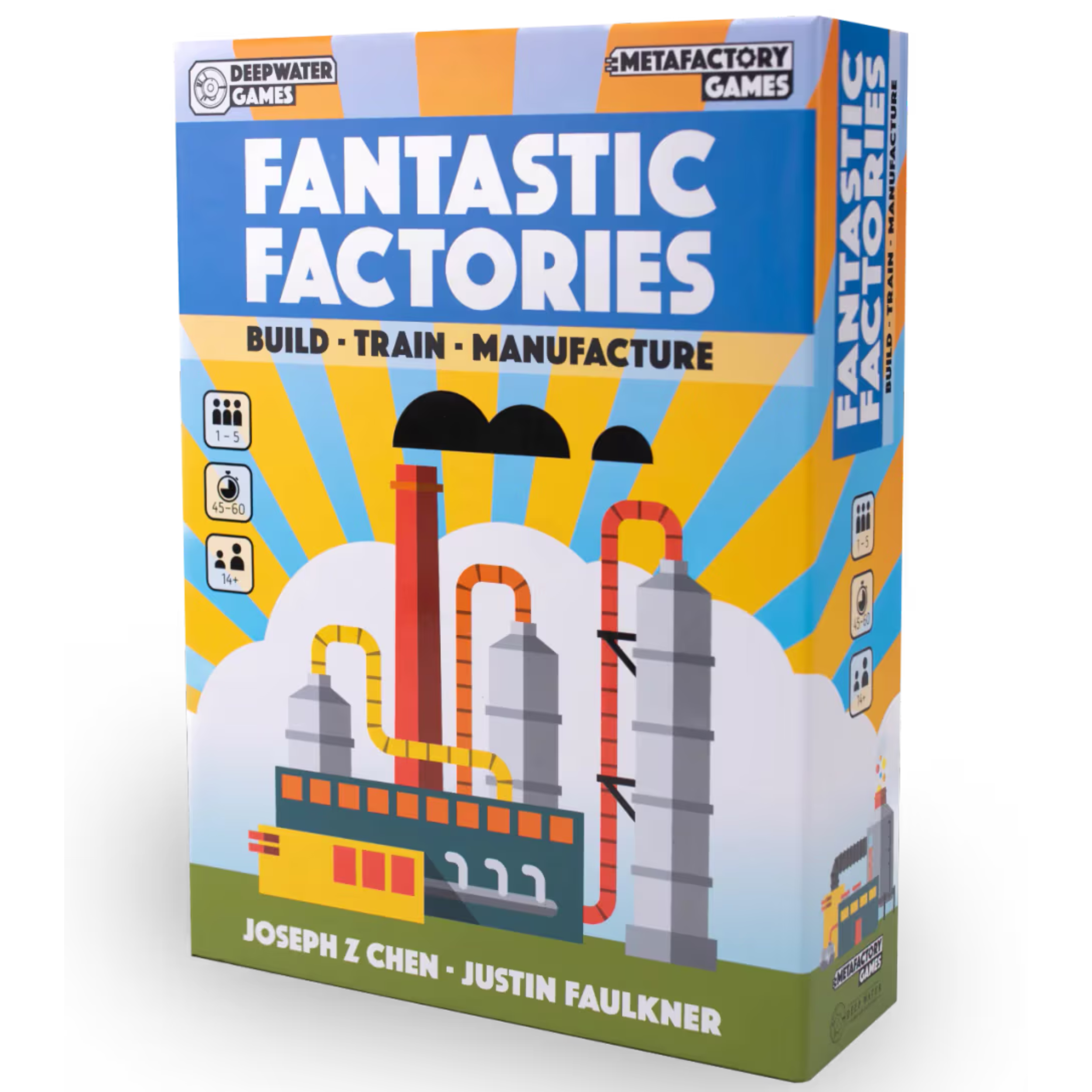
Fantastic Factories
🐸 Dettagli da BoardGameGeek
Consiglio BGG sul numero di giocatori
Categorie
Meccaniche
Design & Art
Lingua
Pairs well with
FroGames — Moments You'll Remember
When the game ends, everyone looks at their production chain and thinks: I could have done better. And next time, they will. That's the kind of game Fantastic Factories leaves on the table.
WHAT IT'S ABOUT
A race for industrial efficiency where dice are workers
Designed by Joseph Z. Chen and Justin Faulkner, Fantastic Factories is an engine-building game released in 2019 that brings a brilliant formula: dice aren't blind luck, they're workers to be placed. Chen also did the illustrations, creating a clean and functional industrial setting.
Each round you build factories, roll dice, and use the results as workers to activate your structures. The game is simultaneous: everyone plays at the same time, transforming each turn into an optimization puzzle. The first to reach 12 goods produced or 10 buildings built wins, but the prestige of the buildings also counts.
What they say abroad
"Every turn is a unique optimization puzzle"
Every turn is a unique optimization puzzle
— Meeple Mountain
A race that waits for no one. While others build their production chain, you must be faster, more efficient, more cunning. And when someone reaches the finish line, your perfect engine only counts if you were on time.
— FroGames

Fantastic Factories
The game includes an official solo mode with official puzzles created by the community and tools to generate new ones. The experience is complete and challenging, but it loses the competitive race against other players that characterizes multiplayer.
FrogScore · FroGames editorial rating · based on rules, international reviews, and gameplay sessionsThe gears of your factory
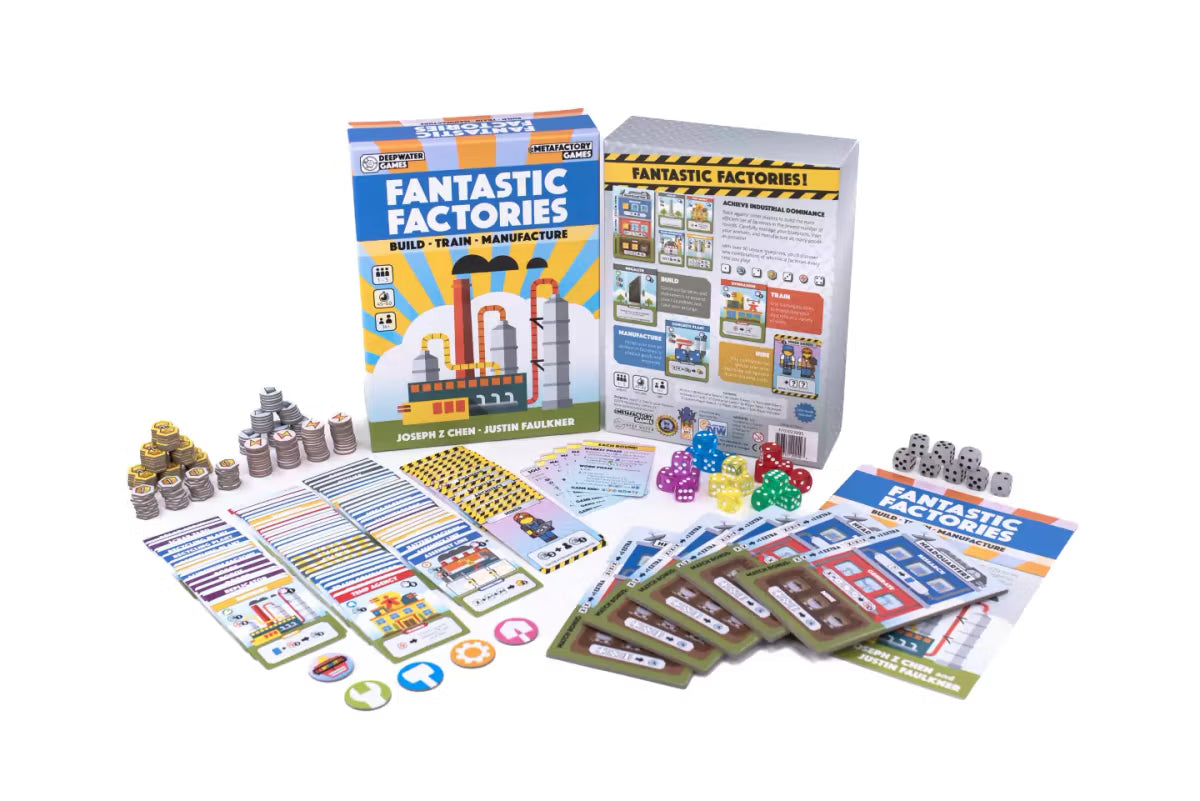
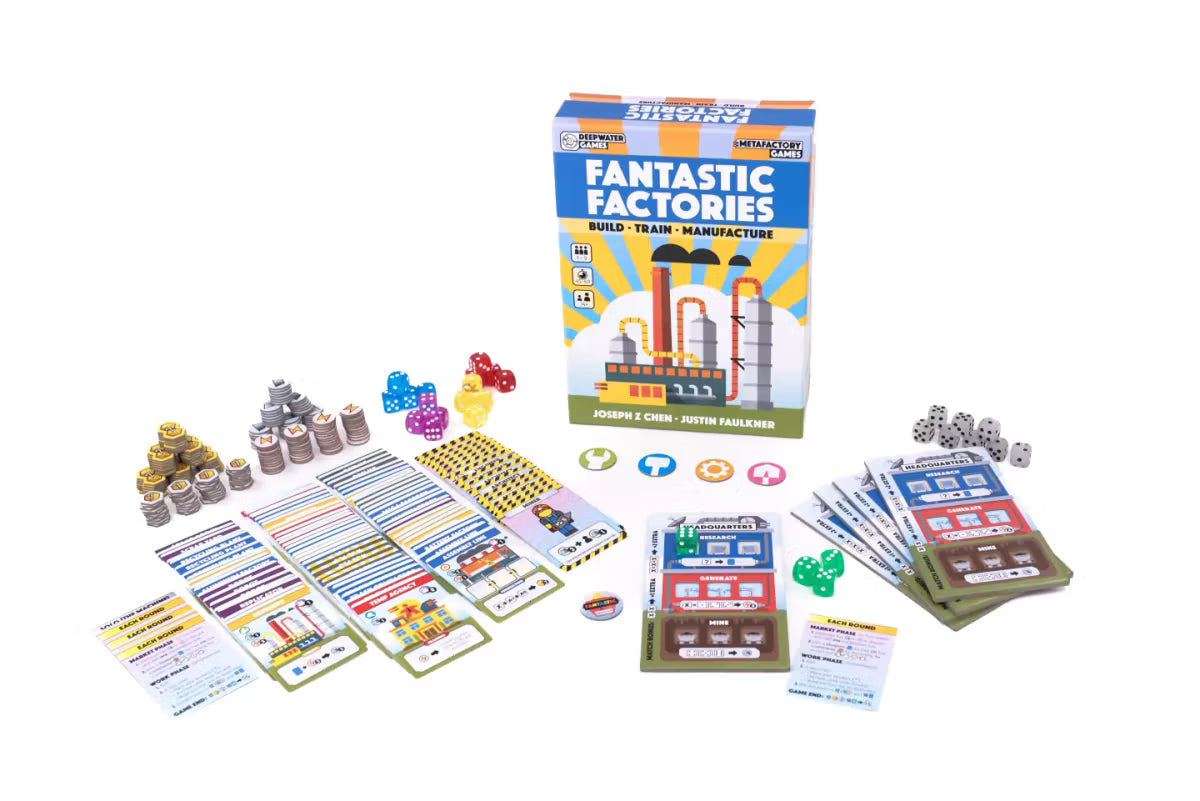
What you find in the box
Blueprint cards
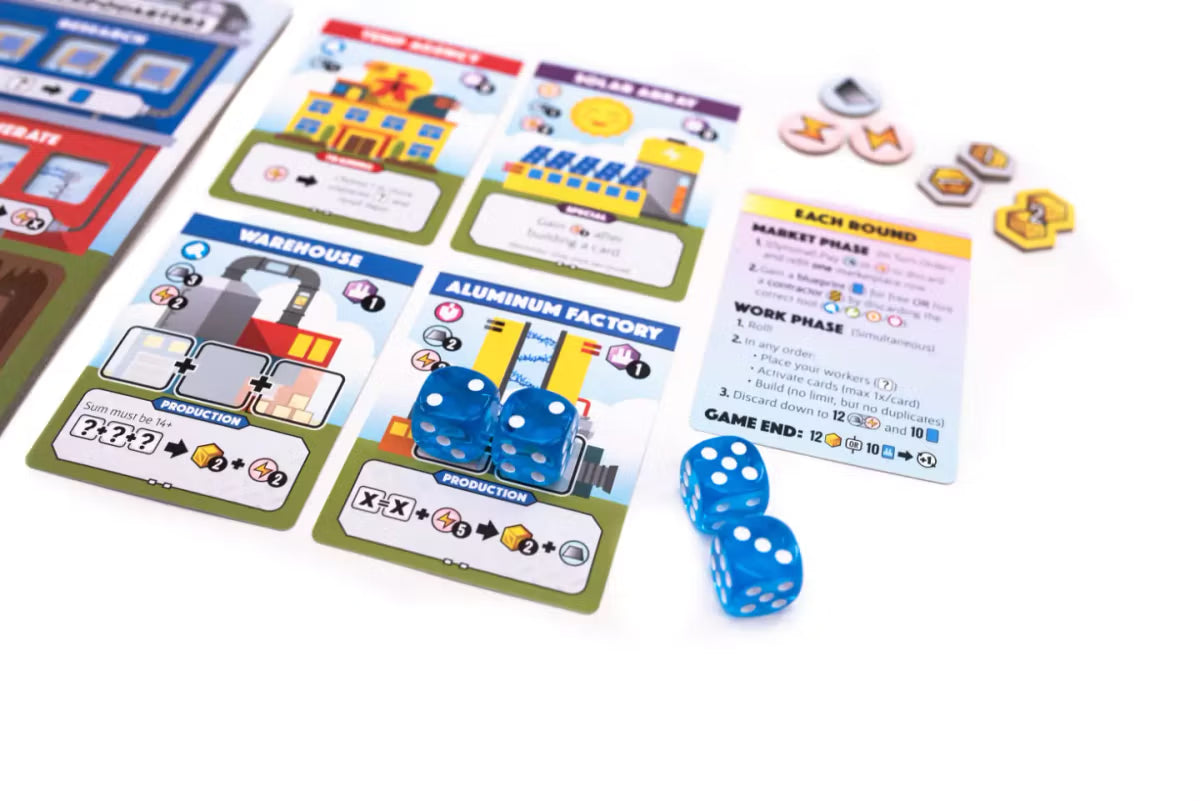
Over 30 different buildings: factories, warehouses, training facilities. Each game you build a unique engine by drafting from the market.
Worker dice
Each player rolls their dice and uses the results as workers. A 4 activates factories that require a 4, but you can manipulate the values with training.
Contractor cards
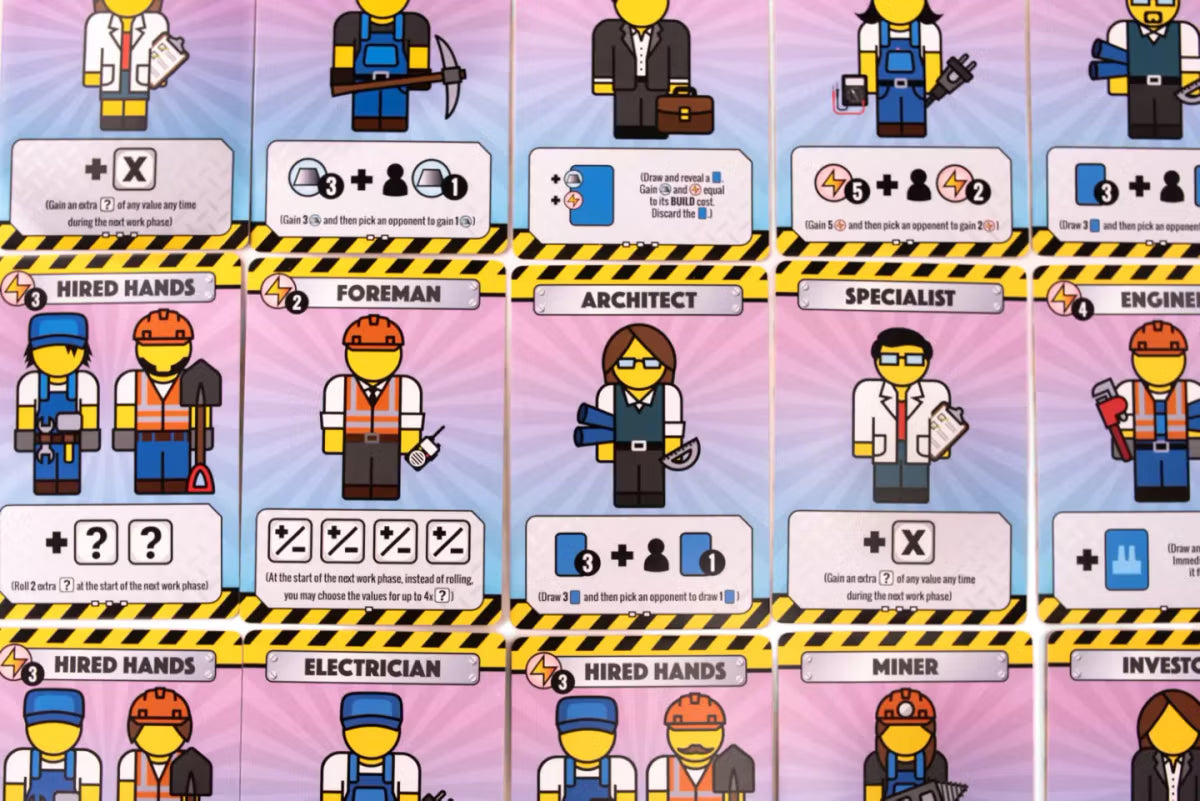
Special workers to hire during the market phase. They provide immediate resources or additional dice to speed up production.
Goods tokens
The goods you produce. Reaching 12 goods is a victory condition, but the prestige of the built buildings also counts towards the final score.
Recommended sleeves 97 cards in 1 size ▼
If you play often, we recommend protecting cards with clear sleeves to make them last longer.
| Size | Quantity |
|---|---|
| 64 × 89 mm | 97 |
| Total cards | 97 |
At the end of the game you look at your production chain and see where you could have optimized. Next time you will. It always happens with Fantastic Factories.
Come si gioca
Video dimostrativo di gameplay.
A game in five moments
What happens at the table
Not the rules. The experience.
The first blueprint
Everyone draws their starting cards and chooses what to build. Some focus on quick factories, others on prestigious buildings. There's no dominant strategy, and this is evident from the first turn.
The first bad roll
You roll the dice, look at the results, and realize you don't have the 3 you needed. Someone uses a training facility to adjust their roll, someone else quietly curses. Perfect planning clashes with the chaos of the dice.
The chain ignites
Your factory starts working: you activate a building, produce a resource, and use it to build another. This is the moment when you see the engine running and understand where you're going. Others do the same, simultaneously.
Someone is close
One player already has 10 goods produced. Another has 8 buildings constructed. The game is ending and you have to decide: do you push for production or build prestigious buildings for final points? The choice is yours, time is not.
Last round
Someone has reached the victory condition. One last turn is played, then points are tallied: goods produced plus building prestige. Whoever built best wins, not just whoever was fastest.
How to play
The flow of each round
Each round is divided into two distinct phases: market (buy blueprints or contractors) and work (play simultaneously with dice).
Choose whether to take a free blueprint from the market or pay to hire a contractor. Blueprints become factories, contractors give you resources or extra dice.
Everyone rolls their dice simultaneously. The results become your workers for this turn. You can manipulate the values with training facilities if you have built any.
Use the dice as workers to activate your factories. Each factory can be used once per turn. The activation sequence is free: finding the optimal order is the puzzle.
If someone has reached 12 goods produced or 10 buildings constructed, the game ends at the end of the next round. Otherwise, it restarts from the market phase.
Why it's different from others
Six mechanics that make a difference
Dice as workers, not as luck
Dice don't decide if you win or lose. They decide which workers you have available this turn. A 6 isn't better than a 2: it depends on which factories you've built. And you can manipulate the results with training facilities.
Simultaneous play
During the work phase, everyone plays simultaneously. Zero downtime, zero waiting. While others solve their puzzle, you solve yours. The game flows fast, even with 5 players.
Over 30 unique blueprints
Each game, the market offers different blueprints. Factories that produce resources, warehouses that multiply output, training facilities that modify dice. Synergies change every time, and discovering them is half the fun.
Cascading production chains
The magic of the game is finding the perfect sequence: you activate a factory, produce a resource, use it to build a building, which in turn generates more. When the chain works, it's pure satisfaction.
Two victory conditions
You can aim for fast production (12 goods) or for prestigious buildings (10 constructions). But whoever truly wins is the one who balances both: when the game ends, goods AND building prestige are counted.
Official puzzles for solo play
The game includes a vast collection of community-created puzzles and tools to generate new ones. The solo mode is well-designed, not improvised.
How it ends
How to win and how to lose
The game ends when a player reaches one of the two victory conditions. One last round is played, and points are tallied.
Victory
- Reach 12 goods produced (triggers the end, but doesn't guarantee victory)
- Build 10 buildings (triggers the end, but doesn't guarantee victory)
- Have the highest score in the final tally: goods produced + prestige of constructed buildings
How to lose
- Build a slow engine: others finish the game before you can produce enough
- Focus only on goods without prestige: you reach 12 goods but in the final tally, others' buildings are worth more
- Ignore synergies between blueprints: without an efficient production chain, you waste precious turns
Fantastic Factories is the game where building the perfect engine isn't enough if you're not also fast. And where every game teaches you a new production chain.
Frequently asked questions
FAQ about Fantastic Factories
Is it suitable for those who have never played an engine-building game?
Yes. The rules can be explained in 10 minutes and the first game gets going right away. The depth emerges later, when you start to see the synergies between blueprints. It's an excellent gateway to more complex engine builders.
How much does dice luck matter?
Less than it seems. Dice give you workers with random values, but you choose which factories to build to utilize them. And you can manipulate the results with training facilities. Planning always beats a lucky roll.
Does it work well with 5 players?
Yes, because the game is simultaneous. During the work phase, everyone plays together, so there's no downtime. Game time remains between 45 and 60 minutes even with the maximum number of players.
Is the solo mode robust?
Very. The game includes official puzzles created by the community and tools to generate new ones. It's not an improvised automa: it's a mode designed to offer different challenges. Perfect for those looking for a puzzle to solve.
Is it available in Italian?
This edition is in English. The text on the cards is present (building names, effects, conditions), so a basic knowledge of English is necessary to play independently.
Fantastic Factories is a strategy and engine-building game for 1-5 players designed by Joseph Z. Chen and Justin Faulkner. Each game lasts 45-60 minutes and is suitable for ages 14 and up. The game uses worker placement with dice: dice results become workers to place to activate factories, produce goods, and build new buildings. With over 30 unique blueprints and mechanics of drafting, tableau building, and simultaneous play, Fantastic Factories offers high replayability and a well-developed official solo mode. Published by Friendly Skeleton, it's a perfect gateway to more complex engine builders. Available on FroGames.it.
Fantastic Factories
Frequently Asked Questions
The answers you're looking for, no beating around the bush.
📸Do the images match the actual product?
The photos on the website often come from BoardGameGeek and are intended to give you an idea of the game. They may vary slightly from the version you receive. The content declared by the publisher is always binding.
📦Does the content of the box match what is indicated?
We always strive to provide the correct content, but minor variations are possible due to reprints or updates. The information comes directly from the publishers. If you have any questions, please contact us!
⏳How do pre-orders work?
Pre-order the game before release, payment is immediate, and the game is reserved for you. As soon as it arrives, we'll ship it right away! If there are any delays, we'll update you promptly.
🔒Can I trust buying here?
Absolutely! Secure payments, tracked shipments, and a team that loves board games as much as you do. If something goes wrong, we'll do our best to fix it.
🛠There's a problem with my order, what should I do?
Write to us now! Whether it's a missing part, damage, or an error, we'll help you resolve it as soon as possible. Your experience truly matters to us.