

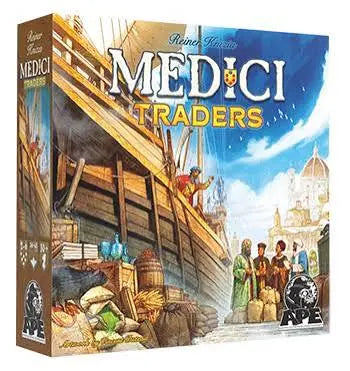

Medici Traders
🐸 Dettagli da BoardGameGeek
Consiglio BGG sul numero di giocatori
Categorie
Meccaniche
Design & Art
Lingua
Pre-order - leggi i dettagli
🐸 Una rana saggia sa quando dividere l’ordine… e quando aspettare il salto giusto.
Si abbina bene con
The FroGames Board
You have three tiles on your tray. Two spices, one silk. Worth eight florins, maybe nine. The others have revealed their trays. Someone has gold. You place two florins on your tray to defend it. Then you look at the others and realize someone will steal everything from you.
WHAT IT'S ABOUT
A new tile-based version of Knizia's classic
Medici Traders is the latest variant of Reiner Knizia's renowned auction game series, set in 15th-century Florence. Unlike the classic card-based Medici, this edition introduces commodity tiles to be drawn, stacked, and claimed through simultaneous auction mechanics. The illustrations are by Vincent Dutrait, the same artist who worked on previous editions of the game.
On your turn, you draw up to three tiles and place them on your tray, then all players reveal their trays simultaneously. At that point, the claiming phase begins: you can choose a tray from the center of the table or snatch another player's tray by adding more florins than they did. The outbid player takes back their florins and chooses again. The acquired goods are loaded onto the ship, arranged on multiple levels representing days of trade. At the end of each day, scores are tallied: whoever has the most valuable cargo and whoever dominates each type of goods earns points. Florins spent on auctions are lost forever, and whoever has the most at the end of the third day wins the game.
What they say abroad
"easy to learn, fast to play, highly interactive, and exceptionally engaging"
easy to learn, fast to play, highly interactive, and exceptionally engaging
— APE Games
Traders has just been released and the first games are starting to hit tables. It's Knizia's promise applied to a tile system: fast auctions, timing tension, continuous decisions on when to defend and when to steal. This page will be updated when we gather more feedback from the field.
— FroGames

Medici Traders
FrogScore · FroGames editorial rating · first reading: based on rules and official presentation, updated with initial playthroughsThe elements in play
What you'll find in the Traders box
Commodity Tiles
Fabrics, spices, grain, furs, dyes, and gold. Each tile has a value and a type. You stack them on the ship, creating visible cargo for everyone, level by level.
Multi-deck Ships
Each player has a ship with spaces for seven tiles divided into three levels (one per day) and an upper deck for special goods. The vertical structure is the novelty of Traders.
Florins
They are simultaneously auction currency and victory points. You use them to defend your trays or steal others'. At the end of the game, whoever has the most wins.
Trays
Each player has a tray where they place up to three newly drawn tiles, then move it to the center of the table. That's where the battle to claim them begins.
🎲How to playThe rules in four steps▼
How to play
The flow of each round
Every day the same cycle repeats: draw, reveal, claim, load. Three days and you're home.
You draw one to three goods tiles and place them on your tray. You can stop earlier if what you've drawn is enough for you. Once decided, you move your tray to the center of the table.
All trays are now visible. The first player chooses a tray from the center (or snatches someone else's) and places florins on it to defend it. Others do the same: you can take an empty tray or outbid someone who already has one, returning their florins.
When everyone has a tray, the florins used to claim go to the bank (lost forever) and you load the tiles onto your ship, stacking them on the current day's level or on the upper deck if you have space.
At the end of the day, you receive florins based on the total value of that day's cargo (whoever has the most valuable cargo earns the most). Then points are awarded for each type of good: whoever has the most of it on their ship earns extra florins.
⏱️Your first gameThe chronicle, moment by moment▼
A game in five moments
What happens at the table
Not the rules. The experience.
First trays on the table
You draw two tiles. Grain and spices, total value four. Not bad. You watch others reveal: someone drew three tiles for one, someone has gold. Mental calculations start immediately: how much is it worth defending your tray? How much does it cost to snatch the one with gold?
The first snatch
You place three florins on your tray. Secure. Then another player places five on the one with gold. You take your three florins back and aim for a different, less coveted tray. The musical chairs game has begun: each round someone is left with something they didn't really want.
Ships filling up
Second day. Ships begin to take shape, level by level. Whoever dominated spices on the first day must now defend them: if someone else collects more spices than you, you lose the bonus points. Every tile that enters play changes the balance of power.
Florins run out
Third day, last tiles. You spent too much in the first auctions and now you find yourself with few florins to defend a valuable tray. Someone snatches it from you for two coins. You take your florins back and settle for the scraps. The game is decided here.
End of the fair
Final score. You count the remaining florins, add bonuses for the most loaded ships and monopolies on goods. Whoever spent little in auctions has more base points, but whoever dominated a type of good gains ground. Wins by two florins. Someone remembers that tile let go on the second day.
🐸Good to know beforehandThree honest things, from friends▼
Good to know beforehand
Three honest things about Traders
Florins are also victory points
Every coin you spend to claim a tray is a coin you won't have at the end. There's no separate budget for auctions: if you bid too much for an eight-point cargo and spend seven, you've made a terrible deal. This mechanism punishes those who don't know when to stop and rewards those who can recognize real value.
Card counting is a real advantage
There are tiles from 0 to 5 for each type of good, plus a gold tile worth 10. If you remember which ones have already come out, you can better estimate the probability of high-value tiles appearing in subsequent rounds. It's not mandatory, but those who keep track will have a tactical edge over more distracted players.
With 5-6 players, times get longer
The box says 30-45 minutes, but with six people at the table, the claiming phases become more complicated: more trays, more snatching, more calculations. The first game can reach an hour. If you're looking for a very quick filler, play it with three or four.
🏆Victory and defeatWhat the end rewards▼
How it ends
How to win
At the end of the third day, whoever has the most florins wins. Period.
Victory
- You have more florins than everyone else at the end of the third day (those remaining after auctions, plus those earned from scores)
- You dominated one or two types of goods throughout the game, earning consistent bonuses at the end of the day
- You spent little in auctions and claimed high-value cargo, maximizing the cost-benefit ratio
Defeat
- You spent too many florins in initial auctions and reached the third day without liquidity to compete
- You gambled everything on one type of good but someone else surpassed you on the last day, losing bonuses
- You filled your ship with low-value cargo because you settled for scraps instead of defending good trays
The beauty of Traders lies in the simultaneous twist: everyone draws, everyone reveals, everyone snatches. You don't wait for your turn. You're always in it.
💬Frequently Asked QuestionsQuick answers before checkout▼
Frequently Asked Questions
Medici Traders FAQ
What mechanics does Medici Traders use?
Simultaneous auction system with tray claiming, set collection for goods types, resource management (florins are both auction currency and victory points), stacking tiles on multi-level ships. The core mechanics are auction/bidding, income, set collection, and victory points as a resource.
Is it different from classic Medici?
Yes. The original Medici uses cards and traditional sequential auctions. Traders introduces physical tiles to stack on vertical ships and a simultaneous auction system based on trays that you can steal by adding florins. The three-day structure and scoring system remain similar, but the gameplay is more direct and visual.
Does it work well with two players?
The box states 2-6 players. It probably works with two, but Knizia auction games are best with 3-4 people: more bidders, more competition, more bluffing. With two, you risk it becoming a pure mathematical calculation without the psychology that makes Medici a classic.
How long does a game actually last?
The box says 30-45 minutes. With three experienced players, you can stay within that. With six players in the first game, expect 60 minutes or more: the claiming phase with many trays on the table slows everything down. After two or three games, it flows quickly even with six.
Is it available in Italian?
No, this edition by APE Games is in English. The game has very little text: the tiles are iconic (symbols of goods and numerical values), so language only affects the rulebook. If someone at the table reads English, you can play it without problems.
The people behind the game
Who invented it, who designed it, who publishes it — and what else they've done.
Medici Traders is a simultaneous auction board game designed by Reiner Knizia for 2-6 players, 30-45 minutes, recommended age 10+. Set in Renaissance Florence, the game uses goods tiles to stack on multi-level ships instead of the cards from classic Medici. Players draw tiles, place them on trays, and then claim them by adding florins, which are also the final victory points. Published by APE Games with illustrations by Vincent Dutrait, Traders combines auction/bidding, set collection, and resource management in a three-day structure. Available on FroGames.it.
Medici Traders
Frequently Asked Questions
The answers you're looking for, no beating around the bush.
📸Do the images match the actual product?
The photos on the website often come from BoardGameGeek and are intended to give you an idea of the game. They may vary slightly from the version you receive. The content declared by the publisher is always binding.
📦Does the content of the box match what is indicated?
We always strive to provide the correct content, but minor variations are possible due to reprints or updates. The information comes directly from the publishers. If you have any questions, please contact us!
⏳How do pre-orders work?
Pre-order the game before release, payment is immediate, and the game is reserved for you. As soon as it arrives, we'll ship it right away! If there are any delays, we'll update you promptly.
🔒Can I trust buying here?
Absolutely! Secure payments, tracked shipments, and a team that loves board games as much as you do. If something goes wrong, we'll do our best to fix it.
🛠There's a problem with my order, what should I do?
Write to us now! Whether it's a missing part, damage, or an error, we'll help you resolve it as soon as possible. Your experience truly matters to us.