

Doctors - 2026
🐸 Dettagli da BoardGameGeek
Consiglio BGG sul numero di giocatori
Categorie
Meccaniche
Design & Art
Lingua
Pre-order - leggi i dettagli
🐸 Una rana saggia sa quando dividere l’ordine… e quando aspettare il salto giusto.
Si abbina bene con
The FroGames Board
Someone raises. You have the best cargo, but your hold is almost full. Passing means leaving gold on the table. Raising means risking not completing the set. And the bank keeps moving.
WHAT IT IS
Florentine merchants, three days of trading, only one winning family
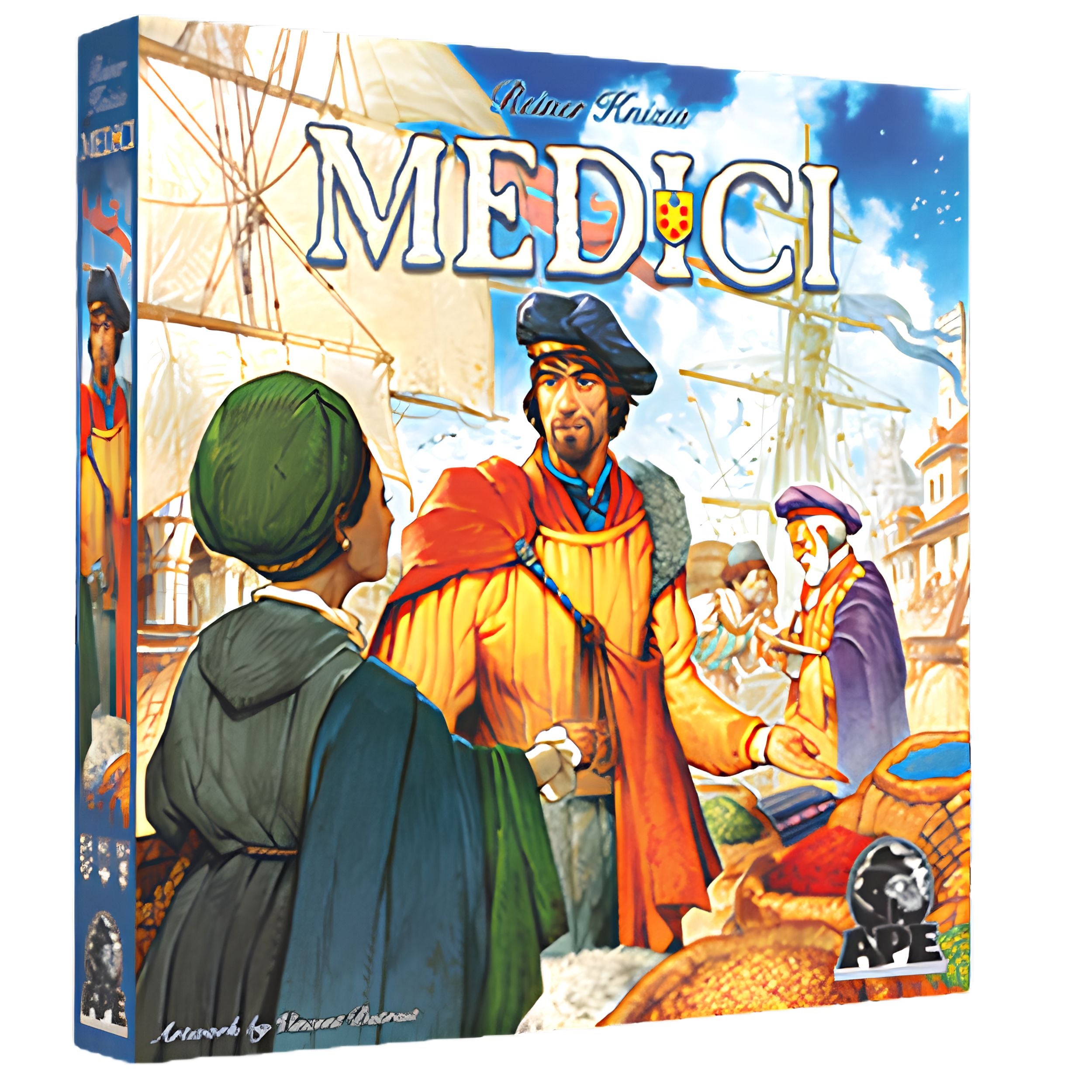
Reiner Knizia published Medici in 1995, the second chapter of his Florentine auction trilogy. The theme is that of great Renaissance merchants filling ships with precious goods: fabrics, spices, furs, grain, dyes. The setting evokes 15th-century Florence, but the mechanic is pure Knizia: elegant mathematics dressed as Mediterranean trade.
Each turn, the bank reveals one to three commodity cards. You decide whether to bid or pass. Whoever wins the auction takes everything and loads it onto their ship. When the ships are full or the deck is exhausted, the round ends: points for whoever has the most of each type of commodity, points for whoever has the most valuable cargo. Three rounds, then count. The problem is that your victory points ARE also your auction currency: each bid brings you closer to victory or depletes you for subsequent turns.
What they say abroad
"One of the best auction games ever designed."
One of the best auction games ever designed.
— The Opinionated Gamers
Medici is Renaissance geometry: sets, majorities, timing. Three rounds that seem simple until you actually try to win one.
— FroGames

Medici
FrogScore · FroGames.it editorial rating · based on rules, international reviews, and gameplay sessionsWhat's on the bank
The goods, the ships, the points that really matter
Commodity cards
Five types (fabrics, spices, furs, grain, dyes) in different quantities and values. Each card shows the type and a number from 0 to 5. The bank draws one, two, or three per lot. You bid on the total, not on a single card.
Player Ships
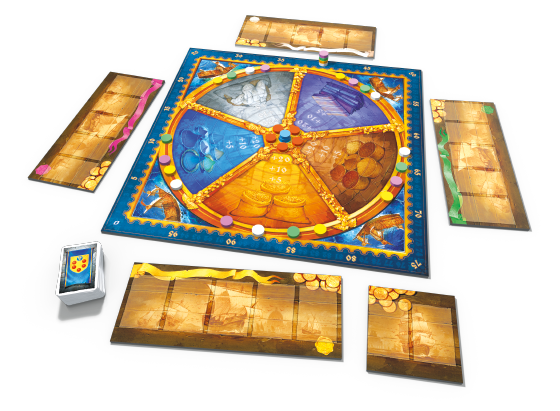
Everyone has a ship with five holds. Win an auction, load the cards. When the fifth hold is full, your round ends: you no longer bid, you wait for the others. Those who fill up first miss opportunities, those who wait too long risk an empty deck.
Majorities by type
At the end of the round, whoever has the most cards of a type gets points (30 for first, 20 for second, 10 for third). Five types, five parallel races. A mixed set leaves you out of all of them.
Total cargo value
Sum the numbers of your five cards. The most valuable cargo is worth 10 points, the second 5, the third zero. Here, quality counts: five cards of 5 beat five mixed cards, even if they win majorities.
Recommended sleeves 112 cards in 3 sizes ▼
If you play often, we recommend protecting your cards with transparent sleeves to make them last a long time.
| Size | Quantity |
|---|---|
| 46 × 68 mm | 40 |
| 56 × 87 mm | 36 |
| 44 × 68 mm | 36 |
| Total cards | 112 |
🎲How to playThe rules in four steps▼
How to play
The flow of each auction round
A round lasts thirty seconds. But within it are three game-changing decisions.
The active player (the dealer) draws a commodity card and reveals it. They can stop or draw up to three cards in total. The more cards they draw, the more the lot is worth (but the more they risk mixing different types and lowering interest).
Starting from the player to the dealer's left, everyone bids or passes. There is only one round: those who pass are out, those who bid must exceed the previous offer. The dealer can bid last (and take their own lot).
The winner pays the bid points (subtracted from their total), takes all cards in the lot, and loads them into the empty holds of their ship. When the fifth hold is full, their round ends: they can no longer bid until scoring.
The player to the left becomes the new dealer and draws. The round continues until everyone has filled their ships or the deck runs out. Then majorities and cargo are counted, points are tallied, and the game restarts. Three rounds, then the player with the most points wins.
⏱️Your first gamePlay-by-play, moment by moment▼
A game in five moments
What happens at the table
Not the rules. The experience.
First auctions, caution
The dealer turns over the first card. Wheat, value 3. No one bids high: it's early, the ship is empty, the deck is full. Someone takes the lot for cheap. Then two spices of 4 and 5 come out: that's where the war begins. The first round is for understanding who wants what.
Ships fill up
Halfway through the round: everyone has three cards in their hold, some have four. The dealer draws three dyes. Those who already have two dyes bid high (they want the majority), those whose ship is almost full pass. One player fills the fifth hold: their round ends, they wait patiently for the others to finish. From now on, every auction is worth double.
End of round, scoring
Everyone has filled their ships. Majorities are counted: furs to whoever has four, spices to whoever has three. Then values are added up: a cargo of 23 beats one of 19. Points are tallied. That sum is also your currency for the second round: those who won big can bid big, those who are behind must save.
Second and third rounds: choices matter
The deck shuffles, ships empty. But points remain: those ahead have more auction margin, those behind must play on lots others leave. The third round is always the most tense: every mistake costs victory. Someone passes on a lot of 12 because they can't afford it, someone takes it and closes the gap.
Final count, the detail that decides
Three rounds scored. Majorities, valuable cargo, all added up. Often the difference is five points: an auction won by too much, a majority lost by one card. Someone remembers exactly when they lost: that bid in the second round, that card let go. Medici does not forget.
🐸Good to know beforehandThree honest things, from friends▼
Good to know beforehand
Three things a friend would tell you
Every point you spend in an auction is a point you deduct from your final total. Bidding means betting that those cards are worth more than what you pay. Making two wrong bids in a row cuts you out of victory. It's the heart of the game, but also the learning curve: you lose the first few games by paying too much.
Drawing cards gives you information: you see what comes out before others, you decide how many cards to reveal, you bid last. In expert tables, being the dealer at the right moment can be worth a majority. But if you draw poorly and no one bids, you're forced to take the lot yourself: a double-edged sword.
Medici formally scales up to six players, but beyond four, the game slows down and reading the table becomes blurred. More players mean more cards in circulation, less predictability, dead time between your turns. The sweet spot is 3-4 players: enough interaction, enough control, games under an hour.
🏆Victory and defeatWhat the ending rewards▼
How it ends
How to win (and how to lose without realizing it)
After three rounds, points are tallied. But the game is decided much earlier, auction after auction.
Victory
- You won at least two majorities per type over three rounds (30+30+30 points just there)
- You built valuable cargo without depleting your auction budget
- You read the table: bid when others passed, passed when others burned points
Defeat
- You paid too much for mediocre lots: points spent in auction, zero majorities won
- You filled your ship too early and left the good cards for others at the end of the round
- You chased multiple majorities at once and didn't secure even one
Medici is mathematics dressed as the Renaissance: an auction that rewards those who count, who wait, who know when to grit their teeth and when to let go. Thirty years later, it still works.
💬Frequently asked questionsQuick answers before checkout▼
Frequently asked questions
FAQ about Medici
What mechanics does Medici use?
Once-around auction, set collection, controlled push-your-luck, variable income system (the points you earn become your budget for subsequent auctions). The core is the auction: you bid or pass, only one chance per turn.
Is it a game for those unfamiliar with auction games?
Yes, but with a caveat: you will lose your first two games. The points-as-currency system isn't intuitive: you need to play once to understand how much to pay. That said, the rules can be explained in ten minutes, and the flow is immediate. Great as a first Knizia game, less so as an absolute first board game.
How much does luck play a role in drawing cards?
Cards are random, but you decide whether to bid or pass on each lot. You leave a bad lot to others, you buy a good lot if you have the budget. Luck exists (sometimes three cards of the same type with a value of 5 come out), but Medici rewards those who can wait and who can read the pace of the deck.
With how many players does it work best?
Three or four. It formally scales to six but slows down too much, loses control, and extends playtime beyond an hour. A two-player official variant exists (Medici vs. Strozzi), but the base game shines with three to four players: enough competition for majorities, enough speed to maintain tension.
Is the edition for sale in Italian?
No, this edition is in English. The game is almost language-independent: commodity cards use symbols and numbers; the rules are read once. English is only needed for the initial rulebook and the labels for commodity types (which are colored icons anyway).
The people behind the game
Who invented it, who designed it, who publishes it — and what else they've done.
Medici is a competitive auction and set collection board game designed by Reiner Knizia, originally published in 1995 and now available in the Grail Games edition. For 2-6 players (ideal 3-4), duration 60 minutes, recommended age 10+. The points-as-currency system creates tension with every bid: every point spent in an auction is a point deducted from the final total. Three rounds of auctions for Renaissance goods, type majorities, valuable cargo. Mechanics: once-around auction, push-your-luck, variable income. A classic of the hobby that scales well, plays fast, and doesn't age. Available on FroGames.it.
Doctors - 2026
Frequently Asked Questions
The answers you're looking for, no beating around the bush.
📸Do the images match the actual product?
The photos on the website often come from BoardGameGeek and are intended to give you an idea of the game. They may vary slightly from the version you receive. The content declared by the publisher is always binding.
📦Does the content of the box match what is indicated?
We always strive to provide the correct content, but minor variations are possible due to reprints or updates. The information comes directly from the publishers. If you have any questions, please contact us!
⏳How do pre-orders work?
Pre-order the game before release, payment is immediate, and the game is reserved for you. As soon as it arrives, we'll ship it right away! If there are any delays, we'll update you promptly.
🔒Can I trust buying here?
Absolutely! Secure payments, tracked shipments, and a team that loves board games as much as you do. If something goes wrong, we'll do our best to fix it.
🛠There's a problem with my order, what should I do?
Write to us now! Whether it's a missing part, damage, or an error, we'll help you resolve it as soon as possible. Your experience truly matters to us.