

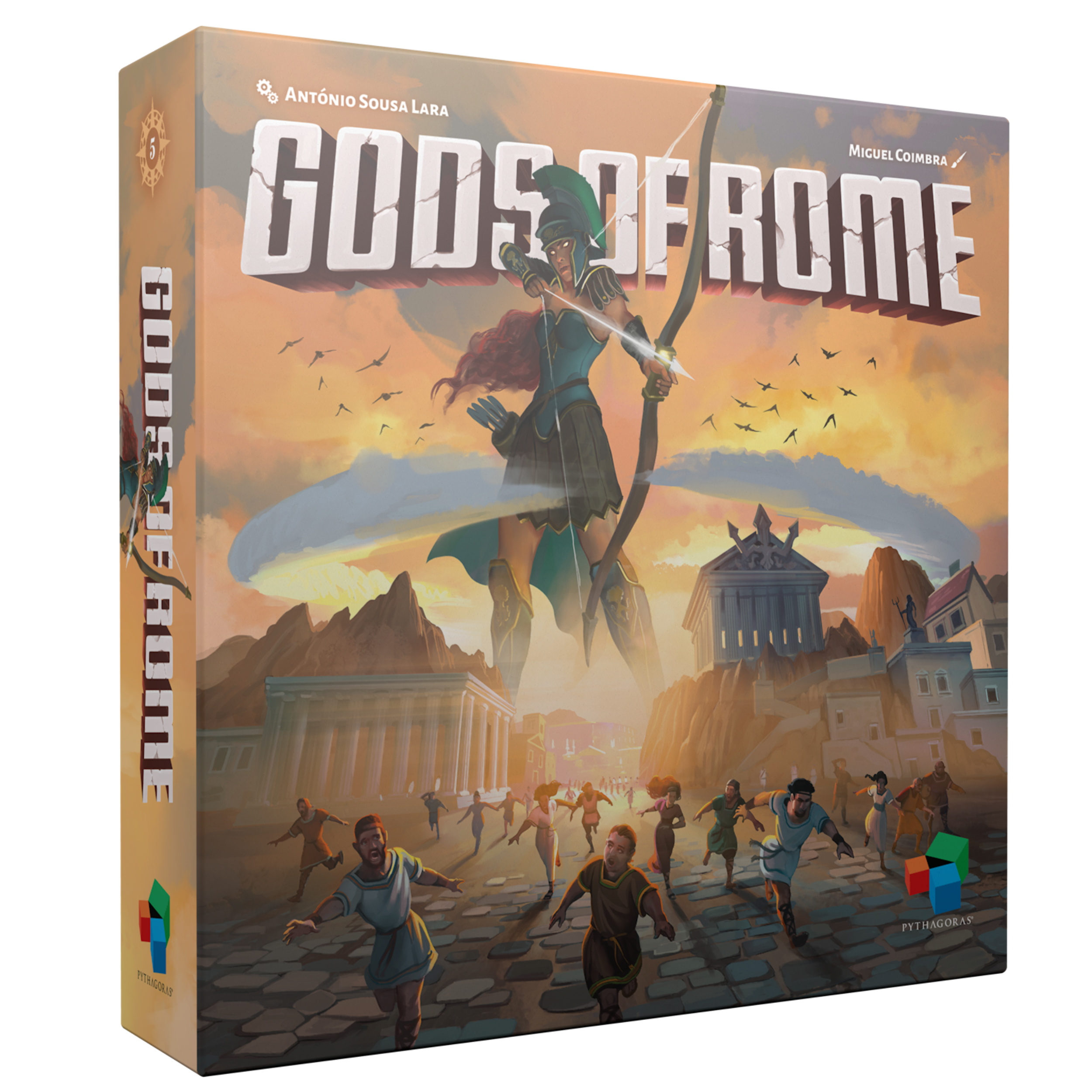
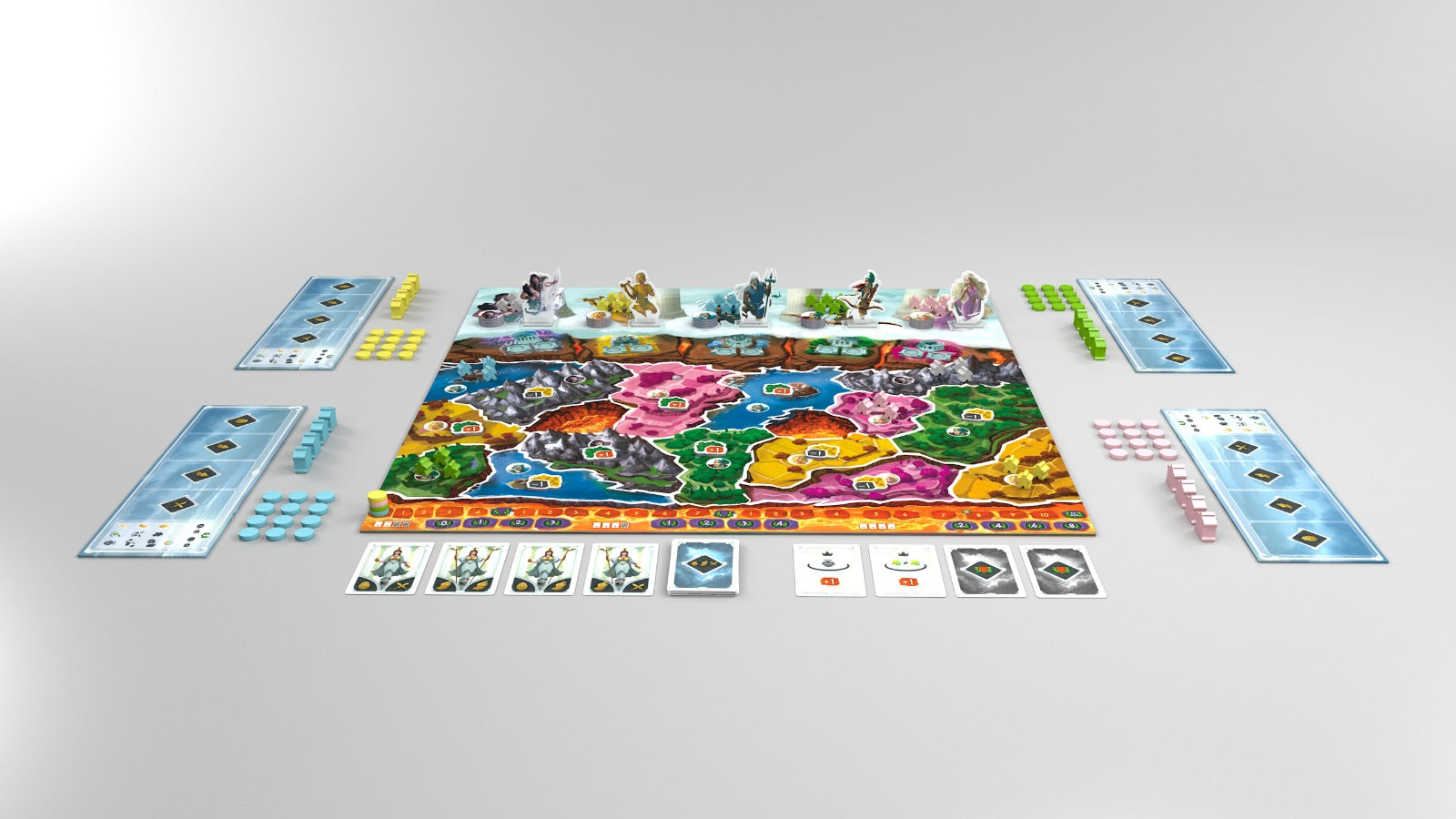
Gods of Rome
🐸 Dettagli da BoardGameGeek
Consiglio BGG sul numero di giocatori
Categorie
Meccaniche
Design & Art
Lingua
Pre-order - leggi i dettagli
🐸 Una rana saggia sa quando dividere l’ordine… e quando aspettare il salto giusto.



Si abbina bene con
The FroGames Card
You've just conquered three territories when someone triggers the checkpoint. Everyone scores. Your lead is cut in half. Next time, you'll decide when to trigger the count, and you'll do it at the worst possible moment for everyone else.
WHAT IT IS ABOUT
Rome is divided. Tribes seek divine favor to restore unity
Antonio Sousa Lara builds an area control eurogame set in early Rome, when tribes competed for the favor of the gods. Illustrations by Miguel Coimbra (7 Wonders, Cyclades) dress the game with a vibrant and layered Roman mythology.
On your turn, you choose one of three actions: visit a god to gain a blessing and place a meeple in their color, activate a card from your tableau to add meeples, move them, or attack, or trigger a collective score that makes everyone score based on controlled territories. Blessings boost future actions. The problem is that when you score, you clear all your blocked actions: you must choose the right moment for you and the wrong moment for others.
What they say abroad
"The gods are divided."
— PYTHAGORAS
The blessing system adds tactical depth without weighing down the flow.
— FroGames

Gods of Rome
The game includes official solo rules without a dedicated automa: you manage a tribe against progressive scoring objectives and timed victory conditions. It works as an optimization puzzle but loses the tactical interaction of multiplayer: no one blocks your territories, no one steals your blessings, no one triggers checkpoints at the wrong time for you.
FrogScore · FroGames editorial rating · based on rules, international reviews and play sessionsYour moves
Blessings, territories and actions: what you face each turn
Divine Blessings
Each god gives you a token that boosts a future action on the map. Visit Mars? The next action in a red territory will be amplified. Blessings build combos if you know where you'll place your meeples.
Colored Territories
The map is divided into regions with colors corresponding to the gods. Control a red territory and have visited Mars? You score more points. The problem is everyone sees where you're aiming.
Action Cards
Your personal tableau: each card allows you to place meeples, move them, or attack. Use a card? You place a token on it and it's blocked until the next score. You must calculate how many actions you need before clearing everything.
Favor Track
You advance by gaining favor through visits to the gods. When you reach a checkpoint, everyone immediately scores based on their relative position on the track. Whoever is last takes negative points. The track is public: you see who is about to trigger the score.
Recommended Sleeves 25 cards in 1 size ▼
If you play often, we recommend protecting your cards with clear sleeves to make them last longer.
| Size | Quantity |
|---|---|
| 56 × 87 mm | 25 |
| Total cards | 25 |
Come si gioca
Video dimostrativo di gameplay.
🎲How to PlayThe rules in four steps▼
How to Play
The Flow of Each Turn
Three possible actions, one mandatory choice: build or make everyone score now.
You can visit a god (take a blessing and place a meeple of the god's color), activate an action card from your tableau (place/move/attack meeples, optionally powered by a blessing), or score (advance on the victory track based on controlled territories, then clear all blocked cards and remove tokens from visited gods).
If you visited a god, you immediately place a meeple of that god's color on a free territory of the same color. If you activated a card, follow the printed effect (it can be placement, movement, or attack) and, if you have a blessing corresponding to the color of the involved territory, apply the bonus (powered action).
If your action was a score, or if during the turn you reached a checkpoint on the favor track, all players immediately score points based on their relative position on the track and controlled territories. Checkpoints are collective moments: even those who didn't want to score now are forced to do so.
The next player begins their turn. The game continues until someone reaches the third checkpoint, after which the last collective score is made, and everything is summed up. There are no formal rounds: the game flows in consecutive turns until its conclusion.
⏱️Your First GameThe Chronicle, Moment by Moment▼
A game in five moments
What Happens at the Table
Not the rules. The experience.
Choose your tribe, choose your first god
Quick setup: each player takes a tribe with asymmetric action cards and a meeple color. You place the first starting territories. Then the first player visits a god: takes the blessing and places a meeple on the map. The others observe and understand where they are aiming. The race for objectives begins immediately, but no one yet knows who will trigger the first checkpoint.
Build your blessing engine
The first few turns are used to visit the gods that correspond to the territories you want to dominate. Do you visit Jupiter because you have objectives in the blue territories? You take the yellow blessing, and then, when you activate an action card in the blue area, the action will be powered up: you place two meeples instead of one, or you attack with more force. The map starts to fill up. Someone already has three different blessings, someone focuses on just one region.
First checkpoint: someone scores
A player reaches the first checkpoint on the favor track. Everyone must score immediately based on controlled territories in regions that correspond to the visited gods. Those who were ready earn solid points. Those who hadn't consolidated yet get little or nothing. And everyone clears their blocked action cards: the tableau is reset. Now the game restarts with new possibilities, but the scores have already diverged.
War for key regions
Mid-game: the most valuable territories (those that score double due to special objectives) become battlegrounds. A player activates a movement card, moves three meeples and uses Mars' blessing to attack an enemy territory. Defeated meeples return to reserve. The territory owner reacts by visiting another god to counterattack in the next turn. The favor track advances: the second checkpoint approaches, and everyone calculates whether it's better to accelerate or slow down.
Third checkpoint and closing
Someone reaches the third checkpoint. Last collective score: those who dominated the right regions in previous phases collect the final points, while those who invested poorly fall behind. The winner is whoever best calculated the timing of the scores and who used blessings to consolidate territories at the right moment. The scores from the three checkpoints plus the bonus from the favor track are summed up. The game ends, and everyone knows exactly which turn was decisive.
🐸Good to know beforeThree honest things, from friends▼
Good to know before
Three things to consider
The colors of the tribes and those of the gods share the map: a red meeple can belong to a player or represent Mars. With four players in low light or with color blindness, map reading slows down. It takes a couple of turns to get used to the double color coding.
With two or three players, the game flows smoothly, with quick turns. With four, downtime increases: while others calculate blessings and attacks, you wait. There are no simultaneous actions or drafting to mitigate the wait. If the group has a slow player (analysis paralysis), the game easily exceeds 90 minutes.
Collective checkpoints reward those who consolidate territories before scoring, but punish those who trigger the checkpoint too early (others catch up). The learning curve for when to score is steep: the first few games will end with unbalanced scores and the feeling of having misjudged the timing. This is normal: it's the heart of the game.
🏆Victory and DefeatWhat the ending rewards▼
How it ends
How to Win
The player with the most points after the third checkpoint wins. There are no alternative victory conditions or asymmetrical paths: it's a pure points race.
Victory
- Sum of points obtained at the three collective checkpoints during the game
- Bonus from the final position on the favor track (whoever is ahead gets extra points)
- Points from special objectives drawn at the beginning of the game (specific territories that are worth double)
How you lose points
- If you are last on the favor track when a checkpoint is triggered, you take negative points
- If you score too early, you clear your blocked action cards and no longer have powered moves for subsequent turns
- If you don't control territories in the colors of the gods you visited, you score zero (or almost zero) in the collective scores
Gods of Rome rewards those who know how to wait and who know how to force the timing of collective scores when others are not ready. If you like eurogames where area control intertwines with resource management and meta-timing, this is your table.
💬Frequently Asked QuestionsQuick answers before checkout▼
Frequently Asked Questions
FAQ about Gods of Rome
What mechanics does Gods of Rome use?
The game combines area control (you dominate territories on the map), light worker placement (you place meeples by visiting gods), card activation (you activate cards from your tableau to perform actions) and a system of collective checkpoints for scoring which is the real twist: you don't decide when to score, it's decided by whoever reaches the checkpoints on the favor track.
Can it be played well with two players?
Yes, with two players it's more controlled and tactical: you see exactly what your opponent does, you calculate when they will score, and you can react directly. It loses a bit of the chaos and unpredictability of multiplayer (with four players, someone might trigger a surprise checkpoint), but the duel works, and the times are kept short.
Are the tribes balanced, or are there strong asymmetrical setups?
Each tribe has action cards with minor variations (one tribe favors movement, another attack), but there are no unbalanced powers. The asymmetry is slight, not like a game with unique factions. The real difference is made by the special objectives drawn at the beginning of the game and the starting position on the map.
How much does luck matter?
Almost zero during the game: everything is deterministic and visible. The only randomness is in the initial setup (drawing special objectives and assigning tribes). Once started, victory goes to whoever plays best and calculates the timing of the scores, not to whoever draws cards or rolls dice.
Is it available in Italian?
The edition sold on FroGames is in English. The text on the action cards is minimal (icons and keywords), so language dependency is low. You need to read the English rulebook once, then the game can be managed visually. There are currently no official Italian editions.
The people behind the game
Who invented it, who designed it, who publishes it — and what else they've done.
Gods of Rome is a competitive area control and worker placement board game for 1-4 players, lasting 60-90 minutes, recommended age 10+. Designed by Antonio Sousa Lara and illustrated by Miguel Coimbra, published by Matagot and PYTHAGORAS, Gods of Rome blends area control, divine blessing management, and a collective checkpoint scoring system that overturns classic genre strategy. Each player leads a Roman tribe to gain the favor of the gods and dominate the map's regions. Its medium weight (2.3/5) and accessible mechanics make it suitable for gateway players, but the tactical depth of score timing and blessing combos also satisfies experienced players. Available on FroGames.it.
Gods of Rome
Frequently Asked Questions
The answers you're looking for, no beating around the bush.
📸Do the images match the actual product?
The photos on the website often come from BoardGameGeek and are intended to give you an idea of the game. They may vary slightly from the version you receive. The content declared by the publisher is always binding.
📦Does the content of the box match what is indicated?
We always strive to provide the correct content, but minor variations are possible due to reprints or updates. The information comes directly from the publishers. If you have any questions, please contact us!
⏳How do pre-orders work?
Pre-order the game before release, payment is immediate, and the game is reserved for you. As soon as it arrives, we'll ship it right away! If there are any delays, we'll update you promptly.
🔒Can I trust buying here?
Absolutely! Secure payments, tracked shipments, and a team that loves board games as much as you do. If something goes wrong, we'll do our best to fix it.
🛠There's a problem with my order, what should I do?
Write to us now! Whether it's a missing part, damage, or an error, we'll help you resolve it as soon as possible. Your experience truly matters to us.