

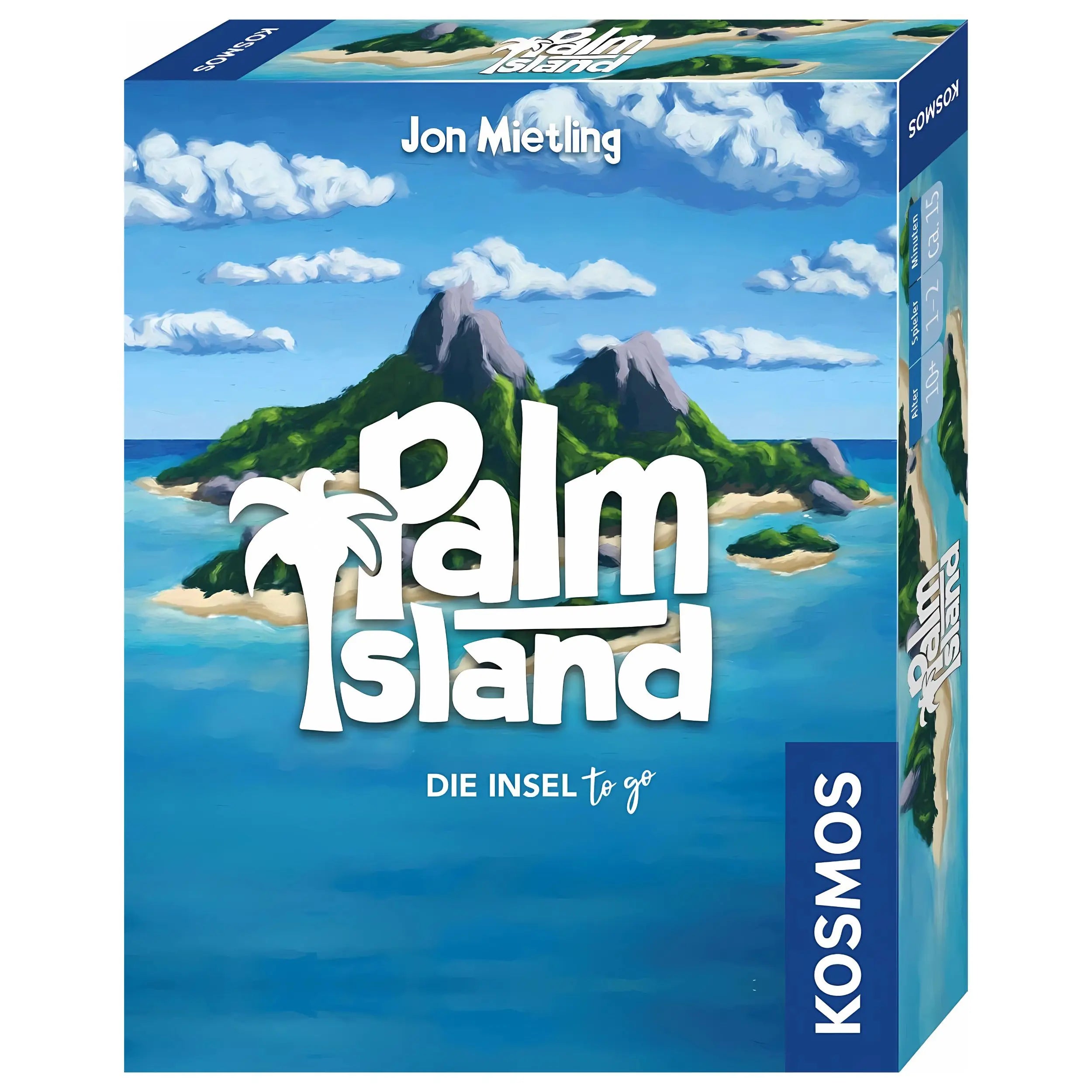
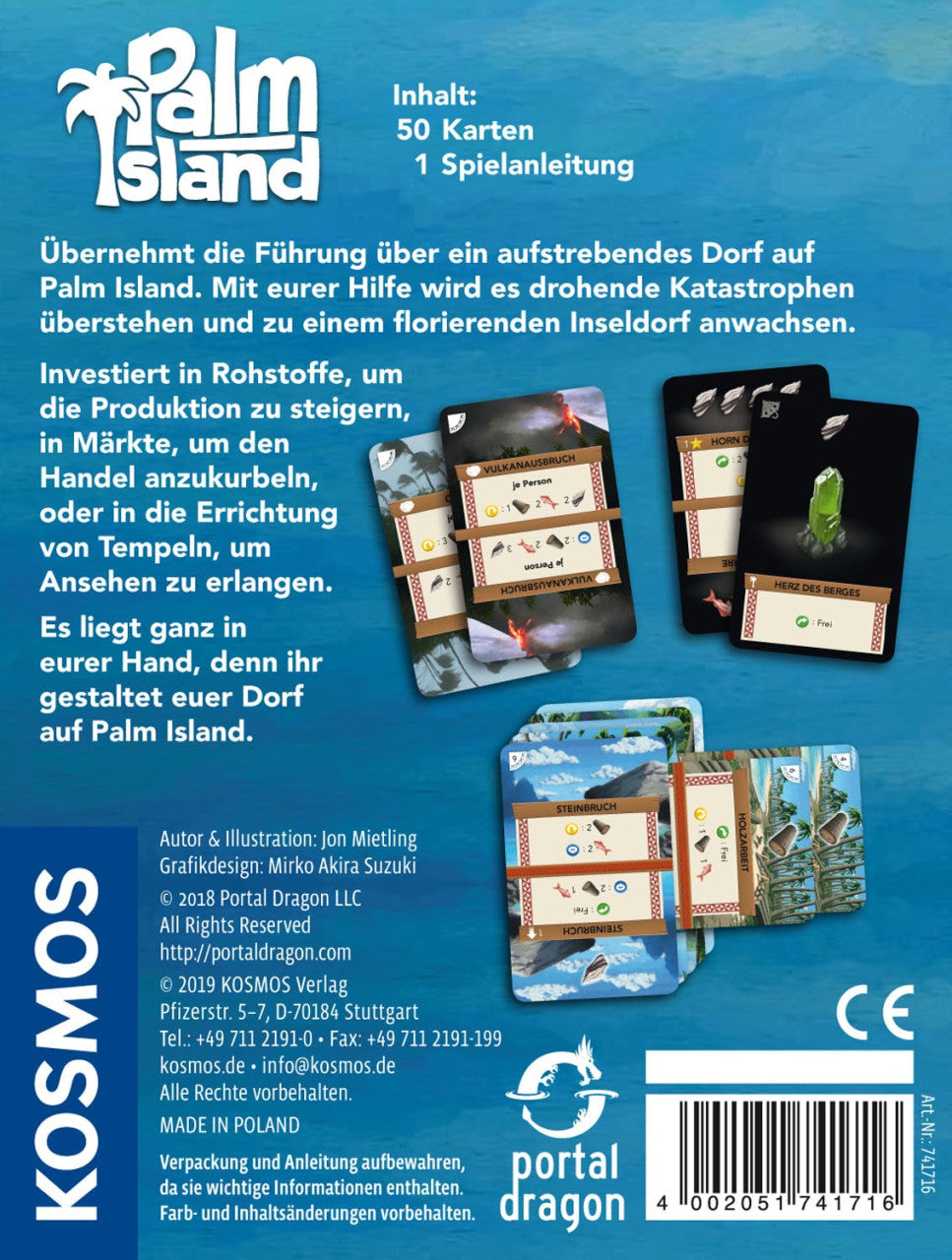
Palm Island
🐸 Dettagli da BoardGameGeek
Consiglio BGG sul numero di giocatori
Categorie
Meccaniche
Design & Art
Lingua
Pre-order - leggi i dettagli
🐸 Una rana saggia sa quando dividere l’ordine… e quando aspettare il salto giusto.
Si abbina bene con
The FroGames Card
You're in line at the post office. You pull out 17 cards. Eight rounds later, you've built a village, optimized resources, won challenges. You put everything back in your pocket. Nobody noticed a thing.
WHAT IT IS ABOUT
A village that fits in the palm of your hand
Jon Mietling designed Palm Island with a crazy goal: to create a board game that doesn't require a board. The result is a pocket deck-builder for 1-2 players, published by Portal Dragon in 2018, which is literally played by holding the cards in your hand. No setup, no surface needed, no excuse not to play.
Each game lasts 8 rounds where you rotate, flip, and archive the 17 cards of your village to gather resources, upgrade buildings, and overcome unique challenges. You can play solo, trying to unlock new objectives, cooperatively, preparing the village before natural disasters, or competitively, vying for bonuses. The deck transforms round after round: every choice changes the sequence of cards you'll have in hand.
What they say abroad
A deck-builder that truly lives in your pocket and offers surprising strategic depth in 15 minutes. The mechanic of rotating cards to change them is simple and brilliant.
— FroGames
"Palm Island proves you don't need a table to build an engine."
Palm Island proves you don't need a table to build an engine.
— Meeple Mountain

Palm Island
Palm Island is designed for solo play: the main mode features a campaign of objectives (feats) to be unlocked progressively, which modify the deck and add new challenges. The game maintains the same depth as multiplayer because the core is optimizing your deck, not interaction. It is one of the best solo fillers on the market.
FrogScore · FroGames.it editorial rating · based on rules, international reviews, and gameplay sessionsYour arsenal
Four cards that make a difference
Village Card
Each card has two sides and can be rotated 90° or 180°. One side is the basic version of the building, the other is the upgrade. You rotate the card by spending resources, archive to unlock abilities.
Resources
Wood, stone, fish: you collect them by activating cards and spend them to rotate buildings or overcome challenges. Each round you must balance production and investment.
Disasters (Cooperative)
In cooperative mode, you draw disaster cards that impose conditions: you must prepare the village before they strike. You fail together or win together.
Feat Card (Solo)
Progressive objectives that unlock new village cards and modify your deck. Each completed feat opens different paths: the campaign branches based on your choices.
Recommended sleeves 173 cards in 2 sizes ▼
If you play often, we recommend protecting your cards with clear sleeves to make them last longer.
| Size | Quantity |
|---|---|
| 63 × 88 mm | 123 |
| 56 × 87 mm | 50 |
| Total cards | 173 |
🎲How to playThe rules in four steps▼
How to play
The flow of each round
Eight rounds identical in structure, but very different in choices.
Hold the 17 cards in your hand. Look at the first card: you can activate it (collect resources, pay to rotate it, or archive it) or pass. Then you move it to the bottom and look at the next one. You continue until you have flipped through the entire deck.
Each activated card produces or consumes resources (wood, stone, fish). Unused resources accumulate between rounds. You must decide: do I invest now to upgrade buildings or accumulate for a big move?
Rotating a card 90° or 180° transforms it into its upgraded version (costs resources). Archiving it removes it from the deck but activates a permanent ability. Each choice modifies the deck's composition for subsequent rounds.
At the end of the round, you face the challenge (cooperative/solo) or check who received the bonuses (competitive). Then you repeat. At round 8, you count the points.
⏱️Your first gameMoment by moment account▼
A game in five moments
What happens at the table (or standing)
Not the rules. The experience.
Deck in hand, go
Take the 17 village cards, shuffle them, hold them in your palm. No setup, no table. You start flipping through: each card has an action (collect resources, rotate a building, archive to upgrade). Choose what to do in the first 2-3 cards and the round begins.
The first upgrade
You've accumulated enough wood to rotate the sawmill. You turn it 90°: now it produces more. You put it back in the deck. You realize that each rotation changes the sequence of the next few hands. You start planning two rounds ahead.
Mid-game, half deck
You are in round 4 of 8. Half of your cards are upgraded, some archived (out of the deck but active as permanent abilities). Production accelerates, but challenges become tougher. In competitive play, your opponent is taking common bonuses: you have to choose whether to chase them or optimize your own path.
The perfect combo
You draw the right card at the right time: three upgraded buildings in a row that trigger a cascade of resources. You overcome the round's challenge with ease. It's the classic deck-building feeling, but compressed into a handful of cards you're literally holding.
Round 8, count points
Last pass through the deck. You optimize the last moves, archive the last building. You count the victory points (upgraded cards, accumulated resources, challenges overcome). In solo play, you check if you unlocked the next feat. You put everything back in the small box. 15 minutes have passed.
🐸What to know beforehandThree honest things, from friends▼
What to know beforehand
Three honest warnings
You flip through the same deck 8 times. The structure is deliberately repetitive: the depth lies in transforming the deck during the passes. If you are looking for scenic variety round by round, this is not the right game. If you like optimizing a compact engine, it's hypnotic.
Even in competitive play, everyone plays their own deck. You compete for common bonuses, but there is no direct attack or blocking. It's a parallel race. If you want conflict, look elsewhere. If you want an optimizable puzzle with company, it works.
You don't need a table, but you have to hold 17 cards in your hand, rotate them, archive them, manage resource tokens. With small hands or poor coordination, it can be uncomfortable. Some people still prefer to rest the deck on a surface, nullifying the portable idea.
🏆Victory and defeatWhat the ending rewards▼
How it ends
How to win and how to lose
Eight rounds, then points are counted. But each mode has its own ending.
Victory
- Solo: reach the required score for the active feat and unlock the next card in the campaign
- Cooperative: collectively overcome all disaster challenges before they strike
- Competitive: accumulate more victory points than your opponent (upgraded buildings, common bonuses, resources)
Defeat or failure
- Solo: fail to reach the feat's score. You try again with the same objective
- Cooperative: one player fails a disaster challenge. You both lose
- Competitive: your opponent scores more points than you (there is no true elimination, just a lower final score)
Palm Island is the game you take anywhere and truly play anywhere. No excuses, just 17 cards and 15 minutes.
💬Frequently asked questionsQuick answers before checkout▼
Frequently asked questions
FAQ about Palm Island
Can you really play without a table or is it just marketing?
Yes, really. The game is designed to be held in your hand: you flip through the cards, rotate them, archive them. Some people still prefer a flat surface for convenience, but it's not necessary. It works standing, sitting, on a train, anywhere.
How long does the solo campaign last?
There are progressive objectives (feats) to unlock. Each completed feat adds new village cards to your pool. The campaign can last dozens of games, depending on how quickly you unlock objectives and how many combinations you want to explore.
Is the cooperative mode truly cooperative or is it just 'combined scores'?
It is truly cooperative: you face disaster cards together that impose conditions (you must prepare the village before they strike). If one fails, you both lose. It's not just about summing scores, it's about coordinating choices.
What mechanics does Palm Island use?
Deck-building (you modify the deck by upgrading/archiving cards), hand management (you flip through the deck deciding what to activate), memory (you remember which cards you have already passed in the round), move through deck (the deck is cycled repeatedly). It's a compact hybrid of classic mechanics.
Is it available in Italian?
This edition is in English. The cards have text (building names, abilities), but the language is essential and accessible. Once you learn the 17 base deck cards, the game is intuitive.
The people behind the game
Who invented it, who designed it, who publishes it — and what else they've done.
Palm Island is a portable deck-building game for 1-2 players, ages 10+, lasting 15 minutes, designed by Jon Mietling and published by Portal Dragon. The game is played entirely by holding the cards in hand, without the need for a table: each game lasts 8 rounds in which you rotate, archive, and optimize a 17-card deck to build a village and overcome challenges. It offers three modes (solo with objective campaign, cooperative against disasters, competitive for points) and deck-building, hand management, and memory mechanics. Ideal for quick sessions anywhere, on a train, during a break, in line. Available on FroGames.it.
Palm Island
Frequently Asked Questions
The answers you're looking for, no beating around the bush.
📸Do the images match the actual product?
The photos on the website often come from BoardGameGeek and are intended to give you an idea of the game. They may vary slightly from the version you receive. The content declared by the publisher is always binding.
📦Does the content of the box match what is indicated?
We always strive to provide the correct content, but minor variations are possible due to reprints or updates. The information comes directly from the publishers. If you have any questions, please contact us!
⏳How do pre-orders work?
Pre-order the game before release, payment is immediate, and the game is reserved for you. As soon as it arrives, we'll ship it right away! If there are any delays, we'll update you promptly.
🔒Can I trust buying here?
Absolutely! Secure payments, tracked shipments, and a team that loves board games as much as you do. If something goes wrong, we'll do our best to fix it.
🛠There's a problem with my order, what should I do?
Write to us now! Whether it's a missing part, damage, or an error, we'll help you resolve it as soon as possible. Your experience truly matters to us.