


Logic & Lore - Second Edition
🐸 Dettagli da BoardGameGeek
Consiglio BGG sul numero di giocatori
Categorie
Meccaniche
Design & Art
Lingua
Pre-order - leggi i dettagli
🐸 Una rana saggia sa quando dividere l’ordine… e quando aspettare il salto giusto.
Si abbina bene con
FroGames — Moments You'll Remember
The winner is the one who asks the right questions at the right time. Then someone figures it all out three turns ahead, and the other thinks they're ahead until the last second.
WHAT IT'S ABOUT
A deduction duel where every question is a move
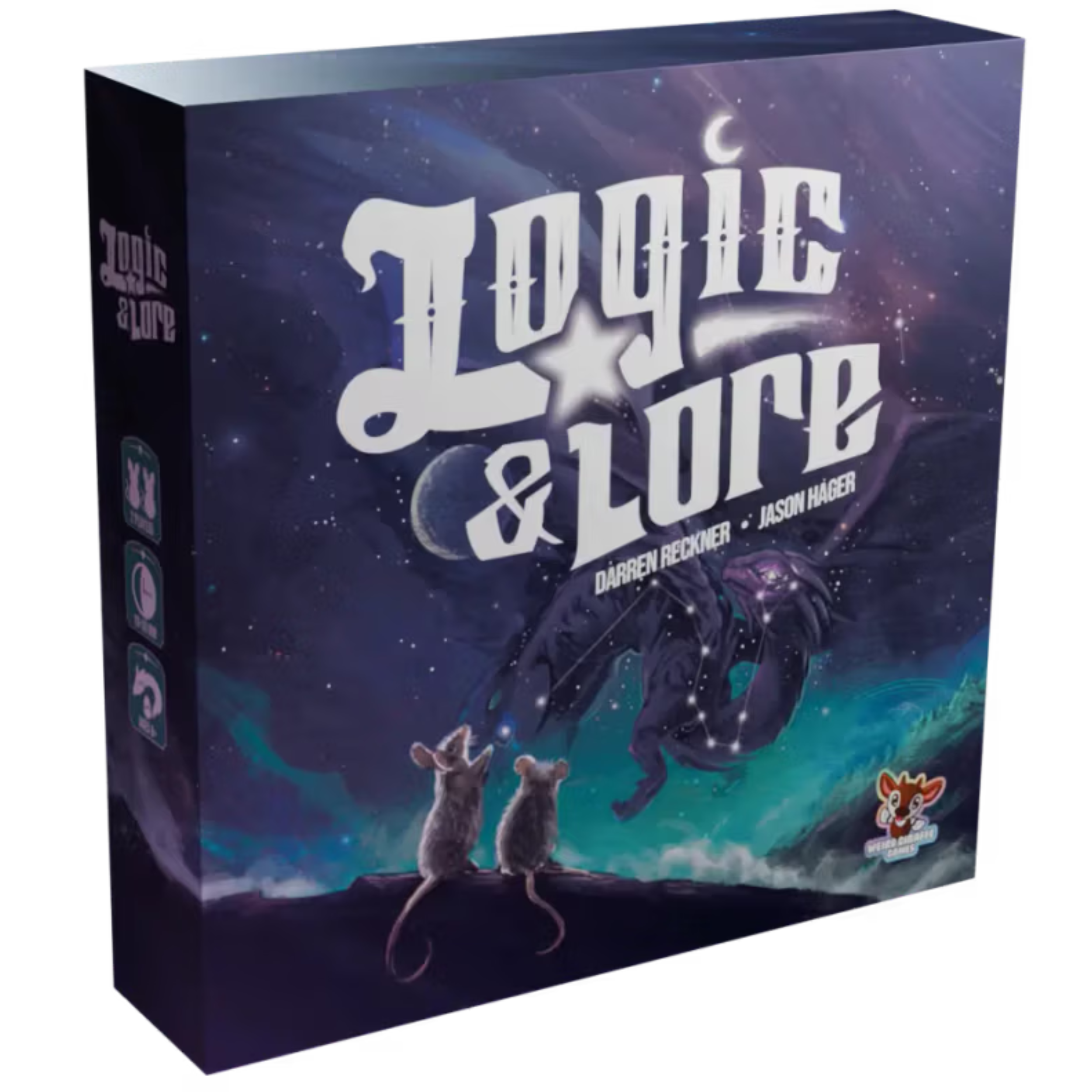
Logic & Lore is by Jason Hager and Darren Reckner for Weird Giraffe Games, and features a cozy but deceptive setting: dragons and mice organizing the cosmos. Behind the tender facade is a competitive and cerebral game, where the one who deduces first wins.
You have nine cards numbered 1 to 9, face down and shuffled. Your goal is to align them in the correct order before your opponent. Each turn you choose two cards, ask your opponent questions, gather information, move cards, take notes. The winner is whoever reveals everything aligned, or whoever catches the other in a mistake.
What they say abroad
A duel that seems like a cooperative puzzle, until you realize that every question you ask also reveals something about yourself.
— FroGames
Every game is a theorem to be solved against time and against an opponent who is doing the same.
— FroGames

Logic & Lore
FrogScore · FroGames editorial rating · based on rules, international reviews and game sessionsThe tools of the cosmos
What's in front of you
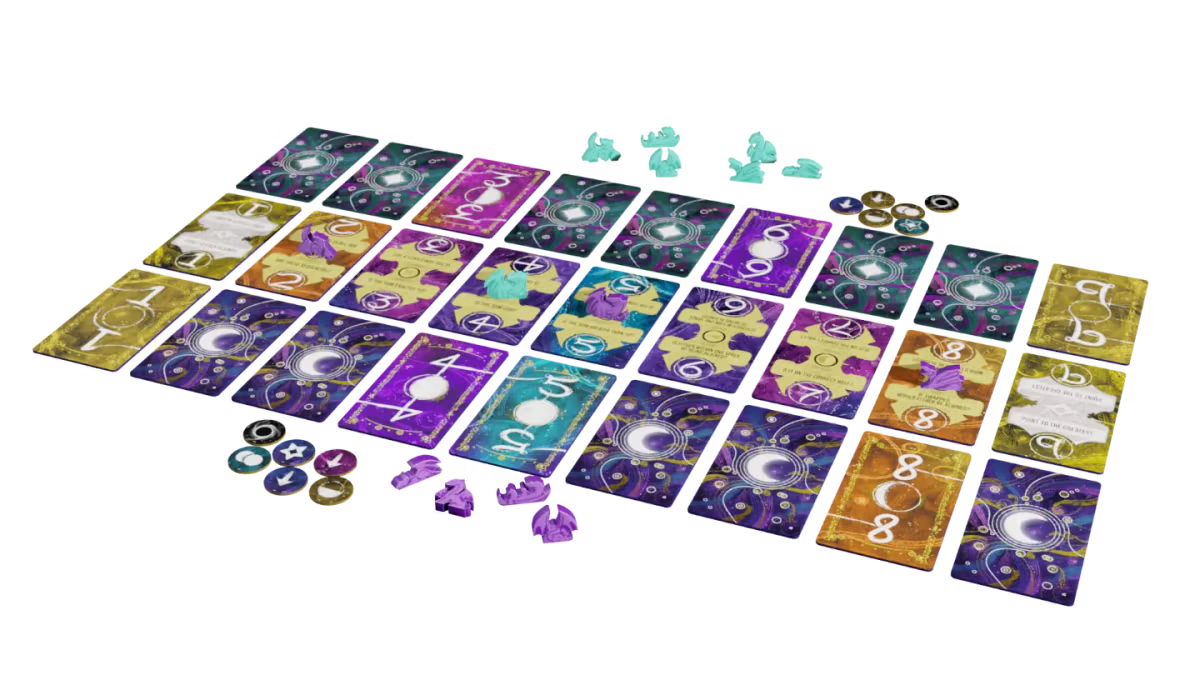
The 9 Stars
Cards numbered 1 to 9, face down at the start. Your goal is to put them in order. Each card is a puzzle piece you need to place correctly.
The Dragons
Meeples you use to indicate the two cards you ask questions about each turn. They are your explorers: choose wisely where to send them.
The Mice
They stay at the base and take notes. In reality, you are the one taking notes: paper, pen, memory. Whoever organizes information best wins.
Deductive Table
Optional sheet to track what you know and what you exclude. Not mandatory, but those who use it well have a clear advantage.
Recommended sleeves 48 cards in 1 size ▼
If you play often, we recommend protecting the cards with transparent sleeves to make them last a long time.
| Size | Quantity |
|---|---|
| 70 × 120 mm | 48 |
| Total cards | 48 |
In half an hour you'll know if you're better at asking questions or hiding answers. Logic & Lore tells you in 30 minutes.
Come si gioca
Video dimostrativo di gameplay.
A game in five acts
What happens at the table
Not the rules. The experience.
Organized Chaos
Shuffle the cards, turn them face down. You both have nine cards numbered 1 to 9, but you don't know where they are. Start asking questions. "Is the card on the left greater than 5?" "Are these two consecutive?" Every answer is a clue.
The First Anchors
After a few turns, you've identified a couple of certain numbers. Maybe you know that 9 is on the far right, or that 2 is near 1. You start to move the cards into more logical positions. Your opponent does the same. The race begins.
The Gordian Knot
Mid-game. You're almost certain about six out of nine cards, but the last three are giving you trouble. You ask increasingly precise questions, comparing old information with new. Every move your opponent makes tells you something: if they move a card far away, perhaps they've deduced an extreme number.
The Revelation
Suddenly everything falls into place. You understand where all the cards are. Or you think you do. Your opponent has a focused expression: are they about to reveal? You have to decide whether to reveal yourself or take another turn to be 100% sure. But if you wait, they might beat you to it.
The Reveal
Someone turns over all the cards. If they are in 1-9 order, they win. If there is even one mistake, they lose and the other player automatically wins. Tension is at its peak until the last card is revealed. It happens that someone reveals with a wrong card and loses by a hair's breadth.
How to play
The flow of each turn
Every turn is identical: choose two cards, ask questions, move, deduce. Simple in theory, difficult in practice.
You place your two dragon meeples on two of your face-down cards. These are the cards you can ask questions about this turn.
Ask your opponent questions about the two chosen cards. Questions like: "Which of the two is higher?", "Are they consecutive?", "Is one of them greater than 7?". Your opponent must answer honestly.
Optional. You can move cards to new positions based on what you've deduced. This is the moment when you reorganize your line to get closer to the 1-9 order.
Optional. If you think you have all the cards in order, you can reveal everything. If it's correct, you win. If there's even one mistake, you lose.
Why it's different from others
Six elements that make a difference
Pure deduction, zero luck
After the initial setup, there are no random elements. Every game is won or lost based on the questions you ask and the deductions you make. You can't blame the dice.
Asymmetric information
You know your cards (through deduction), your opponent knows theirs. But neither sees the other's. Questions are the only channel to get information, and every question you ask reveals something about your reasoning.
The revelation dilemma
You can reveal whenever you want, even if you're not 100% sure. But a single mistake makes you instantly lose. This creates tension: do you wait another turn to be sure, or do you take a risk and reveal immediately before your opponent does?
Notes as metagame
The game explicitly encourages taking notes. Those who organize information better (tables, exclusions, possibilities) have a real advantage. Some use printed Excel sheets, some pencil and eraser, some pure memory.
Strategic questions
Not all questions are equally valuable. Asking "Is it greater than 5?" gives you less information than "What's the difference between these two cards?". Learning to ask efficient questions is half the game.
Cozy theme, competitive heart
The dragons and mice give it a relaxed aura, but Logic & Lore is a ruthless game. There's no mercy: either you've aligned everything correctly, or you've lost. The cute graphics hide a no-compromise mental duel.
How it ends
How to win and how to lose
Two ways to win, one to lose. Simple and brutal.
Victory
- You reveal all your cards and they are correctly aligned from 1 to 9
- Your opponent reveals their cards but made a mistake (you automatically win)
- In some advanced setups, you can win by deducing your opponent's order even before arranging your own
Defeat
- You reveal your cards but even one is out of place
- Your opponent reveals their cards correctly before you
- You spend too much time deducing and the other player beats you to it
Logic & Lore is unforgiving. Either you asked the right questions, or you lost. A logical duel that lasts 30 minutes and makes you sweat until the very end.
Frequently Asked Questions
FAQ about Logic & Lore
How difficult is it compared to games like Mastermind or Sudoku?
Closer to Sudoku than Mastermind. There's no bluffing, just pure logic. But unlike a solo puzzle, here you have an opponent racing against you. The (relative) time pressure adds tension that Sudoku doesn't have.
Is it suitable for people who aren't good at logic or math?
It depends. The rules are very simple, but deduction requires concentration. If you like riddles and puzzles, go for it. If they bore you, Logic & Lore is not for you: there's no narrative or plot twists to save you.
How long does a game actually last? Are 30 minutes realistic?
Yes. The first few games might stretch to 40-45 minutes because you take notes slowly or ask inefficient questions. After 3-4 games, 30 minutes becomes the norm. Experienced players can finish in 20.
Can you play without taking notes?
Technically yes, but it's extremely difficult. With 9 cards and dozens of pieces of information collected, pure memory is not enough. Those who use organized notes almost always win against those who rely on memory.
Is it available in Italian?
This edition is in English. However, language dependency is minimal: the cards are numbers, the questions are yours (and you ask them in whatever language you want at the table). You only need to read the rulebook once.
Logic & Lore is a deduction game for 2 players, lasting 30 minutes, ages 8+. Designed by Jason Hager and Darren Reckner for Weird Giraffe Games, it pits two challengers against each other in a race to align nine numbered cards from 1 to 9. The main mechanic is questions and answers: each turn you choose two cards, ask your opponent questions, gather information, move cards, take notes. The first to correctly reveal all cards in order wins, or the one who catches the other making a mistake. Zero luck after setup, just pure logic. Available on FroGames.it.
Logic & Lore - Second Edition
Frequently Asked Questions
The answers you're looking for, no beating around the bush.
📸Do the images match the actual product?
The photos on the website often come from BoardGameGeek and are intended to give you an idea of the game. They may vary slightly from the version you receive. The content declared by the publisher is always binding.
📦Does the content of the box match what is indicated?
We always strive to provide the correct content, but minor variations are possible due to reprints or updates. The information comes directly from the publishers. If you have any questions, please contact us!
⏳How do pre-orders work?
Pre-order the game before release, payment is immediate, and the game is reserved for you. As soon as it arrives, we'll ship it right away! If there are any delays, we'll update you promptly.
🔒Can I trust buying here?
Absolutely! Secure payments, tracked shipments, and a team that loves board games as much as you do. If something goes wrong, we'll do our best to fix it.
🛠There's a problem with my order, what should I do?
Write to us now! Whether it's a missing part, damage, or an error, we'll help you resolve it as soon as possible. Your experience truly matters to us.