

Stephens
🐸 Dettagli da BoardGameGeek
Consiglio BGG sul numero di giocatori
Categorie
Meccaniche
Design & Art
Lingua
Si abbina bene con
The FroGames Board
The earthquake destroyed everything. Stephens opens a glass factory, you are the master glassmaker. Each turn you choose: work for him or build your parallel empire. At the end of the game, find out who was smarter.
WHAT IT'S ABOUT
The Reconstruction of Lisbon Through Glass
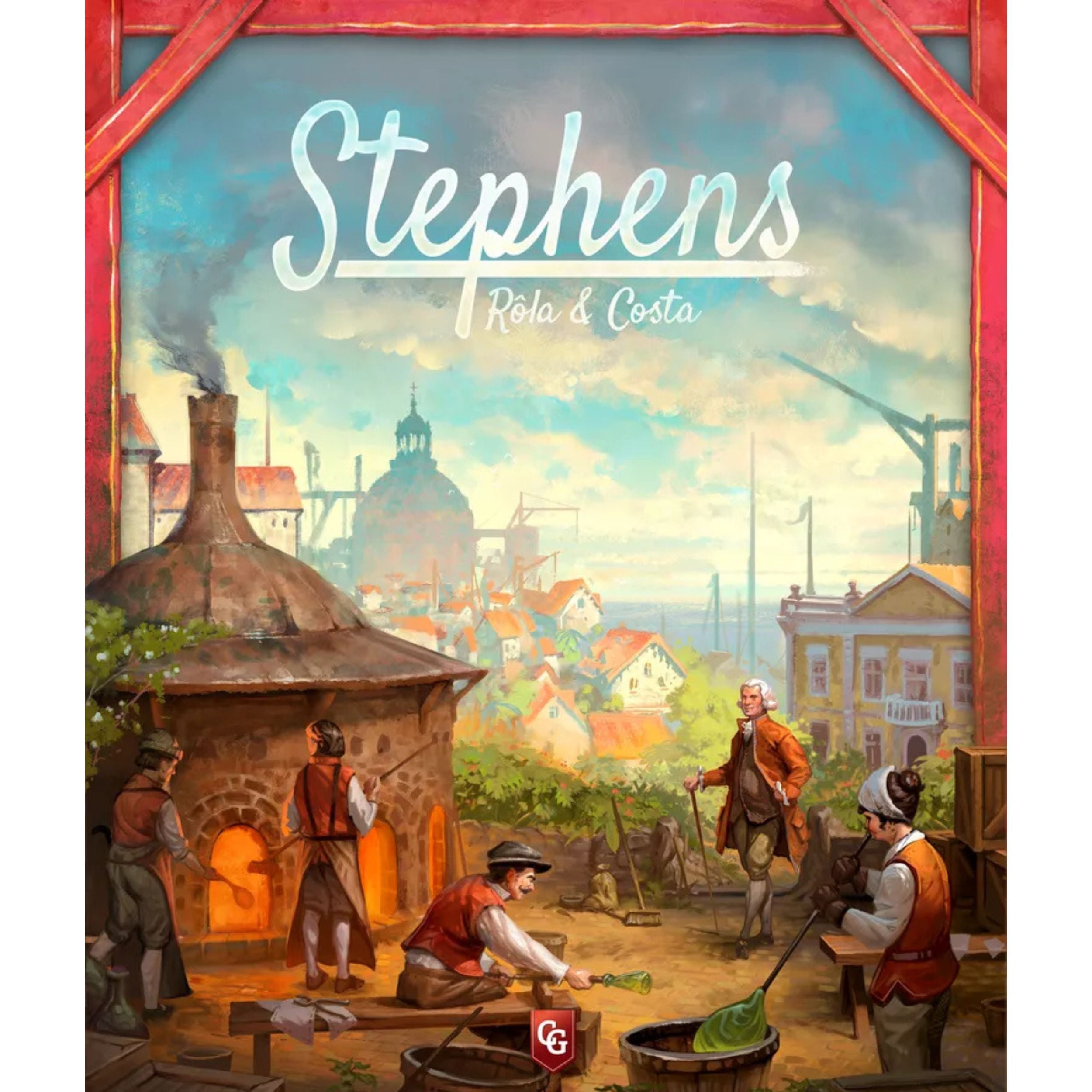
Lisbon, 1755. The most devastating earthquake in European history razed the Portuguese capital and a large part of the southern coast. Windows are needed to rebuild an entire nation. William Stephens, a British entrepreneur, seizes the opportunity and opens a glass factory. Designed by Costa and Rôla, illustrated by Citie Lo and Lukas Siegmon, Stephens tells this race for reconstruction through the lens of the glass industry.
You are a master glassmaker in the Stephens factory. Each turn you choose: activate the central factory (working for Stephens but obtaining common resources) or activate one of your personal investments (building your parallel economic engine). Manage contracts, develop technologies, create jobs. The Napoleonic War arrives as a timer: when the troops reach Lisbon, the one who has accumulated the most prestige wins.
What they say abroad
"After the big earthquake of 1755 that tore down Lisbon and most of Portugal's southern coast, it was necessary to rebuild an entire nation."
— Pile Up Games
Stephens is a young game (2024) with few international reviews available. This board is based on official BGG data and will be updated with the release of the first in-depth analyses.
— FroGames

Stephens
The game includes official solo rules that simulate opponents through an automa card system. The experience works and maintains the tactical decisions of the bi-phasic action, but loses the direct competition for contracts and the interaction on factory placement: it becomes more an optimization puzzle than a race.
FrogScore · FroGames editorial rating · based on rulebook, international reviews, and game sessionsThe Glassmaker's Tools
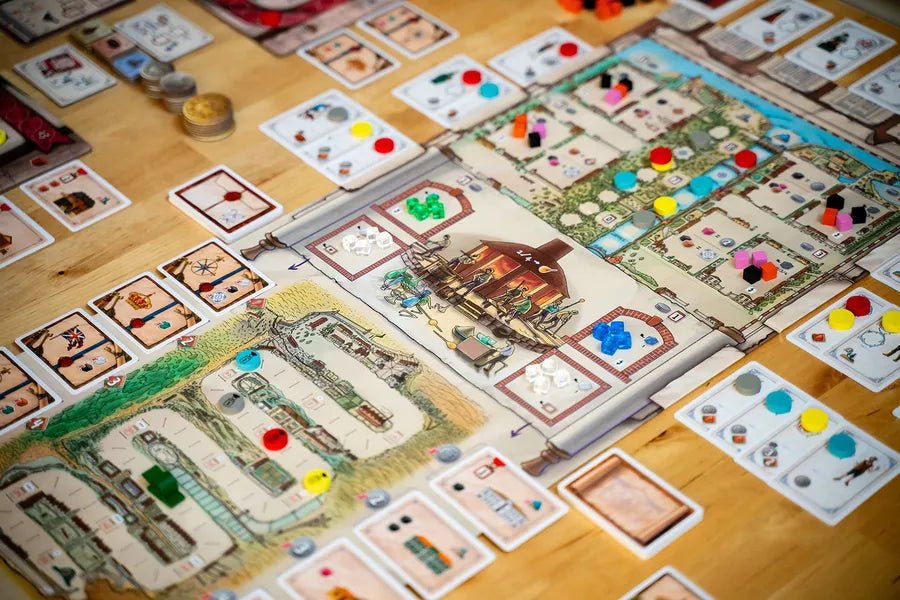
What you manage during the game
Stephens Factory
The central production heart. When you activate it, you produce glass and resources for everyone, but you get immediate bonuses. It's fast, but you work for Stephens, not for yourself.
Personal Investments
Economic activities you build: furnaces, workshops, trade channels. Activating them develops your private engine, but they require setup and don't provide common resources.
Contracts
Orders to complete to earn prestige and money. Direct competition: whoever gets them first takes opportunities from others. Some require specific tech.
Technology Tree
Developments that unlock new actions, improve production efficiency, and open advanced contracts. Long-term investment that pays off in the final turns.
Come si gioca
Video dimostrativo di gameplay.
🎲How to playThe rules in four steps▼
How to play
The flow of each round
Each turn is a binary choice: activate the central factory or one of your investments. Not both.
Choose: Stephens factory (common production, immediate bonus) or one of your investments (personal action, no shared bonus). The choice defines the turn.
If you activate the factory, everyone gets basic resources but you take a bonus worker or money. If you activate an investment, you perform the specific action (production, trade, development) alone.
You can spend resources to complete contracts (prestige and money) or advance on the technology tree (unlocks and multipliers). Direct competition: whoever takes it first blocks others.
Update worker tokens, collect any passive income from developed investments. Pass the turn. The Napoleonic timer advances: when it reaches Lisbon, the game is over.
⏱️Your first gameThe chronicle, moment by moment▼
A game in five moments
What happens at the table
Not the rules. The experience.
Asymmetric Setup
Each player draws their own initial investments and studies the available contract cards. Someone has a furnace, someone else has a trade channel. Already here you understand that the game will not be the same for everyone: each starts with a different engine to build.
The race for easy contracts
First turns: everyone wants simple contracts to make quick cash. The central factory is often activated because it gives immediate resources. Personal investments remain dormant: they seem slow, but someone starts developing them silently.
Strategic bifurcation
Mid-game: those who focused on investments start to see their engine running. Those who ground out contracts have more points now, but fewer options per turn. The tension rises: do I activate the factory for common resources or my investment for future efficiency?
The tech tree opens up the game
Those who have developed technologies unlock advanced contracts inaccessible to others. The jobs created give passive bonuses. Someone realizes that their personal engine now produces twice as much as the central factory. Others try to catch up, but time is running out.
The French arrive
Timer expired: Napoleonic troops enter the scene and the game ends. Prestige count: whoever balanced contracts, tech, and investments wins. Whoever only made glass for Stephens discovers they've worked for second place. Some laugh, some would do everything differently.
🐸Good to know beforehandThree honest things, from friends▼
Good to know beforehand
Three things you need to consider
Medium-high learning curve
The 3.2 weight doesn't lie: the first game requires a thorough explanation of the two-phase system and the tech tree. New players tend to over-activate the central factory, losing efficiency in the long run. Count 15-20 minutes for setup and explanation, plus a warm-up game to understand the rhythm.
Little direct interaction
Competition is over contracts and limited spots, but everyone builds their engine in parallel. If you're looking for constant interaction and sabotage, this isn't the game: interaction is indirect, economic, not tactical. Many appreciate it, some find it solitary even in multiplayer.
Variable scaling
It works from 1 to 4 players, but the pace changes: with 2 players, the game is faster and more tactical, with 4, contracts are scarce and downtime increases. The sweet spot seems to be 3 players, but with 668 total votes on BGG, solid data on final balance is still lacking.
🏆Victory and defeatWhat the ending rewards▼
How it ends
Victory and defeat
The game ends when Napoleonic troops reach Lisbon (timer runs out). The player with the most total prestige wins.
Victory
- Prestige from completed contracts (advanced ones are worth a lot)
- Prestige from developed technologies and created jobs
- End-game bonuses from secret objectives or completed investments
How to fall behind
- Always activating the central factory without building a personal engine: immediate gain but loss of efficiency
- Ignoring the technology tree: advanced contracts become inaccessible
- Taking too many contracts without completing them: they block resources and give no points
Stephens asks you to think of two games in one: the one you play for him, and the one you build for yourself. Those who learn to balance win. Others work for free.
💬Frequently asked questionsQuick answers before adding to cart▼
Frequently asked questions
FAQ about Stephens
What mechanics does Stephens use?
Hybrid worker placement with two-phase actions (common factory vs personal investments), resource management, contracts, technology tree, asymmetric engine building, set collection to fulfill orders. The action selection system is at the core: each turn you choose between shared production (fast but common) and personal development (slow but multiplicative).
How long does a game actually last?
The box indicates 60-120 minutes. With experienced players and 2-3 players, it's about 60-90 minutes. With 4 players and someone new to the genre, it easily exceeds 2 hours: downtime increases and tactical choices slow down the pace. First game: count at least 90 net minutes plus setup.
Is it better with 2, 3, or 4 players?
It works at all player counts but the pace changes: with 2 it's faster and more tactical, ideal for those who want games under an hour. With 3 there's competition for contracts without excessive downtime (sweet spot for many). With 4, resource scarcity increases but so does downtime. The solo game is an optimization puzzle with an official automa.
Do you need to know the history of Portugal?
No, the setting is thematic but not educational. The 1755 earthquake is the narrative pretext for the game's economy (demand for glass = reconstruction), but there are no historical events to manage or quizzes. It's an economic eurogame dressed as post-catastrophe reconstruction: the theme helps immersion but the mechanics stand on their own.
Is it available in Italian?
This edition is in English. The components include text on contract cards, investments, and technologies: a basic knowledge of English or a translated reference is needed. The rulebook is dense (weight 3.2) so we recommend finding a fan translation or having at least one fluent player at the table for the first game.
The people behind the game
Who invented it, who designed it, who publishes it — and what else they've done.
Stephens is a resource management board game for 1-4 players set in 1755 Lisbon, designed by Costa and Rôla and published by Giochix.it. Each game lasts 60-120 minutes and combines hybrid worker placement, contracts, a technology tree, and asymmetric engine building. The two-phase action system (central factory vs personal investments) creates constant tension between immediate gain and strategic development. Suitable for experienced players aged 12 and up, with a weight of 3.2/5 and an official solo mode with an automa. Available on FroGames.it.
Stephens
Frequently Asked Questions
The answers you're looking for, no beating around the bush.
📸Do the images match the actual product?
The photos on the website often come from BoardGameGeek and are intended to give you an idea of the game. They may vary slightly from the version you receive. The content declared by the publisher is always binding.
📦Does the content of the box match what is indicated?
We always strive to provide the correct content, but minor variations are possible due to reprints or updates. The information comes directly from the publishers. If you have any questions, please contact us!
⏳How do pre-orders work?
Pre-order the game before release, payment is immediate, and the game is reserved for you. As soon as it arrives, we'll ship it right away! If there are any delays, we'll update you promptly.
🔒Can I trust buying here?
Absolutely! Secure payments, tracked shipments, and a team that loves board games as much as you do. If something goes wrong, we'll do our best to fix it.
🛠There's a problem with my order, what should I do?
Write to us now! Whether it's a missing part, damage, or an error, we'll help you resolve it as soon as possible. Your experience truly matters to us.