
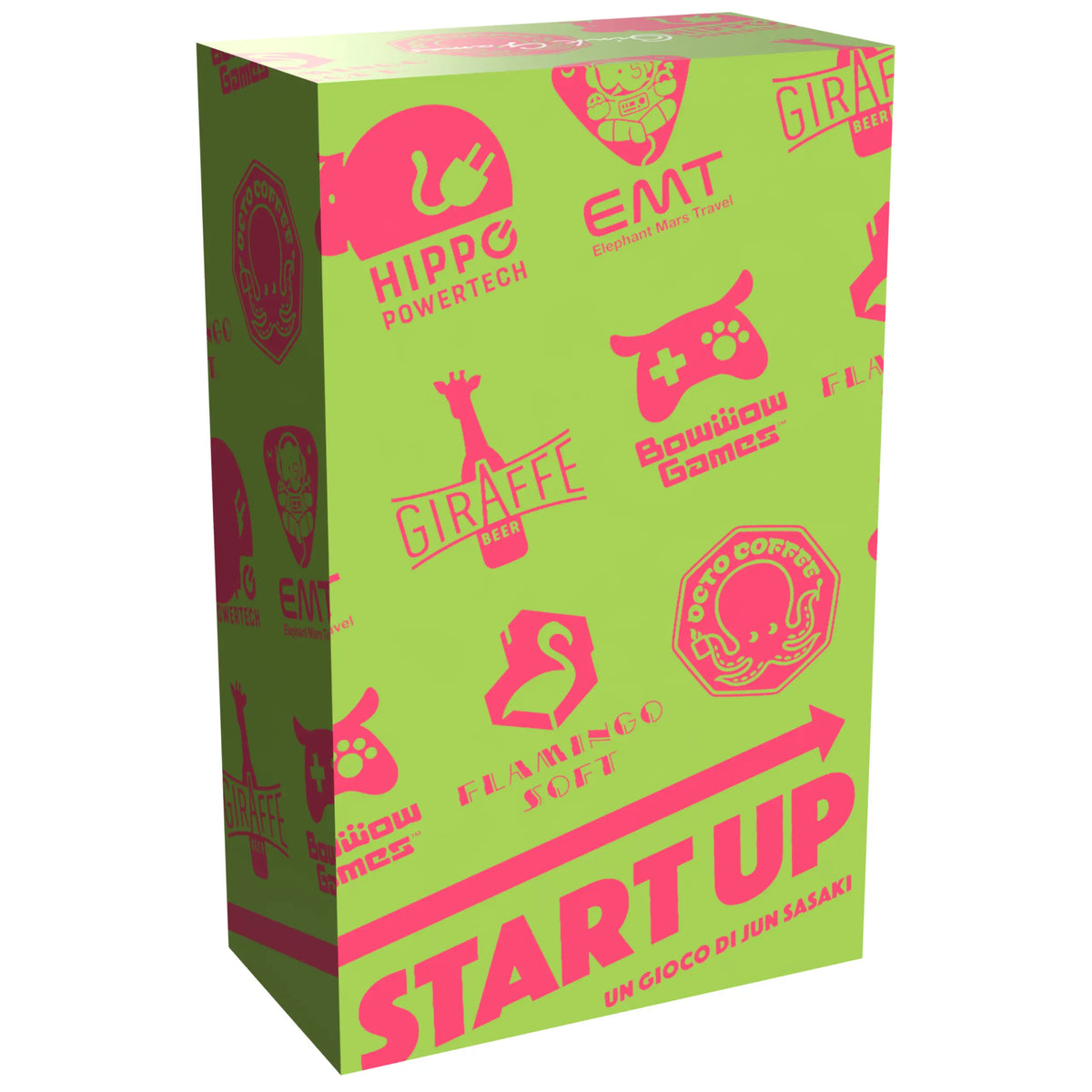
Startups
🐸 Details from BoardGameGeek
Consiglio BGG sul numero di giocatori
Categorie
Meccaniche
Design & Art
Lingua
🐸 How pre-orders work
🐸 A wise frog knows when to split the order… and when to wait for the right leap.
- Arrives
- December 11, 2026




Si abbina bene con
The FroGames Review
Everyone is investing in the same startup. You have three secret cards and must figure out when to exit. Too early and you miss the opportunity. Too late and you get surpassed. Meanwhile, everyone else is bluffing.
WHAT IS IT
Investing in six startups and figuring out when to exit before others do
Jun Sasaki (Deep Sea Adventure, A Fake Artist Goes to New York) creates a minimal economic party game for Oink Games: six budding companies, a handful of cards, and the race to become the majority shareholder. Clean illustrations by Hiroko Izumida, rules in five minutes.
On your turn, you choose a startup and place a card from your hand on it. But your three cards are secret: you can bluff, making it look like you're betting on one company while you're actually accumulating shares in another. When a player exits a company, the count begins: only the one with the most shares cashes in. The others? Nothing. You need to read the tempo, figure out who has what, and exit just before the others surpass you.
What they're saying abroad
"A quick, clever game of reading opponents and timing your exit."
A quick, clever game of reading opponents and timing your exit.
— Meeple Mountain
Startups promises bluffing and majorities in 20 minutes. This review is based on BGG data and early impressions: we will return to update it with the physical game.
— FroGames

Startups
FrogScore · FroGames editorial review · based on rules, international reviews, and gameplay sessionsThe six startups
Companies to invest in and win with
Six companies
Each startup has a deck of number cards. The more players invest, the higher the company's value rises. But only the primary shareholder cashes in.
Three secret cards
At the beginning, you draw three cards and keep them hidden. You can bluff: play on one company while you accumulate shares in another. No one knows what you have in your hand.
Exit counting
When a player exits a startup, the shares are counted. Whoever has the most wins the value of the company. The others lose everything. Timing is everything.
Reset and new hand
After six rounds, the startups reset. You get a new hand and start over. The accumulated money remains, but you must re-read the table from scratch.
Come si gioca
Video dimostrativo di gameplay.
🎲How to playThe rules in four moves▼
How to play
The flow of each turn
Lightning-fast turns: pick a startup, place a card, pass. When someone exits, you count.
On your turn, select one of the six companies and play a card from your secret hand. You can invest where you want: follow the others or bet on a startup being ignored.
Place the card on the table. It can be face down (total bluff) or face up (a clear signal). Others see where you are investing, but don't know how many more cards of that company you have in hand.
After playing, you can exit a startup. If you exit, the count begins: whoever has the most shares wins the company's value. The others lose everything. Timing is crucial.
If someone has exited, that startup closes and resets. Otherwise, the turn passes and you continue. After six rounds, hands are redistributed and you start again, with the accumulated money.
⏱️Your first gameThe play-by-play▼
A game in five moments
What happens at the table
Not the rules. The experience.
Secret hand, poker faces
You draw three cards. They are your shares, but nobody knows it. You watch others look at theirs. Someone smiles, someone doesn't. The first bluffs occur right at setup.
First moves, first lies
The first player places a card on a startup. You choose whether to follow them or invest elsewhere. Every move is a signal: do you really want that company or are you bluffing to get others to exit?
Someone exits too soon
A player announces: "I'm exiting this startup." The shares are counted. They won, but they burnt a company. The others stay in, accumulate, take risks. Timing is everything, and no one knows it yet.
Reading the table gets serious
Halfway through the game, you understand who is accumulating where. Or you think you do. Someone has bluffed well, someone else poorly. The most inflated startups are traps: whoever exits first wins it all, whoever stays risks losing.
The last startup, the final bluff
Cards run out, money is counted. Whoever read the others best wins. Whoever waited too long lost. Someone laughs, someone curses their starting hand. Reset, new hand, we start over.
🐸Good to knowThree honest things, from friends▼
Good to know
Three things you need to know
The starting hand matters
You draw three random cards. If they are all from the same company, you have a clear advantage. If they are scattered, you need to bluff better. Setup is pure luck, and in competitive tables, this can be frustrating.
With 3 players, it's too calculable
Bluffing works best with 4 or more players. With three, hands are easier to read, the chaos drops, and it becomes almost deterministic. The box says 3-7, but the game really explodes from 5 players up.
It repeats if you always play with the same people
After a few games with the same fixed group, you learn others' bluffing patterns. The game thrives on fresh reading: in a family setting or with a rotating group of players, it stays fresh; in a closed circle, it can get repetitive.
🏆Victory and defeatWhat the finale rewards▼
How it ends
How to win and how to lose
The winner is who accumulates the most money at the end of six rounds. Each startup pays only the first shareholder.
Victory
- Become the majority shareholder in a startup and exit before others surpass you
- Accumulate shares in multiple companies and win at least two of them
- Bluff well and cause others to exit the startups where you have the most cards
Defeat
- Wait too long to exit and someone surpasses you as shareholder: you lose everything
- Invest in startups that others ignore: no value, zero money
- Your starting hand is scattered and you fail to dominate any company
Startups is bluffing, timing, and reading the table in twenty minutes. Perfect as an opener, a closer for the night, or a filler between two heavyweights.
💬Frequently asked questionsQuick answers before checkout▼
Frequently asked questions
FAQ about Startups
What mechanics does Startups use?
Area Majority (hidden majority on companies), Investment (capital management), Hot Potato (exit timing), and Score-and-Reset (cyclical rounds with new hands). Even if it's a party game, underneath it has a light eurogame structure.
Does it work with 3 players?
It works, but it's less chaotic. The bluffing is more visible, hands are more calculable, and tension drops. From 5 players up, it explodes: more bluffing, more unpredictability, and more laughter.
Is it suitable for children or is it just for adults?
Recommended age 10+. The rules are very simple, but it requires the ability to bluff and read others. A sharp 8-9 year old can play it as a family, but below that age, it's hard to manage the timing.
How long does a game really take?
The box says 20 minutes, and that's accurate. Six rounds, very fast turns. With 7 inexperienced players, it can reach 25-30 minutes due to post-exit discussions, but it remains a dense filler.
Is it available in Italian?
Yes, this is the Italian Ghenos Games edition. Cards have minimal text (numbers and icons), and a complete rulebook in Italian is included. Language-independent.
The people behind the game
Who invented it, who illustrated it, who publishes it — and what else they have done.
Startups is an economic party game by Jun Sasaki for 3-7 players, with a 20-minute duration, for ages 10+. Published by Oink Games and distributed in Italy by Ghenos Games, it uses Area Majority, Investment, and bluffing mechanics to create tension and table-reading. Each player holds three secret cards and invests in six startups: only the majority shareholder wins, others lose everything. Timing of the exit is crucial. Perfect as a filler or gateway game for quick game nights. Available on FroGames.it.
Startups
Frequently Asked Questions
The answers you're looking for, no beating around the bush.
📸Do the images match the actual product?
The photos on the website often come from BoardGameGeek and are intended to give you an idea of the game. They may vary slightly from the version you receive. The content declared by the publisher is always binding.
📦Does the content of the box match what is indicated?
We always strive to provide the correct content, but minor variations are possible due to reprints or updates. The information comes directly from the publishers. If you have any questions, please contact us!
⏳How do pre-orders work?
Pre-order the game before release, payment is immediate, and the game is reserved for you. As soon as it arrives, we'll ship it right away! If there are any delays, we'll update you promptly.
🔒Can I trust buying here?
Absolutely! Secure payments, tracked shipments, and a team that loves board games as much as you do. If something goes wrong, we'll do our best to fix it.
🛠There's a problem with my order, what should I do?
Write to us now! Whether it's a missing part, damage, or an error, we'll help you resolve it as soon as possible. Your experience truly matters to us.