
Kilia
🐸 Details from BoardGameGeek
Consiglio BGG sul numero di giocatori
Categorie
Meccaniche
Design & Art
Lingua
🐸 How pre-orders work
🐸 A wise frog knows when to split the order… and when to wait for the right leap.
- Arrives
- by the end of April 2027

Si abbina bene con
The FroGames File
You only have one card in your hand. You can use it to procure goods, exert influence over the city council, or advance the construction of the canal. You play it. You pass the deck. And now it’s up to the others to decide.
WHAT IT IS
One canal, three ways to use every resource
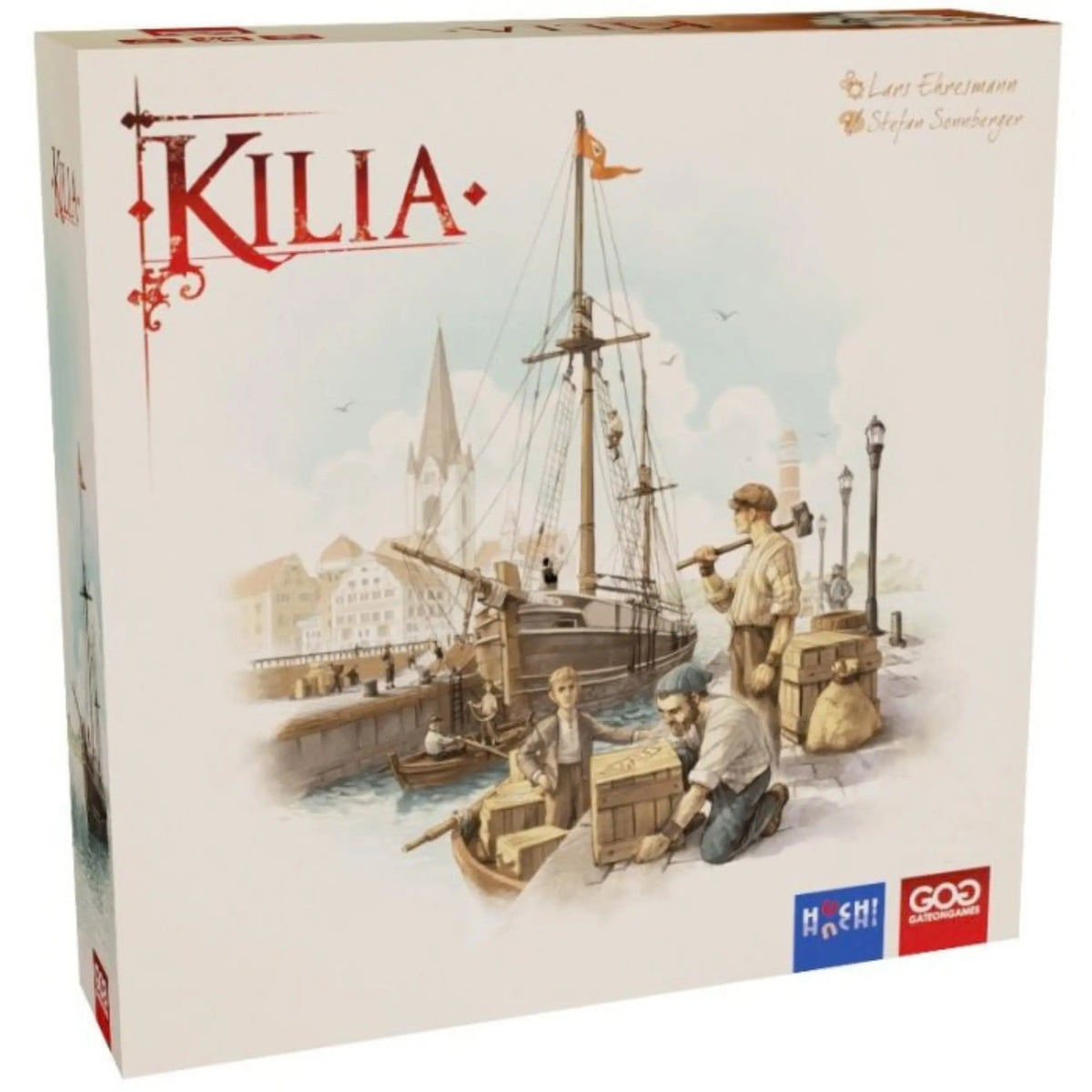
Kiel, Germany, late 19th century: the port on the Baltic becomes the site of an epochal project, the canal that will connect the Baltic to the North Sea. Lars Ehresmann (a designer known for minimalist and elegant approaches) sets an eurogame here in which the entire deck of cards passes from hand to hand, and each card can perform three different functions.
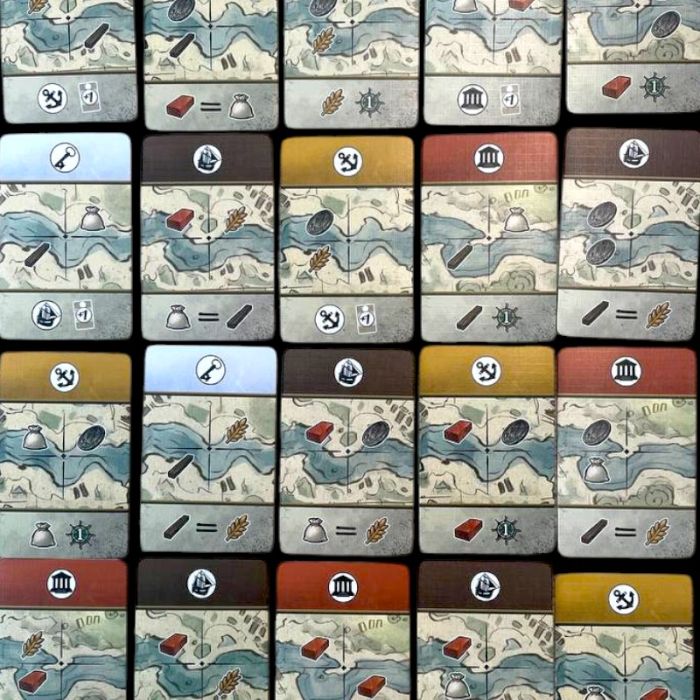
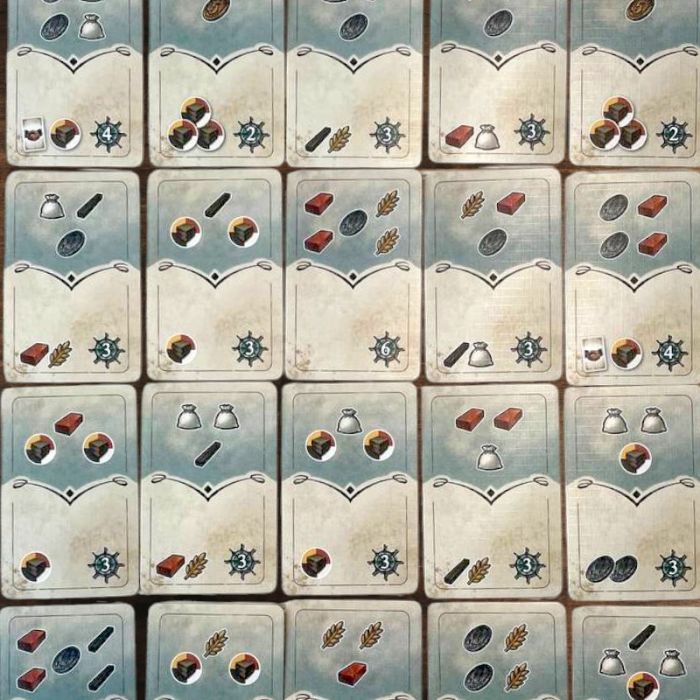
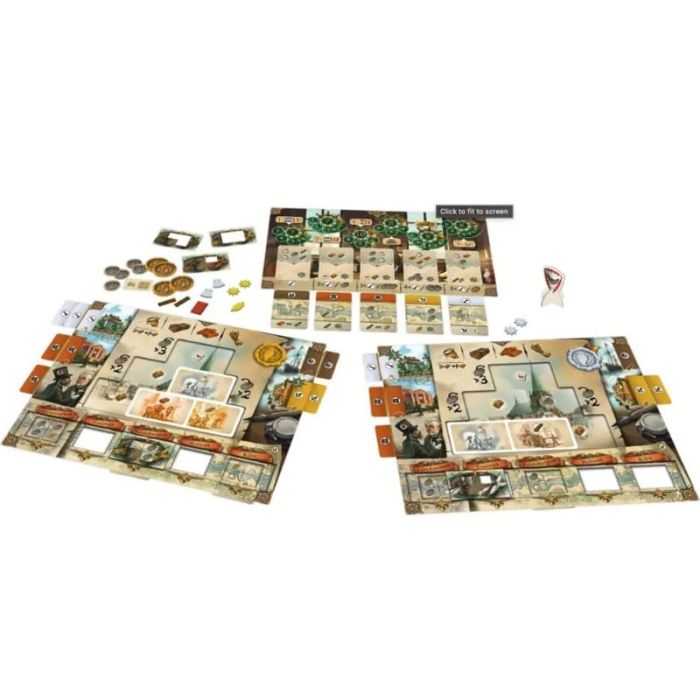
On your turn, you play just one card. You use it to obtain goods, to influence members of the city council, or to build a section of the canal. Then you pass the rest of the deck to the next player. There is no drawing: the deck circulates, and every choice you make changes the options for whoever comes next. The winner is the one who manages to build influence in multiple places simultaneously, without wasting resources.
International reception
"Kiel, Germany — the lively port city on the Baltic Sea — is the starting point for a project of the century: a canal from the Baltic Sea to the North Sea!"
— HUCH!
An eurogame that builds pressure without a timer: you know that if you don't take that card now, it won't be there in a turn's time.
— FroGames

Kilia
FrogScore · FroGames editorial rating · based on the rulebook, international reviews, and play sessionsYour levers
Four fronts on which to invest
Goods
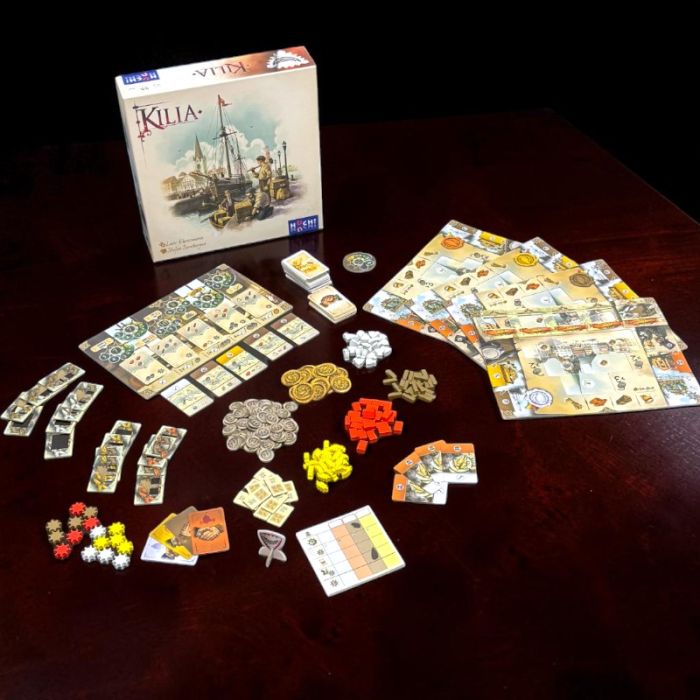
Wood, bricks, iron: the resources you need to build and to fulfill the most lucrative contracts. Each card can provide goods, but only if you play it in the right way.
Political influence
The members of the city council reward those who woo them first. The more influence you accumulate with each of them, the more victory points you gain at the end of the game.
Canal construction
The canal advances section by section. Contributing to its construction gives you immediate points and unlocks bonuses for subsequent turns.
Contracts
Short-term tasks that require specific combinations of goods. Completing them generates points and frees up space for new opportunities.
Come si gioca
Video dimostrativo di gameplay.
🎲How to playThe rules in four steps▼
How to play
The flow of each round
Each player, on their turn, plays only one card and passes the rest of the deck.
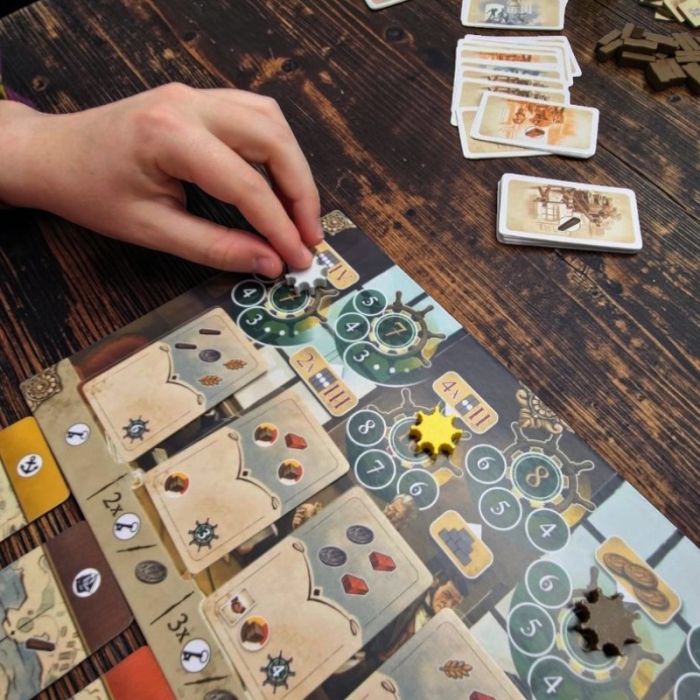
You look at your hand (or the deck you received) and choose one card to play. You decide whether to use it to obtain goods, influence a councilor, or build a section of the canal.
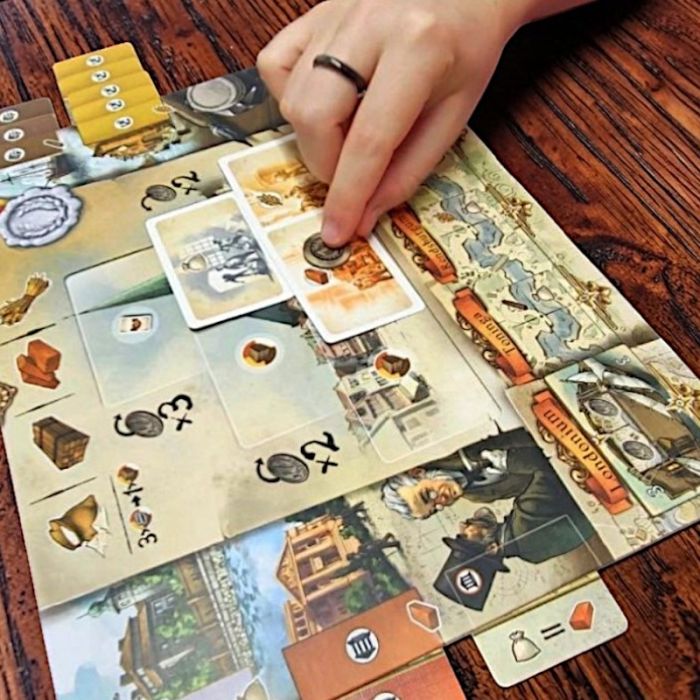
You apply the card's effect in the way you chose: you take resources, advance on an influence track, or contribute to construction. If you complete a contract, you declare it and take the points.
You pass the remaining cards to the next player. The deck circulates until it runs out, then it is shuffled and starts over.
You check if anyone has activated bonuses from canal construction or if new contracts should be added to the common market. Then the turn passes.
⏱️Your first gameThe chronicle, moment by moment▼
A game in five moments
What happens at the table
Not the rules. The experience.
Setup and first reads
The deck is on the table; the visible cards already show which goods will be rarer. Everyone studies their starting hand and decides which councilor to focus on. Someone immediately announces the first contract they want to complete.
The race for contracts
The first three rounds are fast: everyone tries to grab goods to close the simplest contracts. Those who hesitate discover that the best cards disappear from the deck before they return into circulation.
The canal advances
Halfway through the game, some start investing in the construction of the canal. Whoever contributes first unlocks bonuses that others must chase. The tension rises: every card played is watched by opponents.
Binding choices
The deck is now readable: you know which cards are missing, who used them, what remains. A single wrong choice can cost a contract or decisive influence. Someone changes strategy at the last minute, while others remain faithful to the plan.
Final scoring
Points from contracts, influence, and the canal are added up. Often, the winner is the one who diversified instead of betting everything on one area. Someone finds they lost by two points and knows exactly which card they should have played differently.
🐸Need to knowThree honest things, from friends▼
Need to know
Three things to keep in mind
The deck circulates: no hidden drawing
You don't draw cards at random. The deck passes from hand to hand, always visible. You must read what others have taken and understand what will remain when it returns to you. If you don't like mentally tracking cards, this system may feel opaque.
Each choice excludes the other two
Each card has three uses, but you only choose one. You can't have it all: if you take the goods, you give up on influence and construction. Those who struggle to make binding choices will become paralyzed.
Steep learning curve in the first rounds
The first game is slow: you don't immediately understand which use of the card is better. From the second game onwards, the game accelerates, but expect new players to slow down the table in the first rounds.
🏆Victory and defeatWhat the endgame rewards▼
How it ends
How to win and how to lose
The game ends when the deck runs out for the last time. Points are counted from three sources.
Victory
- Points from contracts completed during the game
- Points from influence accumulated on council members (each track is worth differently)
- Points from contributions to canal construction (progressive bonuses for those who participate earlier)
How to lose ground
- Playing cards without a plan: accumulating useless goods or scattered influence gets you nowhere
- Waiting too long: the best cards disappear from the deck and don't come back in time
- Focusing on only one area (only contracts or only the canal): those who diversify almost always win
Kilia is an eurogame that strips away the superfluous and leaves you only with the choices. If you are looking for a game that rewards efficiency and reading the table, this is the right place.
💬Frequently Asked QuestionsQuick answers before the cart▼
Frequently Asked Questions
FAQ about Kilia
What mechanics does Kilia use?
The heart of the game is the multi-use cards mechanic: each card can be played in three different ways (goods, influence, construction). The deck circulates among players without random drawing, so there is also an element of implicit drafting and shared hand management.
Is it suitable as a first eurogame?
Yes, with some help in the first rounds. The rules are simple (you play a card, choose how to use it), but understanding which choice is better requires experience. It's a good gateway for those who want to move from family games to medium-light eurogames, but not for those who have never played anything strategic.
Does it work well for 2 players?
Yes, the circulating deck system also works with two. The game is more tactical and less chaotic, because you can better predict which cards will return. With four, there is more unpredictability and more competition over contracts.
How long does a game last?
About 60 minutes after the first game. The stated duration is realistic: the game has a steady pace, without dead phases. Those who suffer from analysis paralysis might slow the table down slightly, but it rarely exceeds 75 minutes.
Is it available in Italian?
Yes, the edition distributed by GateOnGames is completely in Italian: the rulebook, cards, and tokens are all localized. Setup and the first game are immediate.
The people behind the game
Who invented it, who illustrated it, who publishes it — and what else they have done.
Kilia is a strategy game for 2-4 players (60 minutes, age 14+) designed by Lars Ehresmann and published by GateOnGames in an Italian edition. Set in late 19th-century Germany, Kilia brings the multi-use card mechanic to the table: each card can be played in three different ways (obtaining goods, exercising influence, or building the canal). The deck circulates among players without random drawing, creating constant tension over choices. The winner is the one who manages to diversify investments between contracts, the city council, and canal construction. An eurogame that rewards efficiency and reading the table, suitable for both experienced players and those looking for a gateway into European-style strategy. Available on FroGames.it.
Kilia
Frequently Asked Questions
The answers you're looking for, no beating around the bush.
📸Do the images match the actual product?
The photos on the website often come from BoardGameGeek and are intended to give you an idea of the game. They may vary slightly from the version you receive. The content declared by the publisher is always binding.
📦Does the content of the box match what is indicated?
We always strive to provide the correct content, but minor variations are possible due to reprints or updates. The information comes directly from the publishers. If you have any questions, please contact us!
⏳How do pre-orders work?
Pre-order the game before release, payment is immediate, and the game is reserved for you. As soon as it arrives, we'll ship it right away! If there are any delays, we'll update you promptly.
🔒Can I trust buying here?
Absolutely! Secure payments, tracked shipments, and a team that loves board games as much as you do. If something goes wrong, we'll do our best to fix it.
🛠There's a problem with my order, what should I do?
Write to us now! Whether it's a missing part, damage, or an error, we'll help you resolve it as soon as possible. Your experience truly matters to us.