
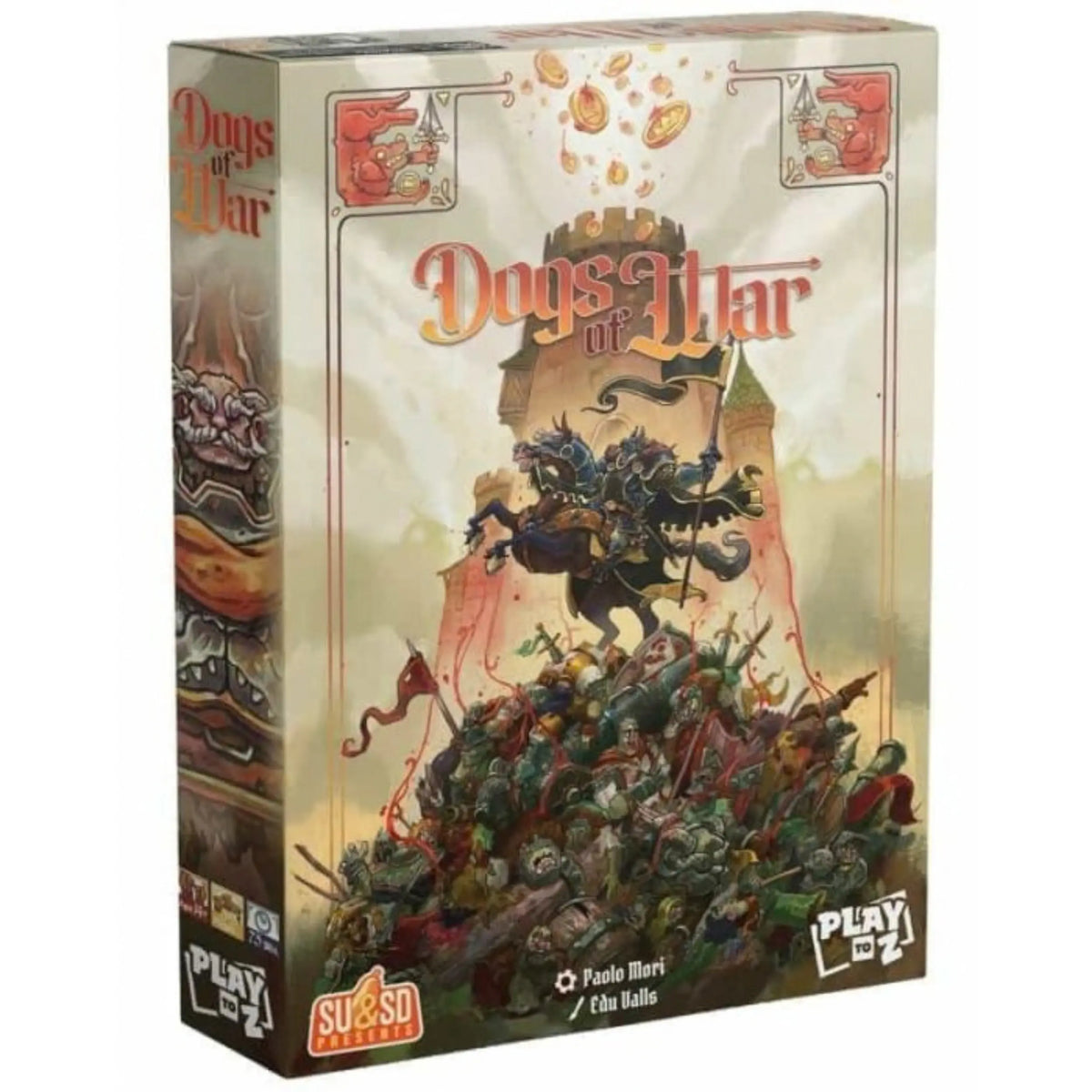
Dogs of War - Seconda Edizione
🐸 Details from BoardGameGeek
Consiglio BGG sul numero di giocatori
Categorie
Meccaniche
Design & Art
Lingua
🐸 How pre-orders work
🐸 A wise frog knows when to split the order… and when to wait for the right leap.
- Arrives
- November 13, 2026


Si abbina bene con
The FroGames Review
You deploy your captains for the house that promises the most gold. Then that house actually wins. And you switch sides again. In the end, all that matters is who you betrayed at the right moment.
WHAT IT'S ABOUT
Mercenaries in a collapsing kingdom: the winner is the one who sells victory to the highest bidder
Paolo Mori (Libertalia, Blitzkrieg!) brings the most cynical side of Renaissance Italy to the table: six noble houses exhausted by civil war, no decent army, and you — the Dogs of War, mercenary captains — who decide who wins and who loses. Art by Mathieu Harlaut and Christophe Madura, miniatures that bring each captain to life, and a setting that cites Shakespeare (Julius Caesar, Act III: "Cry 'Havoc!' and let slip the dogs of war").
Each turn you place your captains on the battlefields: where you put troops, that house has a better chance of winning. But if it wins, you gain influence with them — and influence is only worth points if that house is still standing at the end. So you must balance: help those who pay well today, betray those who will be too strong tomorrow, and figure out what the other mercenaries will do before they do it. Three rounds, six battles, alliances that last only as long as a siege.
What they say abroad
"A brilliant dance of shifting loyalties where your decisions matter more than your dice."
A brilliant dance of shifting loyalties where your decisions matter more than your dice.
— Meeple Mountain
You aren't tied to anyone. You're a mercenary. And that is the only truth that matters when the table is burning and everyone is watching your captains to see whose side you're on.
— FroGames

Dogs of War - Second Edition (Dogs of War)
FrogScore · editorial evaluation by FroGames · based on rules, international reviews, and gaming sessionsYour arsenal
Four levers to manipulate the kingdom
Mercenary captains
Each player has a unique set of captains (miniatures) with different military values. You place them on the battlefields: wherever you put strength, that house wins. But the strongest captain costs more to deploy, and gold is scarce.
Noble houses
Six houses fight in six battles each round. Whoever wins the battle takes the fiefdom and gives rewards to the mercenaries who helped them. You don't control the houses: you control who wins among them.
Influence tokens
Each battle won by a house gives you influence with them. Influence is worth victory points at the end of the game only if that house is still in play. Therefore, you help those you think will survive, not those you like.
Tactics and rewards
The houses offer gold, tactic cards (battle modifiers), or special orders (extra actions off-turn). You choose what to take when you deploy a captain: the immediate prize or long-term influence.
Come si gioca
Video dimostrativo di gameplay.
🎲How to playThe rules in four steps▼
How to play
The flow of each round
Three rounds identical in structure, but the table evolves: weak houses collapse, wealthy mercenaries dominate, and alliances crumble.
In turn, each player places one of their captains in one of the six ongoing battles (or passes and withdraws a captain already deployed). When you place, you immediately take the reward offered by that house: gold, tactical cards, or special orders. You continue until everyone has passed.
Each battle is resolved: you sum the strength of the captains deployed for each house and add any tactical cards played. The house with the most strength wins the fief. Whoever helped that house earns influence tokens (the more you have deployed, the more you get).
Houses that have lost too many battles are out of the game: their fiefs go to their rivals, and their influence over mercenaries becomes worthless (zero points at the end of the game). This is the moment that destroys plans: if the house you bet on collapses, you are in trouble.
You withdraw all captains, redistribute the rewards for the battles of the next round (they change every time), and pass the first player token. If it is the third round, you finish here and count the points. Otherwise, you start deploying captains again with the information from the round that has just concluded.
⏱️Your first gameThe chronicle, moment by moment▼
A game in five moments
What happens at the table
Not the rules. The experience.
Choose your mercenary
Each player draws a war dog with asymmetric power: one has cheaper captains, another earns gold from others' conflicts, a third manipulates rewards. Read the card and realize that the table will not be balanced. And that is exactly how it should be.
First captains, first lies
The first player places a captain in a battle. The others react: some counter, others jump on the move. The negotiations begin: "If you let me win here, I'll help you there." No one trusts anyone, but everyone talks. Gold is scarce, there are three strong captains, and six battles: you already realize you can't win them all.
Battles are resolved
End of the first round: forces are tallied, houses win or lose fiefs and distribute rewards. You look at your influence tokens and realize you bet on a house that is now weak. The others know it too. The second round will be a showdown.
The betrayal that changes everything
Midway through the third round: a player deploys their strongest captain to make the dominant house collapse instead of defending it. The table explodes. Verbal alliances become worthless. Someone laughs, someone swears. It is the moment everyone will talk about later.
The painful tally
The final battles are resolved. Three houses survive, three are ash. You count the points: influence with surviving houses, accumulated gold, battle trophies. Whoever betrayed everyone at the right moment wins. The second-place player curses because they were one captain short in a key battle. You put everything back in the box talking about what you would have done differently.
🐸Know this firstThree honest things, from friends▼
Know this first
Three things you must know before buying
Negotiation is free but not binding
You can promise anything at the table, but no rule forces you to keep it. This means that the game rewards those who know how to lie with a straight face and punishes those who trust too much. If your group hates betrayals, this is not the game for you. If, however, you love backstabbing, it is perfect.
Calculations at the end of the game, not during
In-game mechanics are fast (you place, take a reward, resolve a battle). But the final turn of the third round becomes a mental Excel sheet: you have to calculate which house will survive, how much influence you have with each, and whether it is worth winning or losing a battle. Those who suffer from analysis-paralysis will slow down the finale.
Better with 4-5, lukewarm with 3
With 3 players, the game works but loses its edge: battles have fewer captains deployed, alliances are forced (it's always 2 against 1), and the chaos decreases. Betrayal works when there are at least 4 heads to manipulate. 5 is the maximum: every battle is a negotiation table.
🏆Victory and defeatWhat the finale rewards▼
How it ends
How to win and lose
After three rounds, you count the points: influence with surviving houses, remaining gold, battle trophies. Whoever has the most points wins. But victory is never clear-cut: it is a matter of a captain placed poorly at the wrong time.
Victory
- Accumulate influence with 2-3 different houses, so if one collapses, you don't lose everything
- Win key battles that give you trophies (fixed points not tied to influence)
- Manipulate other players to collapse the houses they bet on, while leaving yours alive
Defeat
- Concentrate all influence on a single house and that house collapses mid-game
- Waste gold deploying strong captains in battles that end up not counting
- Others gang up against you (happens if you seem too far ahead mid-game)
It is not a wargame. It is a timing-of-betrayal game. And that makes it one of a kind.
💬Frequently asked questionsQuick answers before the cart▼
Frequently asked questions
FAQ about Dogs of War - Second Edition
What mechanics does Dogs of War - Second Edition use?
Area majority/influence (majority on battlefields), worker placement (place captains to take rewards), hand management (manage tactical cards), tug of war (houses facing off), asymmetric powers (each mercenary has a unique ability). The structure is Euro, the theme is Renaissance wargame.
Can you play without verbal negotiation?
Technically yes, but you lose half the game. The mechanics work even in silence (place captains, resolve battles, count points), but the heart is verbal manipulation: promises, threats, agreements that you then betray. If your group doesn't talk at the table, this game will be flat.
How much does luck count?
Very little. There are no dice; battles are resolved by the sum of deployed strength. The only random variable is the initial draw of the mercenary (asymmetric), but once chosen, you play only with information visible to everyone. Whoever calculates best wins, not whoever is lucky.
Are the miniatures functional or just aesthetic?
Functional: each captain is a miniature with a value printed on the base. You use them to deploy strength in battles. They are beautiful to see (detailed sculptures) but not essential: you could play with tokens. In the second edition, the quality of the minis has improved compared to the first.
Is it available in Italian?
Yes. This edition published by Studio Supernova is completely in Italian: rulebook, cards, tokens, references on the board. You don't need to know English to play.
The people behind the game
Who invented it, who designed it, who publishes it — and what else they have done.
Dogs of War - Second Edition is a competitive strategy game for 3-5 players by Paolo Mori, 75-minute duration, recommended age 14+. It uses area majority, worker placement, and shifting alliances mechanics: you control mercenary captains who fight for six noble houses in civil war, you earn influence with the houses you help win, but influence is only worth points if those houses survive until the end. Italian Renaissance theme (inspired by Shakespeare's Julius Caesar), cynical setting where betrayal is a game system. Published in Italian by Studio Supernova, it includes miniatures for all captains, tactical cards, and a modular battle board. Available on FroGames.it.
Dogs of War - Seconda Edizione
Frequently Asked Questions
The answers you're looking for, no beating around the bush.
📸Do the images match the actual product?
The photos on the website often come from BoardGameGeek and are intended to give you an idea of the game. They may vary slightly from the version you receive. The content declared by the publisher is always binding.
📦Does the content of the box match what is indicated?
We always strive to provide the correct content, but minor variations are possible due to reprints or updates. The information comes directly from the publishers. If you have any questions, please contact us!
⏳How do pre-orders work?
Pre-order the game before release, payment is immediate, and the game is reserved for you. As soon as it arrives, we'll ship it right away! If there are any delays, we'll update you promptly.
🔒Can I trust buying here?
Absolutely! Secure payments, tracked shipments, and a team that loves board games as much as you do. If something goes wrong, we'll do our best to fix it.
🛠There's a problem with my order, what should I do?
Write to us now! Whether it's a missing part, damage, or an error, we'll help you resolve it as soon as possible. Your experience truly matters to us.