
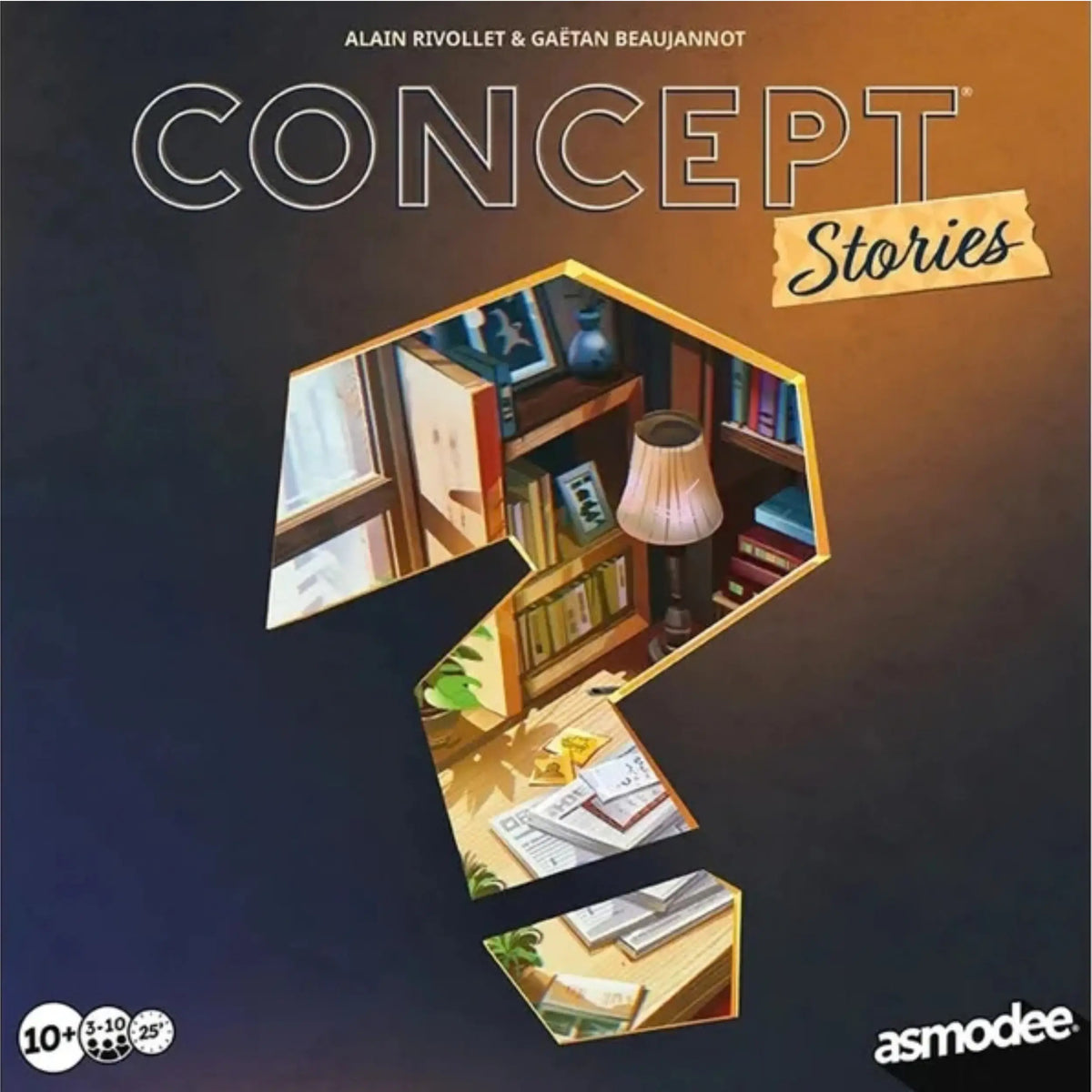

Concept Stories
🐸 Details from BoardGameGeek
Consiglio BGG sul numero di giocatori
Categorie
Meccaniche
Design & Art
Lingua
🐸 How pre-orders work
🐸 A wise frog knows when to split the order… and when to wait for the right leap.
- Arrives
- by the end of February 2027
Si abbina bene con
The FroGames sheet
You place pawns on icons. One after another, you watch the story take shape. When you reach the end, someone will say, 'did that really happen?' And yes, it really did.
WHAT IT'S ABOUT
Concept returns, and this time it tells true stories
Concept Stories adopts the communication system of the original Concept by Gaëtan Beaujannot and Alain Rivollet (winner of the 2014 Jeu de l'Année) and applies it to narrative. Same illustrator, Lesia Lu. Same idea: place pawns on a board of universal icons to make yourself understood without speaking or writing. But the focus changes: you are no longer guessing words or titles, you are telling incredible but true stories.
On your turn, choose one of the 110 story cards. Read the anecdote. Then tell it to the others, step by step, using only the icons on the board. The others watch, hypothesize, and mentally assemble the clues. The story is built together, one icon at a time, until you reach the end and someone exclaims: 'did it really happen like that?' Yes, it happened like that.
What they say abroad
"Communicating without speaking has always been the magic of Concept. In Stories, we put that magic at the service of the most incredible stories we have found."
— Repos Production
This is a game being released in 2027 and there are no verifiable reviews yet. This is a first read, based on official data and the legacy of the original Concept. We will update the sheet once we have our hands on the box.
— FroGames

Concept Stories
FrogScore · FroGames editorial rating · first read: based on the rulebook and official presentation, updated with first gamesWhat's in the box
Tools for telling without talking
Icon board
The same Concept system: dozens of universal illustrations (animals, colors, actions, emotions, locations) that, when combined, tell anything. It is your visual vocabulary.
110 story cards
Incredible true anecdotes taken from current events, history, science. Each card is a complete story for others to discover step by step.
Pawns and tokens
The pieces you place on the icons to build the story: question mark for the main concept, colored cubes for details, connectors for narrative links.
Pure cooperative mode
There is no real score: the goal is to make the story understood and enjoy the final reveal. Works with any number from 3 to 10 players, all involved.
🎲How to playThe rules in four steps▼
How to play
The flow of every story
No rigid turns: the story proceeds at the pace of the narrator and the table.
The narrator for the turn draws a story card and chooses which anecdote to tell from those offered. Difficulties range from the everyday to the absurd.
The narrator places pawns on the board's icons to communicate the story step by step. The other players observe, connect the clues, and propose hypotheses.
There isn't a precise moment for 'got it!': the story emerges gradually. The narrator confirms or adds details with new pawns until the picture is complete.
When the story is clear, the card is read to confirm the details. The turn passes to the next player. No score to keep: the goal is shared discovery.
⏱️Your first gameThe chronicle, moment by moment▼
A game in five moments
What happens at the table
Not the rules. The experience.
Choose the story
Draw a card. There are three or four stories on the card, with increasing difficulty. You choose one. You read it in silence. The others know nothing. You know everything and must make them understand it. Without words.
Start with the context
Place the green question mark on the first key icon. A place? An era? A character? The others begin to propose hypotheses. You listen and add pawns to guide them. The story begins to take shape, but they still don't know where it will end up.
Add details
Every pawn is a clue. Use the colored cubes to connect concepts, separate groups of icons to show distinct events. Someone begins to intuit the direction, someone asks for confirmation. You cannot answer with words, only by placing another pawn.
The plot twist
You reach the point where the story takes an unexpected turn. Place the icon no one expected. You see faces changing: 'wait, so you mean that…?' Do not confirm, but the next pawn makes everything clear. They are about to figure it out.
The revelation
Someone puts the clues together and says the story out loud. You confirm with a gesture. Take the card and read the complete anecdote. Half the table laughs, the other half can't believe it. 'Did that really happen?' Yes, it really happened. Someone asks to play the next one immediately.
🐸Good to knowThree honest points, from friends▼
Good to know
Three things to consider
Stories are consumable
110 stories might seem like a lot, but each story works only once: once told, everyone knows it. If you play often with the same group, you will finish the deck. There is no news of expansions yet.
It depends on the narrator
If the narrator is confused or places unclear icons, the story stalls. Not everyone is a good silent communicator, and the game does not offer timers or mechanisms to save a story that isn't taking off.
Stories are culturally marked
The true anecdotes come from different contexts: some will be immediate, others will require cultural references that not everyone at the table has. Perceived difficulty varies from player to player.
🏆Winning and losingWhat the ending rewards▼
How it ends
Objectives and conclusion
There is no winning or losing in a competitive sense. The goal is shared: to bring the story to light.
Complete story
- The table reconstructs the story in its key moments
- The narrator confirms that the general meaning has been grasped
- The card is read and everyone discovers the final details
Stalled story
- After many attempts, the table fails to connect the clues
- The narrator runs out of useful icons and the story remains opaque
- It is collectively decided to pass or reveal the solution
Concept Stories focuses entirely on narrative surprise and communicative creativity. If you love discovering incredible anecdotes and are looking for a cooperative party game without pressure, this is the right place for you.
💬FAQQuick answers before the cart▼
FAQ
Concept Stories FAQ
Do I need to know Concept (the original game) to play Concept Stories?
No, it is completely standalone. If you already know Concept, you already know how to communicate with icons, but the rules are explained from scratch in the box. You're ready in 5 minutes.
What mechanics does Concept Stories use?
It is a cooperative limited communication game: you use a shared visual language (the icons) to transmit information without speaking. A narrative component is added because you are not guessing single words but reconstructing a complete story step by step.
Does it work well with large groups or is it better with a few?
It scales from 3 to 10 players. With 3-5, everyone participates actively; with 6-10, it becomes more chaotic (more voices proposing hypotheses) but also more fun as a pure party game. There is no downtime: even when you are not the narrator, you are guessing.
How long do the 110 stories last?
It depends on how often you play. In one evening you play 4-6 stories (about 25 minutes each). If you play every week with the same group, you will have seen them all in 4-5 months. If you play occasionally or with different groups, it lasts much longer. The limitation is that each story works only once: those who have already heard it can no longer 'guess' it.
Is it available in Italian?
Yes, the edition we sell is in Italian, distributed by Asmodee Italia. All story cards and the rulebook are translated.
The people behind the game
Who invented it, who designed it, who publishes it — and what else they've done.
Concept Stories is a cooperative narrative game for 3-10 players, 25 minutes per game, ages 10+, designed by Gaëtan Beaujannot and Alain Rivollet (authors of the award-winning Concept) and published by Repos Production for Asmodee. It uses the visual communication system of the original Concept applied to storytelling: 110 incredible true stories to tell by placing pawns on universal icons, without speaking or writing. Purely cooperative, no competitive scoring, perfect as a party game or family game for those who love discovering surprising anecdotes and testing themselves as silent communicators. Available on FroGames.it.
Frequently Asked Questions
The answers you're looking for, no beating around the bush.
📸Do the images match the actual product?
The photos on the website often come from BoardGameGeek and are intended to give you an idea of the game. They may vary slightly from the version you receive. The content declared by the publisher is always binding.
📦Does the content of the box match what is indicated?
We always strive to provide the correct content, but minor variations are possible due to reprints or updates. The information comes directly from the publishers. If you have any questions, please contact us!
⏳How do pre-orders work?
Pre-order the game before release, payment is immediate, and the game is reserved for you. As soon as it arrives, we'll ship it right away! If there are any delays, we'll update you promptly.
🔒Can I trust buying here?
Absolutely! Secure payments, tracked shipments, and a team that loves board games as much as you do. If something goes wrong, we'll do our best to fix it.
🛠There's a problem with my order, what should I do?
Write to us now! Whether it's a missing part, damage, or an error, we'll help you resolve it as soon as possible. Your experience truly matters to us.