

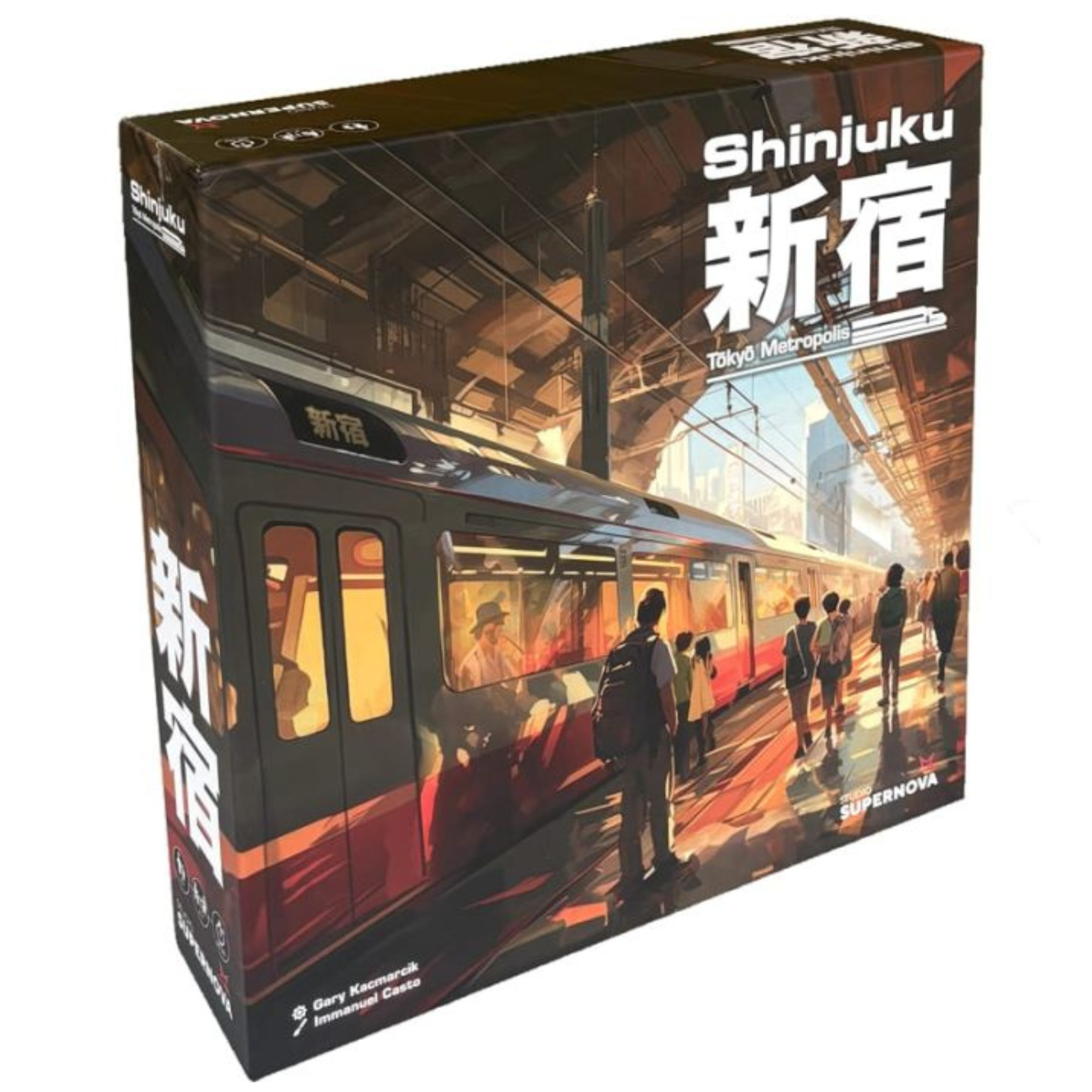
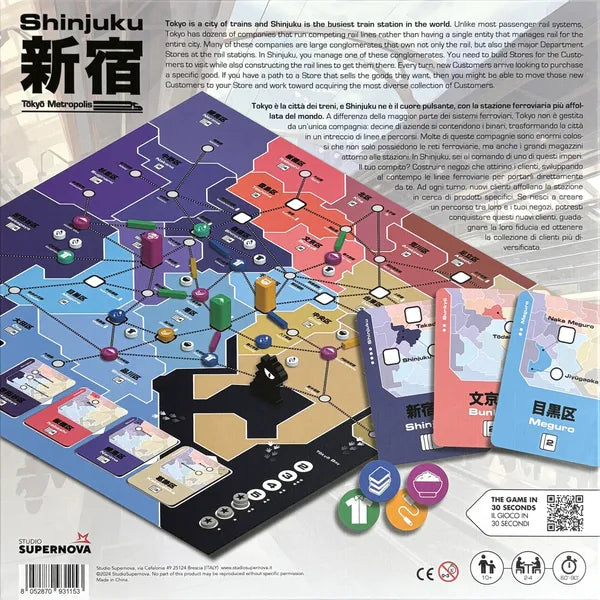
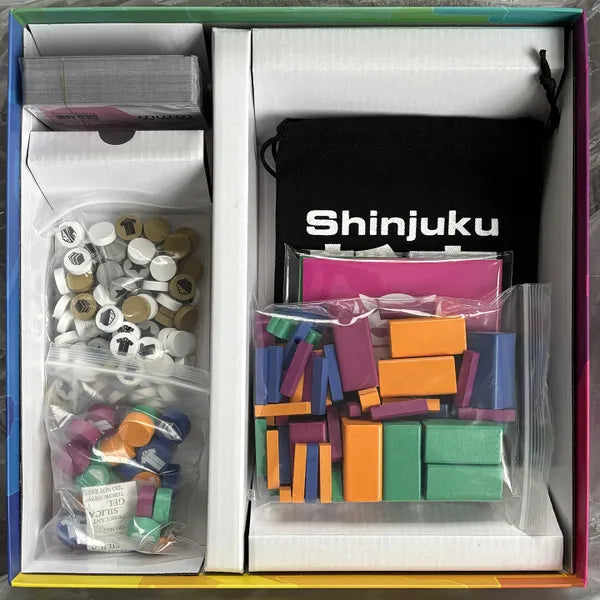
Shinjuku
🐸 Dettagli da BoardGameGeek
Consiglio BGG sul numero di giocatori
Categorie
Meccaniche
Design & Art
Lingua






Pairs well with
The FroGames Card
You have four cards in hand and must choose whether to build a store in Shibuya or extend the railway towards Shinjuku. But if you wait a turn, you might draw that location you need. Or someone else might get there first.
WHAT IT'S ABOUT
Build commercial conglomerates in Tokyo of department stores
Gary Kacmarcik (designer, artist alongside Immanuel Casto and Rokkakudō DADA) brings modern Tokyo to the table as the stage for a competition made of stores, railway lines, and demanding customers. Initially published by rigoler in Japan in 2024, Shinjuku arrives in Italy with Studio Supernova and brings with it a mathematical elegance reminiscent of 90s German classics.
On your turn, choose two different actions from five possible: build a store, extend your railway line, upgrade to a department store, draw cards as income, or move customers along your tracks to your sales points. Each location card that corresponds to a place where you have already built becomes a wildcard: from that moment on, it can represent any other place. More stores = more flexibility. The game ends one round after the last customer arrives, and the player with the most sets of satisfied customers wins.
What they say abroad
"In Shinjuku, a strategic network-building and pick-up-and-deliver board game, you build stores in Tokyo and the rail lines to connect them so that you can build the most successful shopping/rail conglomerate."
— リゴレ (rigoler)
A system of location cards that transform into wildcards as you build is a simple but brilliant idea: it rewards you for expanding and at the same time gives you increasing flexibility.
— FroGames

Shinjuku
FrogScore · FroGames.it editorial rating · based on rules, international reviews, and gameplay sessionsYour tools
Four elements that build your network
Stores
Build sales points on specific map locations. Each store you open transforms that location card into a wildcard: from that moment on, it can represent any other place. More stores = more flexibility.
Railway lines
Expand your rail network by connecting locations. Customers only move along YOUR lines, so you need to build the routes BEFORE the right requests arrive. Each section is a future promise.
Department stores
Upgrade an existing store to a department store. It costs more but allows you to serve more types of customers in one place. It's the investment that changes the value of a strategic location.
Customers
New ones arrive on the map every turn, each looking for one of the four goods. You move them along your tracks to your stores. Collect complete sets (one for each type of good) to maximize points.
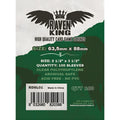
Recommended sleeves 147 cards in 2 sizes ▼
If you play often, we recommend protecting your cards with clear sleeves to make them last longer.
| Size | Quantity |
|---|---|
| 63.5 × 88 mm | 74 |
| 63 × 88 mm | 73 |
| Total cards | 147 |
Come si gioca
Video dimostrativo di gameplay.
🎲How to playThe rules in four steps▼
How to play
The flow of each round
Each player takes a complete turn, then it's the next player's turn. During your turn: always two different actions.
Five options: (a) build a store by playing a location card, (b) expand your railway by playing a location card, (c) upgrade to a department store, (d) draw cards as income, (e) move customers along your railways. Choose one, perform it.
Same five options, but you must choose a different one from the first. You cannot build twice or move twice in the same turn. This limitation forces you to vary your actions.
After everyone has taken their turn, new customers are drawn from the deck and placed on the map at the indicated locations. Each seeks one of the four goods. Demand grows.
When the last customer has been placed, one full round is played to give everyone the same number of turns. Then sets are counted: each complete set (one customer for each of the four goods) is worth more than individual customers.
⏱️Your first gameThe chronicle, moment by moment▼
A game in five moments
What happens at the table
Not the rules. The experience.
The first locations
You look at the four cards in your hand and the empty map. Shibuya? Shinjuku? Someone builds immediately, someone draws cards to see other options. No one knows yet what the winning network will be, but everyone is already planning in their heads.
The first customers arrive
The map fills with colored meeples. You built in Ikebukuro but customers appeared on the other side. Someone laughs, someone curses. You start to realize you need to move preemptively, not chase after them.
Wild cards change everything
You have three stores and now half of your cards are wild cards. You can build wherever you want, expand where needed, react to other players' customers. The feeling of control grows and the network takes shape. This is when the game rewards you.
The race for sets
Someone has already collected a complete set of customers (one for each good). You have three out of four and are desperately looking for that fourth type. Every turn you count the other players' points and recalculate your possibilities.
The last customer
The last meeple arrives on the map. You still have one turn to move, deliver, complete the last set. Then collected customers and complete sets are counted. The most efficient network wins, not the largest.
🐸What to know beforehandThree honest things, from friends▼
What to know beforehand
Three things to keep in mind
The hand of cards is small
You start with four cards and draw one per turn (if you choose the income action). It seems little, but wild cards — those that correspond to locations where you have already built — compensate. At the beginning, you feel limited, after 3-4 turns you have more options than you can use.
The game is faster than it seems
The declared 60 minutes are realistic once you've learned. But the first two games will be slower: you need to understand when to invest in the network and when in delivery. Expect 75-90 minutes the first time, then it runs smoothly.
The map is fixed
Tokyo doesn't change. The locations are always the same, the distances too. After 5-6 games, you start to recognize key positions (nodes, central locations) and the game loses a bit of its discovery. The tactical challenge remains, but the sense of exploration fades.
🏆Victory and defeatWhat the end rewards▼
How it ends
How to win and how to lose
The player who has collected the most complete sets of customers wins. Individual customers (outside of sets) are worth less.
Victory
- Collect complete sets of customers (one for each of the four types of goods). Each set is worth a lot.
- Build the most efficient network: as few routes as possible, maximum coverage. Every turn wasted on unnecessary expansion is a turn not spent on delivery.
- Transform your locations into wild cards quickly: more stores = more flexibility = more ability to react to other players' customers.
Common mistakes
- Building too many stores far apart: the railway doesn't arrive in time and customers get stuck.
- Not upgrading to a department store: you serve only one type of customer per location and lose efficiency.
- Waiting too long to move customers: at the end of the game you find yourself with a beautiful network but few completed sets.
Shinjuku is pure network strategy, without frills. If you're looking for a game where every choice matters and the map rewards you for thinking ahead, this is your place.
💬Frequently asked questionsQuick answers before checkout▼
Frequently asked questions
FAQ about Shinjuku
What mechanics does Shinjuku use?
Network and route building (build railway lines connecting locations), pick-up and deliver (move customers along your rails to stores), hand management (manage a small hand of location cards that become wild cards as you expand), and point-to-point movement (customers move between specific nodes, not freely). It's a spatial optimization Eurogame.
Is it good as a first "network" game?
Yes, the rules can be explained in 15 minutes and the structure is linear (two actions per turn, five clear options). The depth emerges from playing, not reading the manual. It's a good bridge between family games and classic German strategy games, without being punitive.
Does it change much with two players?
The pace changes. With two players, you have more control (less direct competition for locations, less customer chaos) and the game becomes more analytical. With four, it's more chaotic: someone snatches the location you wanted, customers accumulate in unexpected places. Both work, but the experience is different.
How much does luck matter in card drawing?
Initially it matters: if you draw the right cards, you build faster. But the wild card system levels the playing field after 3-4 turns: those who built well have flexibility, those who waited still have specific cards. Luck is present but doesn't dominate. The BGG weight is 2.5, which is accurate.
Is it available in Italian?
Yes, this is the Italian edition by Studio Supernova. Rulebook, location cards, map references: all in Italian. The game uses very little text (mostly icons and Tokyo neighborhood names), so language has little impact on gameplay once learned.
The people behind the game
Who invented it, who designed it, who publishes it — and what else they've done.
Shinjuku is a strategy game for 2-4 players, lasting 60 minutes, recommended age 10+. Designed by Gary Kacmarcik and published in Italy by Studio Supernova, it brings to the table the competition between commercial conglomerates in modern Tokyo through network building, pick-up and deliver, and hand management. Each turn you choose two different actions from building stores, expanding railways, upgrading, drawing cards, or moving customers. Location cards that correspond to places where you have already built become wild cards, giving you increasing flexibility. The game ends after the last customer arrives, and the player who has collected the most complete sets wins. Complete Italian edition, available on FroGames.it.
Shinjuku
Frequently Asked Questions
The answers you're looking for, no beating around the bush.
📸Do the images match the actual product?
The photos on the website often come from BoardGameGeek and are intended to give you an idea of the game. They may vary slightly from the version you receive. The content declared by the publisher is always binding.
📦Does the content of the box match what is indicated?
We always strive to provide the correct content, but minor variations are possible due to reprints or updates. The information comes directly from the publishers. If you have any questions, please contact us!
⏳How do pre-orders work?
Pre-order the game before release, payment is immediate, and the game is reserved for you. As soon as it arrives, we'll ship it right away! If there are any delays, we'll update you promptly.
🔒Can I trust buying here?
Absolutely! Secure payments, tracked shipments, and a team that loves board games as much as you do. If something goes wrong, we'll do our best to fix it.
🛠There's a problem with my order, what should I do?
Write to us now! Whether it's a missing part, damage, or an error, we'll help you resolve it as soon as possible. Your experience truly matters to us.