

Finca
🐸 Dettagli da BoardGameGeek
Consiglio BGG sul numero di giocatori
Categorie
Meccaniche
Design & Art
Lingua
Pairs well with
The FroGames Card
The windmill turns, you choose where to land. Three almonds, two oranges? No, wait: you need a lemon to close that deal. But if you go there now, someone else will snatch the best market. The wind blows, and you have to decide. Immediately.
WHAT IT IS ABOUT
Harvest and Trade under the Mallorcan Sun
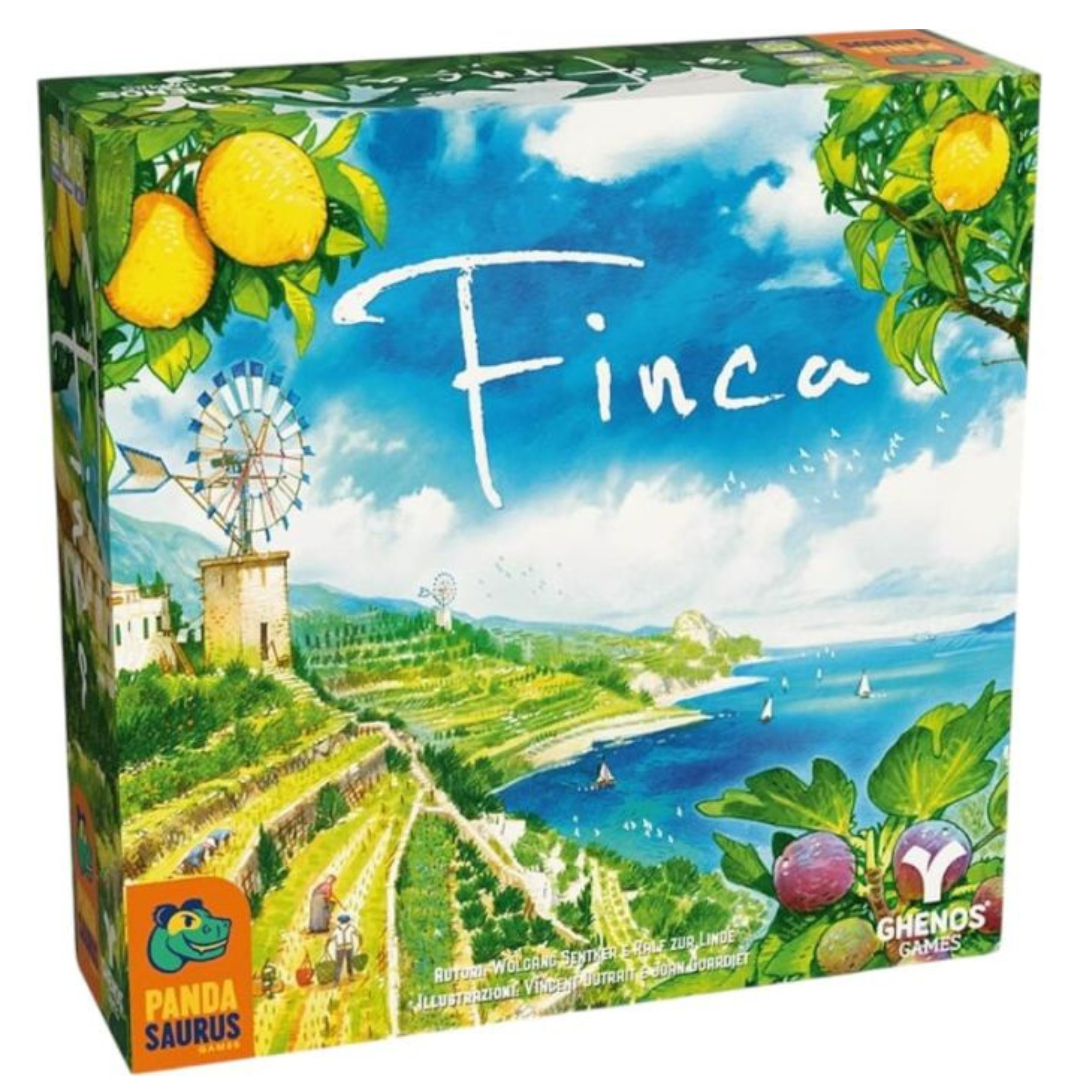
Finca was created in 2009 through the collaboration of Wolfgang Sentker and Ralf zur Linde, with Mediterranean illustrations by Vincent Dutrait. The game was nominated for Spiel des Jahres 2009 and won the Hungarian Boardgame Prize in 2011. Set in Majorca, it transforms the island's agricultural rhythm into an elegant and accessible resource management system.
At the center of the board is a traditional windmill divided into sectors, each with a type of fruit: oranges, lemons, almonds, figs, grapes, fish (in the new edition). You move your workers on the windmill using a mancala mechanic: you take all the workers from one sector, distribute them one by one clockwise, and collect the fruits where you land. Then you deliver sets of fruits to the island's markets to earn points. The player who best optimizes the windmill rotations and anticipates the most profitable markets wins the game.
What they say abroad
"An elegant design that turns a simple mechanism into genuine strategic choices."
An elegant design that turns a simple mechanism into genuine strategic choices.
— The Opinionated Gamers
Finca presents itself as a family game with more depth than it seems at first glance. The mancala mechanic applied to movement creates a timing puzzle where every move influences others' possibilities. After a few games, this page will be updated with more precise impressions.
— FroGames

Finca
FrogScore · FroGames editorial rating · based on rules, international reviews and play sessionsGame pieces
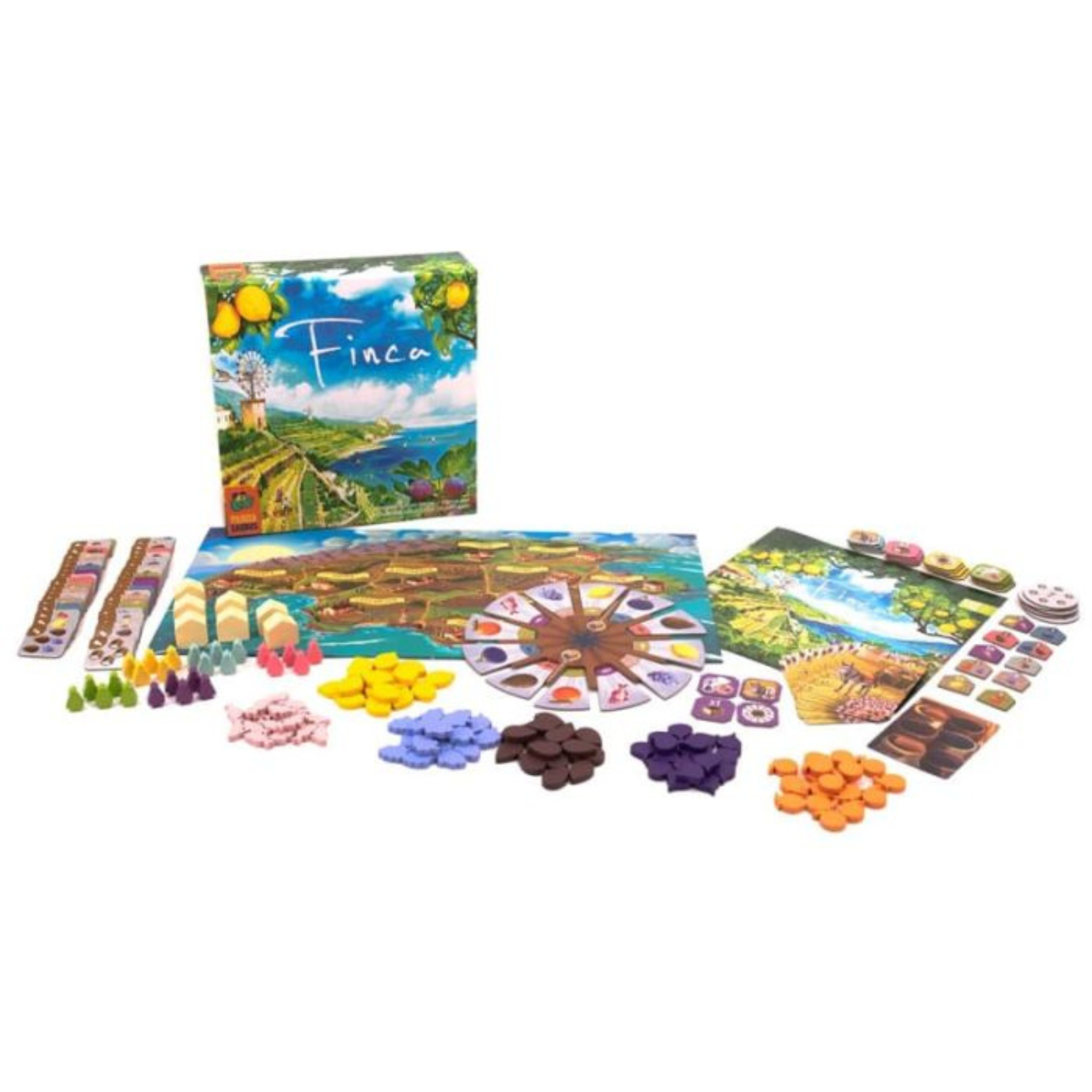
What you'll find in the box
The central windmill
Divided into 6 sectors, each with a type of fruit or resource. Workers move from sector to sector like in a mancala: you take all of them from one wedge, distribute them one by one, and collect where you land. Each rotation changes the landscape of subsequent moves.
Fruits and resources
Oranges, lemons, almonds, figs, grapes, and fish (new in the 2024 edition). Each fruit has a different frequency on the windmill: some abundant, others rare. Collect sets to fulfill market contracts scattered across the island.
Market tiles
Distributed on the Majorca board, they show which fruit sets are required and how many points they are worth. The first to deliver gets the biggest bonus. After each delivery, new tiles enter play. The market empties quickly, and those who delay lose out.
Workers and carts
Each player controls 5 workers on the windmill and a cart that transports fruits to the markets. The cart has limited capacity, so you have to balance: collect all you can, or deliver before someone else snatches the best market?
Recommended sleeves 10 cards in 1 size ▼
If you play often, we recommend protecting your cards with clear sleeves to make them last longer.
| Size | Quantity |
|---|---|
| 63 × 89 mm | 10 |
| Total cards | 10 |
Come si gioca
Video dimostrativo di gameplay.
🎲How to playThe rules in four steps▼
How to play
The flow of each turn
Three simple actions, repeated until someone reaches the victory point threshold. No complex phases, no maintenance. Just: move, collect, deliver.
Take all your workers from a section of the mill. If there's only one, you move it one segment. If there are four, you distribute them one by one across four sections clockwise. The distance you cover depends on how many workers you had accumulated there.
In the last section where you placed a worker, collect as many fruits of that type as there are total workers present (yours and others'). If you land in a crowded section, you get a lot. If it's empty, you get little. The mill rewards those who position themselves in the right places at the right time.
If you have a set of fruits that matches a market tile, you can deliver them and take points. The first to deliver to a market gets the highest bonus; those who arrive later get less. Some tiles run out, others remain available. Decide whether to rush immediately or accumulate for a larger load.
Every time someone delivers, new market tiles are drawn from the deck and placed on the board. This keeps the pressure constant: there are always new opportunities, but also new competition. The game ends when a player reaches the point threshold (varies depending on the number of players).
⏱️Your first gameThe chronicle, moment by moment▼
A game in five moments
What happens at the table
Not the rules. The experience.
First rotations
Everyone studies the mill and the open market tiles. Someone makes a conservative move, takes two oranges, and stops. Someone else spins half the mill and collects an almost complete set. No one has yet understood how important timing is. It seems like a quiet game.
The first contested market
Two players aim for the same lucrative market. One gets there first, delivers, takes 5 points. The other is left with fruits in hand and a dejected expression. Now everyone understands: he who hesitates loses. The pace becomes more tense.
Traffic jam at the mill
Workers accumulate in certain sections of the mill. Those who move from there collect a huge amount of fruit, but then leave that section empty for the next ones. Gaps and opportunities are created. Someone makes a brilliant move, takes advantage of a full section left by an opponent, and turns the game around.
Rare tiles
Markets requiring rare fruits come into play: figs, grapes, fish. They are worth a lot, but require precise moves on the mill to collect them. Those who planned well are already positioned. Those who improvised find themselves with incomplete sets and must choose: sacrifice a turn to reposition or settle for smaller markets?
The last load
Few market tiles remain. Points are counted. A player makes the last perfect delivery: 7 points that put him in the lead. The others count their remaining fruits and realize they are no longer enough. The mill stops. Someone says 'One more' even before counting the final points.
🐸What to know beforehandThree honest things, from friends▼
What to know beforehand
Three things a friend would tell you
Downtime increases with 5 players
With 2-3 players, games are fluid and fast. With 5, the time between your turns lengthens, and you have to wait for four people to move, collect, and decide before playing again. The tension remains, but the pace slows down. If your group is sensitive to downtime, keep it at 3-4 players.
After many games, patterns emerge
The first 10-15 games are great: you discover strategies, learn to read the mill, and refine your timing. After 30+ games, some paths on the mill become obvious, and experienced players repeat similar moves. This is not a problem for casual family gaming, but if you're looking for infinite depth, you might find a ceiling.
Planning required
Finca seems casual but punishes those who improvise. You need to calculate 2-3 turns ahead: where you will land, how many workers you leave, which markets are still accessible. If there are players at the table who suffer from analysis paralysis, be prepared for some pauses for thought. It's not a party game to be played distractedly.
🏆Victory and defeatWhat the ending rewards▼
How it ends
How to win and how to lose
The game ends when a player reaches the victory point threshold (depends on the number of players: 16 points for 2, 15 for 3, 14 for 4, 13 for 5). At that point, whoever has the most points wins.
Victory
- Be the first to reach the point threshold by delivering sets of fruits to the most lucrative markets
- Optimize timing: arrive at markets before opponents, taking high bonuses
- Exploit sections of the mill where other players' workers accumulate, maximizing your harvests
Defeat
- Always come in second on contested markets: you get fewer points and return the tiles to others
- Move workers without planning: you land on empty sections, collect little, waste turns
- Ignore rare markets: you accumulate common fruits while others complete high-value contracts
Finca is one of those games that seem simple on the surface but open up with each game. The mancala mechanic transforms movement into a spatial puzzle where every choice has ripple effects. It's not the most original game of 2024, but it's a classic that deserves a place at the table.
💬Frequently Asked QuestionsQuick answers before checkout▼
Frequently Asked Questions
FAQ about Finca
What mechanics does Finca use?
Finca combines mancala (redistributed movement), set collection (collect combinations of fruits), pick-up and deliver (transport resources to markets), and a system of variable contracts. The heart of the game is the central mill: you move workers by distributing them one by one, and you collect where you land. Simple to explain, profound to master.
Does it work well with 2 players?
Yes, many even prefer Finca with 2-3 players. With fewer people, the game is more tactical and faster, downtime is almost zero, and you can plan your moves better. With 5 players, competition in the markets is fiercer, but the game takes longer. If you're looking for a light strategic duel, Finca with 2 works very well.
How deep is it compared to other family games?
Deeper than Ticket to Ride, less than Concordia. Finca is in the middle: accessible rules in 10 minutes, but tactical choices emerge immediately. It's not a pure gateway game (it requires 2-3 turn planning), but it's not a medium-weight game that scares off newcomers either. Ideal for those who want a step beyond introductory classics without too much complexity.
What changes in the Pandasaurus 2024 edition?
The 2024 edition from Pandasaurus Games introduces two novelties: support for up to 5 players (previous editions went up to 4) and replaces olives with fish as the sixth resource. The mechanics remain identical. Vincent Dutrait's illustrations have been revised, and the board is brighter. If you have the old Hans im Glück edition, you're functionally playing the same game.
Is it available in Italian?
Yes, the edition sold on FroGames is in Italian. It includes rules, cards, and components fully localized. The game has minimal language dependence (market tiles only show fruit icons), so even if you played in English, you wouldn't have problems, but having the manual in Italian makes teaching immediate.
The people behind the game
Who invented it, who designed it, who publishes it — and what else they've done.
Finca is a strategy and resource management game for 2-5 players, set in Mallorca, lasting 45 minutes. Designed by Wolfgang Sentker and Ralf zur Linde, nominated for the Spiel des Jahres 2009, it uses a mancala mechanic applied to worker movement on a central mill. Players collect fruits (oranges, lemons, almonds, figs, grapes, fish) and deliver them to the island's markets to earn victory points. Published by Pandasaurus Games in the 2024 edition, with illustrations by Vincent Dutrait. Weight 2.1/5, accessible yet with tactical depth. Available on FroGames.it.
Finca
Frequently Asked Questions
The answers you're looking for, no beating around the bush.
📸Do the images match the actual product?
The photos on the website often come from BoardGameGeek and are intended to give you an idea of the game. They may vary slightly from the version you receive. The content declared by the publisher is always binding.
📦Does the content of the box match what is indicated?
We always strive to provide the correct content, but minor variations are possible due to reprints or updates. The information comes directly from the publishers. If you have any questions, please contact us!
⏳How do pre-orders work?
Pre-order the game before release, payment is immediate, and the game is reserved for you. As soon as it arrives, we'll ship it right away! If there are any delays, we'll update you promptly.
🔒Can I trust buying here?
Absolutely! Secure payments, tracked shipments, and a team that loves board games as much as you do. If something goes wrong, we'll do our best to fix it.
🛠There's a problem with my order, what should I do?
Write to us now! Whether it's a missing part, damage, or an error, we'll help you resolve it as soon as possible. Your experience truly matters to us.