

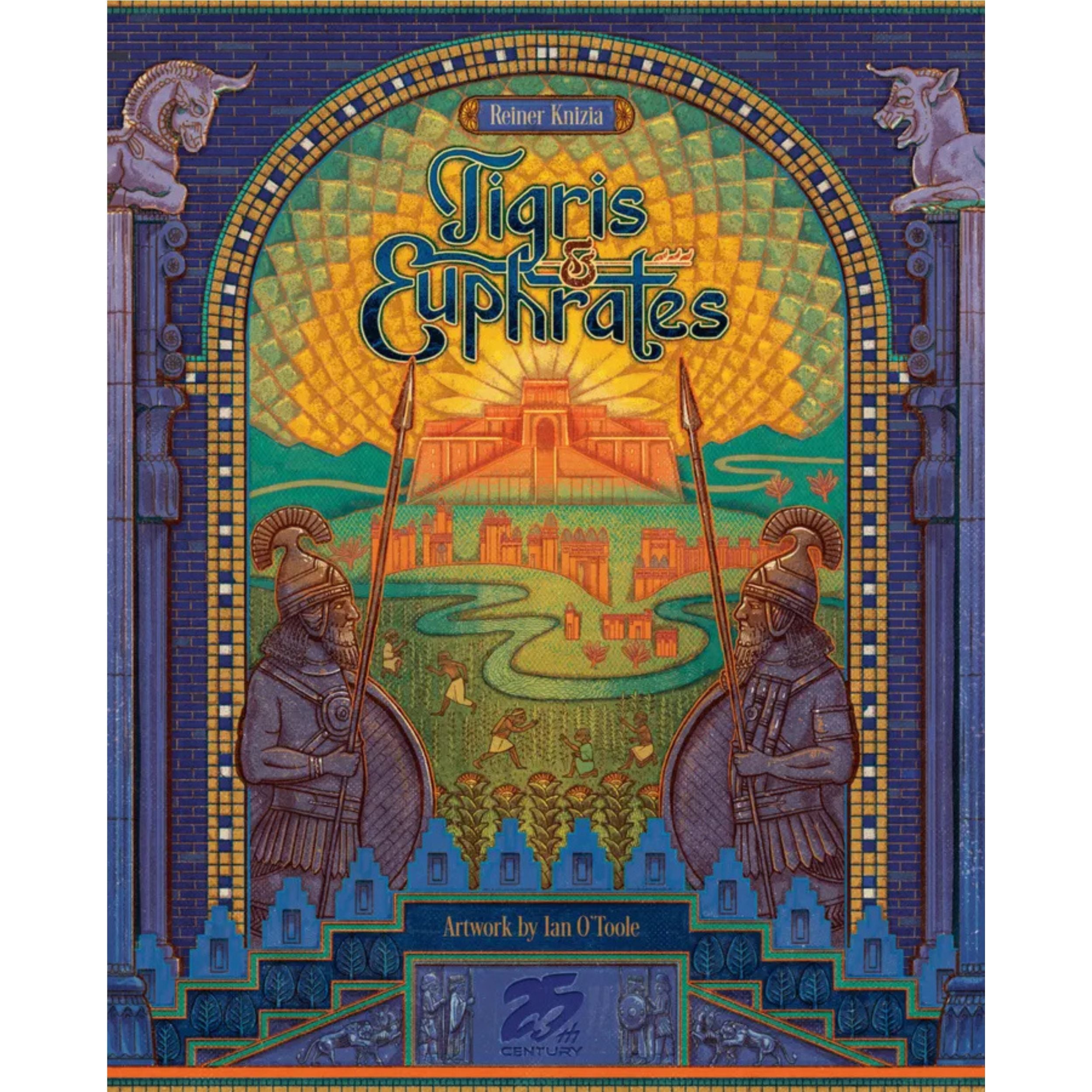

Tigris & Euphrates - and other wooden versions
🐸 Dettagli da BoardGameGeek
Consiglio BGG sul numero di giocatori
Categorie
Meccaniche
Design & Art
Lingua
Pairs well with
The FroGames Card
You have three colors over twenty points and one stuck at four. You win with four. You look at the table: every move that strengthens one leader weakens another. Someone laughs, you don't.
WHAT IT IS ABOUT
Four civilizations, a river, and the rule that changes everything
Designed by Reiner Knizia in 1997, Tigris & Euphrates is considered his absolute masterpiece. Set in the Fertile Crescent, between the Tigris and Euphrates rivers, the game uses a radical abstraction: four colors (agriculture, trade, religion, government) represent the aspects of each civilization. The art varies between editions; Ian O'Toole's version for 25th Century Games has renewed the aesthetics without betraying the mechanics.
Each player controls four leaders, one for each color. You place tiles on the board to expand kingdoms, build monuments, and trigger conflicts. You collect points in all four colors. But at the end of the game, your score is the color in which you have the fewest points. This rule—called highest-lowest scoring—forces you to balance everything. You cannot specialize. You must build a complete civilization or lose.
What they say abroad
"A masterpiece of elegant, unforgiving design."
A masterpiece of elegant, unforgiving design.
— Shut Up & Sit Down
Tigris & Euphrates is a game that rewards those who see three moves ahead and punishes those who only think of one color. Every tile you place is a promise you'll have to keep in subsequent turns, and every conflict is a gamble on what you can afford to lose.
— FroGames

Tigris & Euphrates
FrogScore · FroGames editorial rating · based on rules, international reviews, and gameplay sessionsYour Tools
Four leaders, tiles, conflicts
Four Leaders
King (black), Priest (red), Merchant (green), Farmer (blue). You place a leader to control a kingdom. If someone places a leader of your color in your area, an internal conflict erupts. The loser withdraws their leader.
Civilization Tiles
Draw from the bag, place on the board. Each tile expands a kingdom or creates a new one. If you merge two kingdoms with two kings, an external conflict erupts: the stronger one absorbs the other. Captured leaders return to hand.
Monuments
Build a monument on a 2x2 square of tiles of the same color. The monument cannot be destroyed and generates points each turn for whoever has the corresponding leader in the kingdom. The ziggurat expansion adds an even more powerful 5-tile monument.
Conflicts and Treasures
In conflicts, you play tiles from your hand to strengthen your leader. Win: gain points. Lose: your leader returns to your hand. Treasures are wild tiles worth 3 in any conflict, but they are rare and do not give points at the end of the game.
🎲How to playThe rules in four steps▼
How to play
The flow of each turn
Two actions per turn. Then draw to return to six tiles. Simple in theory, devastating in practice.
You place a leader on a tile of their color in a kingdom. If there is already a leader of that color in the kingdom, an internal conflict erupts: whoever has more supporting tiles of that color wins, the other withdraws their leader.
You place a civilization tile on the board, adjacent to another tile or river. If the tile connects two kingdoms, an external conflict erupts for each type of duplicated leader. Or discard two tiles to build a monument on a 2x2 square.
If you have triggered a conflict, play tiles from your hand to strengthen your leader. The opponent does the same. Whoever has more support wins and takes red points (religion) or black points (government). Treasures are worth 3 but are limited.
If you have a leader in a kingdom, take a cube of its color for each corresponding tile/monument. Then draw tiles up to six. If the tiles run out, the game ends. Each player counts their weakest color: that is the final score.
⏱️Your first gameThe chronicle, moment by moment▼
A game in five moments
What happens at the table
Not the rules. The experience.
The first kingdoms
Everyone places tiles near the river, nobody too aggressive. Someone builds a red temple, someone else a blue farm. You still don't understand which color will be your problem. Everything seems under control.
The first external conflict
Someone places a tile connecting two kingdoms. Two kings in the same kingdom: impossible. War erupts. Whoever has more black tiles in hand wins, the other withdraws their king and loses control. The table understands that every expansion is a risk.
The race for monuments
Someone builds a red monument. Each turn, their priest gains a free point. Others try to build one, but it requires four tiles of the same color in a square. Some succeed, some fail and leave a weak configuration that others exploit.
The weak color emerges
Mid-game, you look at your cubes. Eighteen red, sixteen green, twelve blue, five black. You know you need to recover black, but every turn you use to place a black leader is a turn you don't use to defend other colors. Others see your weakness and exploit it.
The final conflicts
Tiles run out, kingdoms have consolidated. Someone still has two treasures, they use them for a final conflict that overturns a kingdom. Count the cubes: twenty-two, eighteen, fifteen, eight. You win with eight. Someone else has twenty-five, twenty-two, twenty, six. They lose with six. The game ends in silence.
🐸To know beforehandThree honest things, from friends▼
To know beforehand
Three things that change the approach
The minimum score rule
Your final score is the color in which you have the fewest points. It doesn't matter if you have thirty red points if you have three black points: you win with three. This rule forces you to balance everything and makes specialization useless. Many find it counter-intuitive in the first few games, but it is the heart of the game.
Conflicts empty your hand
Every conflict consumes tiles from your hand. Winning a large conflict means gaining points but being left with few tiles for subsequent turns. You must choose which battles to fight. Sometimes losing an internal conflict is better than winning it and remaining exposed.
Scaling for two players
With two players, the game loses some of the political chaos and implicit alliances of 3-4 players. It remains a deep abstract duel, but less unpredictable. With four players, multiple conflicts and table dynamics explode: it's the experience Knizia had in mind.
🏆Victory and defeatWhat the ending rewards▼
How it ends
How to win and how to lose
The game ends when the tiles run out or a player runs out of cubes of a color. Then you count.
Victory
- Each player separates the collected cubes by color and counts how many they have in each
- The final score is the number of cubes of the color in which you have the fewest
- Whoever has the highest score (i.e., the highest 'minimum') wins
How to lose without realizing it
- You have thirty red points and four black points: you win with four, you probably lose
- You lost too many conflicts in the wrong color and didn't recover
- You built powerful monuments but ignored a color, which became your Achilles' heel
Tigris & Euphrates does not forgive specialization. It forces you to build a complete civilization, not a single-color empire. And this makes it unique.
💬Frequently asked questionsQuick answers before checkout▼
Frequently asked questions
FAQ about Tigris & Euphrates
What mechanics does Tigris & Euphrates use?
Tile placement, area majority (territory control via leaders), hand management, set collection (collecting cubes in the four colors), and a conflict system resolved with support cards. The distinctive mechanic is the highest-lowest scoring: you win with the score of your weakest color.
Is it really as difficult as they say?
The rules can be explained in twenty minutes, but the strategic depth emerges after several plays. The first game is surprising because the minimum score rule overturns normal priorities. From the second game onwards, you understand that you have to balance everything, and the game opens up. It's not a gateway game, but it's not an incomprehensible heavy game either.
Does it work well with two players?
It works, but it loses some of the chaos. With two, it's a deep, more deterministic abstract duel. With three to four players, political dynamics, implicit alliances, and chain conflicts explode. Knizia designed it for 3-4, and it shows. With two, it's still excellent, but it's a different experience.
What does the ziggurat expansion include?
From Mayfair 2008 onwards, Tigris & Euphrates includes a double-sided board and components to build a ziggurat: a special monument that occupies five spaces in a cross, cannot be destroyed, and gives a point in the color you choose each turn if you have the king in the kingdom. It adds a powerful but costly strategic resource.
Is it available in Italian?
The edition for sale is in English (25th Century Games). The game is language-independent: the tiles are icons, the leaders are colored cubes. You need to read the rulebook, but once learned, there is no text in the game. There are fan-made translated rulebooks online, but they are not official.
The people behind the game
Who invented it, who designed it, who publishes it — and what else they've done.
Tigris & Euphrates is an abstract strategy game for 2-4 players, lasting 60-120 minutes, recommended age 14+. Designed by Reiner Knizia in 1997, it uses tile placement, area majority, and a conflict system to build civilizations in the Fertile Crescent. The distinctive mechanic is highest-lowest scoring: you win with the score of your weakest color, which forces you to balance agriculture, trade, religion, and government. Published by 25th Century Games, it includes the ziggurat expansion with a double-sided board and special monument. Considered Knizia's masterpiece, it is part of the tile-laying trilogy and is in the BGG Hall of Fame. Available on FroGames.it.
Frequently Asked Questions
The answers you're looking for, no beating around the bush.
📸Do the images match the actual product?
The photos on the website often come from BoardGameGeek and are intended to give you an idea of the game. They may vary slightly from the version you receive. The content declared by the publisher is always binding.
📦Does the content of the box match what is indicated?
We always strive to provide the correct content, but minor variations are possible due to reprints or updates. The information comes directly from the publishers. If you have any questions, please contact us!
⏳How do pre-orders work?
Pre-order the game before release, payment is immediate, and the game is reserved for you. As soon as it arrives, we'll ship it right away! If there are any delays, we'll update you promptly.
🔒Can I trust buying here?
Absolutely! Secure payments, tracked shipments, and a team that loves board games as much as you do. If something goes wrong, we'll do our best to fix it.
🛠There's a problem with my order, what should I do?
Write to us now! Whether it's a missing part, damage, or an error, we'll help you resolve it as soon as possible. Your experience truly matters to us.