
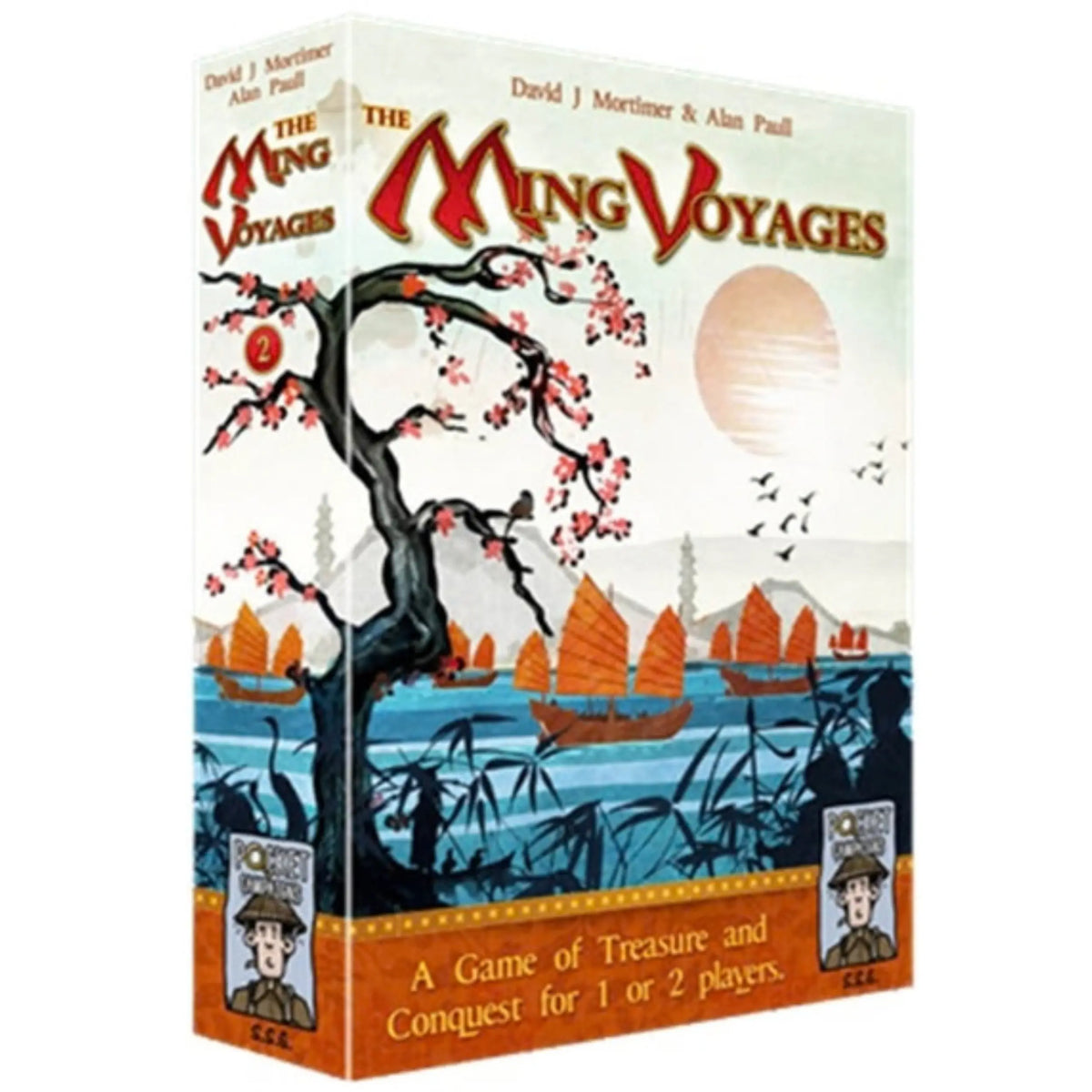
The Ming Voyages
🐸 Details from BoardGameGeek
Consiglio BGG sul numero di giocatori
Categorie
Meccaniche
Design & Art
Lingua
Si abbina bene con
The FroGames Review
You play as the Emperor. You complete a voyage, you swap hands with your opponent. They see what you have, you see what they have. You already know which card they will play. But perhaps that is exactly what they want you to believe.
WHAT IT IS
Seven voyages across the ocean. Or the invasion that halts them.
Between 1405 and 1433, Emperor Yongle of the Ming Dynasty sent Admiral Zheng He with a fleet of colossal junks to reach India, Persia, Arabia, and East Africa. An unprecedented political expansion. But on the land borders, the barbarians were pressing in. David J. Mortimer and Alan Paull (designers of the Pocket Campaigns series) transform this historical tension into a tense and fast asymmetrical duel, with illustrations by Klemens Franz.
One player is the Ming Emperor, who must complete the seven treasure voyages. The other controls three barbarian factions trying to invade the Chinese borderlands. Each turn, you play cards from a shared deck, then swap hands: you always see what your opponent has, but they see what you have. Battles are resolved with dice (triples, doubles, singles). Whoever completes their objective first wins.
What they say abroad
A tense and clever game where swapping hands creates a continuous psychological dance.
— FroGames
"Every card play matters because your opponent will inherit what you leave behind."
Every card play matters because your opponent will inherit what you leave behind.
— BoardGameGeek

The Ming Voyages
Mode included in the base rules: you manage the Emperor against an automated barbarian opponent that follows fixed priorities. The experience loses the tension of the hand swap (which is the heart of the game), but it works as a tactical puzzle to explore the system.
FrogScore · FroGames editorial rating · based on the rulebook, international reviews, and gaming sessionsWhat's in the deck
Multifunction cards, opposing objectives
Shared action cards
A single deck for both players. Each card has multiple functions: reinforcing armies, attacking, completing voyages. You play a card, then pass the rest of the hand to your opponent.
Seven treasure voyages
The Emperor must complete them all to win: Calicut, Hormuz, the Arabian Peninsula, East Africa. Each voyage requires specific cards played in sequence.
Three barbarian factions
The barbarian player controls three independent groups trying to invade the Chinese borderlands. Each faction has its own track.
Dice for battles
Three dice each. You aim for triples (best), doubles (good), or singles (weak). Reserved cards allow re-rolls. The loser loses troops.
🎲How to playThe rules in four steps▼
How to play
The flow of each turn
Four quick phases. Then swap hands and start again.
Choose a card and use it for one of its functions: reinforce an army, attack a region, or advance a voyage. The Emperor always draws a new card after playing.
Some cards grant your opponent an immediate off-turn action. You must anticipate what they can do with what you have just given them.
If you have sufficient strength in a region, you can attack. You both roll three dice. Triples beat doubles, doubles beat singles. Cards can be reserved for rerolls.
End of turn: swap hands. Now you see what they left you, they see what you left them. Start the next turn with perfect information.
⏱️Your first gameThe chronicle, moment by moment▼
A game in five moments
What happens at the table
Not the rules. The experience.
The Emperor prepares the first expedition
Deal the starting cards. The Emperor looks at their hand and plans: which cards to keep, which to play immediately. The Barbarian watches. You both know that in a moment you will swap hands: every card you play is also a signal.
First swap, first reads
End of turn: swap hands. Now you see what your opponent left behind. Were those the cards they really wanted? Or did they play them to avoid giving them to you? You begin to read their priorities. They do the same with you.
First battle on the borders
The Barbarian has enough strength in a region and attacks. You roll the three dice: double six, single two. The Emperor rolls: triple four. They win. The frontier holds. But now you both know you spent a reserved card to reroll.
Third voyage completed. Or third land invaded.
Halfway through the game, one of you is close to victory. The other must decide: slow them down or accelerate their own plan? Cards are getting scarce, the deck cycles. Every choice is tighter.
Seventh voyage. Or complete invasion.
The Emperor plays their last card for Calicut. They complete the seventh voyage. Or the Barbarian invades the last borderland and wins. Ends in thirty minutes. Shuffle, swap roles.
🐸Need to knowThree honest things, from friends▼
Need to know
Three things to keep in mind
If you are looking for a classic card game, this will surprise you: you swap hands every turn. There is no traditional bluffing (they see what you have), but there is second-level bluffing (making them believe you need a card when you actually want to discard it). Not for everyone.
Manage your hand well, place armies, attack at the right time. Then you roll the dice and an unexpected triple changes everything. Reserved cards mitigate, but luck is a factor. If you want total control, this is not the right game.
Emperor and Barbarians play completely differently. You complete voyages in sequence, they invade free regions. In the first game, you need both roles to understand the balance. Difficult to judge after just one.
🏆Victory and defeatWhat the finale rewards▼
How it ends
How you win and how you lose
Two paths to victory, each exclusive to its role.
Victory
- The Ming Emperor completes all seven treasure voyages before the barbarians invade all borderlands
- The Barbarian player invades all Chinese border regions assigned to the three factions before the Emperor completes the seven voyages
- Solo: complete the seven voyages before the Barbarian bot invades the critical regions
Defeat
- The Emperor loses if the borderlands are all invaded before completing the seventh voyage
- The Barbarian loses if the Emperor completes the last voyage before all regions are conquered
- No early elimination: you play until the end, but the one trailing sees it coming
An asymmetric duel in half an hour where you always know what the opponent has, but that doesn't make the game easier. Quite the opposite.
💬Frequently asked questionsQuick answers before checkout▼
Frequently asked questions
FAQ about The Ming Voyages
How does the hand swap work? I've never seen such a mechanic.
At the end of each turn, both players pass their remaining hand to each other. You see what they left you, they see what you left them. Perfect information, but no control: you must anticipate what they will do with those cards, and they do the same. It's like playing chess where you see your opponent's pieces but don't know which move they will choose from the available options.
Is it balanced? The two roles seem very different.
Yes, asymmetric but balanced. The Emperor has the draw advantage (they always draw, the Barbarian does not), but must complete seven objectives in sequence. The Barbarian can attack on three independent fronts and choose where to focus. BGG statistics suggest ~50/50 after a few learning games.
How much does luck matter? I see there are dice.
The dice decide the battles, and an unexpected triple can overturn a clash. But you have reserved cards to reroll, and you can avoid unfavorable battles by managing your hand well. Luck is present (BGG weight 2.5/5), but it doesn't dominate. Reading your opponent weighs more.
What mechanics does The Ming Voyages use?
Hand management with forced swap (an almost unique mechanic), multi-use cards, dice rolling for battles, area majority for barbarian invasions, and campaign/battle card-driven mechanics for voyages. Purely asymmetric: each faction has different powers and victory conditions.
Is it available in Italian?
No, this edition is in English. The text on the cards is essential (icons + brief descriptions of actions), the rulebook is lean. English level required: medium-low. There are no official Italian translations at the moment.
The people behind the game
Who invented it, who illustrated it, who publishes it — and what else they have done.
The Ming Voyages is an asymmetric card game for 1-2 players, 30 minutes duration, ages 12+, designed by David J. Mortimer and Alan Paull for Surprised Stare Games. Based on the Ming Dynasty naval expeditions (1405-1433), it uses hand management with forced hand swapping, dice battles, and multi-use cards. One player is the Emperor who must complete seven voyages, the other controls three barbarian factions invading Chinese borders. Illustrations by Klemens Franz, solo mode included. Available on FroGames.it.
The Ming Voyages
Frequently Asked Questions
The answers you're looking for, no beating around the bush.
📸Do the images match the actual product?
The photos on the website often come from BoardGameGeek and are intended to give you an idea of the game. They may vary slightly from the version you receive. The content declared by the publisher is always binding.
📦Does the content of the box match what is indicated?
We always strive to provide the correct content, but minor variations are possible due to reprints or updates. The information comes directly from the publishers. If you have any questions, please contact us!
⏳How do pre-orders work?
Pre-order the game before release, payment is immediate, and the game is reserved for you. As soon as it arrives, we'll ship it right away! If there are any delays, we'll update you promptly.
🔒Can I trust buying here?
Absolutely! Secure payments, tracked shipments, and a team that loves board games as much as you do. If something goes wrong, we'll do our best to fix it.
🛠There's a problem with my order, what should I do?
Write to us now! Whether it's a missing part, damage, or an error, we'll help you resolve it as soon as possible. Your experience truly matters to us.