
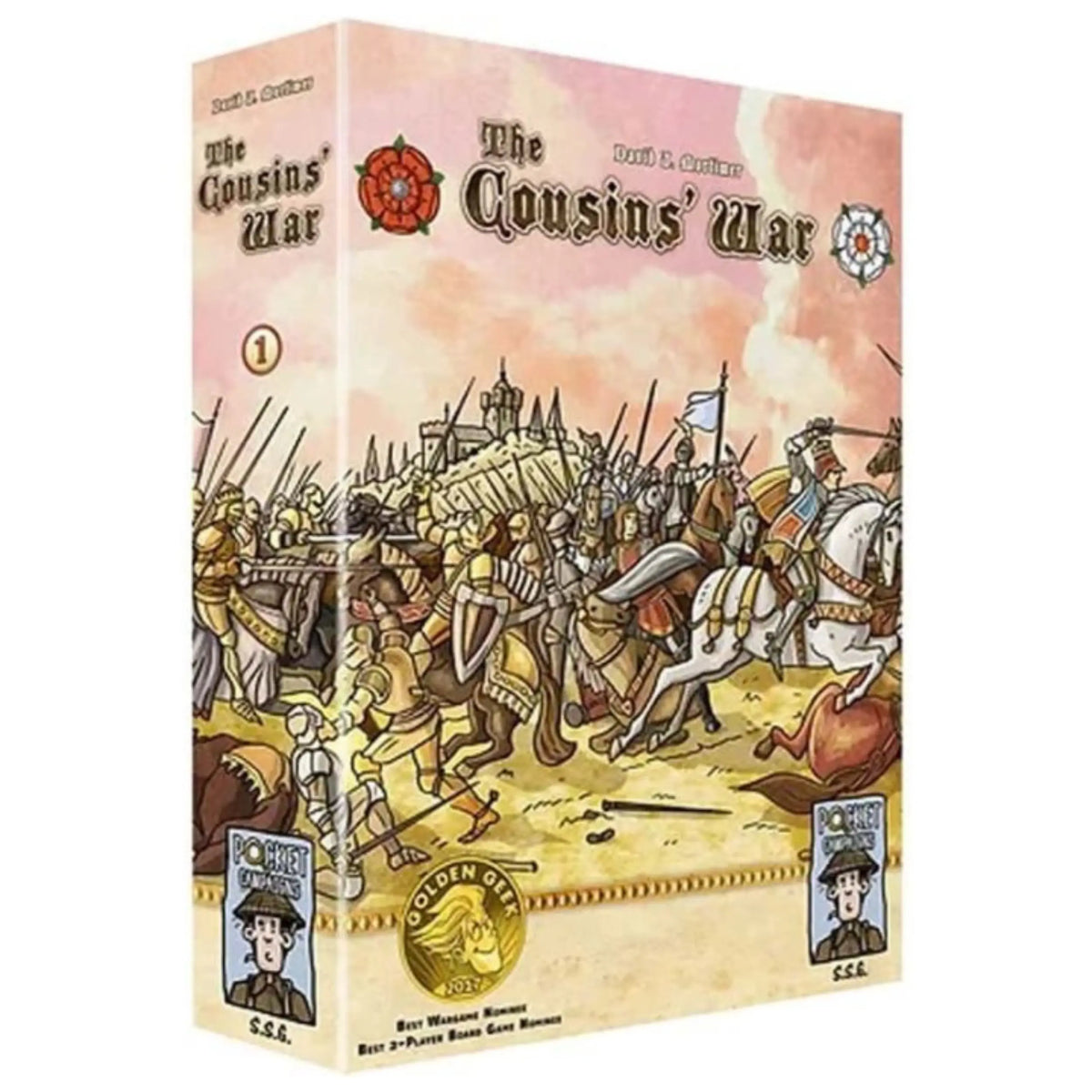
The Cousins' War
🐸 Details from BoardGameGeek
Consiglio BGG sul numero di giocatori
Categorie
Meccaniche
Design & Art
Lingua
Si abbina bene con
The FroGames Review
You have five regions to conquer and three dice for every battle. The other player knows how many troops you've deployed, but not where. You bluff, and if it works, you control England. If you fail, the dynasty ends here.
WHAT IS IT ABOUT
Thirty years of dynastic war in half an hour of play
The Cousins' War brings the War of the Roses—the conflict between Lancaster and York for the throne of England between 1455 and 1487—to the table. Designed by David J. Mortimer with clean, functional art by Klemens Franz, it is part of the Pocket Campaigns series: wargames that fit in your pocket without sacrificing tactical depth. Each round represents years of conflict, decisive battles, and political maneuvering in the English regions.
You play action cards to move troops, modify influence, and prepare the battlefield. Then you declare an attack: deploy troops, roll three dice, and engage in a duel of bluffs and counter-bluffs until one of the two houses no longer controls the territory. Win by dominating all regions or by holding the majority after five rounds. The map is small, time is tight, and every choice carries weight.
What they say abroad
"The Wars of the Roses were fought between the Houses of York and Lancaster for over three decades during the 15th century in England."
— Surprised Stare Games Ltd
The Cousins' War presents itself as a portable tactical duel that promises to condense decades of history into a few cards and three dice. The bluffing mechanic in combat resolution is reminiscent of classics of the genre, applied here to a precise historical context. We look forward to getting it on the table to see if the system holds up to the promised tension.
— FroGames

The Cousins' War
FrogScore · FroGames editorial review · based on rules, international reviews, and gameplay sessionsWhat's in the field
Four elements that define every round
Region map
Five areas of England to control. Each region has an influence value that rises and falls with action cards. Whoever dominates all wins immediately; otherwise, it's counted at the end of the fifth round.
Action cards
You play a card to deploy troops to the battlefield or modify influence in a region. Each card has different values: you must choose whether to use it to prepare for a clash or to consolidate political control.
Troops in the field
Pieces you place on the battlefield during the action phase. Your opponent sees how many you have but doesn't know what you will do with the dice. More troops mean more opportunities to withdraw to absorb hits, but also more possible bluffs.
The three dice
Every battle is resolved by rolling three dice and declaring whether you engage or retreat troops. You can bluff about the strength of your roll, force the other to retreat, or call their bluff. Whoever runs out of troops loses the battle and gives up influence.
Come si gioca
Video dimostrativo di gameplay.
🎲How to playThe rules in four moves▼
How to play
The flow of each round
Each round is a complete battle: choose the field, deploy your troops, fight with the dice, and update influence.
Take turns choosing which region will be the battlefield for this round. That region becomes the theater of the clash: that is where you will move troops and where it will be decided who gains or loses influence.
Take turns playing a card from your hand. Each card allows you to deploy troops onto the battlefield (the indicated number) or to change influence in one or more regions. Choose whether to prepare for military conflict or to consolidate political control elsewhere.
Roll the three dice. Take turns declaring if you are engaging (by betting on a die) or withdrawing a troop. The opponent decides whether to believe your engagement or call your bluff. Whoever loses troops removes them from the field. This continues until one of the two houses has no more troops: that house loses the battle.
The winner of the battle increases their influence in the contested region; the loser decreases theirs. Check if someone dominates all five regions: immediate victory. Otherwise, proceed to the next round. After the fifth round, whoever controls more regions wins the war.
⏱️Your first gameThe chronicle, moment by moment▼
A game in five moments
What happens at the table
Not the rules. The experience.
Choosing the battlefield
Look at the map, choose which region to contend this round. Influence is almost equal everywhere, but you already imagine which area it is best for you to attack and which to defend. You draw action cards: some are gold for deploying troops, others for consolidating influence. The first decision is: where do I concentrate my forces?
Troop deployment
Play cards in turns: you put two troops on the battlefield, the other player puts one but increases influence in another region. Every card changes the balance, and you already start to intuit where they want to take you. The battlefield fills up, but you still don't know if they will really attack or are bluffing to make you waste resources.
The battle
Roll the three dice. You roll a 4, 3, 2. You declare "engage," betting on the 4. The other player stares at you, evaluates their troops, and decides whether to believe your bluff or withdraw. If they call and your die really is high, they lose a troop. If you were bluffing and they call, you lose yours. Every die is a psychological duel until one of the two has no more troops on the field.
Region control
You won the battle: your influence in the region rises, the opponent's falls. You control the area, for now. But there are still rounds left, and you already see them concentrating cards in another zone. The advantage is yours, but it's fragile: a single unlucky round is enough to flip everything.
End of the conflict
Fifth round. If one of you dominates all five regions, you win immediately. Otherwise, count: whoever controls more areas conquers the throne of England. Look at the map again, do the math. One region in the balance decides everything, and there, the last battle's die made the difference. Put the pieces back in the box. Someone asks for a rematch.
🐸Good to knowThree honest things, between friends▼
Good to know
Three honest things
The die can overturn perfect plans
You deployed well, played the right cards, but three unlucky rolls make you lose the battle and influence in a key region collapse. Bluffing mitigates this, but doesn't eliminate it: if you are looking for total control, this is not the right game for you. Variance is part of the simulated historical conflict.
The map is small and easy to learn
Five regions, always the same ones. After a dozen games, you will know the standard opening moves and the strongest control patterns. Replayability comes from bluffing and reading the opponent, not from variety in setups. If you want asymmetrical campaigns or modular maps, look elsewhere.
It is truly pocket-sized, truly fast
Thirty real minutes, rules in ten. It fits in a small box, perfect for travel or lunch breaks. But precisely for this reason, do not expect the depth of a block wargame or the options of a complex CDG: it is a concentrated conflict, not a detailed simulation.
🏆Victory and defeatWhat the finale rewards▼
How it ends
How to win and lose
Two ways to conquer the throne: dominate all regions before the fifth round, or control the majority at the end of the game.
Victory
- You control all five English regions (immediate victory during any round)
- At the end of the fifth round, you control more regions than the opponent
- Tie: the winner is whoever has higher total influence adding the values of all regions
Defeat
- The opponent dominates all five regions before you
- After five rounds, you control fewer regions than the other player
- You lose key battles and influence collapses in strategic regions, leaving you without territories to defend
The Cousins' War puts you in front of real choices with limited resources and unpredictable dice. It does not simulate every detail of the Wars of the Roses, but it captures the tension of those who had to decide where to attack, knowing that a single mistake could cost them the dynasty.
💬FAQQuick answers before the cart▼
FAQ
FAQ about The Cousins' War
Do you need to know the history of the Wars of the Roses to play?
No. The game works perfectly even without knowing Henry VI or Richard III. The map shows generic English regions, and the mechanics are explained in a few minutes. Historical knowledge adds atmosphere but is not necessary to understand what to do or to have fun. It is more important to know how to bluff than to know who won at Bosworth.
How much does luck weigh compared to strategy?
The three dice decide every battle, so the variance exists and is significant. However, you control how many troops to deploy, when to bluff, when to withdraw, and above all, which regions to attack or consolidate with action cards. A more skilled player will win the majority of games, but an unlucky evening can happen. It is not pure abstract, it is not Yahtzee.
Does it work well as a filler or does it require concentration?
It's in between. Thirty real minutes, light rules, so it fits into a break or wraps up an evening. But during battle, you must read the opponent, calculate probabilities on the dice, choose where to invest influence: it is not a party game for chatting. Excellent as a second game of the evening or a quick tactical duel between two longer games.
What mechanics does The Cousins' War use?
Card-driven (you play cards for actions), area majority/influence (you control regions by increasing influence), dice rolling (three dice to resolve battles), bluffing (you declare engagement or withdrawal without showing the dice). Light historical conflict simulation with elements of deduction and hand management. The structure is a compressed campaign: five rounds = thirty years of war.
Is it available in Italian?
This edition is in the English language. The text on the cards is minimal (numerical values and symbols), and the rulebook is short. Language dependence is low: after the first game, you play without consulting anything, and the key terms are few (influence, battlefield, engage, withdraw).
The people behind the game
Who invented it, who illustrated it, who publishes it — and what else they have done.
The Cousins' War is a card-driven wargame for 2 players set during the Wars of the Roses, the dynastic conflict that pitted Lancaster and York against each other for the throne of England in the 15th century. Designed by David J. Mortimer and illustrated by Klemens Franz, it offers 30-minute games in which you control regions, deploy troops, and resolve battles with a bluffing system and three dice. Each round represents years of conflict: win by dominating all regions or controlling the majority after five rounds. Mechanics: card-driven, area majority, dice rolling, light historical simulation. Recommended age 12+, medium-light complexity (weight 2/5). Surprised Stare Games edition, Pocket Campaigns series. Available on FroGames.it.
The Cousins' War
Frequently Asked Questions
The answers you're looking for, no beating around the bush.
📸Do the images match the actual product?
The photos on the website often come from BoardGameGeek and are intended to give you an idea of the game. They may vary slightly from the version you receive. The content declared by the publisher is always binding.
📦Does the content of the box match what is indicated?
We always strive to provide the correct content, but minor variations are possible due to reprints or updates. The information comes directly from the publishers. If you have any questions, please contact us!
⏳How do pre-orders work?
Pre-order the game before release, payment is immediate, and the game is reserved for you. As soon as it arrives, we'll ship it right away! If there are any delays, we'll update you promptly.
🔒Can I trust buying here?
Absolutely! Secure payments, tracked shipments, and a team that loves board games as much as you do. If something goes wrong, we'll do our best to fix it.
🛠There's a problem with my order, what should I do?
Write to us now! Whether it's a missing part, damage, or an error, we'll help you resolve it as soon as possible. Your experience truly matters to us.