
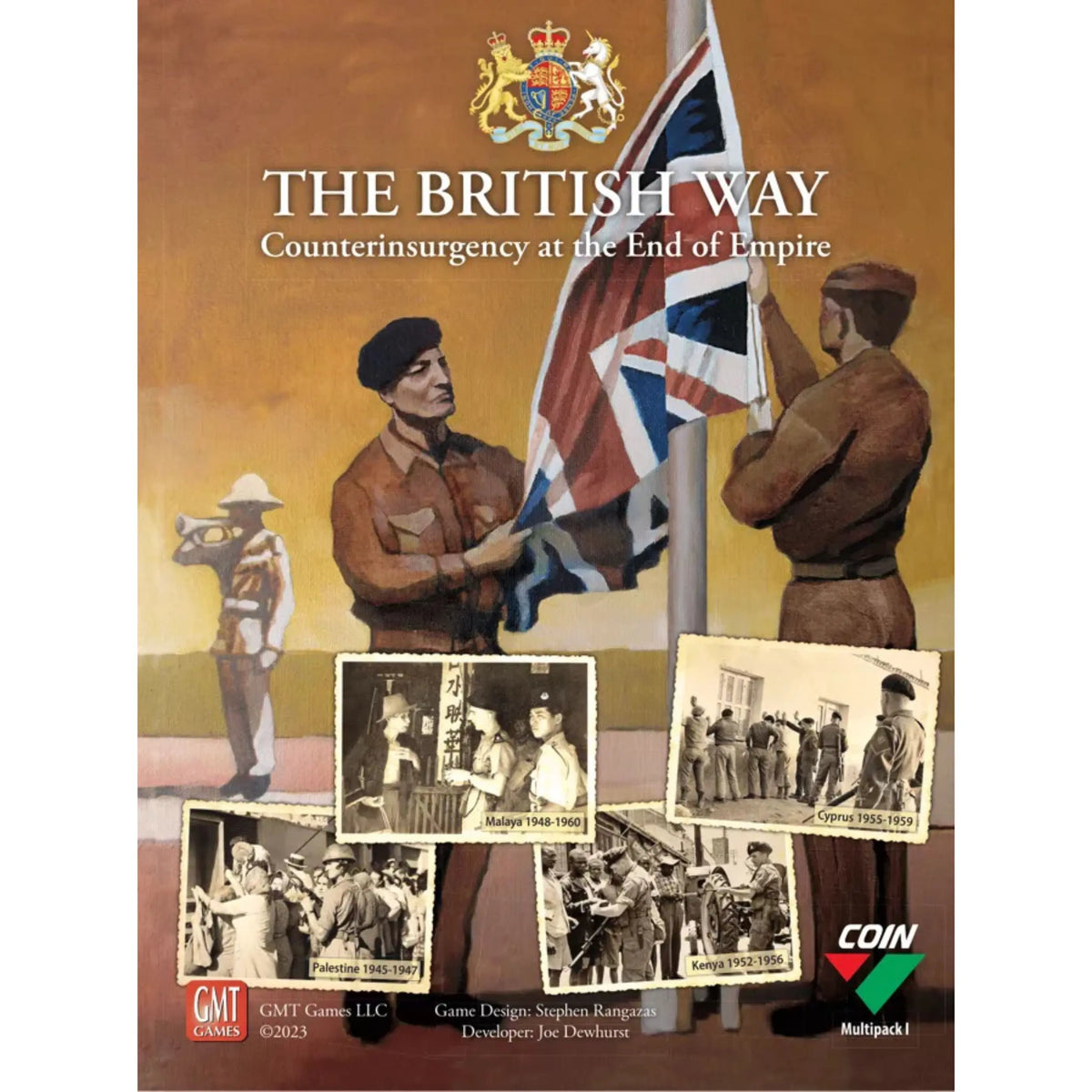
The British Way: Counterinsurgency at the End of Empire
🐸 Details from BoardGameGeek
Consiglio BGG sul numero di giocatori
Categorie
Meccaniche
Design & Art
Lingua




Si abbina bene con
The FroGames Card
Your declaration of independence is an emergency for the other. One builds consensus, the other sows terror. And every game reminds you that colonial wars never end with a clean winner.
WHAT IT'S ABOUT
Four imperial retreats, one counterinsurgency strategy
The British Way collects four British counterinsurgency campaigns fought between 1945 and 1960: Malaya against the communists, Kenya against the Mau Mau nationalists, Palestine and Cyprus against clandestine terrorist organizations. Designed by Stephen Rangazas and illustrated by Matthew Wallhead for GMT Games, it is the first multipack COIN in the series: four complete games sharing the same system but representing very different asymmetric conflicts.
In each scenario, one player leads the British forces (army, police, colonial administration), the other controls the insurgents. The simplified COIN system alternates Event cards with action/reaction phases: build bases, conduct operations, influence the population, organize attacks. Each campaign has its own victory conditions and distinct mechanics that reflect the historical tactics used in the field.
What they say abroad
"Four conflicts, one framework: asymmetric war distilled to its brutal essentials."
Four conflicts, one framework: asymmetric war distilled to its brutal essentials.
— GMT Games
The British Way doesn't sell you the glory of counterinsurgency: it confronts you with the dirty choices every retreating empire had to make. Four campaigns, four defeats disguised as tactical victories. It's the COIN that makes you read history books afterwards, not before.
— FroGames

The British Way: Counterinsurgency at the End of Empire
FrogScore · FroGames editorial rating · based on rules, international reviews, and play sessionsWhat's in the box
Four maps, four wars
Malaya Emergency
Jungle, Chinese villages, communist guerrilla warfare. The longest and most complex campaign: the British must isolate the insurgents, the MCP must maintain support in the New Villages.
Mau Mau Uprising
Kenya, tribal control, forest operations. Insurgents use oaths and terror, the British use mass deportations and detentions. Brutal and fast-paced.
Palestine Mandate
Urban terrorism, Irgun and Haganah against British administration. Attacks, sabotage, manhunts. The most asymmetric campaign: no front, only shadows.
Cyprus Emergency
EOKA against British military bases. Enosis (union with Greece) vs. maintaining control. Political international influence mechanics weigh as much as operations on the ground.
Recommended sleeves 158 cards in 1 size ▼
If you play often, we recommend protecting your cards with transparent sleeves to make them last a long time.
| Size | Quantity |
|---|---|
| 63.5 × 88 mm | 158 |
| Total cards | 158 |
Come si gioca
Video dimostrativo di gameplay.
🎲How to playThe rules in four steps▼
How to play
The flow of each round
Each round is driven by an Event card. The player with initiative decides whether to play the event or take a standard action. The opponent reacts. Then it's on to the next card.
Reveal the round's event card. The event can favor the British, the insurgent, or be neutral. Read the text: it can activate special operations, modify popular support, introduce reinforcements, or penalties.
The player with initiative (indicated on the card) chooses: (a) play the event and resolve its effects, or (b) ignore the event and take a standard action (Move, Attack, Rally, Build/Recruit). Actions cost resources and have geographical limitations.
If the event has not been played, the passive player can activate it (if it benefits them) or take a limited action. If the event has been played, the passive player takes a reduced action. It's not a symmetric turn: the player with initiative sets the pace.
Resolve combat, update support/opposition markers, check victory conditions. Some campaigns have intermediate thresholds (Propaganda Rounds in Malaya). If no one has won, draw the next card and start over.
⏱️Your first gameThe chronicle, moment by moment▼
A game in five moments
What happens at the table
Not the rules. The experience.
Setup: choose your war
Open one of the four maps. One player takes the British (blue cubes, police markers, administration), the other the insurgents (red cubes, guerrillas, hidden bases). Shuffle the dedicated event deck. Someone reads the victory conditions aloud: they are different for each campaign, and you immediately understand that you are not playing the same game.
First turns: territorial control
The British deploy troops in key cities, the insurgents establish bases in remote areas. You draw the first event card: it can trigger a special operation, shift public opinion, or introduce reinforcements. The player with initiative chooses: play the event or take an action (move, attack, rally, build). The other reacts. The pace is broken, not fluid: each card changes the plan.
Mid-game: escalation
The British launch sweep operations to clear a region, the insurgents respond with targeted attacks. Population control fluctuates: a village moves from Support to Neutral, then to Opposition. Every time you lose a base or suffer a terrorist attack, you have to recalculate your entire strategy. Event cards accelerate: reinforcements arrive, the government changes, the UN intervenes (only in Cyprus). The map is no longer what it was ten minutes ago.
The plot twist
An event card turns everything upside down. In Malaya, the Briggs Plan (New Villages) arrives: the British deport entire Chinese populations to isolate the insurgents. In Kenya, Operation Anvil arrests thousands of suspected Mau Mau. In Palestine, the Irgun bombs the King David Hotel. Those who were ahead must rebuild consensus from scratch. Those who were losing see an opening. Someone swears, the other smiles.
End game: control or survive
Check the board: the British win if they have enough popular support and enemy bases eliminated. The insurgent wins if they have maintained sufficient opposition or if the British have run out of resources. In some campaigns (Palestine, Cyprus) the British can lose even by winning tactically: political victory lies elsewhere. Count the markers, read the condition. Someone won, but no one feels like a hero.
🐸What to know beforehandThree honest things, from friends▼
What to know beforehand
Three things you need to know
Four rule sets, not one
Each campaign has dedicated rules that modify the basic system: Malaya uses New Villages, Kenya has Emergency Powers, Palestine introduces urban terrorism without fronts. You learn the COIN core in 30 minutes, but each scenario requires an additional 10-15 minute read. It's not immediate plug-and-play like other COINs.
Radical asymmetry
You don't play the same game as your opponent. The British must build consensus and maintain order, the insurgent must survive and destabilize. Victory conditions are different, powers are different, available actions are different. If you're looking for a symmetrical duel, this isn't the right game.
Non-negotiable historical events
The event deck introduces real historical turning points (Briggs Plan, Operation Anvil, King David Hotel) that you cannot avoid. When the game-changing event arrives, you must adapt. If you prefer total control over variables, the historical component will feel like an intrusion. But that's precisely what gives the game meaning.
🏆Victory and defeatWhat the ending rewards▼
How it ends
How to win and how to lose
Each campaign has its own victory conditions. In general: the British win by controlling the population and eliminating enemy bases. The insurgent wins by maintaining opposition or exhausting British resources.
Victory
- British: reach the required popular support threshold AND have fewer than X active enemy bases (varies by campaign)
- Insurgent: maintain sufficient opposition in key areas OR reduce British resources below the available threshold
- Immediate victory: some event cards can declare early victory (e.g., British political withdrawal in Cyprus)
Defeat
- British: lose control of critical strategic areas OR run out of available troops for operations
- Insurgent: be reduced to zero active bases OR lose all popular support in key regions
- Political defeat: in Palestine and Cyprus, the British can win militarily but lose the war (withdrawal imposed by events)
The British Way is not a game about the glory of counterinsurgency: it's a game about the impossible choices of those who must manage a withdrawal disguised as public order. Historical, asymmetrical, honest.
💬Frequently asked questionsQuick answers before checkout▼
Frequently asked questions
FAQ about The British Way: Counterinsurgency at the End of Empire
What mechanics does The British Way use?
Simplified COIN system: action/event selection, area control, area movement, variable player powers, sudden death ending. Each round you draw an event card: the player with initiative chooses whether to play the event or take an action (move, attack, rally, build). The opponent reacts with a limited action. Dice only for combat.
Can I play it if I don't know the COIN series?
Yes, it's the ideal entry point. The British Way simplifies COIN by eliminating simultaneous multiple factions and reducing tracks. If Cuba Libre or Andean Abyss scared you with their complexity, this is more accessible. But it remains a game with a weight of 3.1: it's not a gateway for those who have never seen a wargame.
How long do games last?
Malaya: 90-120 minutes. Kenya: 60-90 minutes. Palestine and Cyprus: 60-75 minutes. The shorter campaigns (Palestine, Cyprus) are excellent for a single evening. Malaya takes more time but offers greater strategic depth. All four have sudden death conditions that can shorten the duration if one player dominates.
Are the four campaigns very different from each other?
Yes, radically different. Malaya is jungle counterinsurgency with New Villages and sweep operations. Kenya is tribal deportations and Mau Mau terror. Palestine is urban terrorism without fronts (Irgun, Haganah). Cyprus introduces international political influence (UN, Greece). They share the COIN engine but play distinctly.
Is it available in Italian?
No, this edition is in English. Rulebook, event cards, map texts: all in English. The text load is medium: event cards have one paragraph each, but once you learn the system, language is less of a barrier. There are no official Italian localizations at the moment.
The people behind the game
Who invented it, who designed it, who publishes it — and what else they've done.
The British Way: Counterinsurgency at the End of Empire is a historical COIN wargame for 2 players, ages 14+, duration 60-120 minutes. Designed by Stephen Rangazas for GMT Games, it collects four British counterinsurgency campaigns (Malaya, Kenya, Palestine, Cyprus) in a single multipack. Simplified COIN system with action/event mechanics, area control, asymmetric powers. Each scenario has dedicated rules and its own victory conditions. Weight 3.1/5, ideal for experienced players looking for historical asymmetric conflict without the complexity of 4-faction COINs. Available on FroGames.it.
The British Way: Counterinsurgency at the End of Empire
Frequently Asked Questions
The answers you're looking for, no beating around the bush.
📸Do the images match the actual product?
The photos on the website often come from BoardGameGeek and are intended to give you an idea of the game. They may vary slightly from the version you receive. The content declared by the publisher is always binding.
📦Does the content of the box match what is indicated?
We always strive to provide the correct content, but minor variations are possible due to reprints or updates. The information comes directly from the publishers. If you have any questions, please contact us!
⏳How do pre-orders work?
Pre-order the game before release, payment is immediate, and the game is reserved for you. As soon as it arrives, we'll ship it right away! If there are any delays, we'll update you promptly.
🔒Can I trust buying here?
Absolutely! Secure payments, tracked shipments, and a team that loves board games as much as you do. If something goes wrong, we'll do our best to fix it.
🛠There's a problem with my order, what should I do?
Write to us now! Whether it's a missing part, damage, or an error, we'll help you resolve it as soon as possible. Your experience truly matters to us.