

Carnegie
🐸 Dettagli da BoardGameGeek
Consiglio BGG sul numero di giocatori
Categorie
Meccaniche
Design & Art
Si abbina bene con
The FroGames Sheet
You've just sent your director to build a railroad in the Midwest. Someone follows you, someone passes. In two turns, you'll discover that you really needed that action you left to others.
WHAT IT'S ABOUT
From immigration to the American dream: Andrew Carnegie's life in an industrial eurogame
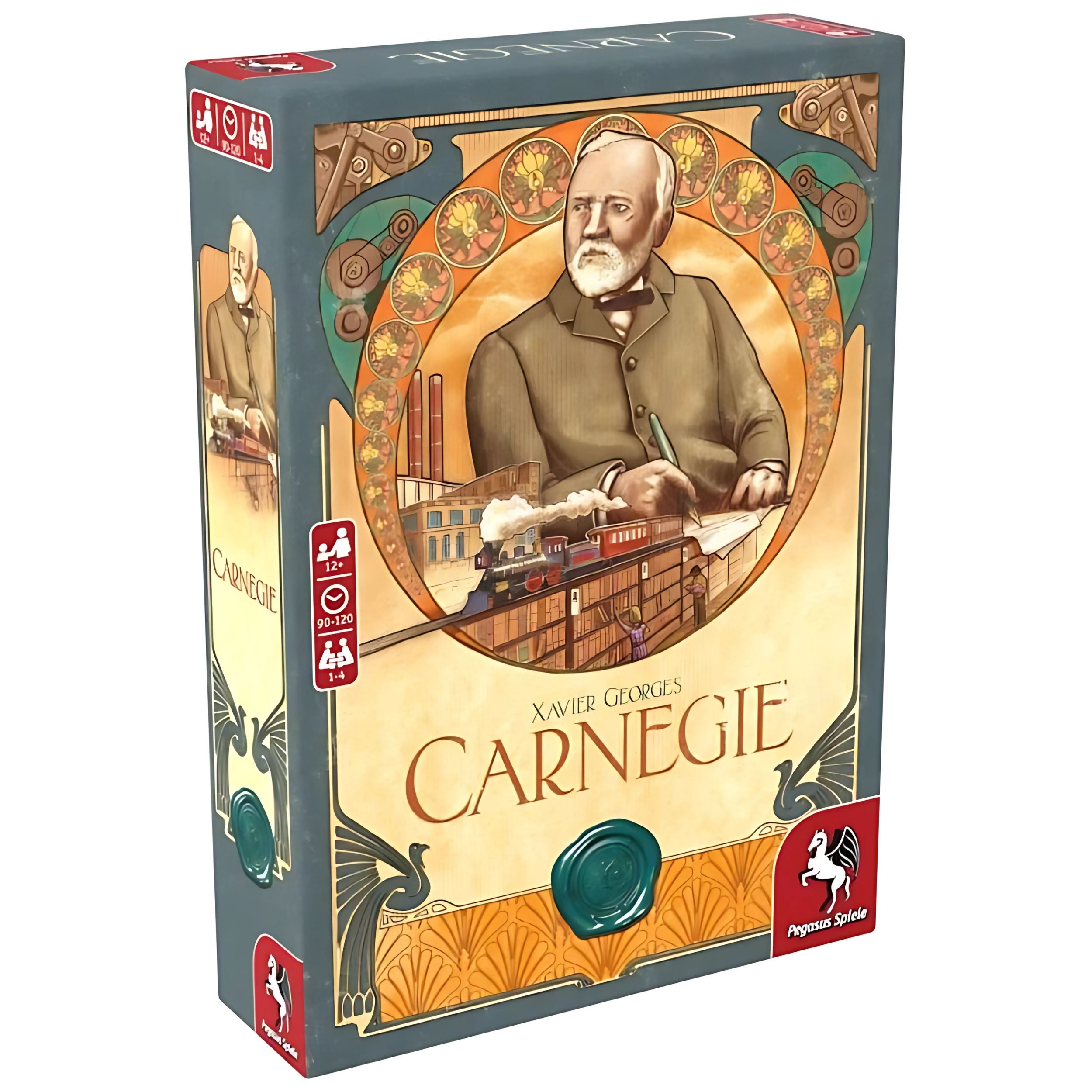
Designed by Xavier Georges and illustrated by Ian O'Toole, Carnegie is inspired by the life of Andrew Carnegie, a Scottish immigrant who became one of America's wealthiest men through the steel industry. The game spans twenty years of expansion (20 rounds), real estate investments, construction of logistics chains, and philanthropy: in the end, Carnegie donated over $350 million to establish nearly 2,500 public libraries in the United States.
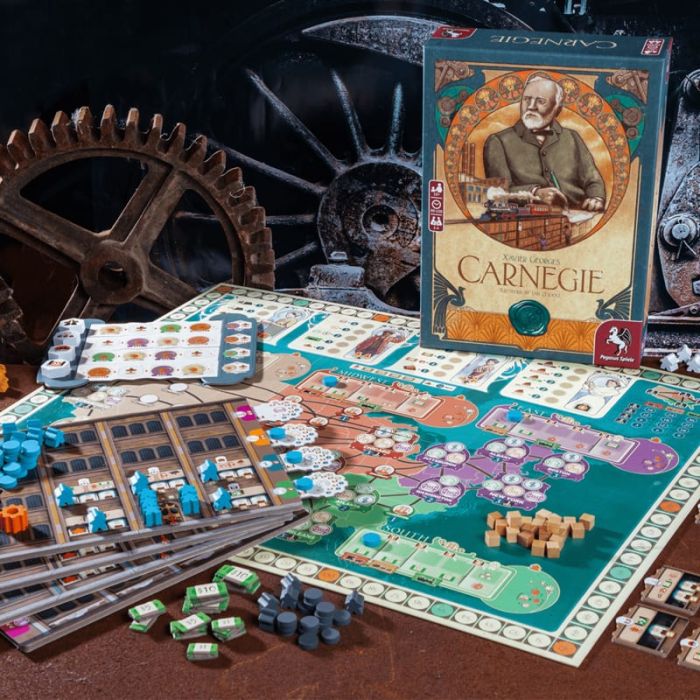
At the table, you recruit and manage specialized employees, expand your company, produce and sell goods, build railway networks, and collaborate with personalities of the era. Each turn, the active player chooses one of four available actions: others can follow it, but with asymmetrical costs and benefits. The winner is the one who builds the most prestigious company, measured in victory points.
What they say abroad
"A thinky optimization puzzle wrapped in a beautiful historical theme."
A thinky optimization puzzle wrapped in a beautiful historical theme.
— Meeple Mountain
Carnegie always presents you with tight choices. Every turn you seem to be missing a resource, an employee, a round. This is exactly what pure eurogame lovers are looking for.
— FroGames

Carnegie
The solo mode uses a simplified automa that draws action cards and simulates an opponent: it occupies spaces on the USA board, recruits employees, and advances on tech tracks. The experience is complete and maintains the tension of multiplayer, but loses the psychological reading of the follow (who follows what, when). Excellent for those who want to practice strategies or play without waiting for the group.
FrogScore · FroGames editorial rating · based on rules, international reviews, and play sessionsYour tools
Four pillars for building the empire
Specialized employees
You recruit workers with unique abilities that grow over time. Each employee has a type (manager, engineer, merchant, philanthropist) and enhances specific actions. Using them at the right time is key.
Production and sales
Produce goods, sell them for money and points. Production chains intertwine with logistics: the more efficient you are in transport, the more you earn. Competition in the markets is fierce.
USA railway network
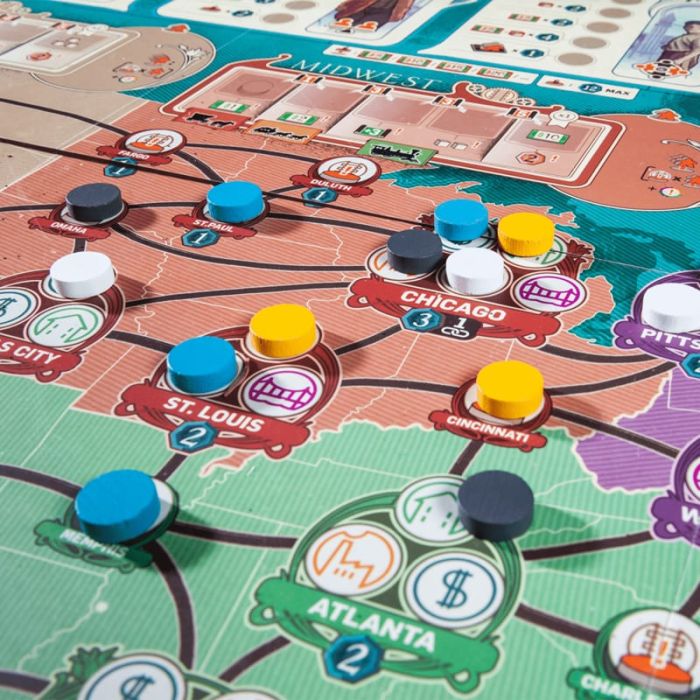
Build connections on the United States board: each route opens new markets and reduces costs. The first to arrive in a region controls the bonuses. The network is a pure race.
Philanthropy and libraries
You donate part of your wealth to build Carnegie libraries: not only victory points, but also in-game advantages. The game rewards you if you balance profit and generosity, as the real Carnegie did.
Recommended sleeves 49 cards in 1 size ▼
If you play often, we recommend protecting your cards with clear sleeves to make them last longer.
| Size | Quantity |
|---|---|
| 57 × 89 mm | 49 |
| Total cards | 49 |
🎲How to PlayThe rules in four steps▼
How to Play
The flow of each round
Each round has an active player who chooses an action. Others can follow (with varying costs) or pass. After 20 rounds, points are counted.
Four options: recruit employees, expand the company (production/sales/logistics), invest in real estate, or build libraries. The choice determines what others can do.
In turn order, each player decides whether to follow the action (paying a reduced cost but with fewer benefits) or pass. Those who pass may gain advantages in subsequent turns.
Everyone performs their chosen actions: moving on the USA board, hiring employees, advancing on tech tracks, producing goods. Employees activate their special abilities.
The turn order changes based on a progressive system: those who are behind play earlier in the next round. After 20 rounds, points are counted and the winner is declared.
⏱️Your First GameThe story, moment by moment▼
A game in five moments
What happens at the table
Not the rules. The experience.
Setup and first employees
Everyone starts with a small company and limited funds. The first turns are pure recruitment: you look for the right employees for your strategy. Some focus on managers (lots of money), some on engineers (fast expansion). The table is quiet, everyone is studying.
First moves on the USA board
Someone places the first rail link. The race is on: who gets to California first? Who controls the Midwest? Follow actions start to matter: if you follow someone, you save money, but you lose control of your turn.
The engines start
Mid-game. You have a production chain running, specialized employees, a few libraries. Now every action is millimetric optimization: how much do I spend on this employee? Do I follow Anna's action or pass? The table slows down: everyone thinks three turns ahead.
The final sprint for points
Last 5 rounds. You realize you're 10 points short of winning. Someone discovers an employee + tech track combo that's golden. Someone builds three libraries at once. Choices are irreversible: no time to correct.
Counting and post-mortem
You count points: employees, libraries, network, remaining money, end-game bonuses. The one who balanced best wins. Someone says "If only I'd hired that manager in round 8...". Someone asks for a rematch. Carnegie leaves no doubt: either you planned well or you lost.
🐸Good to know beforehandThree honest things, from friends▼
Good to know beforehand
Three things you need to consider
The rules are clear, but the interactions between employees, tech tracks, and follow actions take time to assimilate. Count on 150 minutes for the first game, 90-120 minutes from the second game onwards. If the group has someone new, prepare snacks.
Yes, you talk about Carnegie, steel, libraries. But the core is an abstract optimization puzzle: don't expect narrative. If you're looking for thematic immersion, look elsewhere. If you love pure mechanics, this is gold.
You don't directly attack opponents. Interaction is indirect: blocking on the board, a race for employees, follow actions that anticipate your moves. If you're looking for face-to-face confrontation, Carnegie is not the right game.
🏆Victory and defeatWhat the ending rewards▼
How it ends
How to win
After 20 rounds, victory points are counted. The player with the most points wins.
Sources of victory points
- Recruited employees and their development level
- Libraries built and philanthropic donations
- Rail links and control of USA regions
- Goods produced and sold, real estate purchased
- Advancement on tech tracks and end-game bonuses
- Remaining money (converted to points at final scoring)
What makes you lose
- Focusing on a single strategy without diversifying
- Ignoring the USA board: connections are gold
- Recruiting the wrong employees for your economic engine
- Not following others' actions when it's advantageous
- Reaching the final rounds without a plan for end-game points
Carnegie is a mature eurogame: no plot twists, no dice. Just you, your choices, and the weight of the consequences. If that's enough for you, this is the right game.
💬Frequently Asked QuestionsQuick answers before checkout▼
Frequently Asked Questions
FAQ about Carnegie
What mechanics does Carnegie use?
The core is the follow action system: each turn a player chooses an action, others can follow (with different costs/benefits) or pass. This is combined with worker placement with specialized employees, network building on the USA board, tech tracks to unlock abilities, resource management, and production/sale of goods. There is also a progressive system for turn order.
Is it suitable for those unfamiliar with heavy eurogames?
No, Carnegie has a weight of 3.8/5 on BGG: it requires experience with medium-heavy eurogames. If you've played Brass, Gaia Project, or Terraforming Mars and they didn't intimidate you, you're ready. If you're starting from scratch, begin with lighter gateway games.
How many players is it best with?
It scales well from 1 to 4 players. The solo mode with an automa is solid (see dedicated section), with 2 players it's more strategic and controlled, with 3-4 players the follow action creates more chaos. Fans prefer 2-3 players for shorter game times and greater control.
How long does a game really last?
First game: 150 minutes. From the second game onwards, with players who know what they're doing, 90-120 minutes. With 4 expert players, you can stay around 90 minutes; with 4 players including someone new, it easily goes up to 140 minutes. Downtime exists: everyone thinks before choosing.
Is it available in Italian?
This edition is in English. The text on the cards is present and significant (names and abilities of employees), so at least a basic knowledge of English is required. There are no official Italian translations available at the moment.
The people behind the game
Who invented it, who designed it, who publishes it — and what else they've done.
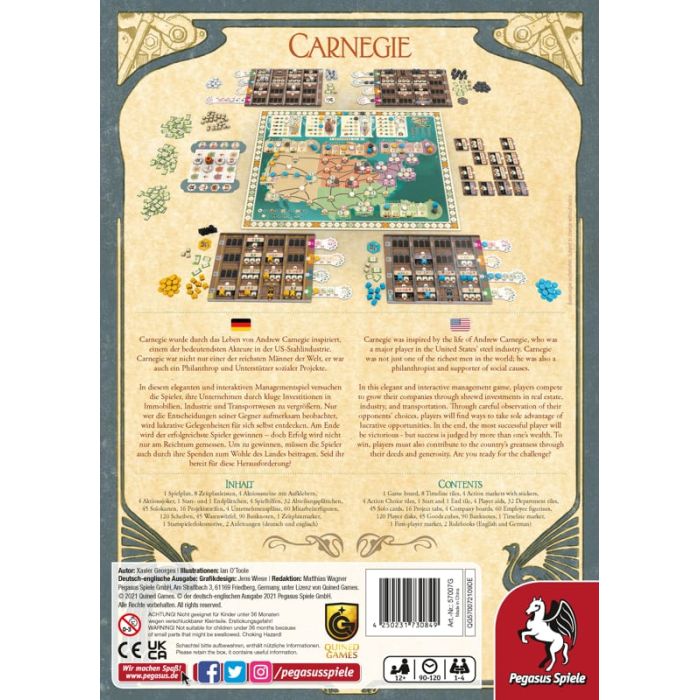
Carnegie is a strategic eurogame for 1-4 players aged 12 and up, with games lasting 90 to 120 minutes. Designed by Xavier Georges and illustrated by Ian O'Toole, published by Quined Games, the game uses an asymmetric follow-action system combined with worker placement (specialized employees), network building on the USA board, tech tracks, and resource management. Inspired by the life of Andrew Carnegie, steel magnate and philanthropist, it offers multiple strategies: industry, rail logistics, philanthropy. Includes a solo mode with automa. Suitable for experienced players looking for optimization and strategic depth. Available on FroGames.it in English edition.
Carnegie
Frequently Asked Questions
The answers you're looking for, no beating around the bush.
📸Do the images match the actual product?
The photos on the website often come from BoardGameGeek and are intended to give you an idea of the game. They may vary slightly from the version you receive. The content declared by the publisher is always binding.
📦Does the content of the box match what is indicated?
We always strive to provide the correct content, but minor variations are possible due to reprints or updates. The information comes directly from the publishers. If you have any questions, please contact us!
⏳How do pre-orders work?
Pre-order the game before release, payment is immediate, and the game is reserved for you. As soon as it arrives, we'll ship it right away! If there are any delays, we'll update you promptly.
🔒Can I trust buying here?
Absolutely! Secure payments, tracked shipments, and a team that loves board games as much as you do. If something goes wrong, we'll do our best to fix it.
🛠There's a problem with my order, what should I do?
Write to us now! Whether it's a missing part, damage, or an error, we'll help you resolve it as soon as possible. Your experience truly matters to us.