

Luthier
🐸 Dettagli da BoardGameGeek
Consiglio BGG sul numero di giocatori
Categorie
Meccaniche
Design & Art
Lingua
Pairs well with

FroGames — Moments You'll Remember
Instruments forged by hand, patrons won through reputation, scores written with every choice at the table.
What it's about
The art of lutherie in classical Europe
It's 18th-century Europe. Bach is composing, Mozart is performing, Beethoven is demanding. And someone has to build the instruments that make it all possible. In Luthier, you are that someone — leading a family of artisans who want to become the most respected workshop of the era.
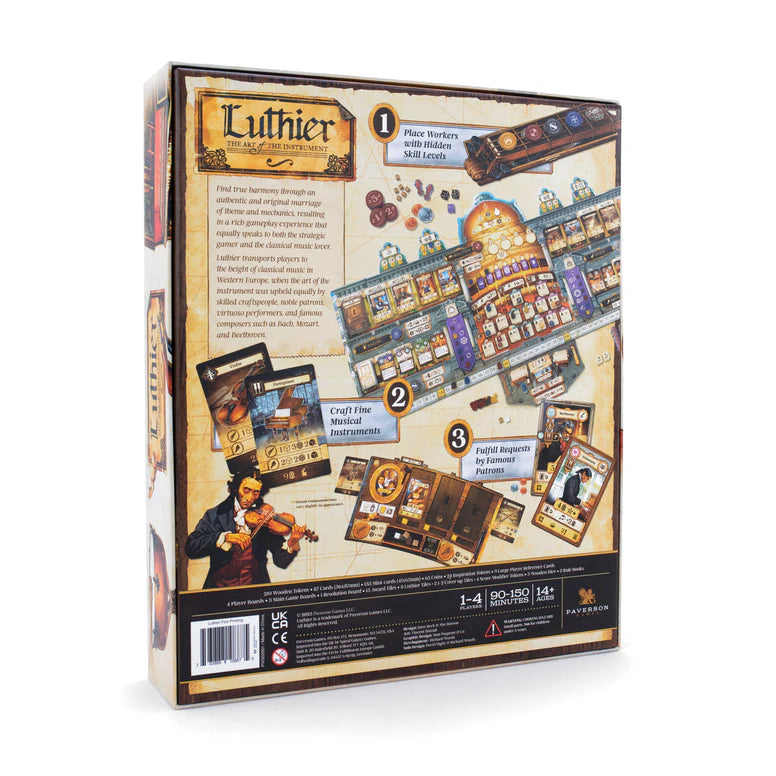
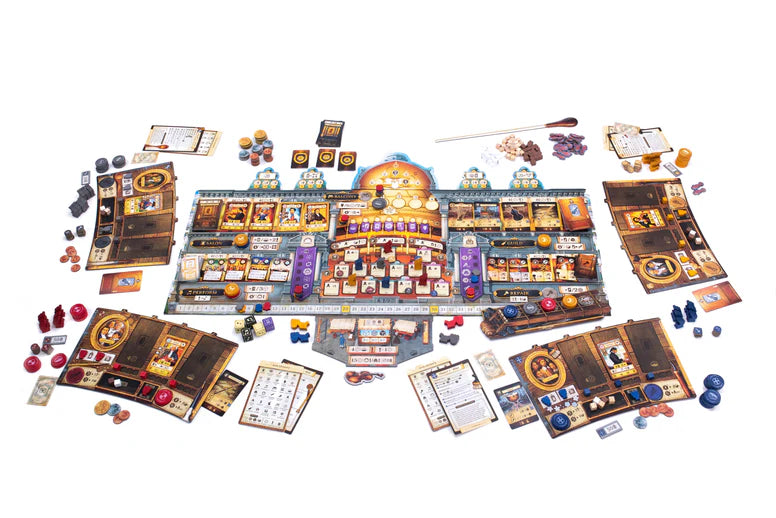
Designed by Dave Beck and Abe Burson and illustrated by the renowned Vincent Dutrait, Luthier combines worker placement and secret bidding in a system never seen before. Each round you place your workers — whose numbers grow over the course of the game — and secretly bid resources to win the most valuable instruments, the most powerful patrons, and the best contracts.
There isn't one single path to victory. You can focus on musical performances, expanding your workshop, training apprentices, or enhancing your family's reputation. Your personal tableau evolves with the patrons you acquire, creating a unique engine for each player.
The secret bidding mechanic isn't just a gimmick — it redefines how you read your opponents. You never know who will compete with you for that violin or patron.
Luthier's secret in one line
When your tableau combines with the right patrons, you feel the workshop come to life. That's the feeling sought in every heavy eurogame — and Luthier delivers it.
From the gameplay experience

Luthier
The automa — co-designed by David Digby and Richard Woods — evolves game after game with an organic deck. It well reproduces the pressure of secret bidding. Excellent for exploring strategies before challenging human opponents.
FrogScore · editorial rating by FroGames · based on rules, international reviews and play sessionsWhat's in the box
Four pillars of your workshop
22 instruments to build
Violins, lutes, harpsichords, organs. Each requires different resources and skills — and offers unique bonuses and points.
30 historical patrons
Real figures from Baroque and Classical Europe. Winning them transforms your tableau into a custom engine.
Workers that grow
Start with three tokens — five by the end. Each added worker represents the growth of your artisan family.
The Rehearsal — tutorial mode
A guided sequence that teaches why each rule exists. With the conductor's baton included in the box.
In a few hours, you'll have built something no one else at the table has built. It always happens with Luthier.
🃏Recommended sleeves3 sizes · 226 cards total
Come si gioca
Video dimostrativo di gameplay.
A game in five moments
What happens at the table
Not the rules. The experience.
The workshop opens. Who will I be?
Boards are distributed, initial patrons chosen, the instrument market analyzed. Everyone already has a vision — who will specialize in violins, who will woo the most demanding patrons, who will focus on performances. The game hasn't even started, and the table is already a map of hidden intentions.
The first secret bid
Everyone hides their chips in their hands. When they're revealed together, someone took the violin everyone wanted — someone else realizes they spent too much for nothing. The secret bidding system hits hard the first time. From then on, the game becomes a battle of wits against your opponents.
The patron grows impatient
Your patron's cube has moved to the right. If you don't satisfy them soon, they'll leave — and take valuable points with them. But to complete their instrument, you need resources you don't have. You divert everything. Someone takes advantage. The 18th-century European theater didn't forgive late workshops.
The tableau takes shape
Conquered patrons slot in behind your board. Bonuses accumulate. What initially seemed like a weak engine now does things others didn't expect. There's always that moment in Luthier when you realize your workshop has become something unique.
The final count. Who built the most?
Completed instruments, loyal patrons, First Chair in the orchestra, reputation. Points come from directions everyone took differently. Someone wins by a narrow margin. Everyone wonders what they would have done with more time — and when they can play again.
How to play
The flow of each round
Four phases that repeat. Mastered in two or three games.
Each player places their workers on available actions — but hides them. When everyone has chosen, they are revealed simultaneously. The highest bidder acts first; the lowest bidder receives compensation resources.
In bidding order, each player performs their chosen action: gather resources, build an instrument, woo a patron, perform a composition, or train an apprentice.
The cubes of unsatisfied patrons advance to the right on their track. Those who let them reach the end lose them — with a point penalty. Those who satisfy them turn them into permanent allies with fixed bonuses.
At certain points in the game, workers increase from three to five — symbolizing the workshop's growth. New resources increase flexibility but also decision-making pressure.
Why it's different from others
Six mechanics that make a difference
Simultaneous Secret Bidding
It's not a classic auction — it's a worker placement system where you don't see what others are doing until everyone has already chosen. Every round you become an expert in opponent psychology.
Game-changing Patrons
The 30 historical patrons are not simple objective cards. Once conquered, they permanently modify your actions. Your engine is different from everyone else's at the table.
22 Instruments, No Two Strategies Alike
Building an organ requires completely different resources and time than a lute. The choice of which instrument to prioritize is already a declaration of strategy.
Multiple Paths to Victory
Performances, repairs, First Chair, apprentice training, reputation. No single path dominates. Luthier rewards those who understand their path and pursue it consistently.
The Audition — narrative tutorial
An introductory mode written with Cody Reimer that guides players through a predetermined session, explaining not only what to do but why. The first game is no longer a barrier.
Evolving Automa
The solo mode uses an organic deck co-designed by David Digby and Richard Woods. The virtual opponent learns and adapts, making each session a different challenge from the last.
How it ends
Europe's Most Illustrious Workshop
The game concludes after a predetermined number of rounds. The player with the most solid reputation wins — achieved through multiple avenues.
Victory
- Most prestige points at the end of the last round
- Points come from built instruments, conquered patrons, First Chair, performances, and repairs
- Unsatisfied patrons deduct points — managing them is an essential part of the strategy
Scoring Paths
- Instruments built and donated to patrons
- First Chair: area control in the orchestra at the center of the table
- Skill tracks, repairs, performances with dice, apprentice training
Luthier is one of the most thematic and original eurogames in recent years. Those who play it can't stop thinking about it between games.
Frequently Asked Questions
Luthier FAQ
Is it worth it even for those who don't love classical music?
Yes. The theme is set in Baroque Europe, but the mechanics work regardless of musical interest. Secret bidding and worker placement are systems that appeal to gamers for what they are — not for the setting. Those who love Agricola or Viticulture will immediately feel at home.
Is it really that long? How to manage 3 hours?
With 3-4 players, the first few games can approach 3 hours — especially with thoughtful players. With 2 players or solo, times are significantly reduced. The Audition mode greatly helps in the first game, eliminating learning downtime. It's a game to plan for, not to pull out spontaneously.
How does the secret bidding mechanic work?
Each player places their hidden workers on available actions. When everyone is ready, they reveal simultaneously. Whoever assigned more resources to an action wins it; whoever assigned fewer receives compensation resources but acts later. It's a system that uniquely blends deduction, bluff, and resource management.
Is it suitable for new eurogame players?
It's not the first eurogame to approach. The complexity of secret bidding, the number of variables, and its duration make it more suitable for those who already have experience with medium-heavy games like Wingspan, Viticulture, or Agricola. The Audition mode helps a lot, but it's still a game that requires commitment.
Is the solo mode satisfying?
Yes — more than usual for a heavy eurogame. The automa designed by David Digby and Richard Woods uses an organic deck that credibly simulates opponent decisions. It's not easy to beat, and the tension of secret bidding remains even when playing alone. Great for practicing strategies or playing without needing to wait for a group.
Is this the English edition?
Yes — this is the English edition published by Giochi Uniti. Texts, cards, and rules are fully in English.
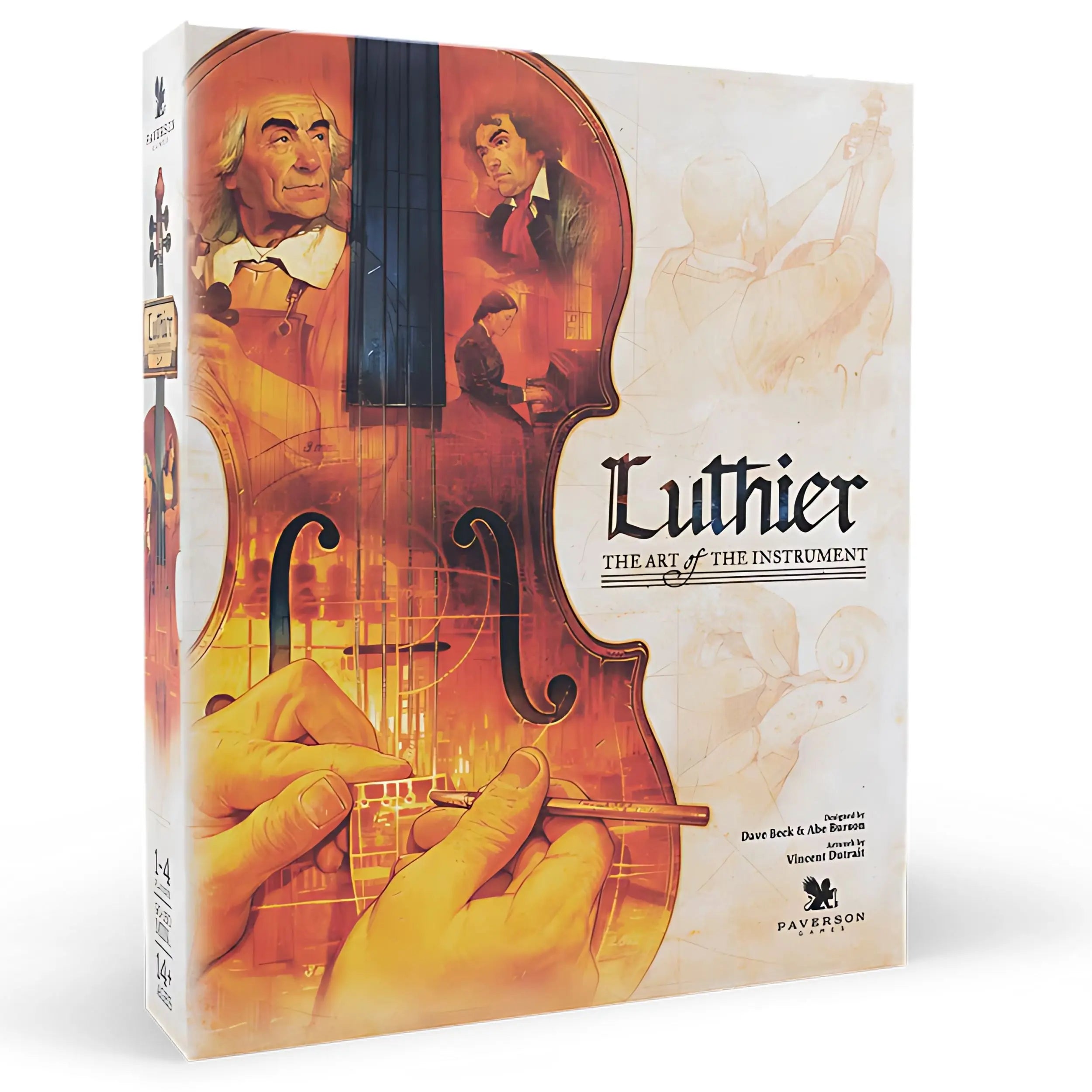
Luthier is an eurogame board game for 1–4 players (ages 14+, duration 90–150 min). Designed by Dave Beck and Abe Burson, artwork by Vincent Dutrait, published by Paverson Games and distributed in Italy by Giochi Uniti. Core mechanics: worker placement with hidden secret bidding and evolving personal tableau. Players manage a family of instrument-building artisans in 18th-century Europe, wooing 30 real historical patrons including figures connected to Bach, Mozart, and Beethoven. Official solo mode with organic automa co-designed by David Digby and Richard Woods. Includes The Audition, a tutorial mode written with Cody Reimer. Full English edition. Available at FroGames.it.
Frequently Asked Questions
The answers you're looking for, no beating around the bush.
📸Do the images match the actual product?
The photos on the website often come from BoardGameGeek and are intended to give you an idea of the game. They may vary slightly from the version you receive. The content declared by the publisher is always binding.
📦Does the content of the box match what is indicated?
We always strive to provide the correct content, but minor variations are possible due to reprints or updates. The information comes directly from the publishers. If you have any questions, please contact us!
⏳How do pre-orders work?
Pre-order the game before release, payment is immediate, and the game is reserved for you. As soon as it arrives, we'll ship it right away! If there are any delays, we'll update you promptly.
🔒Can I trust buying here?
Absolutely! Secure payments, tracked shipments, and a team that loves board games as much as you do. If something goes wrong, we'll do our best to fix it.
🛠There's a problem with my order, what should I do?
Write to us now! Whether it's a missing part, damage, or an error, we'll help you resolve it as soon as possible. Your experience truly matters to us.