

Cross Bronx Expressway
🐸 Dettagli da BoardGameGeek
Consiglio BGG sul numero di giocatori
Categorie
Meccaniche
Design & Art
Lingua




Pairs well with
FroGames — Moments You'll Remember
Some build roads. Some organize the community. Some speculate on buildings. And in the end, the Bronx either survives, or collapses under the weight of your ambitions.
WHAT IT'S ABOUT
Sixty years of urban planning, conflict, and forced cooperation in the heart of New York
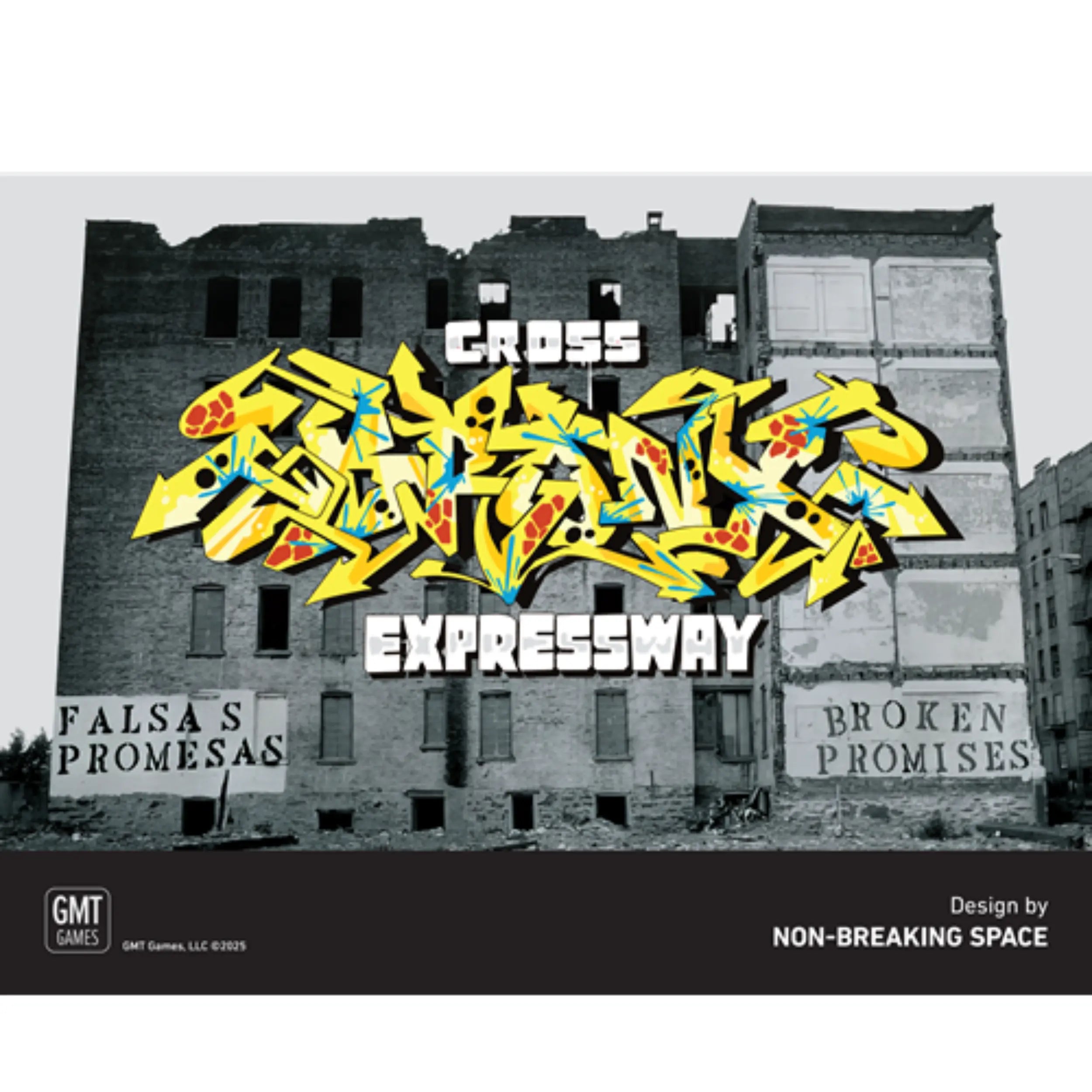
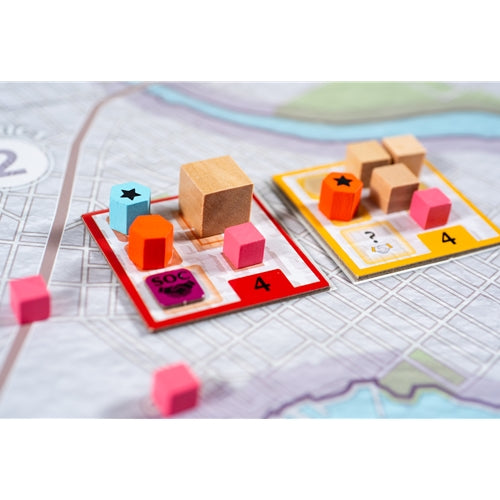
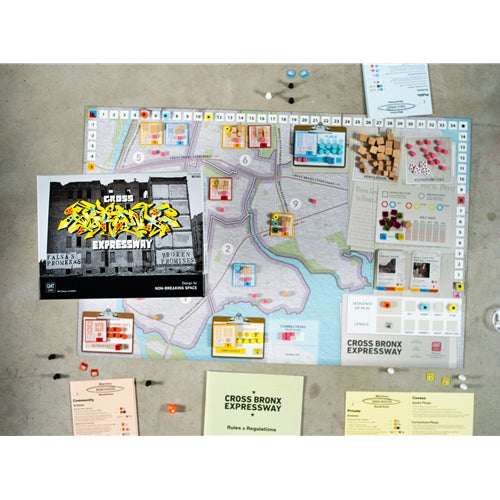
Cross Bronx Expressway is the third installment in GMT Games' Irregular Conflicts Series, designed by Non-Breaking Space with illustrations by Matthew Wallhead. The game simulates the socio-economic processes that shaped the South Bronx between 1940 and 2000, drawing inspiration from Jane Jacobs' seminal work The Death and Life of Great American Cities. Each game is an interactive case study: contradictory incentives, difficult choices, and the human cost of urban policies.
You control one of three asymmetric factions, each with its own objectives but forced to collaborate to keep the neighborhood standing. Through a deck of event cards that determine turns and crises, you build infrastructure, form coalitions, manage the resources of the vulnerable population, and try not to go bankrupt. If the Bronx collapses, everyone loses. If it survives, the player with the most points wins. The tension arises from the fact that winning alone means risking collective defeat.
What they say abroad
"An engaging way to learn about the recent history of American cities through play."
An engaging way to learn about the recent history of American cities through play.
— GMT Games
If you thought building cities was relaxing, Cross Bronx Expressway will show you that every sidewalk has a human cost. And that every personal victory can be a collective defeat.
— FroGames

Cross Bronx Expressway
The game natively supports solo play by managing other factions through simplified automated rules. The experience maintains the economic tension and urban challenges, but obviously loses the negotiation and human unpredictability of coalitions. Excellent for studying mechanics and history.
FrogScore · FroGames editorial rating · based on rules, international reviews, and play sessionsThe elements of the system
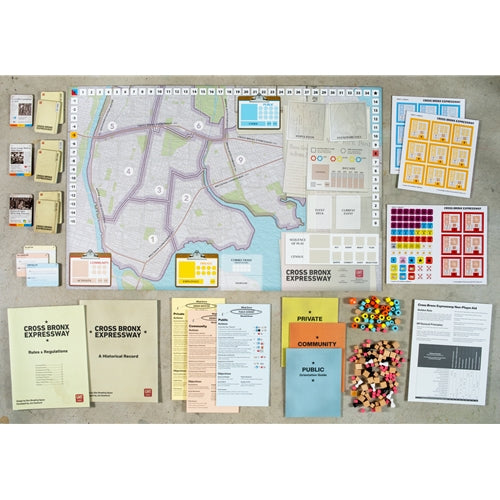
What you put on the table to build (or destroy) the Bronx
Infrastructure and Organizations
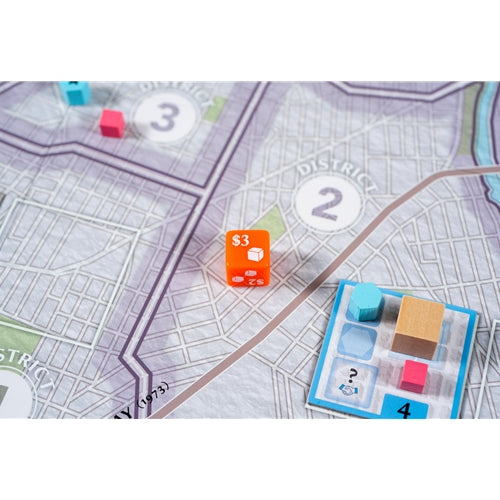
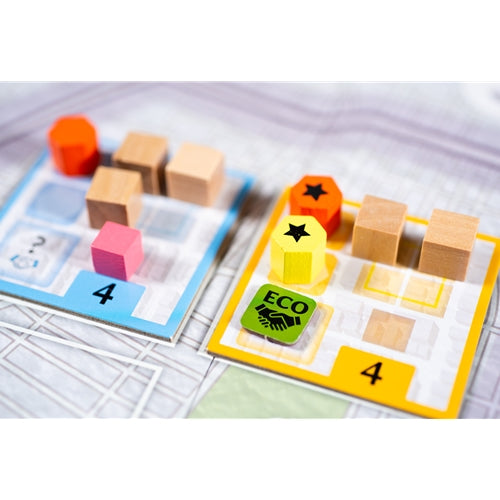
Roads, schools, community centers, hospitals. Every building costs resources but improves neighborhood stability. Or at least it should, if no one speculates on the land.
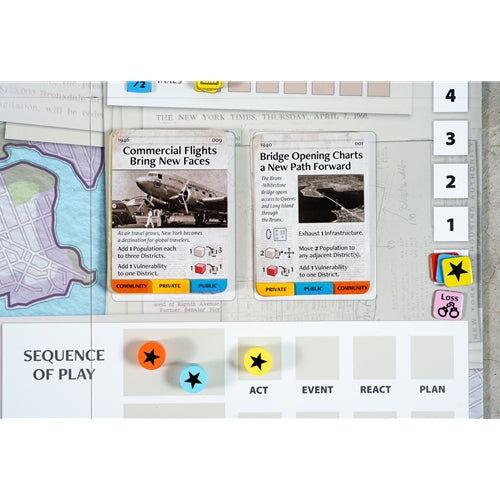
Event Cards
The engine of the game. They determine turn order and trigger crises, opportunities, demographic changes. Each card is a historical moment: from the Great Depression to the 1960s riots.
Coalitions
Factions can temporarily ally to address common problems. But every coalition has a political price, and trusting too much can cost you victory.
Resources and Debts
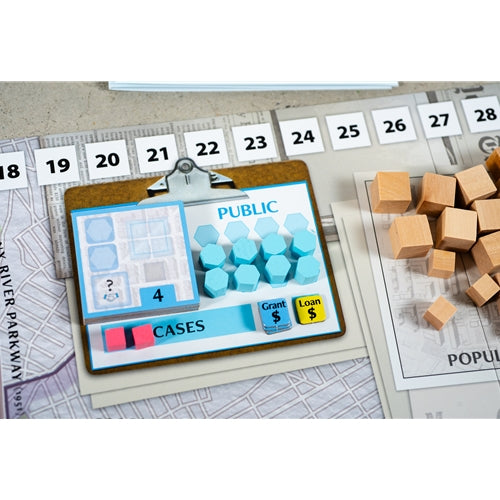
Manage budgets, population, political influence. Going bankrupt means being out of the game. And if too many factions collapse, everyone loses, even those who were ahead.
In a few hours, you'll understand that building a city is not a puzzle. It's a continuous negotiation between what you want, what you can afford, and what the Bronx can endure.
Come si gioca
Video dimostrativo di gameplay.
A game in five moments
What happens at the table
Not the rules. The experience.
The neighborhood takes shape
The first event cards come out. Someone builds a road, someone a school. Everyone seems to be collaborating. But it's already clear who aims for expansion and who for stability. The first tensions arise over priorities: development or welfare?
The first crisis arrives
A negative event hits. Unemployment, crime, population flight. Common resources are not enough. Someone has to pay, but no one wants to go into debt. The first coalition forms out of necessity, not strategy.
The game bifurcates
Mid-game. Someone is accumulating points, someone else is one step away from bankruptcy. Actions become more aggressive: sabotaging a road, blocking someone else's project, speculating on land while the Bronx burns. Cooperation is increasingly forced.
Collective defeat becomes real
Someone miscalculates. A debt too large, an ignored crisis, a chain of events. The Bronx is on the verge of total collapse. Even those in the lead must now choose: sacrifice points to save the system, or risk everything and hope others pay.
The Bronx survives. Perhaps.
The event deck runs out. Points are counted, but first, it is checked: is the neighborhood still standing? If so, someone has won. If not, you all lose. And even in victory, someone will look at the board and think: was it worth it?
How to play
The flow of each round
Cross Bronx Expressway is driven by the event deck. Each card determines who plays, what happens, and how much it costs to stay afloat.
An event card is revealed. This determines the order in which factions act and triggers global effects: economic crises, demographic changes, political opportunities. Each card is different.
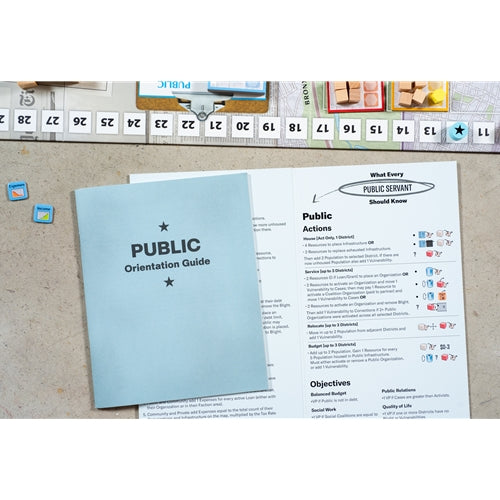
In order, each faction spends resources to perform actions on board spaces: building infrastructure, forming coalitions, solving population problems, managing their debt. Actions are limited by available resources and neighborhood conditions.
If there are open problems (crime, poverty, unemployment), factions must collaborate to mitigate them. Those who don't contribute accumulate penalties. Those who contribute too much go into debt. The balance is fragile.
At regular intervals, it is checked whether the Bronx is still sustainable. If too many negative conditions are active, immediate collective defeat is triggered. Otherwise, victory points are awarded based on faction objectives. The game continues until the deck runs out or collapse occurs.
Why it's different from others
Six mechanics that make a difference
Three Asymmetric Factions
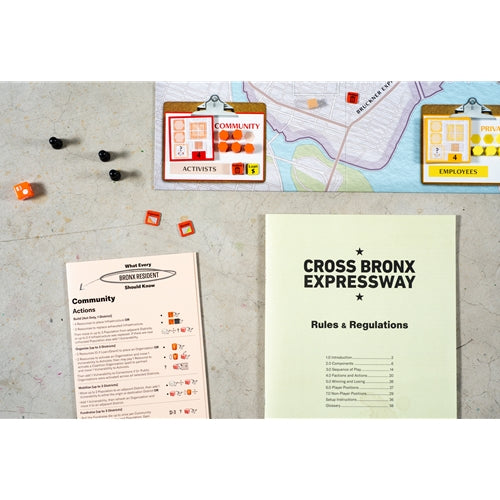
Each faction has different objectives, resources, and abilities. One represents local government, another community organizations, and the third private developers. Each wins differently, but all lose together if the Bronx collapses. Asymmetry creates natural tension.
Historical Events as the Engine
It's not a generic deck of cards. Each event represents a real historical moment: the construction of the Cross Bronx Expressway, riots, the flight to the suburbs, gentrification. The game is also an educational simulation, without being didactic.
Semi-Cooperative with Collective Defeat
It's not a pure cooperative game: you have personal objectives and want to win. But if the urban system collapses due to poverty, debt, or instability, you all lose simultaneously. You must balance selfishness and group survival. Always.
Dynamic Coalition System
Factions can form temporary coalitions to address crises or common projects. But each coalition has political costs and constraints: you can't ally with everyone, and every alliance exposes you. Coalitions form, break, reform. Just like in reality.
Survival Economy
Manage budgets, human resources, political influence. If you go too far into debt, you're out of the game. But not spending enough means leaving the Bronx vulnerable, and if it collapses, dragging everyone with it, even your frugality becomes useless. The game punishes both greed and profligacy.
Rare Thematic Depth
Cross Bronx Expressway doesn't use theme as a skin. It truly simulates the incentives, conflicts, and dilemmas of post-war American urban planning. Every game is also a reflection on what it means to build a city, who pays the costs, and who reaps the benefits. It's not propaganda: it's complexity made playable.
How it ends
How to win and how to lose
In Cross Bronx Expressway you win individually but you can lose collectively. Scoring only matters if the Bronx survives.
Victory
- At the end of the event deck, if the Bronx has not collapsed, the player with the most victory points wins
- Points are earned by building infrastructure, completing faction objectives, and controlling strategic areas
- Each faction has different scoring conditions: government rewards stability, community rewards welfare, developers reward profit
Collective defeat
- If too many instability conditions (crime, poverty, unemployment) accumulate simultaneously, the Bronx collapses and all players lose immediately
- If more than one faction goes totally bankrupt, the neighborhood's economic system seizes up: collective defeat
- Some events can trigger an immediate game end with automatic defeat if not managed in time
Cross Bronx Expressway is the game that makes you feel the weight of urban planning choices. It's not pure simulation, it's not total abstraction. It's a rare balance of history, strategy, and moral dilemma. For those looking for games that make you think.
Frequently asked questions
FAQ about Cross Bronx Expressway
Is it really a game about urban history or is it just a tacked-on theme?
The theme is deeply integrated. Every event is historically documented, the mechanics genuinely simulate the economic and political incentives of the period, and the designer worked with urban historians. It's not a documentary, but it's not just a city-builder with labels either. You learn by playing, but you're not doing homework. It's a rare case of an educational game that remains engaging.
Does it work well with 1 or 2 players, or is it designed for 3?
The game scales well. In solo play, you use automatic rules for the other factions, and the experience is solid, more of a management puzzle than a social one. With 2 players, there's tension but less variety in coalitions. With 3, it explodes: each faction has multiple interlocutors, alliances are more fluid, betrayals more painful. The sweet spot is 3, but 1-2 works if you know what to expect.
How complex is it to learn compared to other GMT games?
It's in the mid-range of GMT games. It's not a monster wargame, but not a gateway either. A BGG weight of 3.4 is accurate: there are many interconnected rules, three asymmetric factions to understand, and the event system is not trivial. The first game requires 30-40 minutes for rules and a good deal of patience. From the second game, it flows much better.
How much 'take that' is there? Can I ruin other players?
Yes, but with consequences. You can block other people's projects, sabotage infrastructure, form coalitions that exclude someone. However, weakening another faction too much can lead to its collapse, and thus to collective defeat. The game punishes you for being too aggressive. Interaction is high, but it's not a chaotic free-for-all. It's competition with brakes.
Is it available in Italian?
No, this is the English edition by GMT Games. The game includes an event deck, rulebook, board, and faction cards entirely in English. Knowledge of the language is necessary to play: each event has narrative and mechanical text. There is currently no localized Italian edition.
Cross Bronx Expressway is a semi-cooperative strategy game for 1-3 players, lasting 90-180 minutes, recommended for ages 14+. Designed by Non-Breaking Space and published by GMT Games in the Irregular Conflicts Series, it simulates the urban development of the South Bronx between 1940 and 2000 through asymmetric card-driven mechanics. Each player controls a faction with distinct objectives but must cooperate to avoid the collective collapse of the neighborhood. The game integrates resource management, coalition formation, historical events, and layered victory/defeat conditions. Cross Bronx Expressway is a medium-to-heavy weight title inspired by the work of Jane Jacobs, suitable for experienced players seeking thematic depth and meaningful decisions. Available on FroGames.it.
Cross Bronx Expressway
Frequently Asked Questions
The answers you're looking for, no beating around the bush.
📸Do the images match the actual product?
The photos on the website often come from BoardGameGeek and are intended to give you an idea of the game. They may vary slightly from the version you receive. The content declared by the publisher is always binding.
📦Does the content of the box match what is indicated?
We always strive to provide the correct content, but minor variations are possible due to reprints or updates. The information comes directly from the publishers. If you have any questions, please contact us!
⏳How do pre-orders work?
Pre-order the game before release, payment is immediate, and the game is reserved for you. As soon as it arrives, we'll ship it right away! If there are any delays, we'll update you promptly.
🔒Can I trust buying here?
Absolutely! Secure payments, tracked shipments, and a team that loves board games as much as you do. If something goes wrong, we'll do our best to fix it.
🛠There's a problem with my order, what should I do?
Write to us now! Whether it's a missing part, damage, or an error, we'll help you resolve it as soon as possible. Your experience truly matters to us.