
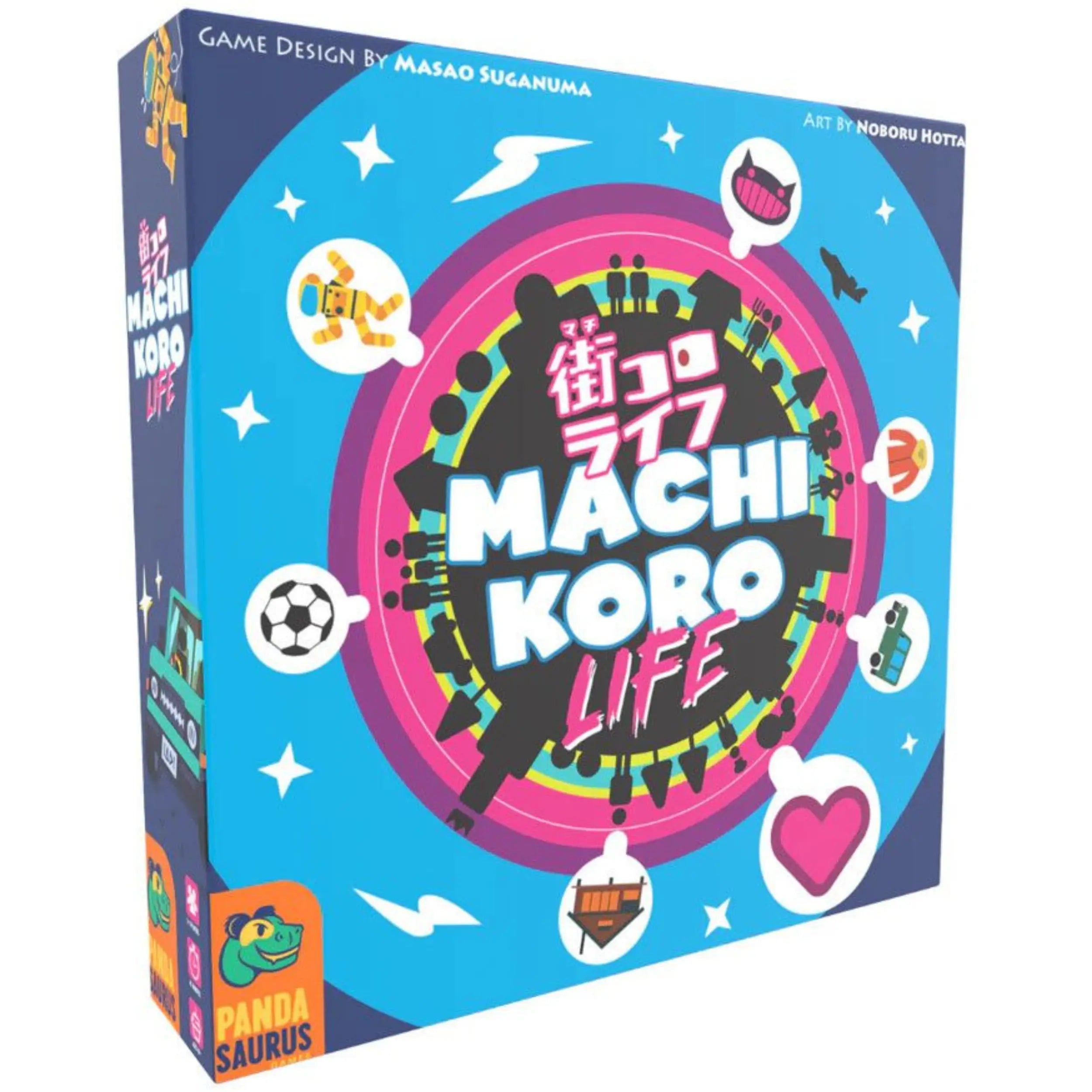
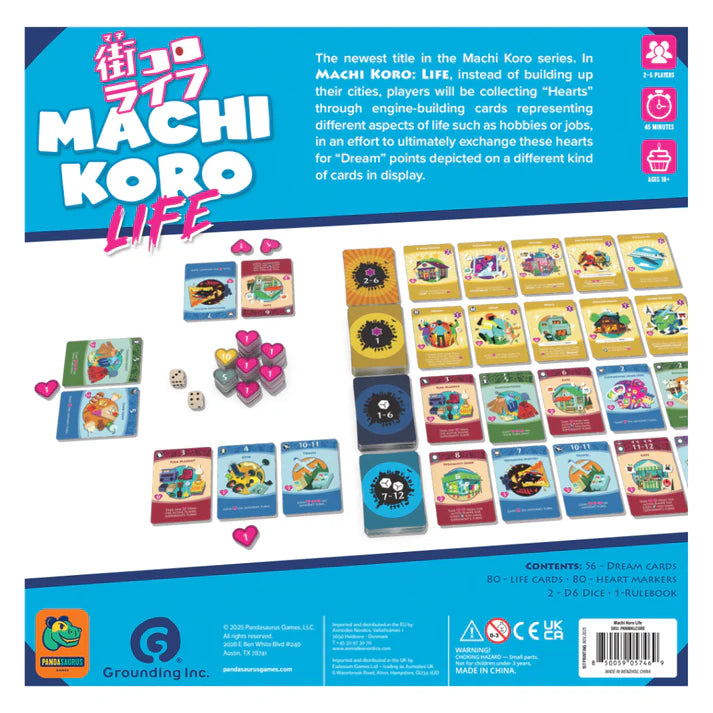
Machi Koro - Life
🐸 Dettagli da BoardGameGeek
Consiglio BGG sul numero di giocatori
Categorie
Meccaniche
Design & Art
Lingua
Pre-order - leggi i dettagli
🐸 Una rana saggia sa quando dividere l’ordine… e quando aspettare il salto giusto.
Si abbina bene con
FroGames — Moments You'll Remember
By the third game, someone starts describing their city as if it were real. The bakery, the flower shop, that time the port changed everything. It's just a dice game, but in the end, we're talking about lives.
WHAT IT'S ABOUT
From the ideal city to the ideal life
街コロライフ (Machi Koro: Life) is the new iteration of the celebrated series created by Masao Suganuma, published by Grounding in Japan and Pandasaurus Games for the international market. Illustrations by Noboru Hotta transform urban construction into something more intimate: instead of buildings, you build a life. Hobbies, jobs, relationships. The dice remain the same, but what you get is different.
On your turn, you roll one or two dice, activate blue, red, and purple cards according to the numbers rolled, collect hearts (representing aspects of life), and then buy: either another engine-building card or a dream card that brings you closer to victory. The first to reach 8 dream points wins. The core mechanics of Machi Koro are intact, but the theme changes everything: you're not optimizing production, you're building an existence.
What they say abroad
A game that makes you build a life, one die at a time.
— FroGames
The familiar mechanics of the series meet a surprisingly thoughtful theme.
— FroGames

Machi Koro: Life
FrogScore · FroGames editorial rating · based on rules, international reviews and game sessionsWhat you build
The cards that become your life
Blue Cards (Engine)
They activate on your turns when the dice show their number. They generate hearts, the game's currency. They are the engine you build to produce constant resources.
Red Cards (Reactive)
They trigger when other players roll your number. They give you hearts stolen from whoever just rolled. The passive interaction that makes every turn relevant for everyone.
Purple Cards (Active)
They activate only on your turns, but have powerful effects: they take resources from others, manipulate dice, accelerate your production. They cost more, but change games.
Dream Cards
They represent your life goals. They cost hearts and are worth victory points. The first to reach 8 dream points wins. They are different every game, changing strategies.
After a few games, you'll discover you were building more than a tableau. You were building alternative lives. It always happens with Machi Koro.
A five-moment game
What happens at the table
Not the rules. The experience.
The first card
Everyone starts with the same two basic cards. The first die is rolled, someone gets a heart, someone else nothing. Disparity begins immediately. You buy your first engine card and understand what kind of life you want to build: fast and risky, or slow and safe.
The engine starts
After three turns, the tableau begins to take shape. Someone has bet everything on a 6, someone else has diversified. The red cards start to activate on others' turns: those who invested in them are laughing, the others are biting their hands. Hearts accumulate unequally.
The first dream card
Someone buys the first dream card and puts 2 points on the table. The others speed up. It's clear now: it's not enough to build the engine, you need to know when to stop and convert hearts into victory. Those who hesitate lose time, those who rush risk running out of resources.
The die betrays
A player rolls the two dice, aiming for their key number. The wrong one comes up. Zero hearts, turn lost. The other takes advantage, activates three cards at once, buys a purple card that steals resources, and buys a 3-point dream. The table groans. Luck decides, but those who built better suffer less.
The last dream card
Someone reaches 7 points. One card is missing. The others have 4-5 points, they have to hope for a disastrous turn from their opponent. They roll the dice: the right number comes up, two cards activate, enough hearts are collected. They buy the last dream card. 8 points. End. You look at your unfinished tableau and think: in the next life, I'll do better.
How to play
The flow of each round
A turn lasts 30 seconds. Roll, activate, buy. Repeat until someone reaches 8 dream points.
Decide whether to roll a single die (results 1-6) or two dice (results 2-12). Two dice activate higher numbers but are less predictable.
First, everyone's blue and red cards (in reverse order from the active player), then your purple cards. Collect the hearts produced. Other players' red cards also activate on your turn.
You can buy an engine card from the common market (blue, red, purple) to improve your engine, or a dream card to get closer to victory. You are not obliged.
The next player rolls the dice. Your red cards might activate on their turn. You are always involved, even when it's not your turn.
Why it's different from others
Six mechanics that make a difference
One or two dice, every turn
It's not just luck: choosing how many dice to roll is a strategic decision. One die is predictable, two dice open up high numbers but dilute probability. Your cards tell you what's best, but you decide the risk.
Hearts instead of coins
The currency is not abstract: they are hearts that represent aspects of life. Hobbies, work, relationships. The theme is not cosmetic; it changes how you talk about the game. You don't say 'I have 5 coins', you say 'I have 5 hearts to spend on my dream'.
Variable dream cards
Dream cards change every game. Some cost little and are worth little, others are heavy investments. Choosing which dreams to pursue guides your entire strategy: you build the engine for those specific dreams, not for a generic goal.
Red cards always active
Your red cards activate on other players' turns when your number is rolled. This means you are always involved, even when you're waiting. Every die that rolls on the table is an event for everyone, not just for the one who rolled it.
Light engine-building
It's not a complex eurogame: it's entry-level engine-building. You build simple combos (cards that activate on the same number), but you don't manage multiple resources or intricate chains. Perfect for families and gateway games.
Fast games
A crisp 45 minutes, no downtime. Turns are very quick, there are no complex phases, and the fact that red cards always activate keeps everyone attentive. You don't look at your phone: you wait for the dice.
How it ends
How to win
The game ends immediately when a player reaches 8 dream points. There is no final round, no ties: whoever gets there first wins.
Victory
- Accumulate 8 dream points by buying dream cards from the market
- Dream cards cost hearts (collected through your engine of blue/red/purple cards)
- You need to balance: buying engine cards to produce more hearts, or immediately converting hearts into dream points
How to fall behind
- Investing too much in the engine and being late to buy dream cards
- Betting everything on numbers that never come up (the dice show no mercy)
- Ignoring red cards: others produce hearts on your turns while you don't on theirs
Machi Koro: Life is a family-friendly engine-building game that hides an existential reflection. You build alternative lives, one die roll at a time. And in the end, you ask yourself: which life would you have chosen?
Frequently Asked Questions
Machi Koro: Life FAQ
Is it necessary to know other Machi Koro games to play Life?
No, Machi Koro: Life is completely standalone. The core mechanics (dice, blue/red/purple cards) are the same, but the theme and cards are new. If you know classic Machi Koro, you'll pick it up immediately, but it's not a prerequisite.
How does the choice between one or two dice work?
You decide each turn. One die produces results 1-6, which are more predictable. Two dice produce 2-12, opening up high numbers but with lower probability. Your cards tell you what's best: if you have many cards on 1-6, stick to one die. If you have cards on 7-12, risk with two.
How long does a real game take, including setup?
Setup takes 3 minutes (arrange the card market, give everyone basic cards). Game 40-45 minutes. Total under an hour, even with 5 players. Turns are very quick, there's no analysis paralysis.
Is it suitable for children or does it require board game experience?
It's a solid family game for ages 10 and up. The rules are immediate, the iconography clear. No prior experience is needed, but you do need to know how to add dice and plan 2-3 turns ahead. Perfect as a second or third modern family game.
Is the edition for sale in Italian?
No, this edition is in English. The texts on the cards are minimal (card names and symbols), the manual is in English. Language dependency is low: after the first game, you play from memory of the icons.
Machi Koro: Life is a light engine-building game for 2-5 players lasting 45 minutes, designed by Masao Suganuma and published by Pandasaurus Games. The game uses the classic mechanics of the Machi Koro series (dice rolling, blue/red/purple cards) but replaces urban construction with an existential theme: instead of buildings, you build an ideal life by collecting hearts and buying dream cards. Suitable for families and players aged 10 and up, with immediate rules and fast games. Available on FroGames.it.
Machi Koro - Life
Frequently Asked Questions
The answers you're looking for, no beating around the bush.
📸Do the images match the actual product?
The photos on the website often come from BoardGameGeek and are intended to give you an idea of the game. They may vary slightly from the version you receive. The content declared by the publisher is always binding.
📦Does the content of the box match what is indicated?
We always strive to provide the correct content, but minor variations are possible due to reprints or updates. The information comes directly from the publishers. If you have any questions, please contact us!
⏳How do pre-orders work?
Pre-order the game before release, payment is immediate, and the game is reserved for you. As soon as it arrives, we'll ship it right away! If there are any delays, we'll update you promptly.
🔒Can I trust buying here?
Absolutely! Secure payments, tracked shipments, and a team that loves board games as much as you do. If something goes wrong, we'll do our best to fix it.
🛠There's a problem with my order, what should I do?
Write to us now! Whether it's a missing part, damage, or an error, we'll help you resolve it as soon as possible. Your experience truly matters to us.