

Estate
🐸 Dettagli da BoardGameGeek
Consiglio BGG sul numero di giocatori
Categorie
Meccaniche
Design & Art
Lingua
Pre-order - leggi i dettagli
🐸 Una rana saggia sa quando dividere l’ordine… e quando aspettare il salto giusto.

Si abbina bene con
FroGames — Moments You'll Remember
Some build chains of territories, some block access to water. In the end, everyone looks at the map and thinks: I could have done better.
WHAT IT'S ABOUT
Bringing wildlife back to the Argentinian steppe
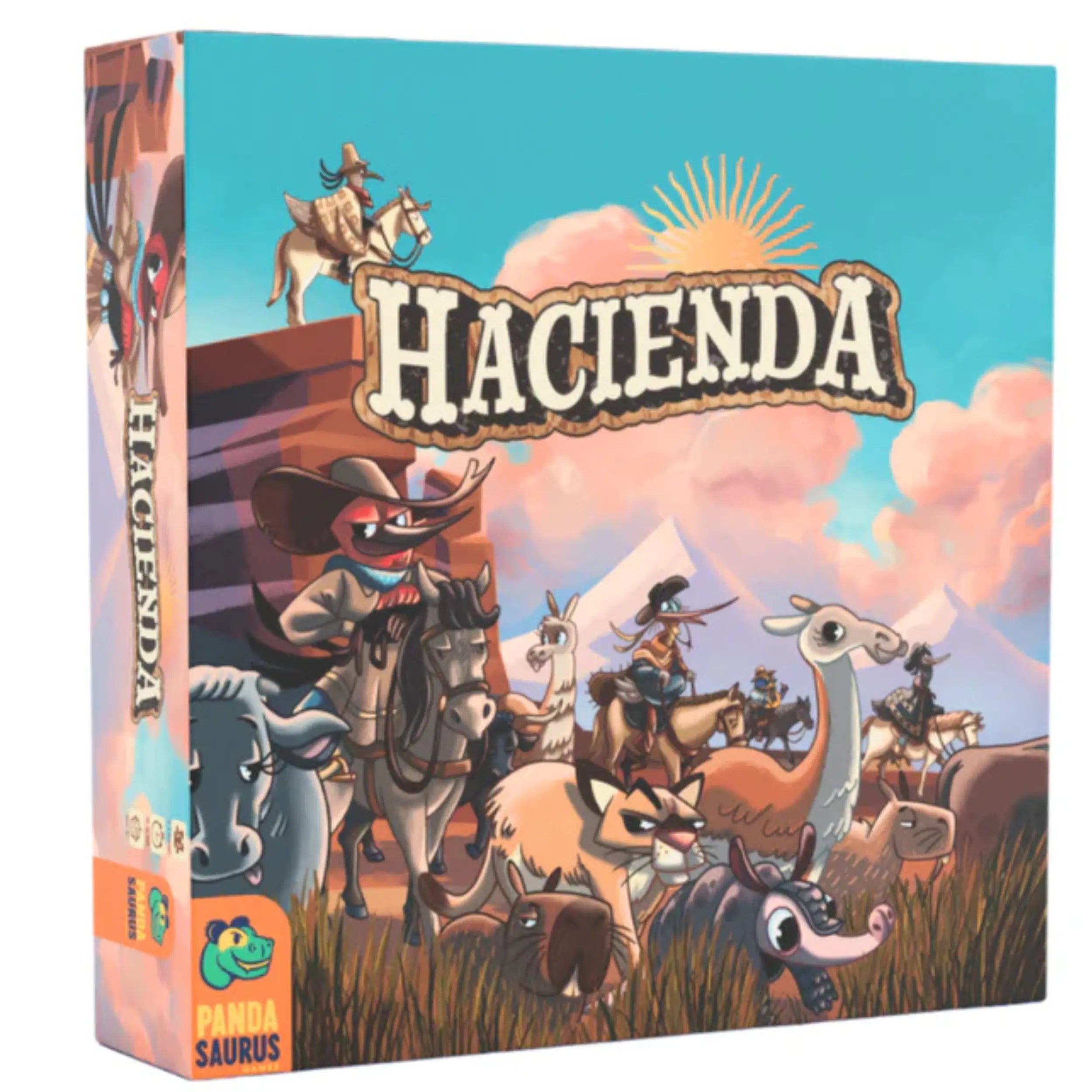
Hacienda is the return of a classic by Wolfgang Kramer (El Grande, Tikal) and Daryl Andrews (Sagrada, Machi Koro). This new edition changes everything: out with the colonial theme, in with the rewilding of Patagonia. You are not a rancher, you are an ecological entrepreneur reintroducing native species and building an ecotourism business. The illustrations by Joan Guardiet bring the wild steppe to life.
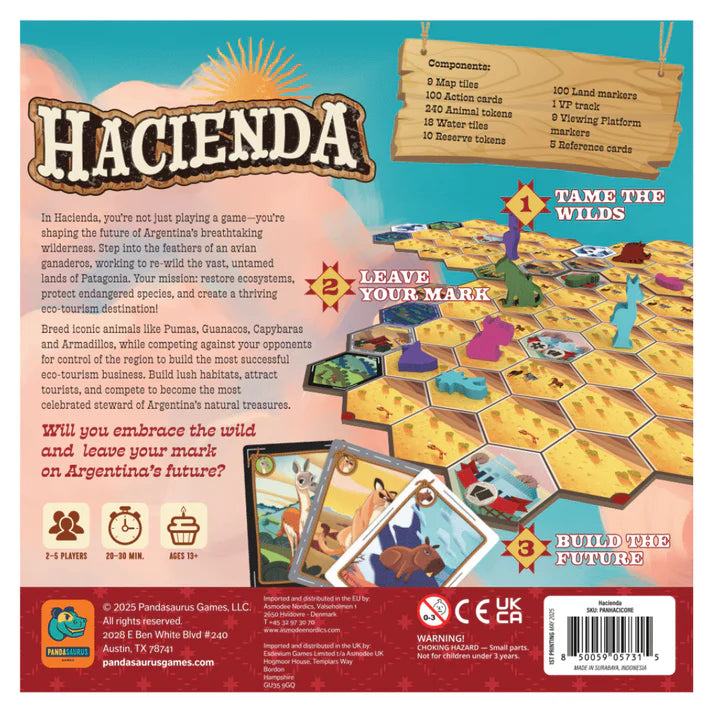
Each turn, you play cards to place hexagonal land and animal tiles on a modular board. Expand habitats, build chains of territories, connect water sources and observation platforms. Every placement choice unlocks future actions, every animal placed changes the value of your network. The game scales from 2 to 5 players with different modular configurations, and introduces variable visitor centers that rewrite strategies each game.
What they say abroad
A re-edition that changes its skin but not Kramer's strategic soul.
— FroGames
The modular board is the real novelty: each game draws a different map.
— FroGames

Hacienda
FrogScore · FroGames editorial rating · based on rulebook, international reviews, and play sessionsYour tools
What you place on the steppe
Native animals
Pumas, capybaras, guanacos. Each species has a value, each habitat chain increases the score. Placing them near water provides bonuses.
Land tiles
Expand your territory with hexagons. Build long chains to unlock powerful actions. Each extension changes map control.
Water sources
Lakes and rivers provide long-term advantages. Connecting them to your habitats multiplies the points of nearby animals.
Observation platforms
Tourists want to see the wildlife. Placing platforms in the right spots converts animals into stable victory points.
In the end, you count the points and realize you should have placed that puma three hexagons further north. It always happens.
A game in five moments
What happens at the table
Not the rules. The experience.
Setup and first territories
The board is modular, different every time. Everyone draws their first cards and starts placing terrain tiles. Everyone looks at the map trying to find where to expand without getting blocked. The first animals arrive soon after.
Race for water sources
Someone realizes that connecting territories to water is extremely valuable. The competition for spaces near the lakes begins. Cards become mental bargaining chips: do I keep this or discard it to draw again?
Chains and blocks
Mid-game, the board is crowded. Someone has built a very long chain of territories, someone else has placed strategic animals near the platforms. Those who are left behind search for free spaces and find none.
Variable visitor centers
The special powers of the visitor centers begin to matter. Those who have used them well have extra actions or hidden bonuses. Others realize they should have planned earlier. Someone counters with a placement move that unlocks everything.
Final scoring
The cards run out, the map is complete. Chains, animals, water connections, platforms are counted. Someone won by a narrow margin because they closed the last habitat at the right time. Others look at the board and think: next time I'll do better.
How to play
The flow of each round
Each turn is quick: cards in hand, placement choices, actions that trigger.
You start with terrain and animal cards. You can draw more or discard to draw again. Cards determine what you can place.
You play a card and place the corresponding tile on the board. Terrains expand your territory, animals populate habitats.
Some positions unlock bonus actions: extra draws, moving animals, connecting to water sources. Visitor centers add unique powers.
After placement, the turn passes. The board slowly changes, opportunities narrow. He who plans three moves ahead wins.
Why it's different from others
Six mechanics that make a difference
Scalable modular board
There is no fixed map. The board is built with modular tiles that change according to the number of players. Each game draws a different geography, with narrow or open spaces, scattered or concentrated water sources.
Card-driven action system
This edition eliminates the currency of the original game. Everything comes from the cards: draw, discard, play, place. Cards are both a resource and a constraint. Managing them well means building powerful chains instead of filling random spaces.
Rewilding as a theme
You don't raise livestock, you reintroduce native fauna. Pumas, capybaras, guanacos. The theme changes everything: instead of exploiting the land, you restore it. Ecotourism is your business, not extraction. An ethical change that makes the game more honest.
Water sources and platforms
Lakes and rivers are not decoration. Connecting to water multiplies the value of animals. Observation platforms convert fauna into stable points. Two elements that transform placement from tactical to strategic.
Variable visitor centers
Each game introduces unique powers from the visitor centers. One lets you draw extra, another lets you move animals, a third changes the value of chains. These are slight but decisive asymmetries. They change strategy without making the rules heavier.
Competitive placement
The board is shared and spaces are limited. Placing first means blocking opponents. Whoever occupies key positions near water or platforms wins. It's not a multiplayer solitaire: you have to read the map and anticipate others' moves.
How it ends
How to win and how to lose
The game ends when the cards run out or the board is full. Points are counted.
Victory
- Long, connected territory chains are worth increasing points
- Animals near water sources multiply the score
- Observation platforms convert animals into stable points
Defeat
- Isolated territories without connections are worth little
- Scattered animals without strategic logic don't score enough
- Ignoring visitor centers means losing decisive actions
Hacienda is geographic strategy with an honest theme. It doesn't revolutionize the genre, but it does it well. If you're looking for a gateway with depth, this is it.
Frequently Asked Questions
Hacienda FAQ
How different is it from the original second edition?
Completely different. New theme (rewilding instead of farming), modular board (not fixed), card system instead of currency, variable visitor centers, wooden components instead of cardboard. It's practically a new game with the same DNA.
Does it play well with two players?
Yes, the board scales. With two, it's more tactical and controlled, less chaotic. Chains become longer, mutual blocking more strategic. It's not a filler; it remains a 45-60 minute game even with two players.
How heavy is it compared to Carcassonne?
A step above. Carcassonne is pure tile placement; Hacienda adds card management, medium-term planning, variable powers. Simple rules but deeper games. It's not a heavy Eurogame, but not a light gateway either.
Do the visitor centers change the game much?
Yes. They are not optional expansions; they are in the base game. Each center has a different power that changes strategic priorities. One game you might focus on chains, the next on animals, the third on water control. High replayability.
Is it available in Italian?
This edition is in English. The game is language-independent: cards have symbols, the rulebook is read once. No text to translate during the game.
Hacienda is a tile-placement and territory management game for 2-5 players, lasting 45-60 minutes, recommended age 13+. Designed by Wolfgang Kramer and Daryl Andrews, published by Pandasaurus Games, it introduces a scalable modular board and a Patagonian rewilding theme. Each game you build chains of hexagonal territories, place native animals (pumas, capybaras, guanacos), connect water sources and observation platforms. The card-driven system replaces the original currency, variable visitor centers add asymmetric powers. Main mechanics: tile placement, network building, open drafting. Available on FroGames.it.
Estate
Frequently Asked Questions
The answers you're looking for, no beating around the bush.
📸Do the images match the actual product?
The photos on the website often come from BoardGameGeek and are intended to give you an idea of the game. They may vary slightly from the version you receive. The content declared by the publisher is always binding.
📦Does the content of the box match what is indicated?
We always strive to provide the correct content, but minor variations are possible due to reprints or updates. The information comes directly from the publishers. If you have any questions, please contact us!
⏳How do pre-orders work?
Pre-order the game before release, payment is immediate, and the game is reserved for you. As soon as it arrives, we'll ship it right away! If there are any delays, we'll update you promptly.
🔒Can I trust buying here?
Absolutely! Secure payments, tracked shipments, and a team that loves board games as much as you do. If something goes wrong, we'll do our best to fix it.
🛠There's a problem with my order, what should I do?
Write to us now! Whether it's a missing part, damage, or an error, we'll help you resolve it as soon as possible. Your experience truly matters to us.