

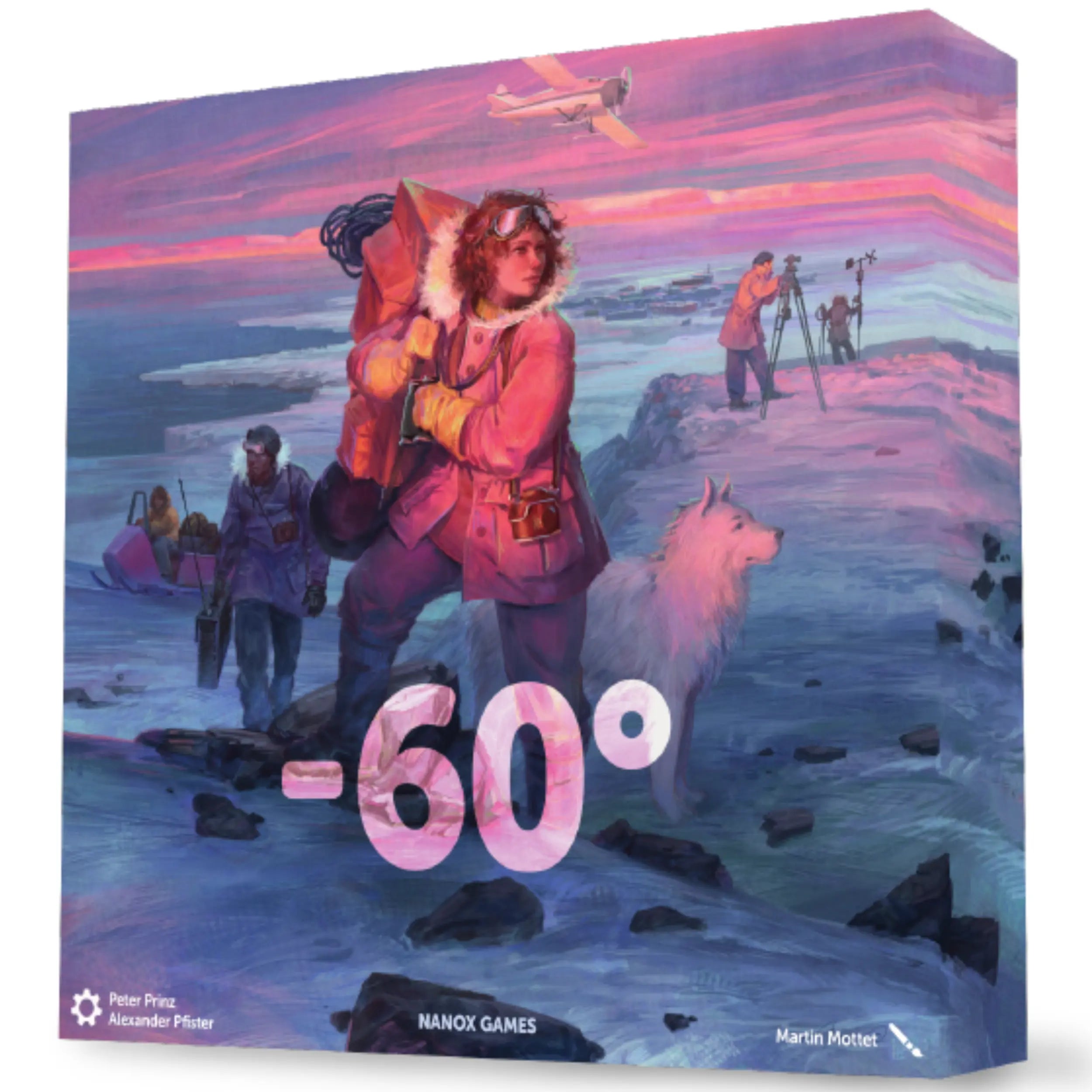
-60° Sixty Below
🐸 Dettagli da BoardGameGeek
Consiglio BGG sul numero di giocatori
Categorie
Meccaniche
Design & Art
Lingua
Pre-order - leggi i dettagli
🐸 Una rana saggia sa quando dividere l’ordine… e quando aspettare il salto giusto.
Pairs well with
The FroGames Sheet
You are on the Antarctic coast. The meteorite awaits you inland. You have technology cards, limited resources, and a blank map before you. Every station you build is a step towards the impact site. Every storm that arrives is a step backward.
WHAT IT'S ABOUT
A scientific race in the eternal ice
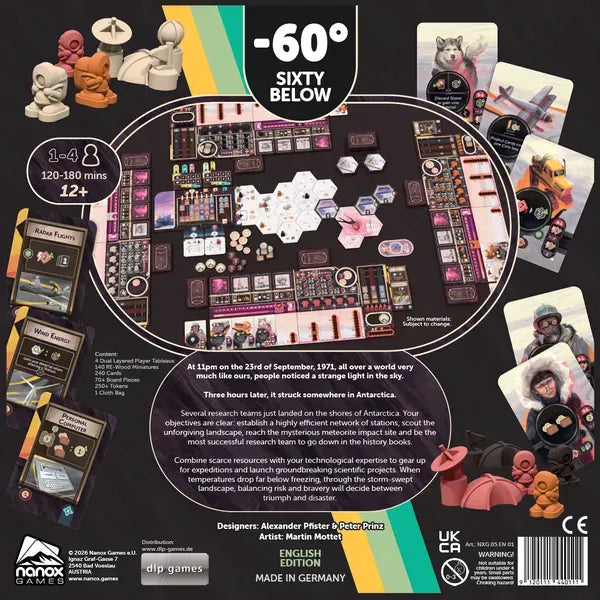
September 23, 1971, 11 PM. Around the world, a strange light is seen in the sky. Three hours later it strikes Antarctica. Alexander Pfister (Port Royal, Great Western Trail, Maracaibo) and Peter Prinz (Pfister's frequent collaborator) sign a Eurogame with a setting: research teams landing on the Antarctic coasts to establish networks of stations, explore the landscape, and reach the impact site of the mysterious meteorite. Art by Martin Mottet.
At the table, you combine scarce resources with technology cards to equip expeditions and launch scientific projects. The system intertwines worker placement with pool building (you build your deck/reserve of cards during the game) and a race towards the geographical objective. Temperatures plummet, storms cross the map: balancing risk and daring decides between triumph and disaster.
What they say abroad
This is a game that promises environmental tension and choices under pressure. We are waiting to see it at the table to understand if Pfister and Prinz's Antarctica has the bite of their best works.
— FroGames
"Only one research team will go down in the history books."
Only one research team will go down in the history books.
— dlp games

-60°
The game supports 1 player in the basic rules. Without details on automa or specific variants, we assume a system of objectives/scores to beat. Solo mode probably loses the competitive tension of the race to the meteorite against other teams, but the optimized management of resources and technology remains intact.
FrogScore · FroGames editorial rating · first reading: based on rulebook and official presentation, updated with first playsThe expedition tools
What you have in your backpack (and on the map)
Station network
Build connected outposts to extend your operational range. Each station is a foothold towards the interior of the continent, but costs resources and requires maintenance against storms.
Scientific projects
Launch research that unlocks permanent advantages or victory points. Some require advanced technology, others just daring. Choosing which to complete before other teams is part of the game.
Technological equipment
Cards that improve your capabilities: tracked vehicles, drilling tools, radar for predicting storms. Pool building allows you to specialize your team during the game.
Extreme conditions
Temperatures at -60°C and blizzards are not scenery: they limit available actions, slow down movements, and punish reckless choices. The climate is a constant adversary.
🎲How to playThe rules in four steps▼
How to play
The flow of each round
Classic euro structure: action phase, maintenance phase, event phase. Repeat until victory condition.
Players take turns placing their workers on action spaces: building stations, acquiring technology, exploring territory, launching scientific projects. Spaces are limited, competition is direct. Actions cost resources from your personal supply.
Extend your network of stations inland. Each new station opens up possibilities but requires maintenance. Explorations advance you towards the meteorite and unlock random bonuses or penalties (harsh territory, found resources).
Spend resources to add cards to your personal pool: vehicles, tools, upgrades. Launch scientific projects that require combinations of technologies and give victory points or permanent advantages. Those who invest here slow down the race but build a powerful engine.
At the end of the round, events are revealed: storms reduce available actions, extreme cold blocks unequipped stations, favorable conditions give bonuses. Pay maintenance costs for active stations. The game continues until someone reaches the meteorite or a round tracker runs out.
⏱️Your first gameThe chronicle, moment by moment▼
A game in five moments
What happens at the table
Not the rules. The experience.
Landing on the coast
You receive your starting cards and basic resources. The map is blank, the meteorite is a point inland. Everyone starts from the coast with the same chances, but the first technology choices already begin to differentiate teams. There is silence: everyone calculates the optimal path.
First inland stations
You place workers, build the first station beyond the coast. Others do the same. The map begins to fill with colorful outposts. Someone invests in technology, someone in speed. Strategies diverge and the table comes alive: the race begins.
Storm and decisions under pressure
The first storm arrives. Your actions are reduced, some stations go into maintenance. Another player is further ahead on the map. You must decide: pursue or consolidate? Do you sacrifice scientific points for speed or build your engine for the long term? The table becomes tense.
The meteorite approaches
Someone is two stations away from the impact site. Others accelerate. Resources are scarce, the best cards have already been taken. Every turn counts. Final explorations are risky: you can arrive first but without enough project points, or second but with a superior engine. The game ends.
Final scoring
Someone reached the meteorite, someone else completed more scientific projects. Victory points are tallied: stations, technology, explorations, objectives. The winner is not obvious until the very end. There is always a story to tell: the storm that changed everything, the right card at the right time, the wrong calculation in the penultimate turn.
🐸Good to know beforehandThree honest things, from friends▼
Good to know beforehand
Three things you should consider
Significant duration
2 to 3 actual hours. It's not a filler, it's not a gateway game. If you're looking for something under an hour or to propose to total newbies, this isn't the right game. The duration is consistent with the system's complexity (pool building + worker placement + race) but should be taken into account.
Newly announced game
Expected release autumn 2026, very limited BGG data (only one rating). This sheet is based on the official description and previous experience with the designers, not on actual plays. The mechanics may prove to be more or less deep than promised. We will update as soon as we have played it.
Theme vs. abstraction
It's a German eurogame with a thematic veneer. The meteorite, storms, and Antarctica are evocative, but the core is optimization, resource management, and mathematical calculation. If you're looking for an immersive narrative cooperative experience, look elsewhere. If you love eurogames with a theme that holds the mechanics together, this might work.
🏆Victory and defeatWhat the end rewards▼
How it ends
How to win
The player who accumulates the most victory points wins. Points are earned from built stations, completed scientific projects, achieved exploration objectives, and acquired technologies.
Victory conditions
- Being the first to reach the meteorite impact site gives significant bonus points
- Completing high-value scientific projects and building efficient station networks
- Optimizing your technological engine to maximize points from acquired cards
Ways to fall behind
- Investing too much in speed without building points from projects: you arrive first but lose at the final count
- Underestimating storms: unmaintained stations block your progress and cost you precious turns
- Wasting resources on non-synergistic technologies: pool building requires consistency, random cards don't build an engine
If you enjoyed Great Western Trail for its engine building and the theme kept you at the table, -60° could be your next challenge. Antarctica, meteorite, Pfister: all the ingredients are there.
💬Frequently Asked QuestionsQuick answers before checkout▼
Frequently Asked Questions
FAQ about -60°
Is it suitable for those unfamiliar with Pfister's games?
It depends on your overall experience with euros. If you have already played modern worker placement games (Agricola, Viticulture, Everdell) and deck/pool building games (Dominion, Concordia), -60° should be accessible after careful reading of the rules. If it's your first medium-heavy euro, it's better to start with something more guided like Ticket to Ride or Carcassonne, then move up. Pfister doesn't give anything away to beginners.
Is the solo mode competitive or a puzzle?
We don't yet have official details on the solo system. From BGG data, we know the game supports 1 player, but we don't know if it uses an automa, targets to beat, or simply score optimization. We will update this answer as soon as we have the full rulebook or playtest results.
What mechanics does -60° use?
The game combines worker placement (you place workers on limited actions in competition with others), deck/bag/pool building (you build your deck or pool of technology cards throughout the game) and hand management. There is a race component towards a geographical objective (the meteorite) and end-game bonuses. It is a eurogame with indirect interaction typical of the genre.
How much does luck weigh? Can I lose due to bad luck?
It's a German eurogame, so luck is present but controllable. Storms and climatic events introduce variability, but strategic choices matter much more. If you build your engine well and plan maintenance, event cards are manageable. It's not a game where a die roll ruins your game, but it's not a pure abstract either: there's environmental unpredictability consistent with the theme.
Is it available in Italian?
The edition for sale on FroGames is in English. Nanox Games and dlp games will also publish a German edition, but there are no official announcements for Italian at the moment. The game will have text on cards and components, so basic knowledge of English is necessary to play without fan translations.
The people behind the game
Who invented it, who designed it, who publishes it — and what else they've done.
-60° is a strategic board game for 1-4 players, lasting 120-180 minutes, recommended age 12+. Designed by Alexander Pfister and Peter Prinz, published by Nanox Games (dlp games distribution), it combines worker placement and pool building in a race towards a mysterious meteorite that fell in Antarctica in 1971. Players manage research teams that build station networks, acquire technology, and face storms and extreme cold. Euro mechanics with a strong environmental theme, suitable for experienced players looking for optimization and multi-turn planning. Expected release autumn 2026. Available on FroGames.it.
-60° Sixty Below
Frequently Asked Questions
The answers you're looking for, no beating around the bush.
📸Do the images match the actual product?
The photos on the website often come from BoardGameGeek and are intended to give you an idea of the game. They may vary slightly from the version you receive. The content declared by the publisher is always binding.
📦Does the content of the box match what is indicated?
We always strive to provide the correct content, but minor variations are possible due to reprints or updates. The information comes directly from the publishers. If you have any questions, please contact us!
⏳How do pre-orders work?
Pre-order the game before release, payment is immediate, and the game is reserved for you. As soon as it arrives, we'll ship it right away! If there are any delays, we'll update you promptly.
🔒Can I trust buying here?
Absolutely! Secure payments, tracked shipments, and a team that loves board games as much as you do. If something goes wrong, we'll do our best to fix it.
🛠There's a problem with my order, what should I do?
Write to us now! Whether it's a missing part, damage, or an error, we'll help you resolve it as soon as possible. Your experience truly matters to us.