
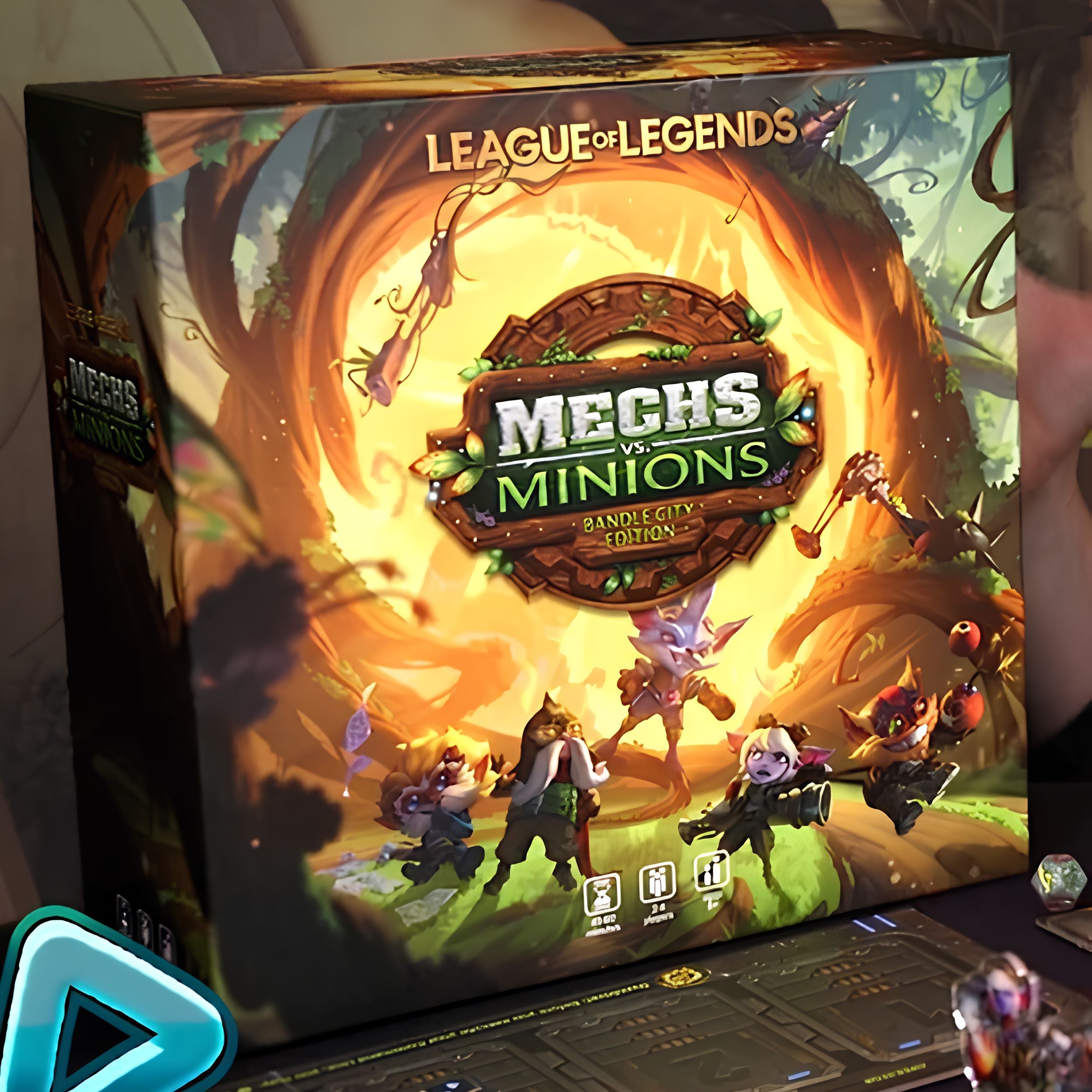
Mechs vs. Minions
🐸 Dettagli da BoardGameGeek
Consiglio BGG sul numero di giocatori
Categorie
Meccaniche
Design & Art
Lingua
Pre-order - leggi i dettagli
🐸 Una rana saggia sa quando dividere l’ordine… e quando aspettare il salto giusto.
Si abbina bene con
FroGames — Moments You'll Remember
The plan was perfect. Then a mech started spinning in circles, firing into the void, and for two minutes no one at the table could stop laughing.
What it's about
Program the mech. Then watch what you've done.
Bandle City, Runeterra. Four Yordles — Corki, Tristana, Heimerdinger, and Ziggs — have built four mechs and are about to unleash them against a horde of minions. Mechs vs. Minions is the cooperative campaign created by Riot Games in 2016, now reprinted by Incredible Dream Studios for its tenth anniversary.
The heart of the game is the command line: six slots where you place, one turn at a time, command cards drawn from a shared pool with others. What you program stays there. Mission after mission, your mech becomes more powerful and, for the exact same reason, increasingly difficult to control. Mechs vs. Minions doesn't punish you with defeat: it punishes you by making you literally execute what you requested three turns ago.
Mechs vs. Minions: Bandle City Edition retains identical gameplay to the original in a much more compact box — double-sided acrylic standees instead of pre-painted mechs, cardboard tokens instead of a hundred minion miniatures, tuck boxes instead of mission envelopes. Plus, ten new solo puzzle challenges and new skin cards to change the Yordles' appearance.
What they say abroad
Reviews of the 2016 edition: the gameplay of the Bandle City Edition is the same.
"Mechs vs Minions is REALLY good!"
Mechs vs Minions is REALLY good.
— Shut Up & Sit Down
"Delightful is the word for it."
"Delightful" is the right word for it.
— SPACE-BIFF!

Mechs vs. Minions: Bandle City Edition
This edition adds ten puzzle challenges designed for a single player: new content, not an adaptation of the campaign. However, they remain a dry and cerebral experience — the campaign is best with someone making mistakes with you.
FrogScore · FroGames editorial rating · based on rules, international reviews, and play sessionsYour arsenal
What you actually have in your hands
Four elements, and the whole game revolves around how you combine them.
Your Yordle mech
Corki, Tristana, Heimerdinger, or Ziggs. In this edition, they are double-sided acrylic standees, with a folder that collects the schematics you've acquired.
The 6-slot command line
Your mechanical brain. Commands are executed from left to right and are not cleared: to change them, you must overwrite them.
Damage cards
Minions don't destroy you: they sabotage you. Some damage occupies a slot and moves the mech against your will until you repair it.
Map tiles
Each mission reconfigures the field: bombs to tow, lava walls, bosses, endless waves. The map changes, the problem changes.
In two hours, no one will remember who placed the decisive command. You'll all remember the turn when a mech walked into the lava wall on its own.
🔄What's different from the original 2016 versionSame game · redesigned box
- Much smaller box — the original was known for its bulk; this edition fits on a normal shelf.
- Double-sided acrylic standees instead of the four pre-painted mechs.
- Cardboard tokens instead of a hundred minion miniatures.
- Unified boards — some sideboards have been merged into one.
- Tuck boxes instead of mission envelopes, and champion folders to store acquired schematic cards.
- New content — ten solo puzzle challenges and skin cards to change the Yordles' artwork.
- Unchanged rules — gameplay is stated to be identical to the 2016 version.
🎯The ten-mission campaign60–90 minutes per mission
The campaign is played over ten consecutive missions. Each arrives sealed in its tuck box and should only be opened when needed: inside you'll find new objectives, new rules, and new components that come into play from that moment on.
The first mission serves as a tutorial without explicitly saying so. From then on, the difficulty increases in stages: you go from towing a bomb to standing in front of a lava wave, up to boss battles. Each mission takes about 60–90 minutes and can be replayed if the group fails.
By completing missions, you earn schematic cards, which remain with the champion in their folder and make the mech progressively more capable — and harder to tame.
🇬🇧Language and EditionBandle City Edition · English
This is the Bandle City Edition in English, co-published by Incredible Dream Studios with Riot Games for the game's tenth anniversary.
English text is present on the rulebook, command cards, and mission materials. Command cards are highly iconic and can be read at a glance after the first mission, but the campaign has a narrative and written instruction component: at least one person at the table needs to be comfortable with English.
Come si gioca
Video dimostrativo di gameplay.
A mission in five moments
What happens at the table
Not the rules. The experience.
The mission box opens
No one knows what's inside. You pull out the map, read the objective aloud, and see where the minions appear. Five minutes later, someone says "okay, but then I should be on the left." The plan is born there, and it lasts for a very short time.
The first command that stays there forever
You draw from the common pool. You take the rotation card because you needed it — and take away the only decent movement card from the others. You place it in the second slot. From now on, every single turn, your mech will spin around. You wanted it.
A minion writes on you
A minion reaches you and leaves you a damage card that goes straight into your command line. Now the mech moves two spaces when you wanted to stop. You can repair it — but repairing costs a turn, and you don't have the turn.
The turn when the machine works
It always comes. Six commands in a row that fit together: you move forward, shoot, the flamethrower activates, the rotation puts you back on track, and you end up exactly where you needed to be. Half the board is cleared. At the table, someone raises their arms. You'll talk about this for months.
Mission end. No one gets up.
Objective completed — or failed by one space. In both cases, the phrase is the same: "come on, let's open the next one." The next mission box is there, still closed, and no one has any idea what it contains.
How to play
The flow of each round
Four phases that repeat until the mission ends. The rules can be explained in fifteen minutes; keeping the mech under control is what takes three games.
From the common pool, each pilot takes only one command card and places it in one of the six slots of their command line. You can overwrite an old command, but you can't just delete it: something always remains programmed.
The mech executes all commands from left to right, with no chance for second thoughts. Movements, rotations, weapons: everything starts in sequence. This is when you discover what you really programmed two turns ago.
Minions move towards their objective, new ones appear, and they hit anyone in their path. They don't destroy the mech: they insert damage cards that mess up its program.
The mission's specific threat advances: the lava wall expands, the boss charges its attack, the timer ticks down. Each mission has its own clock, and it doesn't stop just because you have a plan.
Why it's different from other co-ops
Six design choices that change everything
Commands are not erased
In most programming games, you start from scratch each turn. Not here: what you write stays, and to change it, you have to write over it. Your mech is the sum of all your previous decisions.
Drafting is shared
Everyone draws from the same pool. Taking the card you need means taking it away from someone else. This is where true cooperative conversation begins — and the only arguments at the table.
Damage enters the program
You don't lose health points: you end up with unwanted commands planted in your command line. The mech continues to function, it just no longer does what you want. This is the main source of laughter for the evening.
Ten missions that change the rules
Each sealed box introduces new objectives, components, and rules. It's not the same game on different maps: it's a game that rewrites itself as you play it.
No one gets left out of the game
There is no player elimination. Even the most battered mech continues to move and count, meaning no one watches others play — and whoever is losing can still save everyone.
Same game, box that fits
The 2016 edition was legendary for its size. The Bandle City Edition uses acrylic standees and cardboard tokens to bring the full campaign in a normal-sized shelf box.
How it ends
You win together, you lose together
It's a pure co-op: there's no winner at the table, there's a successful or failed mission. What changes is what you carry over to the next mission.
Mission successful
- Complete the mission objective before the danger reaches you
- The group earns schematic cards, which stay with the champion in their folder
- You move on to the next box — and the rules it brings with it
Mission failed
- The mission timer runs out before you reach the objective
- No player is ever eliminated: you lose as a team
- The mission is replayed — usually with a much nastier plan
Mechs vs. Minions is the cooperative game that won the Golden Geek in its category in 2016 and for years was only available secondhand. This edition brings it back to the table — with ten solo challenges that didn't exist before.
Frequently asked questions
FAQ on Mechs vs. Minions: Bandle City Edition
Why get the Bandle City Edition and not the original with miniatures?
Because the game is the same. The rules, the ten missions, and the campaign are identical: only the materials change. Instead of pre-painted mechs, there are double-sided acrylic standees; instead of a hundred minion miniatures, there are cardboard tokens, and the box is much smaller. In return, you get content that the original doesn't have: ten solo puzzle challenges and skin cards. If you're looking for a collector's item, the miniature version still exists; if you're looking for the game, this is the same table experience.
Is it a real board game or League of Legends merchandise?
It is a real game, and this is where Mechs vs. Minions surprised everyone in 2016. It won the Golden Geek for best cooperative game of the year and was very well received by international specialized press. The license is the packaging: underneath, there's a cooperative programming game with a well-structured campaign, which works even for those who have never opened the video game.
Do I need to know League of Legends to enjoy it?
No. The four Yordles — Corki, Tristana, Heimerdinger, and Ziggs — have abilities that can be explained at the table in thirty seconds, and the campaign is self-contained. Those who play League recognize characters, minions, and references and find an extra layer of enjoyment, but no rule requires knowing who Ziggs is.
How long does the full campaign last?
Ten missions, about 60–90 minutes each: eight to fifteen hours of gameplay depending on the group and the missions you have to repeat. It's fair to say: when the campaign ends, the story is over. What remains are the ten solo challenges of this edition and the possibility to replay your favorite missions or restart it with a new group.
Can it be played solo?
Yes, and this is the main novelty of this edition: ten puzzle challenges designed for a single player, which do not exist in the 2016 version. These are quick, cerebral games, very different from the chaos of the four-player campaign. The campaign itself is best enjoyed with company, where half the fun is watching someone else's plan go up in flames.
Is it available in Italian?
This is the English language edition. The command cards are very iconic and can be read at a glance after the first mission, but the rulebook, mission texts, and narrative materials are in English: at least one person at the table needs to be proficient in the language.
Mechs vs. Minions: Bandle City Edition is a cooperative campaign board game for 2–4 players (ages 14+, 60–90 minutes per mission), set in the world of Runeterra from the League of Legends universe. Designed by Chris Cantrell, Rick Ernst, Stone Librande, Prashant Saraswat, and Nathan Tiras, originally published by Riot Games in 2016 and re-released in 2026 by Incredible Dream Studios for its tenth anniversary. Main mechanic: action programming on a six-slot command line with shared drafting and modular tile maps. Each player pilots one of the four Yordles — Corki, Tristana, Heimerdinger, and Ziggs — through ten sealed missions with ever-new objectives, rules, and components. Winner of the Golden Geek 2016 for best cooperative game. This edition introduces acrylic standees, cardboard tokens, ten solo puzzle challenges, and skin cards. English edition. Available on FroGames.it.
Mechs vs. Minions
Frequently Asked Questions
The answers you're looking for, no beating around the bush.
📸Do the images match the actual product?
The photos on the website often come from BoardGameGeek and are intended to give you an idea of the game. They may vary slightly from the version you receive. The content declared by the publisher is always binding.
📦Does the content of the box match what is indicated?
We always strive to provide the correct content, but minor variations are possible due to reprints or updates. The information comes directly from the publishers. If you have any questions, please contact us!
⏳How do pre-orders work?
Pre-order the game before release, payment is immediate, and the game is reserved for you. As soon as it arrives, we'll ship it right away! If there are any delays, we'll update you promptly.
🔒Can I trust buying here?
Absolutely! Secure payments, tracked shipments, and a team that loves board games as much as you do. If something goes wrong, we'll do our best to fix it.
🛠There's a problem with my order, what should I do?
Write to us now! Whether it's a missing part, damage, or an error, we'll help you resolve it as soon as possible. Your experience truly matters to us.