
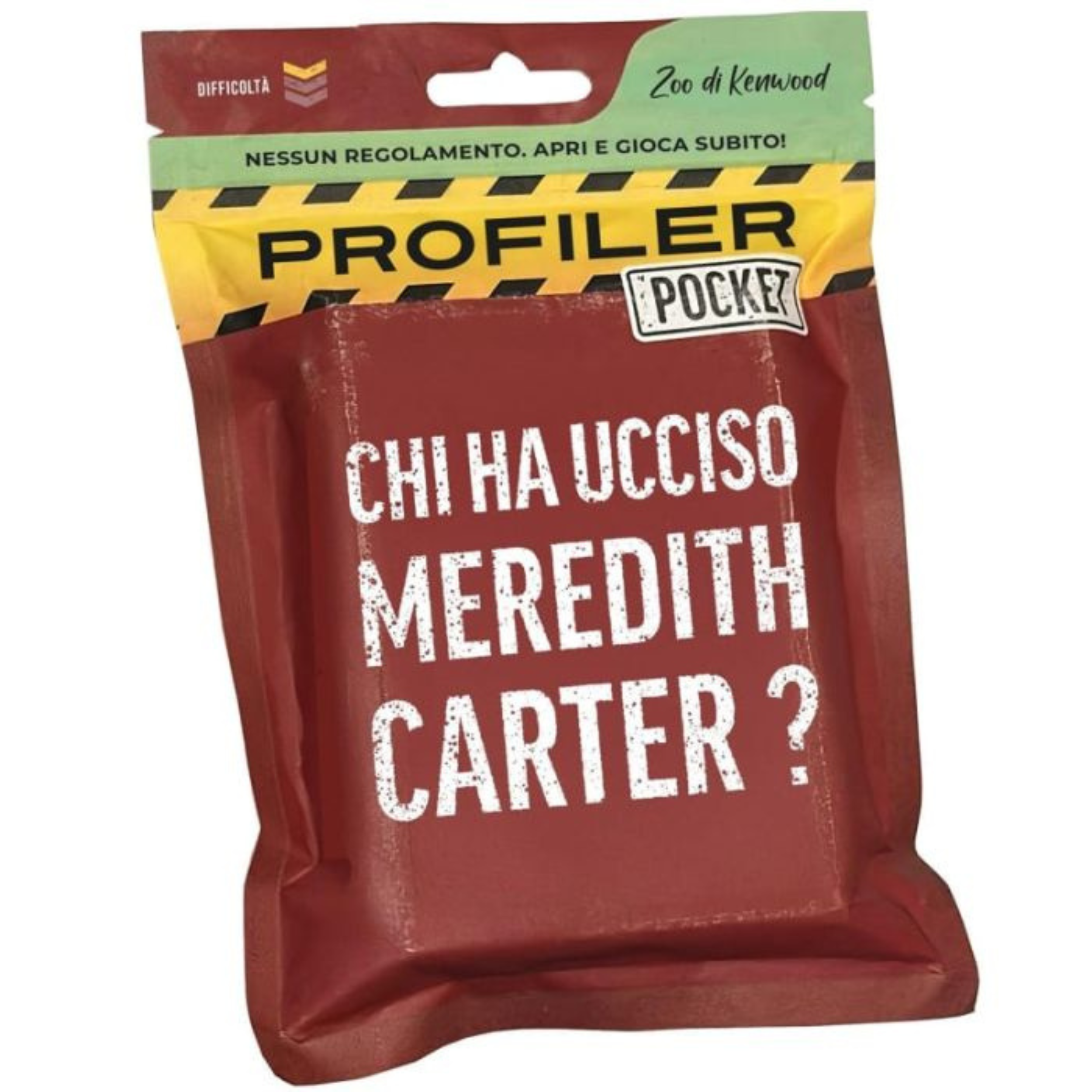
Profiler Pocket - Chi Ha Ucciso Meredith Carter?
🐸 Dettagli da BoardGameGeek
Consiglio BGG sul numero di giocatori
Categorie
Meccaniche
Design & Art
Lingua
Si abbina bene con
FroGames — Moments You'll Remember
Everyone holds their cards. No one speaks. Then someone says, "Wait, look at this photo." And the silence breaks. Eventually, you find out who did it, but the beauty was putting it together.
WHAT IT'S ABOUT
A criminal case solved without reading any rules
Meredith Carter, a world-renowned primatologist and founder of the Kenwood Zoo, was found dead in the bear enclosure. Accident or premeditated murder? The Dossiers Criminels Pocket series brings the card-based investigative format to its purest form: zero manual, zero setup. Open the box and start investigating.
At the table, you divide over 40 cards, including testimonies, photos, floor plans, security camera footage, and letters. Reconstruct the timeline of events, compare versions, find contradictions. When all the pieces fit, you'll know who killed her and why. Pure cooperative play, also playable solo.
What they're saying abroad
Open, observe, discuss. No rules needed when the investigation speaks for itself.
— FroGames
Forty cards are more than enough for a mystery that keeps you going until the last deduction.
— FroGames

Who killed Meredith Carter? — Dossiers Criminels Pocket
Also designed for solo play from the start. Lay the cards out in front of you and think on your own. The experience is identical to cooperative play; in fact, no one interrupts you just as you're about to make the crucial connection.
FrogScore · editorial rating FroGames · based on rules, international reviews, and play sessionsThe clues on the table
What the dossier contains
Camera footage
Who came in, who left, who lied about the time. Cameras never lie, people do.
Zoo floor plans
Where each person was at the time of the incident. Someone is lying about their location. Someone had the right keys.
Testimonies
Four different versions of the same evening. Some coincide, others contradict. It's up to you to figure out who is protecting whom.
Photographs and letters
Hidden relationships, veiled threats, secrets that explain the motive. Each card adds a piece you didn't expect.
Tomorrow someone will ask you: "Did you solve it?" And you'll reply: "Yes, but I'm not telling you anything." It always happens with mysteries.
A game in five moments
What happens at the table
Not the rules. The experience.
Opening the box
Take the cards out of the deck. There's no manual to read, no setup. Someone deals the cards, someone starts reading the first testimony. The feeling of being real investigators, not just players, starts immediately.
The first contradiction
One testimony says one thing, the camera shows another. Someone starts arranging the cards in chronological order. The first suspect emerges, and you all realize this won't be a simple case.
The maze of clues
The table is covered with cards. Photos, letters, floor plans. Every new piece of information changes everything. You go back to re-read the testimonies, because now you know what to look for. The silence is only broken to say: "Look at this one."
The final click
Someone says: "Wait. If he was there, and she had the keys, then..." All the pieces click into place in a second. The motive becomes clear, the sequence of events is reconstructed. No need to check the solutions: you know you've solved it.
The confirmation
You open the solution card. You were right. Or almost. You mentally review all the cards and realize the clues you had underestimated. Someone says: "It was obvious." But for forty minutes, it wasn't at all.
How to play
The flow of investigation
There are no rounds. Deal the cards, examine everything, discuss, solve.
Remove the solution card and set it aside. Shuffle the other cards and deal them among the players. For solo play, lay them all out in front of you.
Each player reads their cards and shares them with the others. Begin to reconstruct the timeline of events. Who was where, who said what, who saw whom.
Compare testimonies, floor plans, footage. Look for contradictions, suspicious details, hidden motives. Physically arrange the cards on the table to visualize the sequence.
When you are sure you have identified the killer and reconstructed the facts, open the solution card and verify. There are no points: either you've solved it or you haven't.
Why it's different from others
Six reasons why it works
Zero manual
You don't read any rules. You open the box and start. The only setup is removing the solution card. The rest is pure intuition. It lowers the barrier to entry: even those who never play board games immediately understand what to do.
Concrete clues
Each card is a real document of the case: testimonies, photos, camera footage, floor plans. There are no abstract mechanics. You reason like real investigators, not like players following a procedure.
Spatial puzzle
The cards don't just stay in your hand: you arrange them on the table, move them, overlap them, put them in chronological order. The solution emerges visually when everything fits together. It's a physical puzzle before it's a logical one.
Real cooperation
There are no turns, actions, phases. There is only free discussion. Someone notices a detail, someone else connects it to a testimony, a third person understands the motive. The deduction comes from dialogue, not from mechanics.
Pocket format
Forty-five minutes, fewer than fifty cards. It fits in your pocket, can be played anywhere, doesn't require huge tables. The duration is perfect: enough to immerse yourself, not so long that you lose focus.
True solo
It's not an adapted cooperative game: it works alone by design. You deal the cards in front of you, reason in silence, connect the clues. The experience is identical; in fact: no one distracts you while you're about to figure everything out.
How it ends
How to win (and how to lose)
There are no points. Either you've identified the killer and correctly reconstructed the facts, or you haven't.
Case solved
- You identified who killed Meredith Carter
- You reconstructed the sequence of events: who was where and when
- You understood the motive and how the killer was able to act
Incorrect solution
- You accused the wrong person
- You reconstructed a timeline that doesn't explain all the clues
- You overlooked a key contradiction in the testimonies
A pocket mystery that puts the cards in your hand and tells you: figure it out yourself. No app, no manual. Just logic, attention, and the pleasure of seeing everything fall into place.
Frequently asked questions
FAQ about Who Killed Meredith Carter? — Dossiers Criminels Pocket
Is there really no rulebook to read?
Truly. You open the box, remove the solution card, deal the others. The rest is intuition. The idea is that the clues speak for themselves: you examine them, compare them, discuss them. There are no turns, phases, hidden mechanics. It's closer to solving a crossword puzzle together than playing a traditional board game.
Can it really be played solo, or is it an adaptation?
It can be played solo by original design. You lay out all the cards in front of you and reason by yourself. Nothing changes: there are no mechanics designed for groups. The only difference is that no one interrupts you while you're about to make the decisive connection. In fact, many prefer solo play precisely for this reason.
Once solved, can I play it again?
No. It's a one-shot. Once you know the solution, you know the solution. You can pass it on to someone else who hasn't seen it, but for you, the case is closed. It's like a mystery novel: you read it once. The pocket format keeps the price low precisely for this reason.
Is experience with investigative games required?
Zero experience required. It's designed as a first step into the genre. If you've already played Sherlock Holmes Consulting Detective or Detective, you'll find the same spirit here but without setup, without manuals, without fear of making a mistake. If you've never played anything like it, it's perfect for seeing if you enjoy investigating at the table.
Is it available in Italian?
Yes, this is the complete Italian edition published by MS Edizioni. All cards are translated: testimonies, letters, documents. No need to know other languages. The original French title is «Qui a tué Meredith Carter?».
Who Killed Meredith Carter? is a cooperative investigative game for 1-6 players, lasting 45 minutes, recommended age 14+. It is part of the Dossiers Criminels Pocket series published in Italy by MS Edizioni. The game requires no manual: open the box, deal over 40 cards (testimonies, photos, floor plans, camera footage) and immediately start investigating. The main mechanic is pure cooperative deduction: compare clues, reconstruct the timeline, find contradictions. Meredith Carter, primatologist and founder of Kenwood Zoo, was found dead in the bear cage. Accident or murder? It works perfectly in solo play as well. Available on FroGames.it.
Profiler Pocket - Chi Ha Ucciso Meredith Carter?
Frequently Asked Questions
The answers you're looking for, no beating around the bush.
📸Do the images match the actual product?
The photos on the website often come from BoardGameGeek and are intended to give you an idea of the game. They may vary slightly from the version you receive. The content declared by the publisher is always binding.
📦Does the content of the box match what is indicated?
We always strive to provide the correct content, but minor variations are possible due to reprints or updates. The information comes directly from the publishers. If you have any questions, please contact us!
⏳How do pre-orders work?
Pre-order the game before release, payment is immediate, and the game is reserved for you. As soon as it arrives, we'll ship it right away! If there are any delays, we'll update you promptly.
🔒Can I trust buying here?
Absolutely! Secure payments, tracked shipments, and a team that loves board games as much as you do. If something goes wrong, we'll do our best to fix it.
🛠There's a problem with my order, what should I do?
Write to us now! Whether it's a missing part, damage, or an error, we'll help you resolve it as soon as possible. Your experience truly matters to us.