
Attack on Titan - Deck-Building Game
🐸 Dettagli da BoardGameGeek
Consiglio BGG sul numero di giocatori
Categorie
Meccaniche
Design & Art
Lingua
Pre-order - leggi i dettagli
🐸 Una rana saggia sa quando dividere l’ordine… e quando aspettare il salto giusto.
Si abbina bene con
FroGames — Moments You'll Remember
Someone yells to reinforce the south side, someone burns a last card for the final blow, someone sacrifices themselves to save others. And in the end, no one talks about who won.
WHAT IT'S ABOUT
Humanity's last bastion under siege
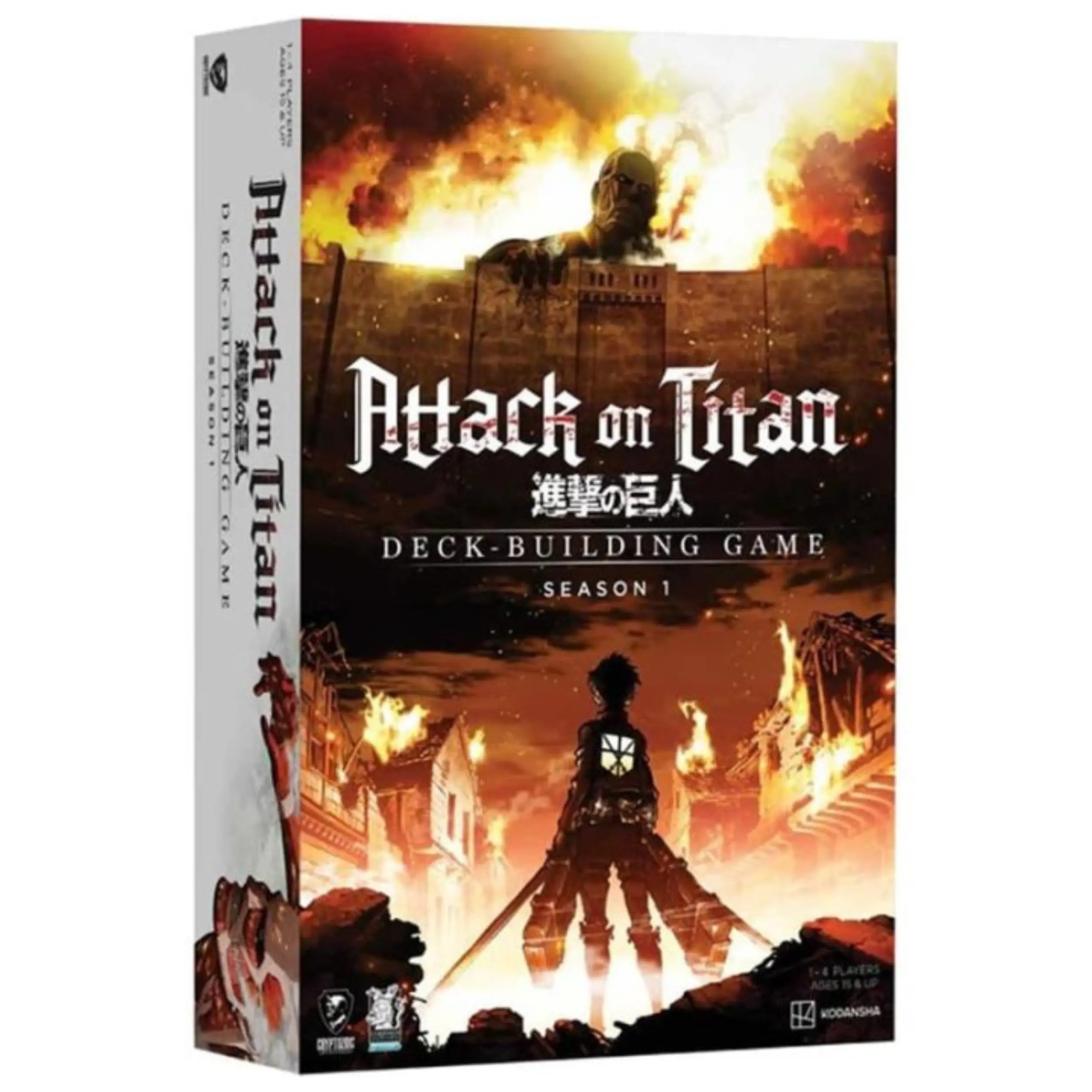
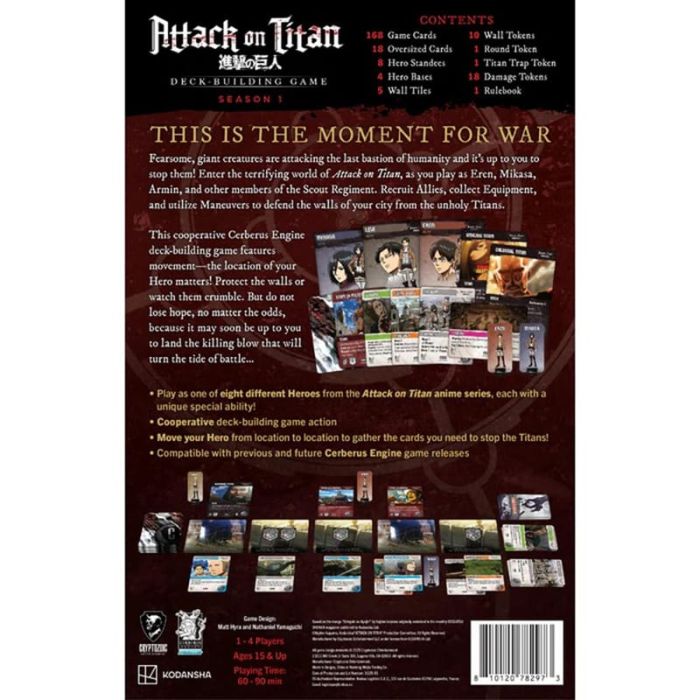
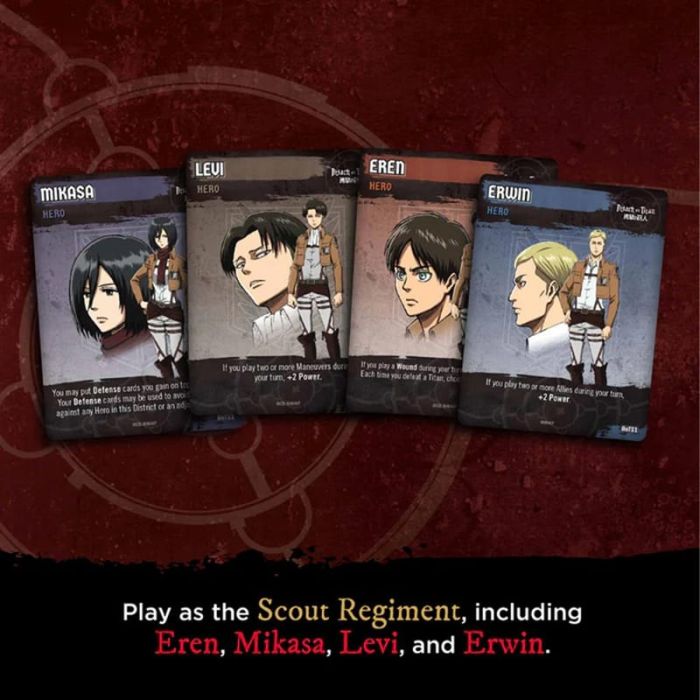
Designed by Matt Hyra for Cryptozoic Entertainment, Attack on Titan: Deck-Building Game brings the adrenaline of the eponymous anime to the tabletop. The game uses the Cerberus Engine, the same mechanical structure as the DC Deck-Building Game, but introduces a new feature: movement. You embody Eren, Mikasa, Armin, and other members of the Survey Corps in the last desperate defense against the Titans who want to tear down the walls and exterminate what remains of humanity.
At the table, you build your deck by acquiring weapons, tactics, and equipment from the central market. But it's not enough to have the right cards: you also need to be in the right place at the right time. The Titans advance towards the walls, you move to intercept them, protect weaker sections, and coordinate attacks with other players. Each hero has unique abilities, and each turn is a choice between strengthening your deck or defending immediately. If the walls fall, humanity falls with them.
What they say abroad
"The movement adds real tension to every decision."
The movement adds real tension to every decision.
— Meeple Mountain
It's not just about buying cards. It's about choosing whether to save your teammate or save the game.
— FroGames

Attack on Titan: Deck-Building Game
The game officially supports solo play by controlling a single hero against the Titan assault. The experience works and maintains positional tension but completely loses the tactical coordination and desperate rescues that make multiplayer memorable. It remains a good alternative for those who love the IP.
FrogScore · FroGames editorial rating · based on rules, international reviews, and play sessionsYour weapons against the Titans
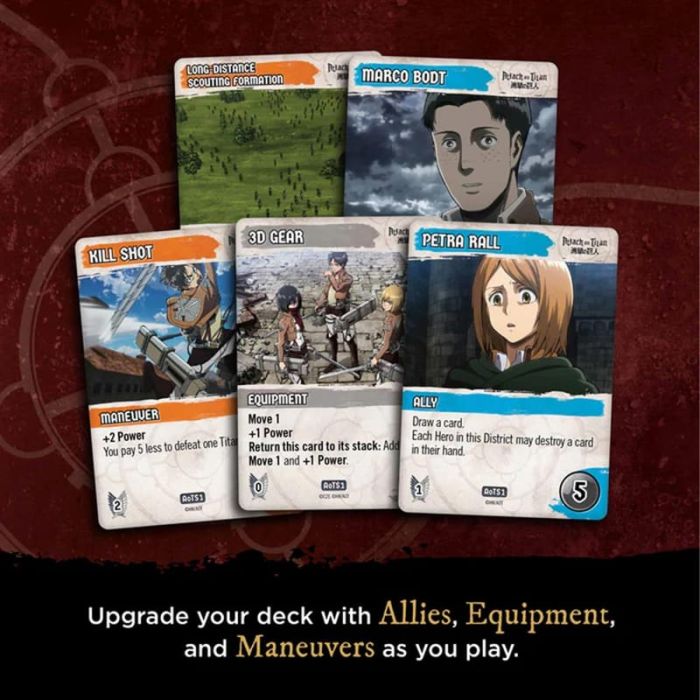
What you find in the market and in your deck
Ultra Hard Steel Blades
The blades that cut the Titans' nape. They deal direct damage, but wear out quickly: you must balance power and deck sustainability.
Omni-Directional Mobility Gear
The 3D equipment that allows you to move quickly across the map. Essential for intercepting Titans before they reach the walls.
Tactical Formations
Tactics cards that enhance coordinated attacks. More players in the same zone mean more damage: the game rewards team positioning.
Titan Cards
The enemies of the game: each Titan has health points, special abilities, and advances towards the walls. Some move fast, others resist damage, all are lethal.
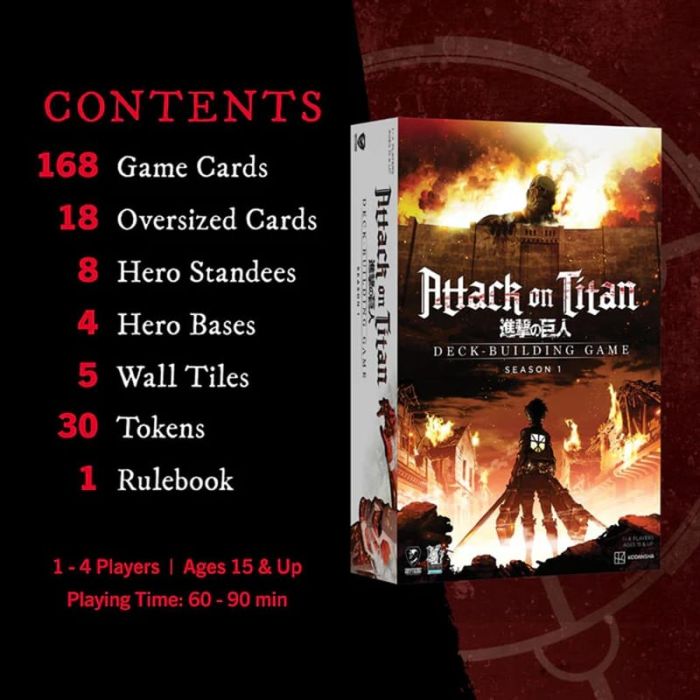
Recommended Sleeves 201 cards in 2 sizes ▼
If you play often, we recommend protecting your cards with clear sleeves to make them last longer.
| Size | Quantity |
|---|---|
| 64 × 89 mm | 188 |
| 76 × 102 mm | 13 |
| Total cards | 201 |
In an hour and a half, someone will have shouted, someone will have cursed their deck, and everyone will remember the moment Mikasa saved Armin in the last turn.
Come si gioca
Video dimostrativo di gameplay.
A five-moment game
What happens at the table
Not the rules. The experience.
The first assault
Choose your hero, read the special ability, look at the map. The first Titans appear at the edges, you are in the center with a basic five-card deck. Everyone immediately understands: there's no time to lose. You start buying cards and moving towards the nearest threats.
The walls begin to creak
Someone already has a decent deck, someone draws poorly and has to choose: strengthen the deck or defend immediately? The Titans advance, one reaches the south wall. First damage to the walls. Tension rises: you realize you can't be everywhere, and saving one sector means leaving another exposed.
The critical moment
A particularly resilient Titan threatens an already damaged section. Two players converge on the same area, coordinate attacks, burn their best cards. The Titan falls, but the market is now depleted of the strongest weapons. Those who built their deck well start to make a difference, those who lagged behind struggle.
The impossible rescue
A player is surrounded, their hero risks elimination. Another burns their turn to reach them, sacrificing a purchase to cover their back. That gesture saves the game: the hero survives, counterattacks, takes down two Titans in one turn. The table explodes. This is the moment you'll remember.
The last Titan
The walls barely hold, the decks are well-oiled, the last Titan appears. Everyone knows what to do: converge, unleash every card, close out the game. The final attack lands, the Titan collapses, humanity survives. Or not: a section gives way, the walls crumble, and you all lose together. In either case, you want to play again immediately.
How to play
The flow of each round
Each round is a race against time: move, buy, attack, then the Titans advance.
You draw 5 cards, play them all. You gain buying power and attack points. You can move your hero one zone, buy cards from the central market (which go into your discard pile), and attack Titans in your zone.
Each active Titan moves one zone towards the nearest walls. If it reaches a wall, it inflicts damage. If a Titan accumulates enough damage from attack cards, it is eliminated and goes into the discard pile of the player who defeated it (victory points).
Draw new Titan cards from the enemy deck and place them at the map's edges according to spawn rules. Some Titans have special abilities that activate immediately (resistance, extra movement, area damage).
Discard your hand, reshuffle if necessary, the next player begins. The market fills with new available cards. The game proceeds until the walls collapse (defeat) or you defeat all Titans (victory).
Why it's different from others
Six mechanics that make a difference
Tactical movement
It's not a static tabletop deck-builder: your position on the map matters. You can only attack Titans in your zone, so each turn you have to choose whether to move towards a threat or stay and defend. Movement is limited (one zone per turn), so planning routes is crucial. This adds a tactical layer that almost all cooperative deck-builders lack.
Walls that truly crumble
The walls are not just scenery: they have physically tracked health points and each section can fall independently. When a Titan reaches a wall, it inflicts damage. If a section collapses completely, that part of the map becomes inaccessible and Titans can enter freely. The pressure is constant and visible: you see the walls crumbling turn by turn.
Asymmetrical heroes with iconic powers
Each hero (Eren, Mikasa, Armin, Levi, etc.) has unique abilities that reflect their anime character. Eren inflicts massive damage but risks elimination, Mikasa moves fast and protects allies, Armin enhances group tactics. They are not just skins: they radically change how you build your deck and position yourself on the map.
Coordinated attacks
Some tactic cards only activate if multiple heroes are in the same zone. This encourages positional coordination: it's not enough to have a strong deck, you need to be where reinforcements are needed. Desperate rescues and group assaults are the most memorable moments of the game, and the system mechanically rewards them.
Modified Cerberus Engine
The game uses the base of the DC Deck-Building Game (you buy cards with power, attack enemies, discard everything at the end of the turn), but adds cooperative layers: shared market, enemies that threaten everyone, no competition for points. It's familiar enough to learn in 15 minutes if you know Dominion or similar, but different enough not to feel like a reskin.
Titans with personality
They are not just generic card decks: each Titan has distinct stats and abilities. Some move two zones per turn, others resist initial damage, still others inflict area damage when defeated. This forces you to prioritize threats and change tactics on the fly: you can't approach them all the same way.
How it ends
How to win and how to lose
The game ends in one of two ways: either you save humanity, or the walls crumble and you all lose together.
Cooperative Victory
- Defeat all Titans in the enemy deck before the walls completely collapse
- At least one section of the walls still stands when the last Titan falls
- No hero has been permanently eliminated (optional variant: victory even with fallen heroes)
Defeat
- All sections of the walls suffer critical damage and collapse: Titans invade the city
- Too many heroes are eliminated and there is no longer enough strength to defend (variant: at least 2 heroes must remain active)
- The Titan deck runs out while there are still active threats on the map (optional, depends on the scenario)
Attack on Titan: Deck-Building Game is not a game about the anime. It's a game about how long you last before crumbling, and about who you save when you can't save everyone.
Frequently asked questions
FAQ about Attack on Titan: Deck-Building Game
Do I need to know the anime to play?
No, absolutely. The game works perfectly even if you've never seen Attack on Titan. The mechanics are solid and the theme is clear: defend the walls, defeat the giants. Of course, if you know the characters, you'll appreciate the asymmetrical powers and card references more, but it's not mandatory. Many groups play it completely ignoring the IP.
Is it hard to learn if I've never played a deck-builder?
No, it's one of the most accessible deck-builders. If you've played Dominion, Star Realms, or similar, you'll learn in 10 minutes. If it's your first deck-builder, add another 10 minutes to understand the 'buy cards → go to discard → reshuffle → draw' cycle. The map movement part is intuitive: if you're in the Titan's zone, you can attack it. That's it.
Does the game scale well from 1 to 5 players?
The sweet spot is 3-4 players: enough for coordinating group attacks, not too many to slow down turns. It works with 5, but wait times increase. Solo play loses much of the cooperative charm (rescues, coordination), but it remains a solid challenge against the Titan automaton. With 2 players, it's tactical but less epic.
How long does a game last?
60-90 minutes on average with 3-4 players, once you know the rules. The first game might approach two hours due to setup and the learning curve. Solo games are faster, 45-60 minutes. The pace is constant: there are no long downtimes; each turn is buy/move/attack and off you go.
Is it available in Italian?
No, this edition is in English. The cards have text (tactic names, hero abilities, Titan effects), so a basic understanding of the language or the use of a translated reference is needed. There is no official Italian edition currently. The language dependency is medium: once the main cards are understood, the game flows smoothly.
Attack on Titan: Deck-Building Game is a cooperative game for 1 to 5 players, lasting 60-90 minutes, recommended for ages 15+. Designed by Matt Hyra and published by Cryptozoic Entertainment, it uses the modified Cerberus Engine with the addition of tactical map movement. Players embody heroes from the anime (Eren, Mikasa, Armin, Levi) and must build decks of weapons and tactics to defeat the Titans before they destroy humanity's walls. Mechanics: cooperative deck-building, variable powers, open drafting, positional movement. Perfect for fans of dynamic cooperative games, accessible even to those unfamiliar with the IP. Available on FroGames.it.
Frequently Asked Questions
The answers you're looking for, no beating around the bush.
📸Do the images match the actual product?
The photos on the website often come from BoardGameGeek and are intended to give you an idea of the game. They may vary slightly from the version you receive. The content declared by the publisher is always binding.
📦Does the content of the box match what is indicated?
We always strive to provide the correct content, but minor variations are possible due to reprints or updates. The information comes directly from the publishers. If you have any questions, please contact us!
⏳How do pre-orders work?
Pre-order the game before release, payment is immediate, and the game is reserved for you. As soon as it arrives, we'll ship it right away! If there are any delays, we'll update you promptly.
🔒Can I trust buying here?
Absolutely! Secure payments, tracked shipments, and a team that loves board games as much as you do. If something goes wrong, we'll do our best to fix it.
🛠There's a problem with my order, what should I do?
Write to us now! Whether it's a missing part, damage, or an error, we'll help you resolve it as soon as possible. Your experience truly matters to us.