

Emozionarium + Free promo cards
🐸 Dettagli da BoardGameGeek
Consiglio BGG sul numero di giocatori
Categorie
Meccaniche
Design & Art
Lingua
Pre-order - leggi i dettagli
🐸 Una rana saggia sa quando dividere l’ordine… e quando aspettare il salto giusto.
Pairs well with
FroGames — Moments You'll Remember
Someone tries to act like an angry retiree at the post office. Someone else like a terrified photographer at a wedding. And in the end, you discover that understanding other people's emotions is harder than you thought.
WHAT IT'S ABOUT
A party game that makes you truly engage with emotions
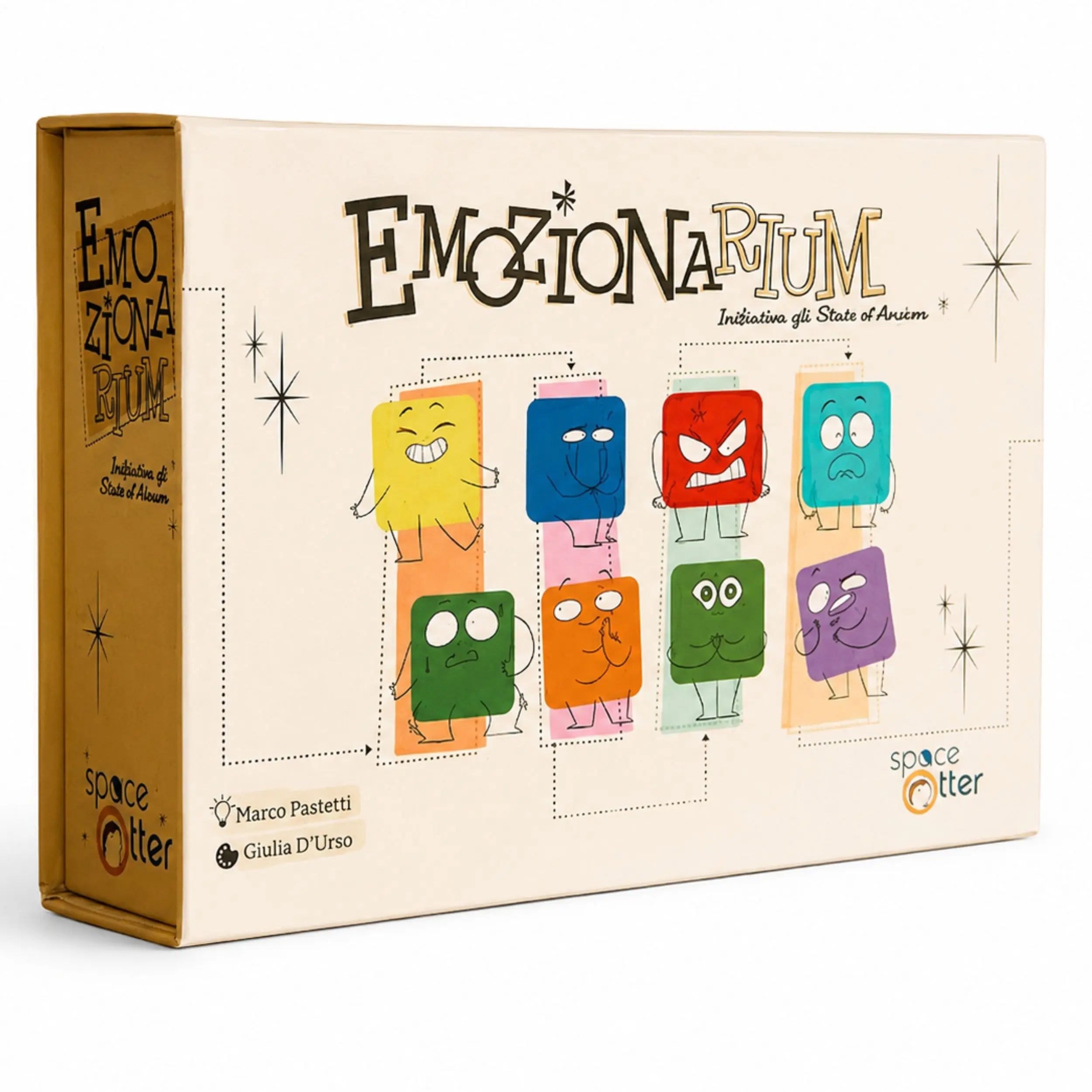
Emozionarium is published by Space Otter Publishing, with illustrations by Giulia D'Urso. It's not the usual game where the best actor wins: here you have to convey what your character feels using Plutchik's Wheel of Emotions, the scientific tool that maps human emotions. A mix of party game and light role-playing game that can even win over those who usually don't like acting.
Each round, you receive a public Situation (your character) and a secret Emotion. You must interpret that scene, making others understand what you feel, without naming it, without synonyms, without cheating. Others must guess your emotion. You must guess theirs. Three rounds of increasing difficulty guided by Plutchik's Wheel of Emotions make each game a different journey through primary, secondary, and complex emotions.
What they say abroad
A party game that teaches you something while you laugh. That doesn't happen often.
— FroGames
Acting is easy. Making people understand what you really feel, without naming it, is a whole other story.
— FroGames

Emozionarium
FrogScore · FroGames editorial rating · based on rules, international reviews, and game sessionsWhat's in the box
The tools to enter the Emozionarium
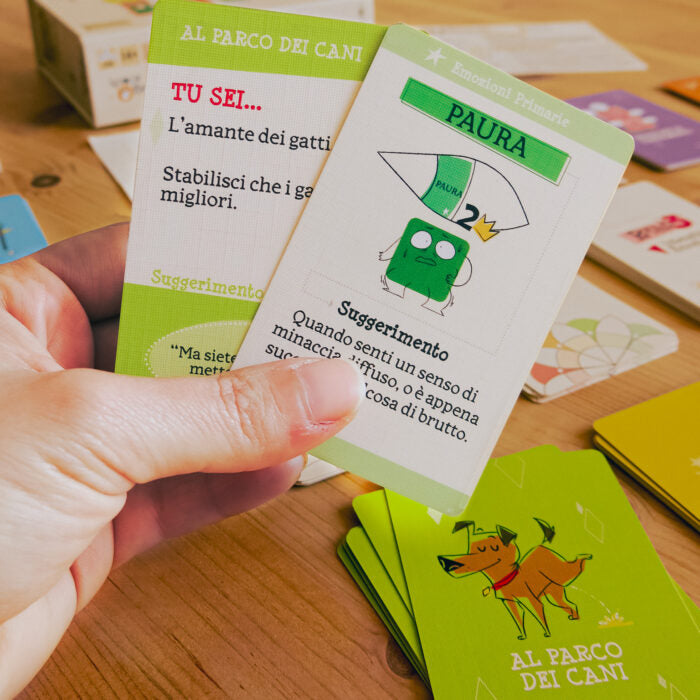
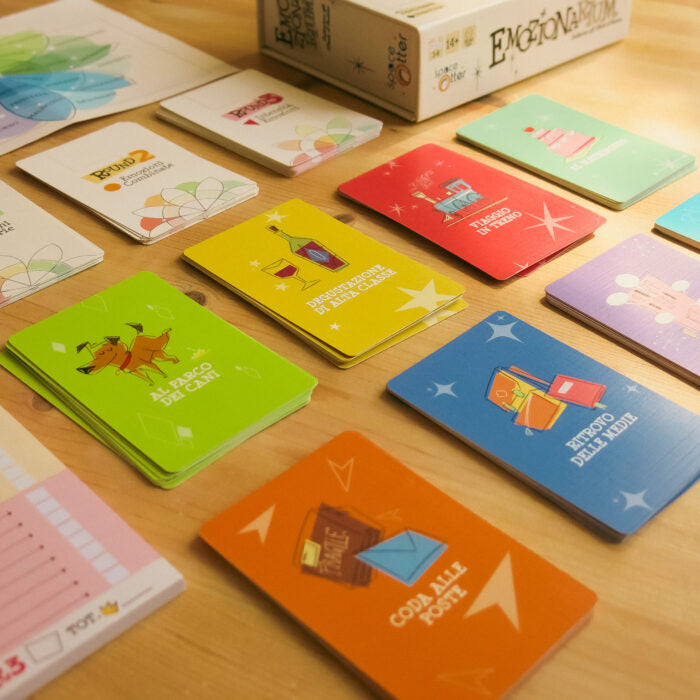
Situation Cards
Your public persona: the photographer at the wedding, the retiree at the post office, the employee at the interview. Everyone sees them, no one knows what they feel.
Emotion Cards
Your secret card. It can be a primary emotion (fear, joy), secondary (pride, envy), or complex (nostalgia, remorse). Only you know it.
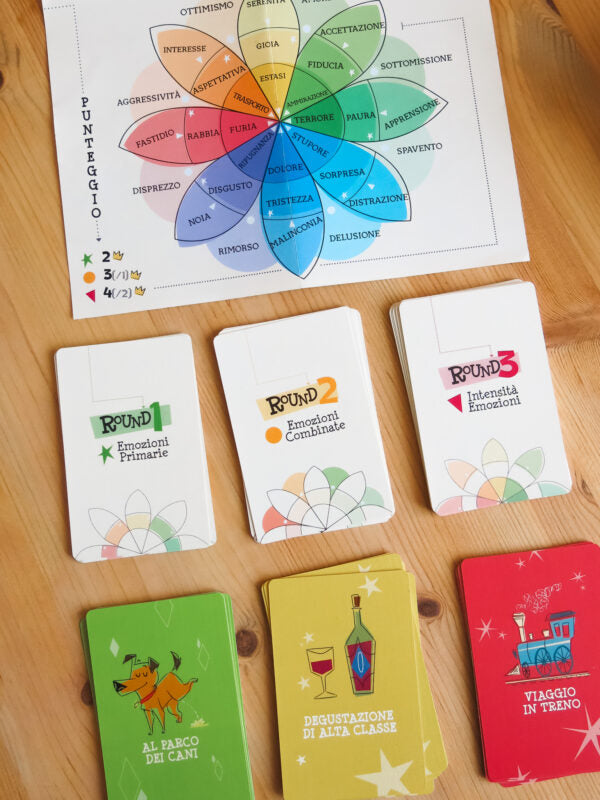
Plutchik's Wheel of Emotions
The scientific tool that maps human emotions. Three levels of difficulty: basic, secondary, and complex emotions. It guides you round after round.
Score Markers and Aids
Tokens to track who guessed what, quick rules references, and some help for those who want to explore Plutchik's Wheel of Emotions further.
In an hour, someone will have discovered that acting out shame is harder than anger. And you will have learned something about the emotions of others.
A game in five moments
What happens at the table
Not the rules. The experience.
The first cards
You draw your Situation (public) and your Emotion (secret). Others see that you are the pensioner at the post office. Only you know that you are ecstatic. Someone is already laughing, but the game hasn't even started yet.
The first round
Primary emotions. Fear, joy, anger, sadness. It should be easy, but when you have to play the terrified photographer at the wedding without saying "I'm scared", you discover it's not so obvious. Others write their guesses. You write yours for them.
Secondary emotions
Round two, increasing difficulty. Pride, envy, disappointment. The nuances become more subtle. Someone is playing pride at a job interview, but it looks more like arrogance. Others discuss, compare, rewrite. Plutchik's Wheel of Emotions becomes your map.
The revealing moment
Round three: complex emotions. Nostalgia, remorse, shame. Now it's difficult for everyone. Someone plays nostalgia at a family dinner and half the table understands, the other half thinks it's sadness. When you reveal the cards, someone says: "Ah, that's why you were making that face."
Scoring and laughter
Points are tallied. The one who guessed the most emotions of others wins, but no one really remembers. What remains are the interpretations: the ecstatic pensioner, the terrified photographer, the nostalgic shop assistant. And the awareness that understanding emotions is harder than you thought.
How to play
The flow of each round
Each round follows the same rhythm: draw, act, guess, reveal. The difficulty increases with Plutchik's Wheel of Emotions.
Each player receives a Situation card (public, everyone sees it) and an Emotion card (secret, only yours). The Situation tells you who you are, the Emotion what you feel.
In turn, each person interprets their Situation trying to convey the secret Emotion. No naming it, no using synonyms, no cheating. Just pure acting.
While others are acting, write down what emotion you think they are feeling. Use Plutchik's Wheel of Emotions to navigate primary, secondary, and complex emotions. Finally, write your own guess for each player.
Everyone reveals their Emotion cards. You score a point for each emotion guessed correctly. You score a point if someone guessed yours. Next round: increasing difficulty.
Why it's different from others
Six elements that make the difference
Plutchik's Wheel of Emotions
It's not an invention of the game: it's the scientific tool developed by psychologist Robert Plutchik to map human emotions. Eight primary emotions that combine into secondary and complex emotions. Emozionarium uses it to guide three rounds of increasing difficulty, transforming a party game into a journey through emotional psychology.
Acting without talent
You don't have to be good at acting to play. The game doesn't reward those who perform best, but those who can communicate an emotion understandably. No over-acting, no dramatics. Just an honest interpretation of a concrete situation.
Emotional intelligence at play
It's not just fun: Emozionarium trains you to recognize emotions in others and communicate your own. After a few games, you start to notice the nuances between pride and arrogance, between sadness and nostalgia, between fear and anxiety. It's a party game that teaches you something.
Progressive difficulty
The first round uses only the eight primary emotions of the Wheel: easy, immediate, fun. The second introduces secondary emotions: more subtle combinations. The third throws you into complex emotions: nostalgia, remorse, shame. The difficulty curve keeps everyone engaged.
No bluffing
Fundamental rule: you cannot cheat. You cannot name the emotion, you cannot use synonyms, you cannot make conventional gestures. You must interpret the situation naturally, allowing the emotion to shine through. This eliminates clever strategies and rewards authenticity.
Works with 3 to 8 players
Three players are enough to start, eight is perfect chaos. The game scales well because each player acts in turn and everyone else is always involved in guessing. Zero downtime, maximum interaction, and the more players there are, the more unpredictable the interpretations become.
How it ends
How to win and how to lose
After three rounds of increasing difficulty, the player with the most points wins. But in the end, no one really remembers the score.
Points and victory
- You score a point every time you guess another player's emotion
- You score a point every time someone guesses your emotion
- After three rounds, the player with the most points wins. Ties? Immediate rematch.
When it doesn't work
- If no one ever guesses your emotion, you're acting badly (or too well)
- If you never guess the emotions of others, maybe you need to look closer at Plutchik's Wheel of Emotions
- If you miss all the complex emotions in round three, you're in good company: they're difficult for everyone
Emozionarium is one of those games that works with everyone, even those who don't like acting. Because in the end, you're not acting: you're communicating.
Frequently asked questions
Emozionarium FAQ
Is it difficult to play if I can't act?
No. Emozionarium doesn't reward theatrical performance, but emotional communication. You don't have to put on a show: you just have to interpret a concrete situation (e.g., the pensioner at the post office) letting an emotion shine through. Many players who hate acting games love Emozionarium precisely for this reason.
How long does a game last?
Three complete rounds take 30-60 minutes, depending on the number of players and how long it takes you to interpret. With 3-4 players, it's about 30 minutes; with 7-8, it can be up to an hour. The rules are explained in 5 minutes, and the first game is immediate.
Is Plutchik's Wheel of Emotions really scientific?
Yes. Robert Plutchik was a psychologist and professor of psychiatry who developed this model in the 1980s. The eight primary emotions (joy, trust, fear, surprise, sadness, disgust, anger, anticipation) and their combinations are used in psychology to map human emotional experience. Emozionarium transforms it into a game.
Does it work well with 8 players?
It works great. Each player acts in turn, and while one is interpreting, everyone else is involved in guessing. There's no downtime, and with 8 people, the interpretations become even more varied and unpredictable. The only limit is time: with 8 players, a complete game can take up to an hour.
Is it available in Italian?
Yes, this is the Italian edition published by Space Otter Publishing. All Situation and Emotion cards are in Italian, as are the rules and the material on Plutchik's Wheel of Emotions.
Emozionarium is a party game for 3-8 players aged 14 and up, with games lasting 30 to 60 minutes. Published by Space Otter Publishing with illustrations by Giulia D'Urso, Emozionarium assigns you a public Situation (your character) and a secret Emotion to interpret without naming it. Others must guess what you feel, and you must guess their emotions. The game uses Plutchik's Wheel of Emotions, the scientific tool of psychologist Robert Plutchik, to guide three rounds of increasing difficulty: primary, secondary, and complex emotions. It's not a game where the best actor wins, but rather one where those who can communicate and recognize emotions honestly prevail. A mix of party game and light role-playing that hones emotional intelligence while having fun. Available on FroGames.it.
Emozionarium + Free promo cards
Frequently Asked Questions
The answers you're looking for, no beating around the bush.
📸Do the images match the actual product?
The photos on the website often come from BoardGameGeek and are intended to give you an idea of the game. They may vary slightly from the version you receive. The content declared by the publisher is always binding.
📦Does the content of the box match what is indicated?
We always strive to provide the correct content, but minor variations are possible due to reprints or updates. The information comes directly from the publishers. If you have any questions, please contact us!
⏳How do pre-orders work?
Pre-order the game before release, payment is immediate, and the game is reserved for you. As soon as it arrives, we'll ship it right away! If there are any delays, we'll update you promptly.
🔒Can I trust buying here?
Absolutely! Secure payments, tracked shipments, and a team that loves board games as much as you do. If something goes wrong, we'll do our best to fix it.
🛠There's a problem with my order, what should I do?
Write to us now! Whether it's a missing part, damage, or an error, we'll help you resolve it as soon as possible. Your experience truly matters to us.