

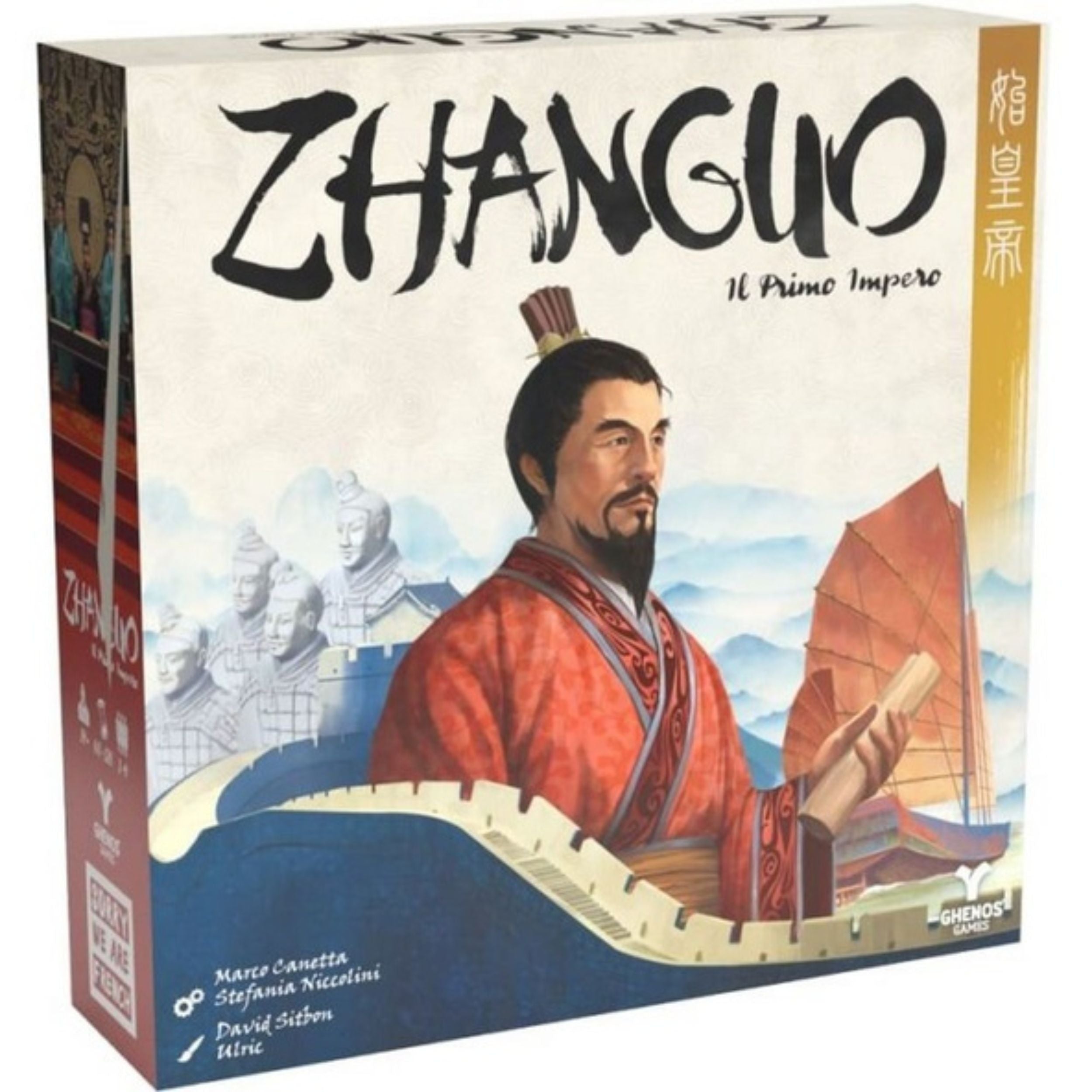
Zhanguo - The First Empire
🐸 Dettagli da BoardGameGeek
Consiglio BGG sul numero di giocatori
Categorie
Meccaniche
Design & Art
Lingua
Pairs well with
FroGames — Moments You'll Remember
Six cards per round. Each is a choice you can't go back on. And in the end, when you tally the points on five different tracks, you realize you should have prioritized that region you neglected.
WHAT IT'S ABOUT
Building the empire that lasted two thousand years
Year 221 BC. Qin Shi Huangdi unifies the warring states and founds Imperial China. A common script, currency, and universal laws are needed. And then palaces, governors, the Great Wall. A work so vast that one lifetime is not enough. Marco Canetta and Stefania Niccolini (authors of Koryo, Coimbra, Newton) recreate that era in a eurogame where each card is a resource you use only once.
You have six cards per round. Each card serves two purposes: an immediate action or a permanent bonus for the rest of the game. You play them all, but you must choose what to keep as an engine and what to burn for its immediate effect. Your choices unfold on five scoring tracks: palaces, governors, unification, the Great Wall, immortality. You cannot dominate everything. You must understand where to focus and when to shift priorities.
What they say abroad
"Every card feels critical, every decision irreversible."
Every card feels critical, every decision irreversible.
— Meeple Mountain
The game presents you with choices whose impact will only be seen at the end. It's the type of eurogame that rewards those who can build a plan over five rounds and are not distracted by opportunities.
— FroGames

Zhanguo: The First Empire
The game includes an automa that draws cards and competes on the scoring tracks. The experience is complete: all mechanics work, the strategic weight remains intact. You only lose the tension of reading human opponents in majorities.
FrogScore · FroGames editorial rating · based on rules, international reviews and play sessionsThe Tools of the Empire
What you play each round
Multi-use cards
Six cards per round. Each card has two sides: an immediate action or a permanent bonus. Choose what to keep active and what to burn for the effect.
Palaces and governors
Build buildings in regions and install governors. These are used for territorial control and to unlock stronger actions.
Great Wall
A construction track that yields huge final points. But it requires continuous resources and takes attention away from other fronts.
Elixir of Immortality
Send ships in search of the legendary elixir. An alternative track that can overturn scores if others neglect it.
Recommended sleeves 175 cards in 1 size ▼
If you play often, we recommend protecting your cards with transparent sleeves to make them last longer.
| Size | Quantity |
|---|---|
| 57 × 89 mm | 175 |
| Total cards | 175 |
When it's over, recount the points on all five tracks. And someone discovers that neglected palace was worth more than the entire Wall.
A game in five moments
What happens at the table
Not the rules. The experience.
The initial draw
Everyone receives six cards. Silence. Everyone decides which one to keep as a permanent bonus and which one to play immediately. The first choices seem easy, but they influence the rest of the game.
The first engines
Some build palaces, some go for governors, some aim straight for the Great Wall. The chosen permanent bonuses begin to diverge strategies. No one knows yet who took the right path.
Contested majorities
Regions fill up. Someone snatches a governor that gave double points from you. You realize that the unification track you ignored counts for much more than you thought.
The elixir turning point
One has invested in immortality. Ships return, cascading bonuses. Others discover that neglecting a track can cost the game. Everything reopens, but it's too late to radically change strategy.
The final count
Add up the points: palaces, governors, unification, Great Wall, elixir. Each track weighs differently. Those who diversified beat those who pushed too hard on one front. The difference lies in those two governors placed at the right time.
How to play
The flow of each round
Five rounds identical in structure, very different in available choices.
Each player receives six cards from their deck. You look at what you have, plan what to keep as a permanent bonus and what to play for the effect.
Everyone plays cards at the same time, but turns alternate to resolve actions. Some cards give resources, others allow you to build or move.
You use the resources obtained to build palaces, install governors, advance on the Great Wall, or send ships for the elixir. Each action costs something.
Some tracks give intermediate points. Others don't. You prepare for the next round knowing that fewer and fewer cards will remain.
Why it's different from others
Six mechanics that make the difference
Permanent vs. disposable cards
Each card can become a permanent engine that helps you for the rest of the game, or be burned for an immediate action. Choose what to sacrifice and what to build. There's no going back.
Five scoring tracks
Palaces, governors, unification, Great Wall, immortality. Each scores points differently. You can't master them all. You need to understand where to focus and when to diversify.
Regional majorities
China is divided into regions. You control a region if you have more palaces than others. Majorities give bonuses, but require continuous investment. And others can steal your control.
Great Wall as a gamble
Building the Wall gives huge final points, but requires constant resources. If you neglect it, you're out; if you invest too much, you lose control over other tracks.
Elixir as a hidden track
Sending ships for immortality seems secondary. Then you discover that the elixir's cascading bonuses can turn the game around in the last two rounds.
Increasing asymmetry
The further you go, the more players build different engines. The accumulated permanent cards make each strategy unique. By the end of the fifth round, no one is playing the same game.
How it ends
How to win and how to lose
At the end of the fifth round, points from all five tracks are tallied. The player with the highest total wins.
Victory
- Build an engine of permanent cards that produces resources or extra actions every round
- Dominate at least two out of five scoring tracks (e.g., palaces + Great Wall)
- Diversify enough not to lose too many points on neglected tracks
Fatal errors
- Focusing on only one track and finding that the other five cost you the game
- Burning all cards for immediate actions without building permanent bonuses
- Ignoring the elixir of immortality and seeing it explode in the last two rounds in other players' hands
An eurogame that rewards those who can balance short-term choices and long-term building. Every card is a sacrifice. Every round, fewer options. In the end, only the scores tell who built best.
Frequently asked questions
FAQ about Zhanguo: The First Empire
Is it too complex for those who don't play heavy eurogames?
Yes. Weight 3.8 on BGG, 175 multi-use cards, five tracks to manage in parallel. The rules are explained in 20 minutes, but you'll get lost in the details in the first game. Experience with medium-heavy eurogames (Agricola, Tzolk'in, Kanban) is needed to appreciate it from the start.
How long does a game really last?
With 4 players, 90-120 minutes. With 2 players, even 60-75. It depends on how much time is needed to plan card plays. Downtime can be high if someone thinks a lot about permanent vs. immediate choices.
Is there direct interaction or does everyone play for themselves?
Constant indirect interaction. You compete for regional majorities, for governors, for common card bonuses. They don't attack you directly, but they steal spaces and cut you off from scoring tracks. Typical of area control eurogames.
Is the solo mode worth it?
Yes. The automa competes on the tracks credibly, all mechanics remain in play. Only the tension of reading opponents in majorities is lost. If you appreciate solo eurogames like Viticulture or Wingspan, this works.
Is it available in Italian?
Yes. This Ghenos Games edition includes rules, cards, and components completely in Italian. The cards have text, so localization is essential.
Zhanguo: The First Empire is a strategic eurogame by Marco Canetta and Stefania Niccolini for 1-4 players, ages 14+, duration 60-120 minutes. Set in China in 221 BC, the game revolves around multi-use card management and control of five scoring tracks: palaces, governors, unification, Great Wall, immortality. Each card can become a permanent bonus or be burned for an immediate action. The area majority mechanic intertwines with long-term engine building. Weight 3.8 on BoardGameGeek, high complexity, high replayability. Published by Ghenos Games in a complete Italian edition. Includes a dedicated automa solo mode. Available on FroGames.it.
Zhanguo - The First Empire
Frequently Asked Questions
The answers you're looking for, no beating around the bush.
📸Do the images match the actual product?
The photos on the website often come from BoardGameGeek and are intended to give you an idea of the game. They may vary slightly from the version you receive. The content declared by the publisher is always binding.
📦Does the content of the box match what is indicated?
We always strive to provide the correct content, but minor variations are possible due to reprints or updates. The information comes directly from the publishers. If you have any questions, please contact us!
⏳How do pre-orders work?
Pre-order the game before release, payment is immediate, and the game is reserved for you. As soon as it arrives, we'll ship it right away! If there are any delays, we'll update you promptly.
🔒Can I trust buying here?
Absolutely! Secure payments, tracked shipments, and a team that loves board games as much as you do. If something goes wrong, we'll do our best to fix it.
🛠There's a problem with my order, what should I do?
Write to us now! Whether it's a missing part, damage, or an error, we'll help you resolve it as soon as possible. Your experience truly matters to us.