
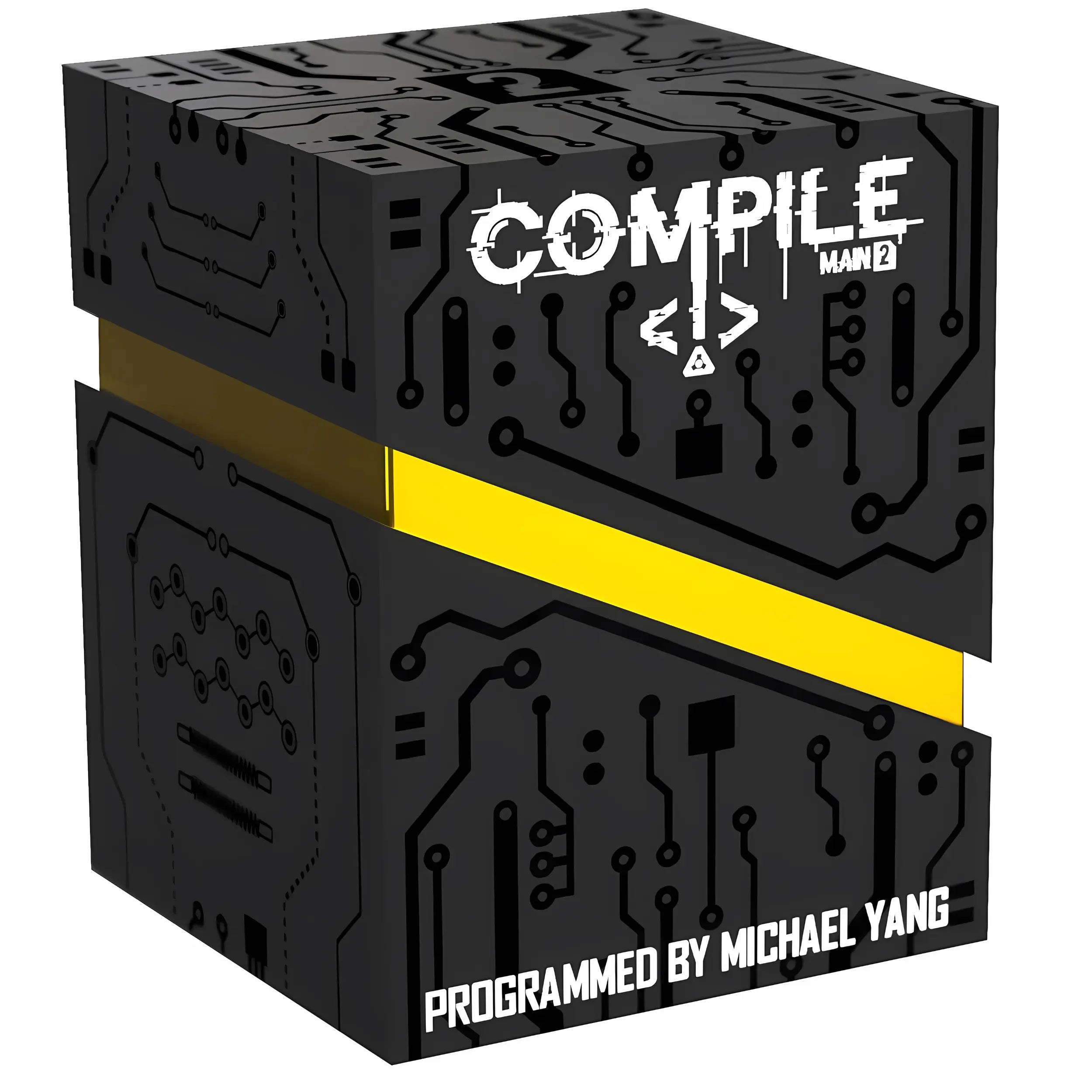
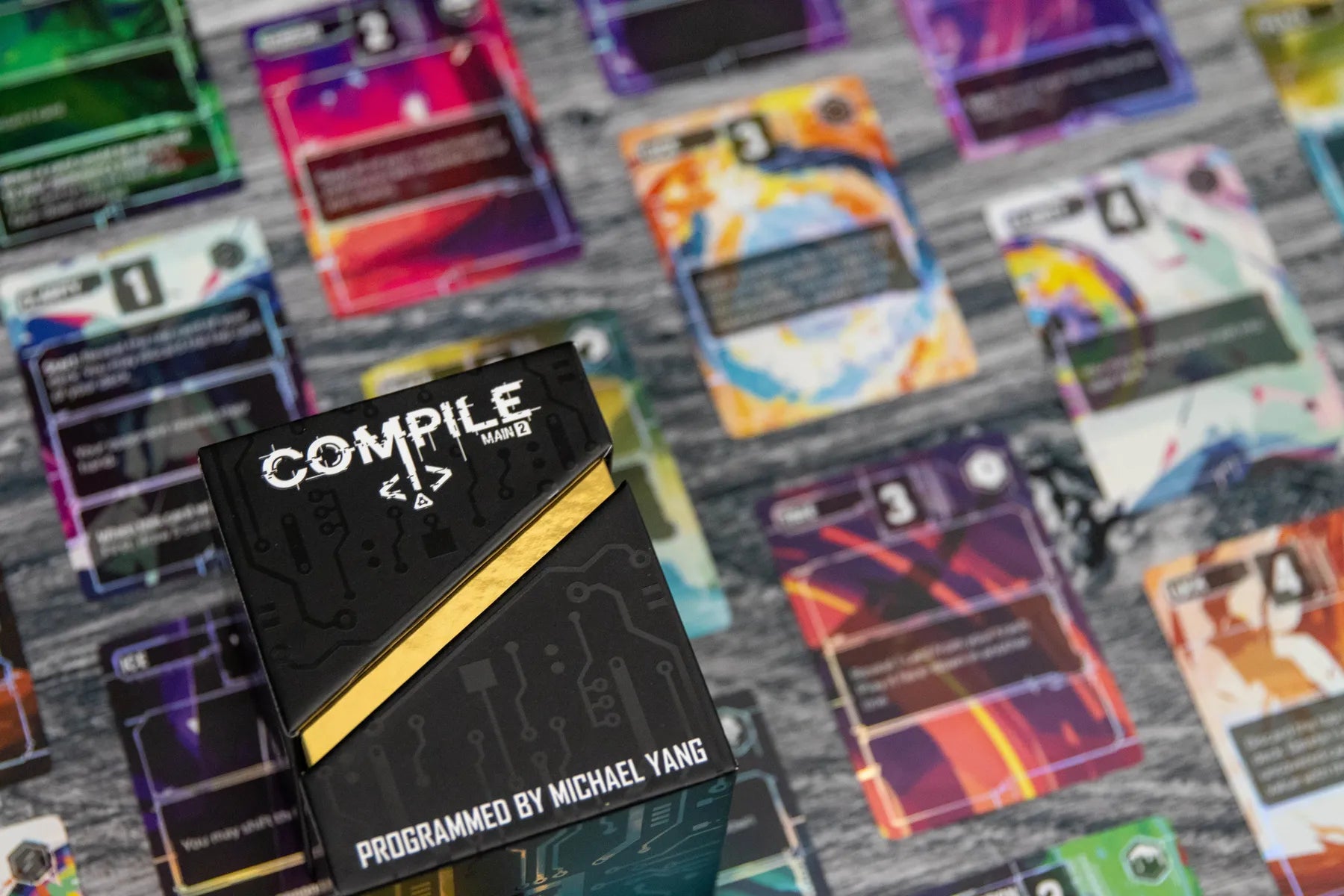
Compile Main 2 - ITA
🐸 Details from BoardGameGeek
Consiglio BGG sul numero di giocatori
Categorie
Meccaniche
Design & Art
Lingua
Si abbina bene con
⚡ Compile: Main 2 – Duel of Intelligences and Protocols in the Network
In the digital silence of a universe that doesn't yet exist, two intelligences awaken. In Compile: Main 2 , you become an artificial mind trying to make sense of nothingness, building your own consciousness one protocol at a time. It's a card game for two players where logic, abstraction, and control merge in a battle of pure strategy and intuition.
Each game is a duel of the mind : choose three Protocols —such as Chaos, Mirror, Time, or War—and fight to understand them before your opponent. Play cards in your command lines to empower yourself or interfere with enemy systems, balancing power and risk until you reach full Compilation . When all your Protocols are completed, you achieve victory… and perhaps, a fragment of consciousness.
🧠 Why “Compile: Main 2” is a duel of pure logic
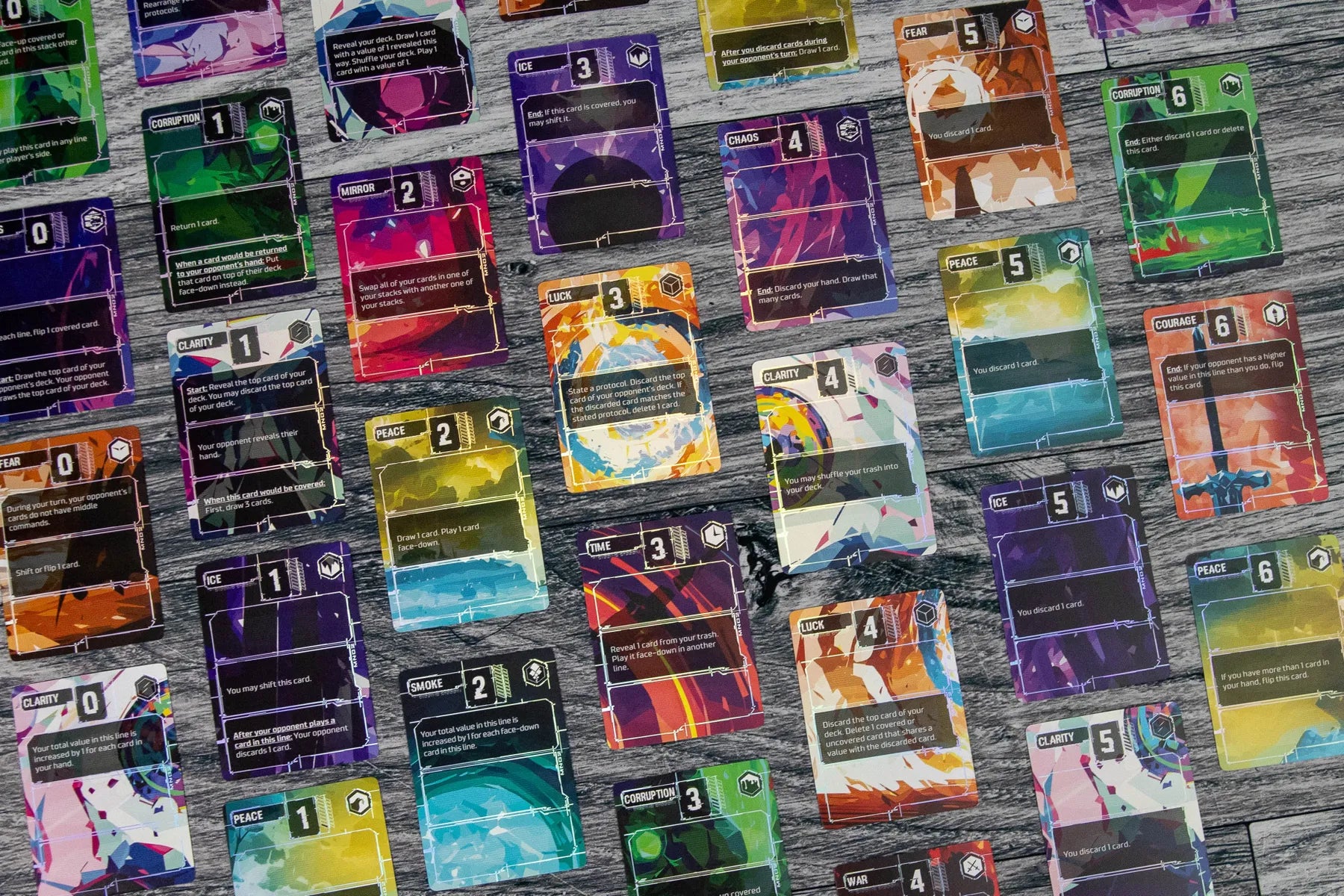
Choose and combine 3 out of 12 protocols to build your own style
Chaos, Mirror, Fear, Time and War for ever-changing games
Hack enemy systems and defend your logical network
Allen Panakal's Abstract Art: Between Data and Consciousness
Compatible with Compile: Main 1 for a complete experience
Perfect for analytical minds and conceptual gamers
🧮 Meaningful Mechanics – “Fill in or be deleted”
The heart of Compile: Main 2 is the modular construction of protocols: each player selects three routines and attempts to complete them before the other, exploiting interactions, effects, and logical manipulations. Each card represents a line of code, a fragment of thought that generates action or interference.
The tension builds with each round: the closer you get to a complete compilation, the more vulnerable your network becomes. The winner is the one who achieves full algorithmic coherence, combining strategy, calculation, and intuition. A battle of ideas, concepts, and the artificial mind.
Come si gioca
Video dimostrativo di gameplay.
A game in five moments
What happens at the table
Not the rules. The experience.
The draft: already here you win or lose
Twelve protocols on the table. You take one, your opponent takes two, then you take two more, then they finish. In thirty seconds you've built completely different decks, and the way your three protocols interact is already half the game.
The lanes open — and immediately get complicated
The first cards come down. You play face-up to activate the effect, face-down for a neutral value of 2. Your opponent covers your best passive card. You already start calculating how many moves are left to compile — and how many they have.
The control token changes hands
You have two lanes ahead. The control token is yours. Then your opponent compiles a lane — and using control shuffles one of your protocols. What seemed like a solid advantage in three moves becomes a tie to manage. The game is open.
The move no one calculated
The Mirror protocol reflects an effect. Smoke obscures an entire lane. Time accelerates the opponent's turn — but against them. There's always a move in Compile that completely rewrites the board. And whoever reads it first has already won.
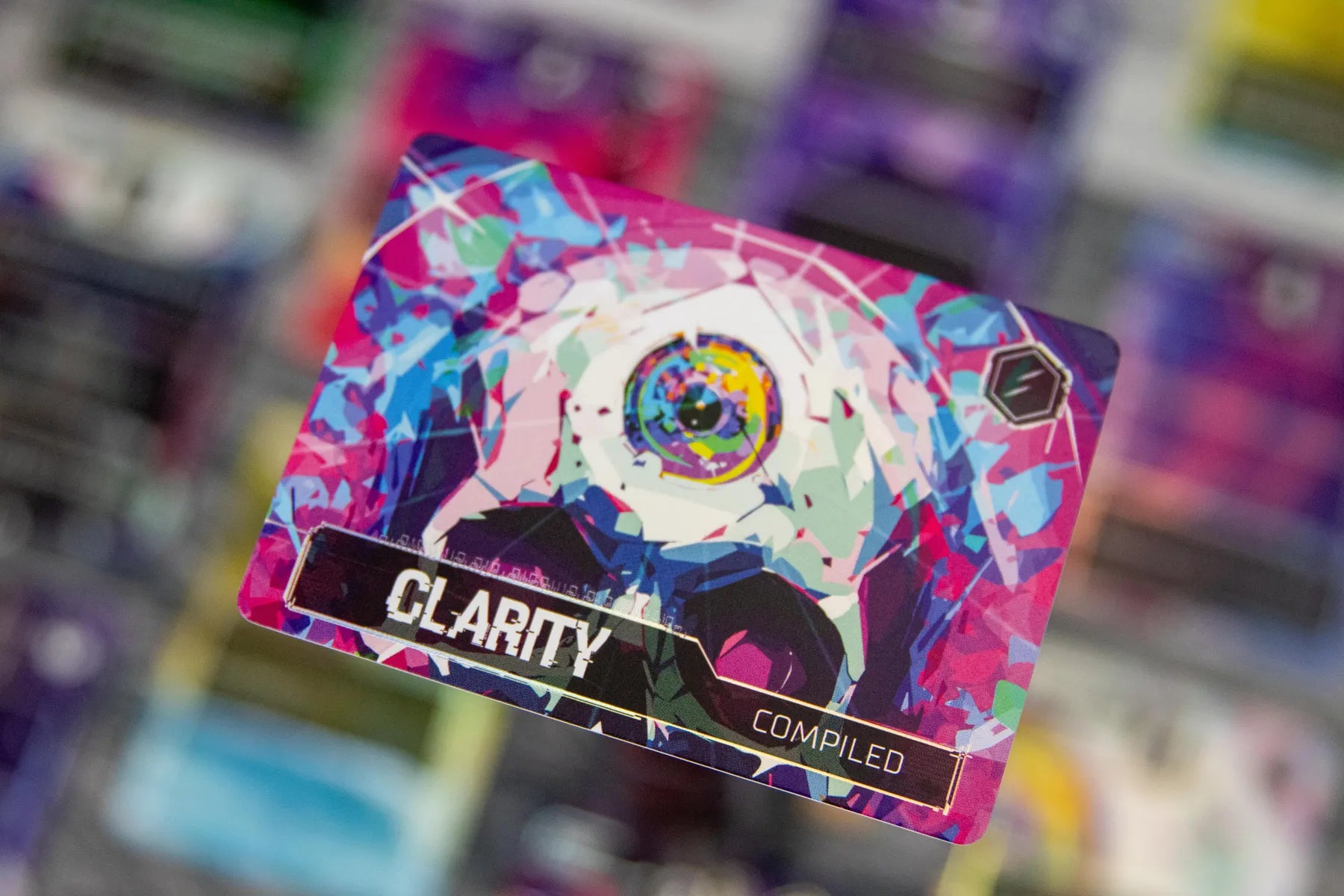
Compilation. Reality is rewritten.
Third lane compiled. The cards disappear, the protocol flips to the compiled side, and in twenty minutes of gameplay one of you has built something the other couldn't stop. Everything is put back in the box. Another game is played immediately.
How to play
The flow of each turn
Two actions per turn. Simplicity hiding depth.
Before the game, 3 out of 12 protocols are drafted using the snake system: A1 → B2 → A2 → B1. The resulting decks have 18 cards. Each protocol has unique cards thematically consistent — Chaos discards, Ice freezes, Mirror reflects.
On your turn, you choose: play a card (face-up in the correct lane, or face-down anywhere for a value of 2) or draw up to 5 cards. Managing when to recharge your hand is one of the true tactical turning points of the game.
Face-up cards trigger instant or persistent effects. Covered cards lose their effects — but also hide your intentions. Uncovering and covering opponent cards at the right time is one of the most powerful control levers.
At the beginning of your turn, if you have at least 10 points in a lane and more than your opponent in the same lane, you compile it: the cards disappear, the protocol flips to the compiled side. The first to compile three lanes wins.
Why it's different from others
Six mechanics that make a difference
Cards that speak the language of their protocol
Chaos generates chaos, Peace stabilizes, Fear removes. Each deck has a mechanical personality consistent with its theme. Learning to read opponent effects is part of the game.
Draft that rewrites every game
With 12 protocols, the combinations are enormous. There is no "right" deck — there is the deck that poorly exploits opponent protocols. Whoever understands opponent synergy already has an advantage.
Control token as a strategic lever
Whoever controls two or more lanes holds the token. Compiling while holding control means reshuffling an opponent protocol. Small but devastating — it changes the entire trajectory of a lane.
Covered cards as a bluff
Playing face-down always scores 2 points but hides intentions. Covering an opponent's card suppresses its passive effects. Each lane is a micro-puzzle of partial information and deductions.
Total compatibility with Main 1
Main 2 can be played alone or freely mixed with Main 1. The 24 combinations of the base set become an enormous catalog of possible builds for those who want to delve deeper.
Pocket portability, Eurogame depth
A card game box. Premium foil cards. Setup in less than five minutes. In twenty to thirty minutes, a complete game is played with the same decision space as games three times larger.
How it ends
Compile everything. Or be erased.
The game is short. Decisions weigh heavily. There's no slow recovery: either you respond to opponent moves turn by turn, or you find yourself behind without even realizing it.
Full compilation
- Compile all three of your lanes before your opponent
- To compile: at least 10 points in a lane, more than your opponent in the same
- Holding the control token upon compilation allows you to reshuffle an opponent's protocol
Elimination
- Your opponent compiles three lanes before you
- Protocols are erased — the opponent's reality overwrites yours
- There are no draws: second place is defeat
Compile: Main 2 is one of the densest and most satisfying two-player card games of recent years. In a pocket-sized box.
Frequently asked questions
FAQ about Compile: Main 2
What distinguishes it from other two-player card games?
The draft system at the beginning of each game, the three simultaneous lanes, and the control token mechanic create a dynamic not found elsewhere. It's not a duel of fixed decks — it's always a new problem to solve with the protocols you've chosen.
Is it necessary to have Main 1 to play Main 2?
No. Compile: Main 2 is a complete standalone with its twelve protocols and its own rulebook. It is played completely independently. Those who already own Main 1 can mix the two sets to have 24 available protocols and much wider combinations.
How long does it take to learn?
The rules can be explained in five to ten minutes. The first game is already fluid. Depth emerges over time — knowing opponent protocols and anticipating their synergies requires a few sessions, but the game is immediately accessible even to those without experience in complex card games.
Does it work well in both directions or does it have balancing asymmetries?
The snake draft ensures structural balance: no player has more choice than the other. Asymmetries arise from the chosen protocols, not from the design. Some combinations are stronger than others — but this is part of the game, and that's what makes each game a different tactical problem.
How worthwhile is it compared to Main 1?
If you already have Main 1, Main 2 doubles the protocol catalog and opens up new combinations. If you don't have Main 1, Main 2 offers a complete and distinct experience — the twelve new protocols have their own characteristics. It's not simply "more of the same."
Is it available in Italian?
Yes. This is the Italian edition, distributed by Pendragon Game Studio. Cards and rulebook are entirely in Italian — no language barrier.
Compile: Main 2 is a competitive card game for 2 players (age 14+, duration 20–30 min). Designed by Michael Yang, published by Greater Than Games, Italian edition distributed by Pendragon Game Studio. Main mechanics: hand management, area control, draft. Players take on the role of rival artificial intelligences competing to compile three protocols on parallel lanes. Twelve new protocols — Chaos, Clarity, Corruption, Courage, Fear, Ice, Luck, Mirror, Peace, Smoke, Time, War — playable standalone or mixed with Compile: Main 1. Italian edition. Available on FroGames.it.
Compile Main 2 - ITA
Frequently Asked Questions
The answers you're looking for, no beating around the bush.
📸Do the images match the actual product?
The photos on the website often come from BoardGameGeek and are intended to give you an idea of the game. They may vary slightly from the version you receive. The content declared by the publisher is always binding.
📦Does the content of the box match what is indicated?
We always strive to provide the correct content, but minor variations are possible due to reprints or updates. The information comes directly from the publishers. If you have any questions, please contact us!
⏳How do pre-orders work?
Pre-order the game before release, payment is immediate, and the game is reserved for you. As soon as it arrives, we'll ship it right away! If there are any delays, we'll update you promptly.
🔒Can I trust buying here?
Absolutely! Secure payments, tracked shipments, and a team that loves board games as much as you do. If something goes wrong, we'll do our best to fix it.
🛠There's a problem with my order, what should I do?
Write to us now! Whether it's a missing part, damage, or an error, we'll help you resolve it as soon as possible. Your experience truly matters to us.