
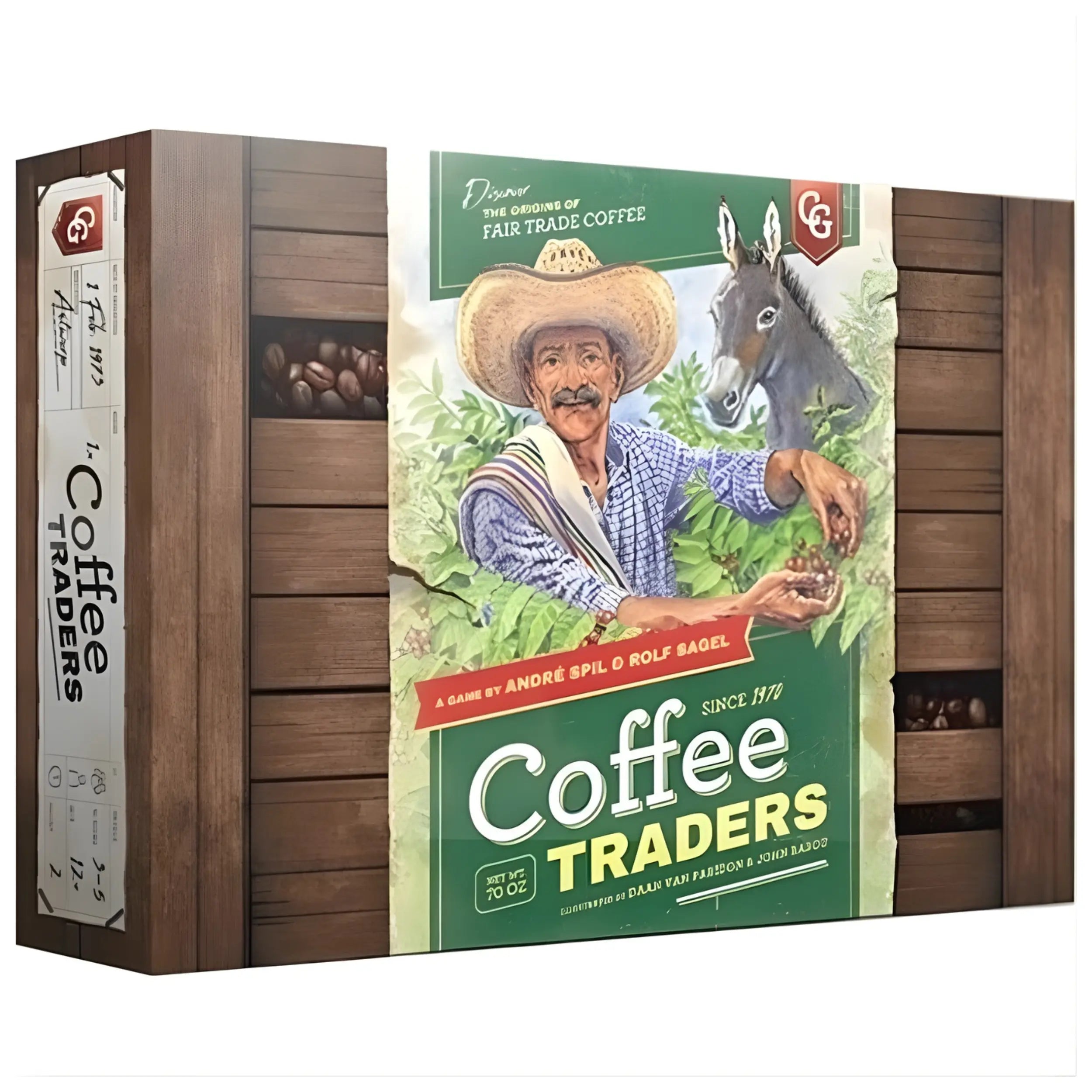
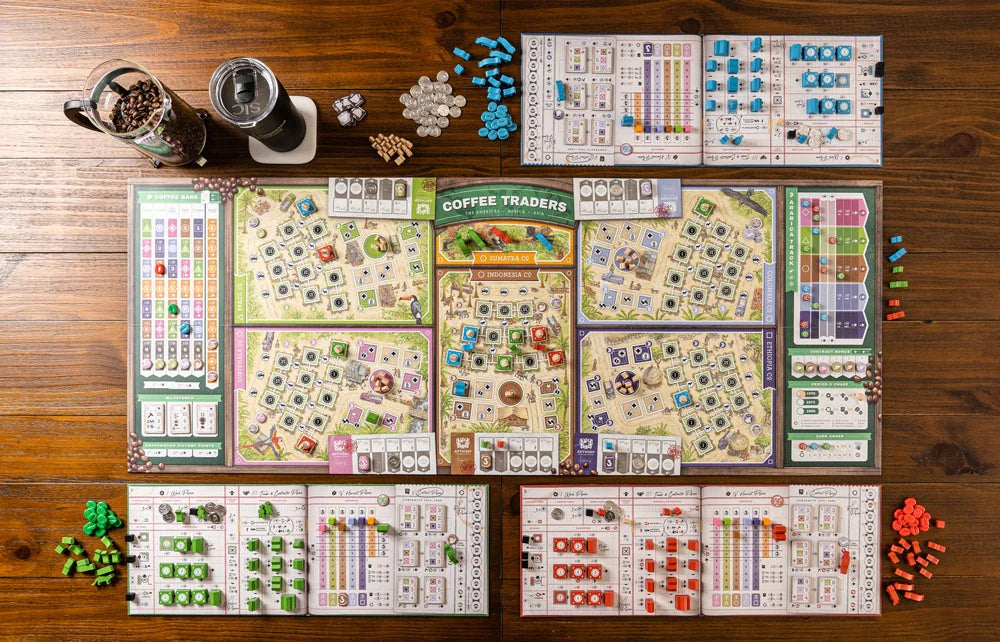
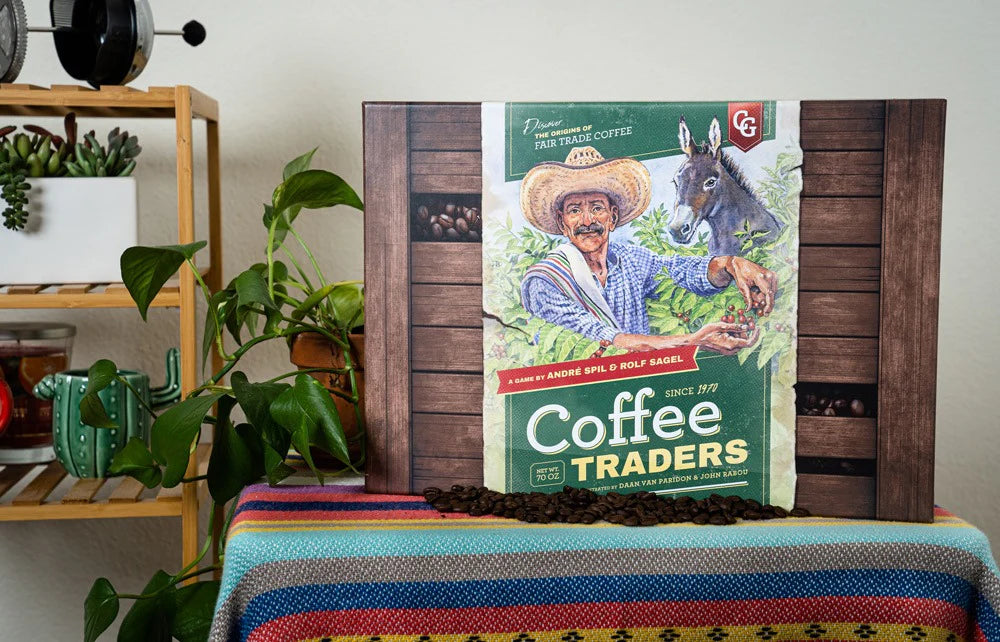
Coffee Traders
🐸 Details from BoardGameGeek
Consiglio BGG sul numero di giocatori
Categorie
Meccaniche
Design & Art
Lingua
Si abbina bene con

FroGames — Moments You'll Remember
1970s. Hillside plantations, trade routes to Antwerp, Fair Trade cooperatives to build. A global market that waits for no one.
What it's about
The global coffee market, on a board game table
The 1970s. Fair Trade cooperatives are organizing in Guatemala, Brazil, Ethiopia, Colombia, and Indonesia. The world's best Arabica beans make their way to Antwerp — and whoever controls the routes, plantations, and right connections wins the game.
In Coffee Traders by Rolf Sagel and André Spil (the same as Wildcatters), each player builds a trading empire through three dense and interconnected rounds: expand plantations in the right regions, build buildings that multiply production, manage contracts to the global market.
The alternating turn action point mechanism keeps interaction high — regions are contested, markets become saturated, rival cooperatives grow exactly where you hoped to expand. Coffee Traders is the kind of eurogame where every choice has a cost and every game tells a different story.
Six regions to cultivate, only one global market to sell in. Whoever controls the chain — from plantation to Antwerp — controls the score.
The secret of Coffee Traders in one line
You don't win by dominating one area — you win by building connections that others cannot replicate in time. With each passing round, space shrinks.
From the game experience

Coffee Traders
FrogScore · FroGames editorial rating · based on rules, international reviews, and play sessionsWhat you manage in each game
Your coffee empire
Plantations in the regions
Guatemala, Brazil, Ethiopia, Colombia, Indonesia and Sumatra. Each region has different characteristics — choose where to invest before your opponents.
Buildings that enhance
Build structures that amplify your cooperative's production. Each building changes your engine — and can block an opponent's strategy.
Contracts to Antwerp
Arabica beans end up on the global market. Those who have built the right routes, at the right time, sell with higher margins.
Fair Trade Track
Advancing on the Fair Trade track unlocks bonuses and exclusive options. It's not just a side path — it can determine the final score.
Three rounds. Six phases per round. Every turn a crossroads. In the end, one of you will have built something others can only admire.
🎲
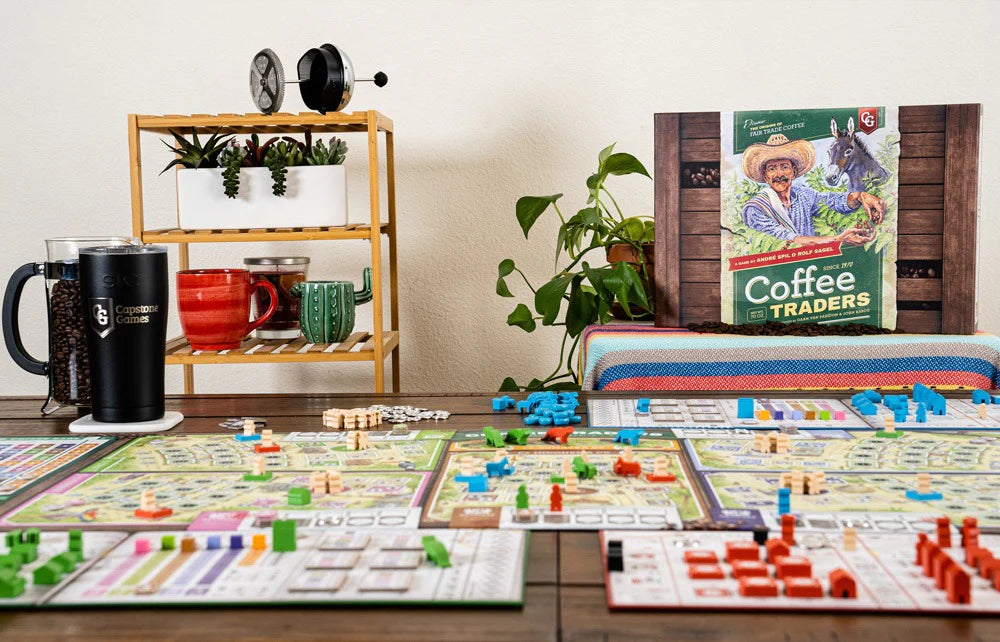
ComponentsPremium production · over 650 pieces
📖
RulebookEnglish · Official PDF
Come si gioca
Video dimostrativo di gameplay.
A game in five moments
What happens at the table
Not the rules. The experience.
The first move: where you plant your flag
The board is open, six regions ahead, everyone still silent. The first choice — Guatemala or Ethiopia? Colombia or Indonesia? — will define your identity for the entire game. It takes a second to decide. You'll still be talking about it after the game is over.
The moment you truly understand the game
Mid-first round, something clicks. You see that others' buildings are boosting the exact region you wanted to expand. The market shrinks. What seemed like a solid plan requires immediate adjustment. Welcome to Coffee Traders.
The market heats up and routes become gold
Round 2. Those who invested in trade routes to Antwerp start selling their beans with better margins. Others watch and realize what they should have done. The Arabica track rises, contracts multiply, the table becomes dense with decisions.
The last phase of the final round: total silence
Round 3, Phase 5. Everyone calculates. Points aren't clearly visible — they're spread across too many tracks. Someone thinks they're ahead. Someone knows they're behind but not by how much. Every remaining action point is worth double. Every choice could be the last good one of the game.
The final tally: six criteria, one surprise
The final score counts six different items. When tallied, there's almost always a surprise — someone who seemed second is first, or vice versa. We discuss, analyze, and wonder where we could have done better. Then we pack everything up and talk about the next game.
How to play
The flow of each round
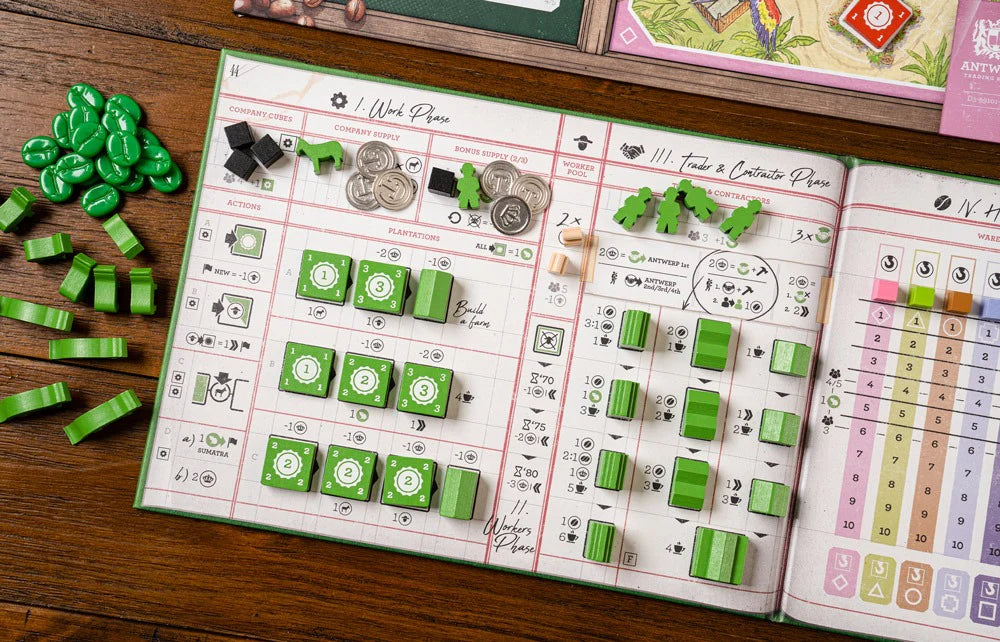
Three rounds, six phases each. Learn in one session, master in three.
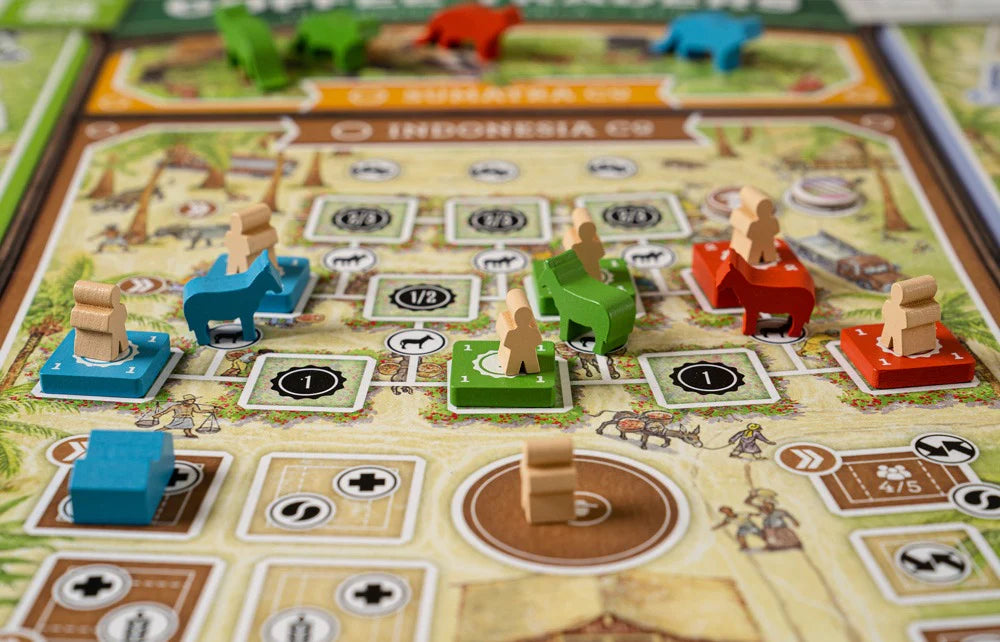
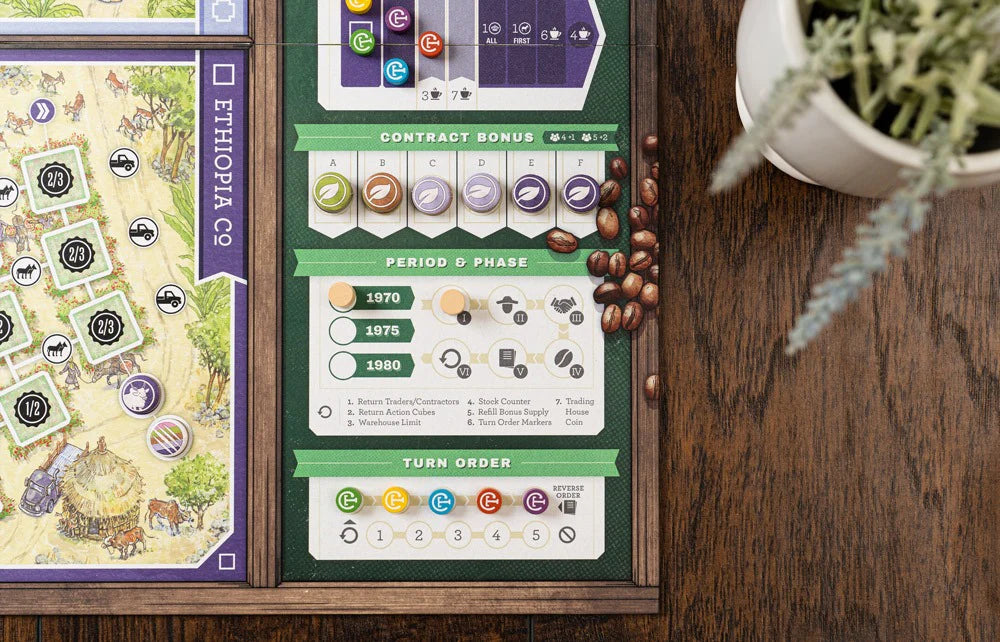
In turn order, each player performs one action at a time in the regions: expanding plantations, constructing buildings, hiring workers. The first to pass chooses the order for the next round.
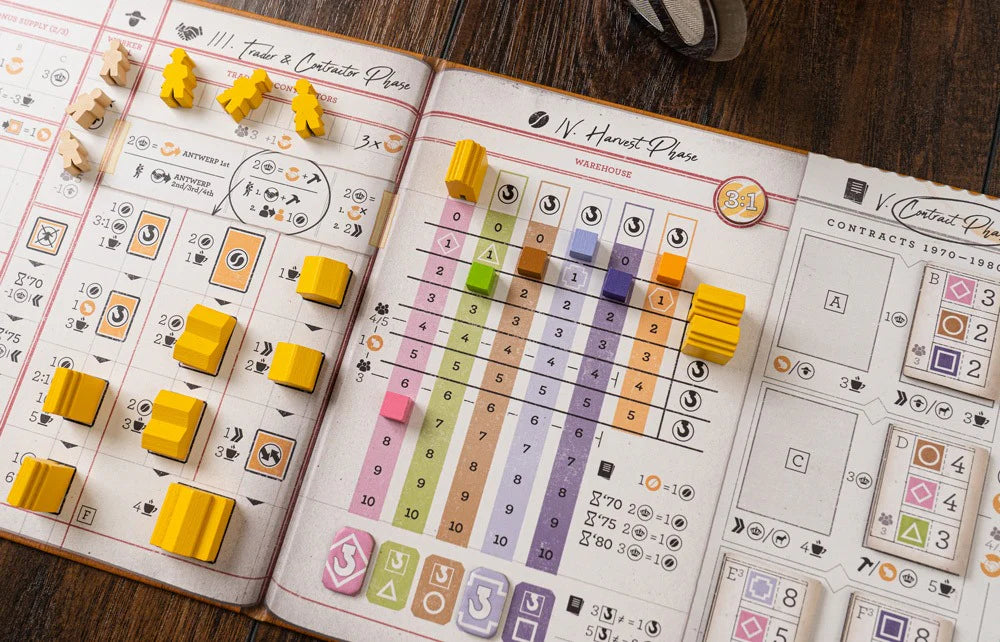
Active plantations produce Arabica beans based on the region's development level and the buildings constructed. Those who invested most harvest most.
Beans are sold in Antwerp and regional markets. Prices depend on supply — latecomers sell for less. Built trade routes provide sales bonuses.
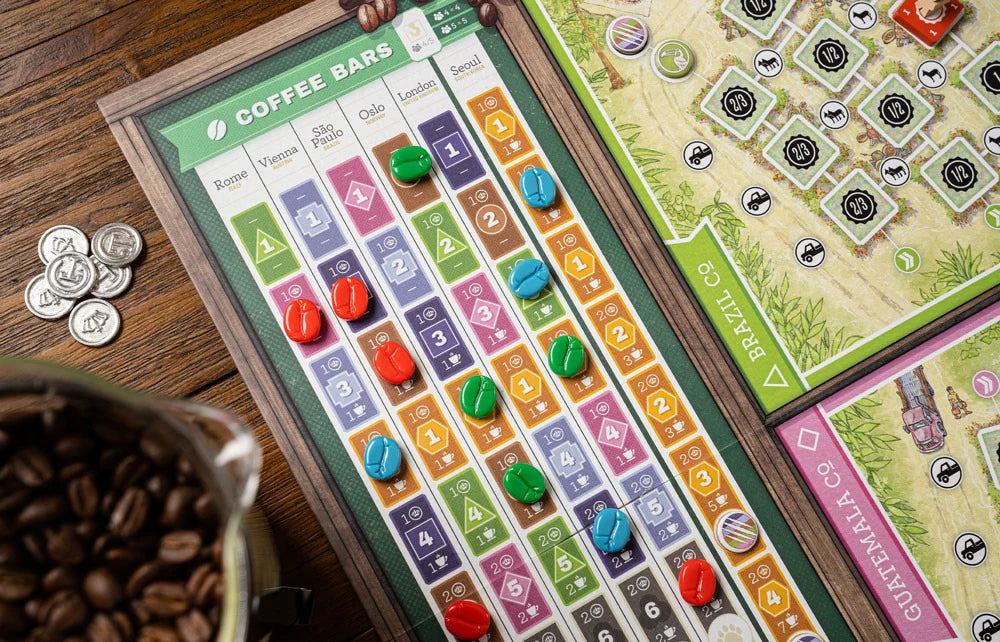
At the end of each round, points are awarded from the Arabica track and the Coffee Bar. Markers are repositioned, the next round is prepared. Three rounds like this — then the final tally.
Why it's different from others
Six mechanics that make a difference
Six real, distinct regions
Guatemala, Brazil, Ethiopia, Colombia, Indonesia, and Sumatra each have different production characteristics. Specializing in just one region is a risk — being everywhere is impossible. Deciding where to invest is the most important decision of the game.
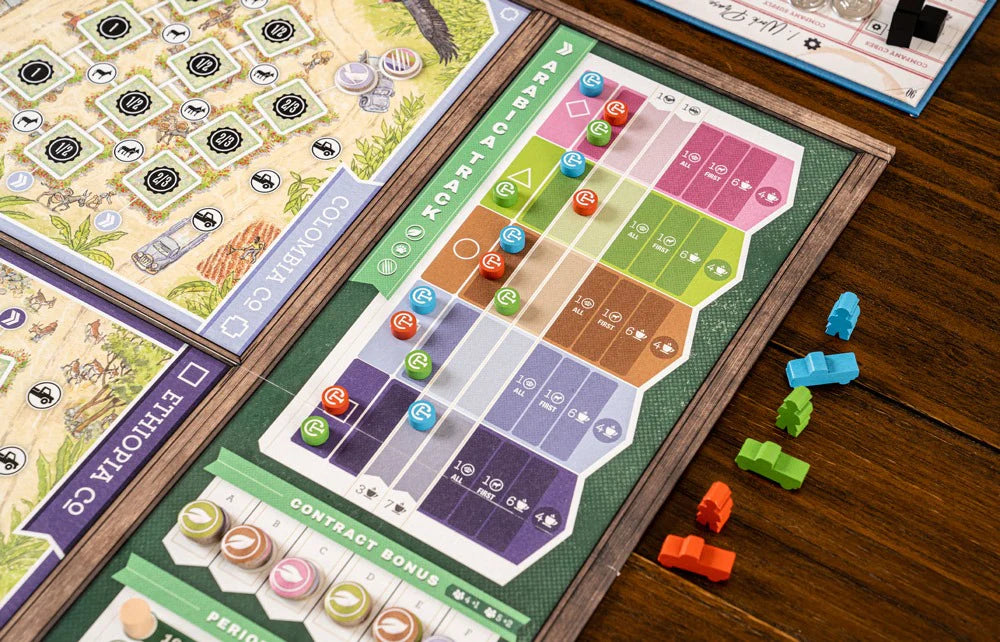
Arabica Track — pressure builds
As regions develop, the Arabica track advances and the value of beans changes. Those who understood market trends before others sell at the right time. Those who wait find prices already compressed.
Buildings that build your engine
Each building adds a cog to your engine. There are no intrinsically good or bad choices — there are choices consistent or inconsistent with your plan. A building constructed at the wrong time becomes a burden.
Fair Trade as a strategic path
It's not just thematic flavor — the Fair Trade track opens up exclusive options and bonuses that change the final score. Ignoring it is a valid, but conscious, choice. Following it requires investment and planning.
Turn order as a resource
Whoever passes first in the Work phase chooses the order for the next round. This mechanic creates continuous micro-decisions — playing early to position yourself first or staying in the game longer to optimize.
Opaque multidimensional scoring
Six different scoring categories, no visible leaderboard during the game. You never know for sure where you stand — and this opacity is intentional. It maintains tension until the final tally.
How it ends
Who wins and who doesn't
There's no in-game elimination — everyone plays until the end. But not everyone will be prepared for the final tally.
Victory
- Having the highest score by summing the six final categories
- Arabica Track, Coffee Bar, buildings, contracts, plantations, and Fair Trade bonuses
- Whoever balanced all areas well beats whoever excelled in only one
How to lose
- Ignoring the global market for too long while others are selling
- Building an engine without a commercial outlet — producing without selling is worth zero
- Neglecting secondary scoring categories that prove decisive
Coffee Traders is the kind of eurogame where every game teaches you something — and the next game is always more precise. For those who love understanding their mistakes almost as much as winning.
Frequently Asked Questions
Coffee Traders FAQ
Is it really that hard to learn?
The complexity is real — we're looking at a BGG weight of around 4.2/5, among the densest eurogames out there. The original rulebook had layout issues (Capstone released an improved 1.5 version). With the updated rulebook and good preliminary reading, the first game is manageable. It's not a game for those unwilling to invest time in preparation.
With how many players does it work best?
With 3 or 4 players, you find the sweet spot — enough competition to make regions contested, without the excessive downtime that emerges with 5. With 2, it works but the pressure on regions is reduced. With 5, it's the most intense experience but also the longest: easily count on 3 hours.
Can it be played solo?
No. Coffee Traders does not have an official solo mode. The game is built around competition for regions and market pressure — without real opponents, the central mechanisms lose meaning. If you're looking for a heavy eurogame with solo support, there are more suitable titles.
Is it available in Italian?
This is the English edition. The text on the cards and in the rules is in English — for a game of this complexity, it's advisable to have a good command of the language. The official English PDF rulebook is available on BGG and linked in the relevant section of the product page.
Does it have expansions or additional content?
At the moment, Coffee Traders does not have official expansions released. The base game is nevertheless very complete — the variability in regions, buildings, and contracts ensures good replayability without the need for additional content.
What distinguishes it from other heavy economic eurogames?
The Fair Trade theme integrated as a real strategic mechanic — not just decorative. The combination of area majority on regions with personalized engine building and a global market with variable prices creates a system where no two games are alike. Those familiar with Brass or Lacerda games will find familiar points of contact but an original structure.
Coffee Traders is a heavy eurogame board game for 2–5 players (ages 12+, duration 120–150 min). Designed by Rolf Sagel and André Spil, artwork by John Rabou and Daan van Paridon, published by Capstone Games in 2021. Main mechanics: action points, area majority/influence, contracts, pass order. Players manage Arabica coffee plantations in six regions of the world (Guatemala, Brazil, Ethiopia, Colombia, Indonesia, Sumatra), constructing buildings, developing Fair Trade cooperatives, and selling on the global market in Antwerp. Three rounds structured into six phases each, final multidimensional scoring, zero luck. Premium components: 387 wooden pieces, 55 metal coins, 90 coffee beans. English edition. Available at FroGames.it.
Coffee Traders
Frequently Asked Questions
The answers you're looking for, no beating around the bush.
📸Do the images match the actual product?
The photos on the website often come from BoardGameGeek and are intended to give you an idea of the game. They may vary slightly from the version you receive. The content declared by the publisher is always binding.
📦Does the content of the box match what is indicated?
We always strive to provide the correct content, but minor variations are possible due to reprints or updates. The information comes directly from the publishers. If you have any questions, please contact us!
⏳How do pre-orders work?
Pre-order the game before release, payment is immediate, and the game is reserved for you. As soon as it arrives, we'll ship it right away! If there are any delays, we'll update you promptly.
🔒Can I trust buying here?
Absolutely! Secure payments, tracked shipments, and a team that loves board games as much as you do. If something goes wrong, we'll do our best to fix it.
🛠There's a problem with my order, what should I do?
Write to us now! Whether it's a missing part, damage, or an error, we'll help you resolve it as soon as possible. Your experience truly matters to us.