

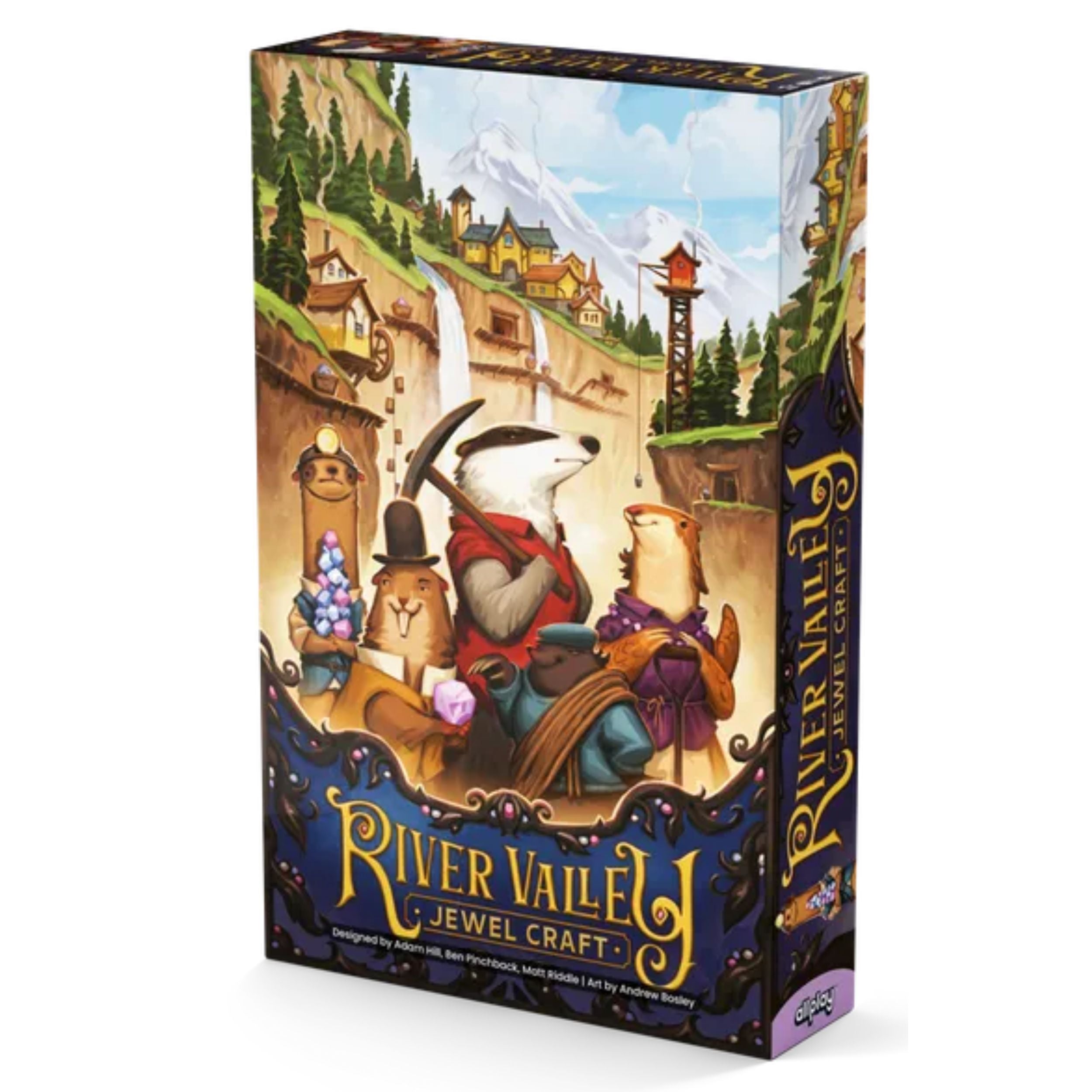

River Valley Jewelcraft
🐸 Dettagli da BoardGameGeek
Consiglio BGG sul numero di giocatori
Categorie
Meccaniche
Design & Art
Lingua
Pairs well with
The FroGames review
You roll the dice. Your creature digs the column you chose. You collect three gems, but you need a fourth to craft that tiara. Others look at your board and calculate. You place a new tile, reorganize the mine. You roll again.
WHAT IT'S ABOUT
Mines, gems, and jewelers in the coziest tabletop valley
River Valley Jewelcraft is the standalone sequel to River Valley Glassworks, the drafting puzzle with forest creatures that scored 7.3 on BGG. Designed by the trio Adam Hill, Ben Pinchback, and Matt Riddle, illustrated by Andrew Bosley and published by Allplay, the game returns to the valley but digs deeper: beneath the glass are gems, grid mines, and a completely new jewelry crafting engine.
Each turn you roll dice to extract gems, move your asymmetric creature to explore the mine with unique rules, place tiles to improve future digging potential, and finally use the gems to craft jewelry according to specific recipes. Each jewelry card has a precise combination of required gems and builds a scoring engine: necklaces, rings, tiaras, and watches interact with other effects and scoring.
What they say abroad
"cosy-but-clever lane"
cozy-but-clever lane
— Backseat Gamer
Glassworks already has a faithful following for being quick, fun, and smarter than it looks. Jewelcraft promises to dig even deeper while maintaining that same accessibility.
— FroGames

River Valley Jewelcraft
The game includes an achievement-based solo mode: you earn a rating by crafting jewelry and completing specific challenges you choose to pursue. The experience is complete, and the optimization puzzle works great without opponents, but you lose the indirect interaction on common jewelry cards.
FrogScore · FroGames editorial rating · first read: based on rulebook and official presentation, updated with first playsWhat's in the mine
Components, creatures, and gameplay engine
Asymmetric creatures
Each worker has unique movement rules and special powers: some collect gems from farther away, others use rock (which normally hinders) to their advantage. You're a badger, a mole, a meerkat, or a gopher: each digs differently.
Colored gems
Each turn you roll dice to activate rows or columns on your grid board and collect the corresponding gems. Not all have the same rarity: planning around what the dice offer is essential.
Mine tiles
You place tiles on the grid to improve future digging potential. Tile drafting and mine building are puzzly and strategic: each piece changes what you'll collect in subsequent turns.
Jewelry cards
Each piece of jewelry requires a specific gem recipe. They have a type (necklace, ring, tiara, watch) and interact with secondary scoring: tiaras unlock new ways to score points at the end of the game. Build an engine.
Come si gioca
Video dimostrativo di gameplay.
🎲How to PlayThe rules in four steps▼
How to Play
The Flow of Each Round
Each turn takes place in four linear phases: roll, dig, place, craft. Then it's on to the next.
You roll the game dice and choose a result to activate a row or column on your grid board. The dice determine which gems you potentially collect.
Move your animal meeple according to its unique rules. As you move, you activate spaces, clear rock, and collect gems in your path. Each creature digs differently.
Take a tile from the market and place it on your grid to improve future digging areas. The tile arrangement radically changes what you will collect in the next turns.
If you have the right gems, you can craft one or more jewel cards from the common market. Each jewel has a precise recipe and builds your scoring engine for the endgame.
⏱️Your First GameThe chronicle, moment by moment▼
A game in five moments
What happens at the table
Not the rules. The experience.
Choose your creature
Each player takes an empty grid board and chooses an animal. The badger digs wide, the mole goes straight, the meerkat has powers over rare gems. Someone is already laughing at the gopher. The mine is empty but strategies diverge immediately.
First rolls, first digs
You roll the dice, activate a row or column, collect gems. At first, the grid is bare and the results are random. You place the first tile to improve an area: those who plan three turns ahead already see where to go. Those who improvise hope for the right dice.
The jewel race
On the table are common jewel cards. Everyone sees which recipes give the most points. You start crafting the first rings to unlock bonuses, but that tiara everyone wants requires gems you don't have. Tension rises: who will get it first?
The engine runs
Your mine is now full of tiles. Each roll produces precise gem combos. You craft two jewels in one turn, activate chain effects, someone complains because you took the card they wanted. The puzzle works: you see three moves ahead.
Counting and surprises
End of game: jewels are counted, tiaras that give extra points, leftover gems. Someone who seemed behind overturns with a 15-point tiara. Someone realizes they crafted poorly in the last turns. Everyone asks for a rematch: there are four other creatures to try.
🐸Good to know beforehandThree honest things, from friends▼
Good to know beforehand
Three things that change the experience
Dice decide, but not always
Each turn you roll dice to activate rows/columns. The result limits your options, but with well-placed tiles and creature powers, you can mitigate a lot. If you hate depending on dice even by just 30%, this might frustrate you. If you like the idea of optimizing around random constraints, it's perfect.
Fast learning curve but deep puzzle
Allplay is known for games that finish before midnight: rules explained in 10 minutes, first game immediate. But the puzzle emerges later: understanding which tile to place where, when to craft which jewel, how to use the creature's power. The first two games will be exploratory.
Light interaction, competition for jewels
You don't directly attack anyone. Interaction is all about common jewel cards that everyone wants: if someone crafts that 12-point tiara before you, you've lost the opportunity. You need to look at other players' boards to see who is close to crafting what. If you're looking for direct conflict, you won't find it here.
🏆Victory and DefeatWhat the ending rewards▼
How it ends
How to win and how to lose
The game ends when a player crafts a certain number of jewels or the card deck runs out. Points are tallied.
Victory
- Points from crafted jewel cards: each type (necklace, ring, tiara, watch) has different values and bonuses
- Tiaras that unlock additional scoring at the end of the game (leftover gems, completed sets, etc.)
- Advanced gems and secondary objectives if you play with the Mastercrafts expansion
How to fall behind
- Crafting jewels randomly without building a consistent engine: points come from synergies between cards
- Ignoring mine tiles: if your grid remains empty, dice rolls produce little, and others overtake you
- Not watching what others are crafting: you wake up at the end of the game to find they've snatched all the best cards
It's a family game that respects the intelligence of the table: easy to learn, difficult to master, and with enough variability not to get boring after ten games.
💬Frequently Asked QuestionsQuick answers before checkout▼
Frequently Asked Questions
FAQ about River Valley Jewelcraft
Do I need to know River Valley Glassworks to play Jewelcraft?
No: River Valley Jewelcraft is a standalone game with completely unique gameplay and components compared to Glassworks. Allplay believes both deserve a place in a good collection, but there is no dependency. If you loved Glassworks, you'll love this for different reasons.
What mechanics does River Valley Jewelcraft use?
Dice rolling to activate rows/columns, tile placement to build the mine grid, set collection to gather gems, pattern building to optimize the layout, recipe fulfillment to craft jewels, engine building because each jewel card unlocks points and synergies. All in 60 minutes.
Does it scale well from 1 to 5 players?
The game includes a robust solo mode based on achievements and challenges. 2 to 4 is the ideal range: competition for jewel cards is tense but not chaotic. At 5, downtime increases slightly and the best cards disappear faster, but it remains enjoyable if the group is fluid.
How long does it really last? Is 60 minutes realistic?
Yes, if everyone knows the rules. First game with explanation: 75–90 minutes. From the second game onwards: a solid 60 minutes. Allplay designs games that finish before midnight, and Jewelcraft lives up to that promise. It's not a game that drags on.
Is it available in Italian?
The edition sold on FroGames is in English. The game has moderate language dependency: jewel cards with text effects and creature cards with abilities. Basic knowledge of English or translated references (which the community often produces) is required.
The people behind the game
Who invented it, who designed it, who publishes it — and what else they've done.
River Valley Jewelcraft is a strategic board game for 1-5 players lasting 60 minutes, recommended for ages 10+. Designed by Adam Hill, Ben Pinchback, and Matt Riddle, illustrated by Andrew Bosley and published by Allplay, it is the standalone sequel to River Valley Glassworks with completely revamped mechanics. Each game combines dice rolling to extract gems, tile placement to build personalized mine grids, and recipe fulfillment to craft jewels according to specific recipes. The asymmetrical creatures (badger, mole, meerkat, gopher) have unique powers that radically change digging strategies. A family game that scales from solo to group, with tactical depth hidden beneath accessible rules. Available on FroGames.it.
Frequently Asked Questions
The answers you're looking for, no beating around the bush.
📸Do the images match the actual product?
The photos on the website often come from BoardGameGeek and are intended to give you an idea of the game. They may vary slightly from the version you receive. The content declared by the publisher is always binding.
📦Does the content of the box match what is indicated?
We always strive to provide the correct content, but minor variations are possible due to reprints or updates. The information comes directly from the publishers. If you have any questions, please contact us!
⏳How do pre-orders work?
Pre-order the game before release, payment is immediate, and the game is reserved for you. As soon as it arrives, we'll ship it right away! If there are any delays, we'll update you promptly.
🔒Can I trust buying here?
Absolutely! Secure payments, tracked shipments, and a team that loves board games as much as you do. If something goes wrong, we'll do our best to fix it.
🛠There's a problem with my order, what should I do?
Write to us now! Whether it's a missing part, damage, or an error, we'll help you resolve it as soon as possible. Your experience truly matters to us.