
Celtae
🐸 Dettagli da BoardGameGeek
Consiglio BGG sul numero di giocatori
Categorie
Meccaniche
Design & Art
Lingua
Si abbina bene con
The FroGames Card
You send the farmer to harvest grain, but there's a noble on the rondel. You swap them. Now you have the noble in hand and the power to recruit unlocks. Five turns later, you'll realize that swap decided the game.
WHAT IT'S ABOUT
Celtic tribes building citadels as Rome advances
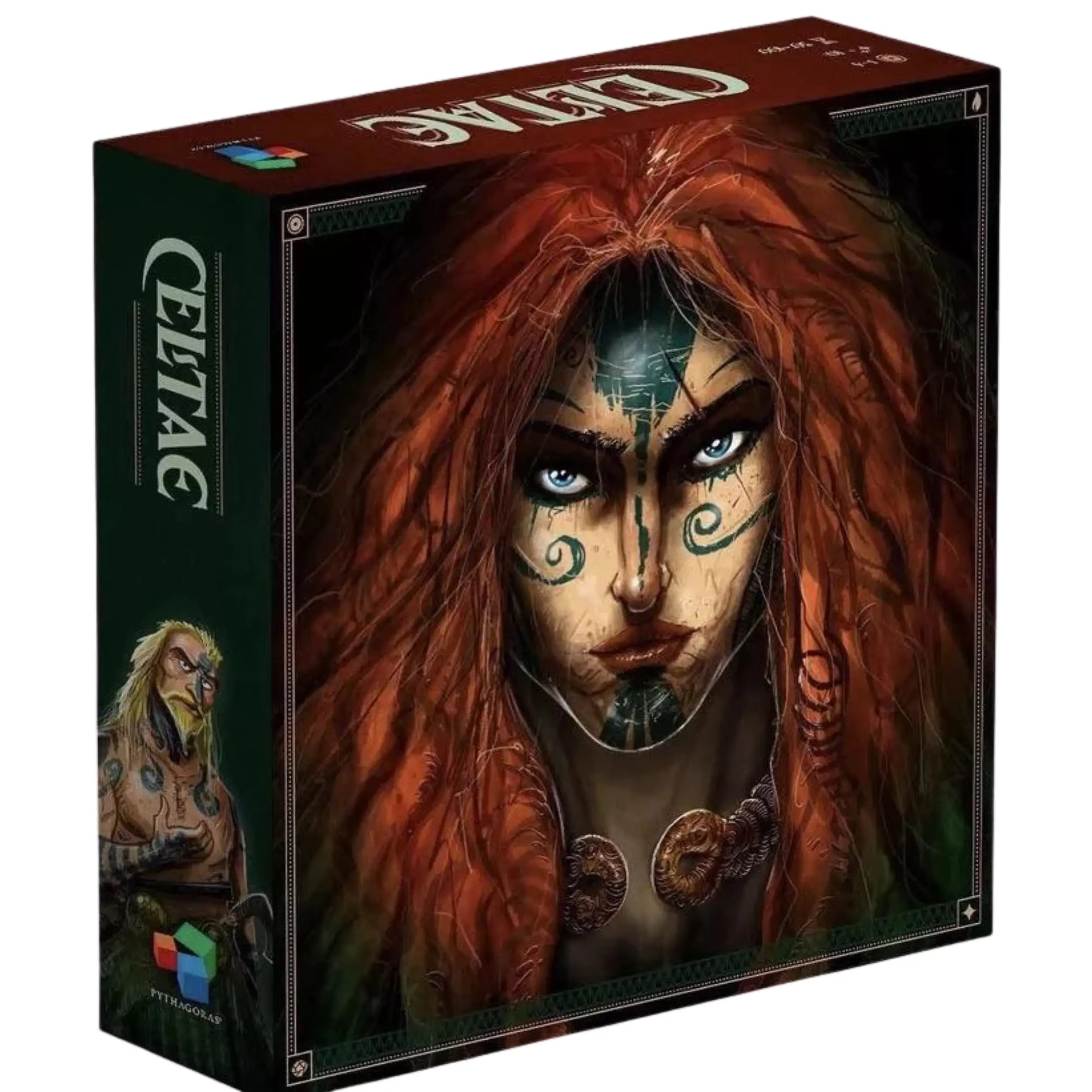
Designed by Orlando Sá and illustrated by Mihajlo Dimitrievski, Celtae brings the Celtic world of the 2nd century BC to the table, when tribes from Ireland to Galatia controlled much of Europe. The game focuses on building citadels and recruiting specialized workers — farmers, builders, soldiers, nobles — as the Roman legions draw ever closer.
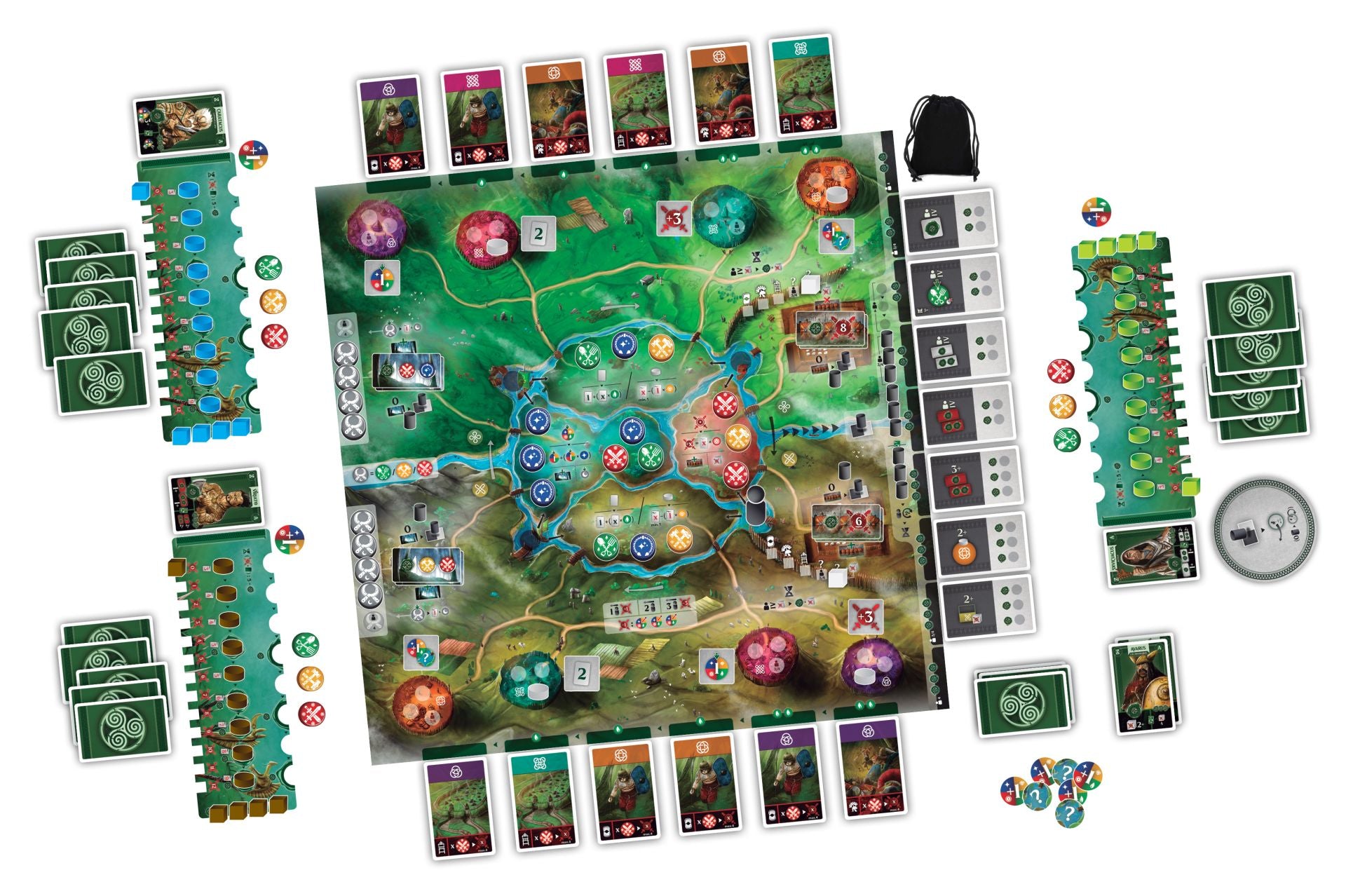
On your turn, you swap one of your three active workers with one present in the action space you want to activate on the central rondel. The action you perform is boosted if you have the right type of worker in your pool: farmers boost card drawing, builders citadel expansion, soldiers combat against Rome, nobles recruitment. Citadels are only completed if all players contribute, and only score points if finished: forced cooperation within a competitive race.
What they say abroad
A worker-swapping system that breaks the routine of classic placement.
— FroGames
"A fascinating blend of cooperation and competition in an evocative Celtic setting."
A fascinating mix of cooperation and competition in an evocative Celtic setting.
— Meeple Mountain

Celtae
The game includes official solo rules with an automa deck that simulates an opponent by placing discs on citadels and consuming resources. It works as training to understand the rondel engine, but loses the political interaction and tension over shared citadels that are the core of the multiplayer experience.
FrogScore · FroGames editorial rating · based on rules, international reviews and play sessionsThe tribe's gears
What you build and with whom
The four types of workers
Farmers for drawing cards, builders for expanding citadels, soldiers for fighting Rome, nobles for recruiting. Each type boosts a specific action, and you can send the best to the druidic order for wild workers.
Shared citadels
You place your discs on incomplete citadels: each gives a different bonus when you build on it. But they only score points if completed, and to do so, everyone's discs are needed. You must choose: help finish or block others by expanding elsewhere.
Multi-use cards
Cards collected with the farming action have three uses: building citadels, preparing battles against Rome, or engaging with the druidic order. You can't do everything: each card spent is a sacrifice.
Double-sided leaders
Each tribe has a leader with two sides: an easy one that gives few sure points, and a heroic one with tough requirements but high multipliers. When to flip them is one of the key decisions of the game.
Recommended sleeves 94 cards in 1 size ▼
If you play often, we recommend protecting your cards with clear sleeves to make them last longer.
| Size | Quantity |
|---|---|
| 57 × 87 mm | 94 |
| Total cards | 94 |
🎲How to PlayThe rules in four steps▼
How to play
The flow of each turn
Each turn is a worker swap plus a powered-up action. Clean, fast, deep.
The rondel has six action spaces: farming (draw cards), build (expand citadels), battle (fight Rome), recruit (get new workers), druid order (send workers to druids), favor (place progress markers). Each space has three workers on it.
Take one of the three active workers from your tribe and swap it with one of the three workers present in the chosen action space. The worker you take returns to your tribe; the one you leave stays on the rondel for the next player.
Perform the basic action of the space. If you have the right type of workers in your tribe (farmers for farming, builders for building, etc.), the action is powered up: you draw more cards, place more discs, defeat stronger enemies. Druids act as wilds.
If the rondel marker completes a round, the player with Teutates' favor places a progress marker on a progress card: those marked at the end of the game will score points, others will not. You determine together what counts and what doesn't.
⏱️Your First GameThe chronicle, moment by moment▼
A game in five moments
What happens at the table
Not the rules. The experience.
Setup and first moves
Shuffle the cards, assign leaders, place random bonuses on citadels. In the first turns, everyone gathers cards and recruits: you need a worker pool before you can build or fight. The rondel turns slowly, exchanges are simple.
The engine warms up
You have three farmers in hand, you draw four cards in a turn. Someone expands the first citadel and gets the bonus they need. The timing of trades starts to matter: take that soldier now or wait for the rondel to come back? Each choice blocks others.
Forced cooperation
A citadel has six slots, four are occupied. Everyone looks at it: closing it now gives points, but whoever places the last disc unlocks a powerful bonus. Someone has to sacrifice to finish it, otherwise no one scores. They negotiate, they calculate, someone yields.
Rome advances
The Roman army deck becomes threatening: stronger armies are worth more points but require more soldiers. Someone flips their leader to heroic mode and focuses entirely on combat. Strategies diverge: some go for citadels, some for battles, some for druids. Three different games at the same table.
End of the race
The progress marker completes the last round of the rondel. Count the discs on the completed citadels: the one you left with five slots is worth nothing. Heroic leader points make the difference. Someone wins by two points thanks to a battle that seemed useless ten turns ago.
🐸What to know beforehandThree honest things, from friends▼
What to know beforehand
Three honest warnings
Downtime with four players
With four players, if someone suffers from analysis paralysis, the downtime between your turns can become significant. The game offers many choices each turn, and those who optimize everything slow down the table. With two or three, it flows better.
Light theme
The Celtic setting is evocative on the box, but in play, it remains superficial. The mechanics are classic Eurogame: points, optimization, engine building. If you are looking for narrative immersion or historical evocation, this is not the right game.
Difficult to read scores
Points come from various sources (citadels, leaders, battles, progress) and many are only revealed at the end of the game. You don't know who is winning until the final count: good for tension, frustrating if you want to correct your course.
🏆Victory and defeatWhat the end rewards▼
How it ends
How to win
The game ends when the marker on the rondel completes all intended rounds (depends on the number of players). The player with the most victory points wins.
Sources of points
- Discs placed on completed citadels (only completed ones count)
- Leader requirements (normal side: few easy points; heroic side: many points if you meet tough conditions)
- Roman armies defeated during battles
- Progress cards on which at least one marker has been placed (others are worth nothing)
What doesn't count
- Discs on incomplete citadels: they don't give any points
- Progress cards without markers: ignored in the final count
- Workers in the tribe or druidic order: they don't count directly, only for the bonuses they have unlocked
A Eurogame that forces you to cooperate while competing, with a worker swapping system that changes the rhythm of classic worker placement. If you like optimizing resource pools and are not afraid of a theme that remains in the background, Celtae works.
💬Frequently Asked QuestionsQuick answers before checkout▼
Frequently Asked Questions
Celtae FAQ
What mechanics does Celtae use?
Worker swapping (you swap your workers with those on the rondel instead of placing them), rondel (actions are arranged in a circle and the game advances with each full rotation), hand management (you manage multi-use cards), area majority (you compete for presence on citadels), engine building (you build a pool of specialized workers that power up actions).
Is it suitable as a first Eurogame?
No. Its weight of 2.7 places it in the upper-middle range: the basic rules are simple, but managing the upgrade engine, knowing when to flip the leader, and coordinating citadel construction requires experience. A gateway game like Ticket to Ride or Splendor is better before this one.
How much does luck factor into card drawing?
Not much. Cards offer options, not unique solutions: you can use them to build, fight, or engage with druids. Even a weak hand can adapt. The difference is made by the timing of swaps and the optimization of your worker pool, not the deck.
Does it scale well from one to four players?
Solo play works for understanding the engine but loses interaction. With two and three players, it's fluid and downtime is acceptable. With four, it lengthens, and with slow players, it becomes heavy: the rondel imposes waits between turns.
Is it available in Italian?
This edition is in English. The cards have text (names of citadels, bonuses, leader abilities) and a basic knowledge of the language is needed to play without stopping to translate. There are no official rules or cards in Italian at the moment.
The people behind the game
Who invented it, who designed it, who publishes it — and what else they've done.
Celtae is a strategic board game for 1-4 players designed by Orlando Sá, lasting 50-100 minutes, recommended for ages 10+. The worker swapping on a rondel system replaces classic worker placement: each turn you swap one of your workers with one present in the action space you want to activate, then perform the boosted action if you have the right type of worker (farmers, builders, soldiers, nobles). Citadels are completed only with the cooperation of all players, but points are individual, creating tension between helping the table and maximizing your own position. Includes official solo mode with automa. Available on FroGames.it in the PYTHAGORAS English edition.
Celtae
Frequently Asked Questions
The answers you're looking for, no beating around the bush.
📸Do the images match the actual product?
The photos on the website often come from BoardGameGeek and are intended to give you an idea of the game. They may vary slightly from the version you receive. The content declared by the publisher is always binding.
📦Does the content of the box match what is indicated?
We always strive to provide the correct content, but minor variations are possible due to reprints or updates. The information comes directly from the publishers. If you have any questions, please contact us!
⏳How do pre-orders work?
Pre-order the game before release, payment is immediate, and the game is reserved for you. As soon as it arrives, we'll ship it right away! If there are any delays, we'll update you promptly.
🔒Can I trust buying here?
Absolutely! Secure payments, tracked shipments, and a team that loves board games as much as you do. If something goes wrong, we'll do our best to fix it.
🛠There's a problem with my order, what should I do?
Write to us now! Whether it's a missing part, damage, or an error, we'll help you resolve it as soon as possible. Your experience truly matters to us.