
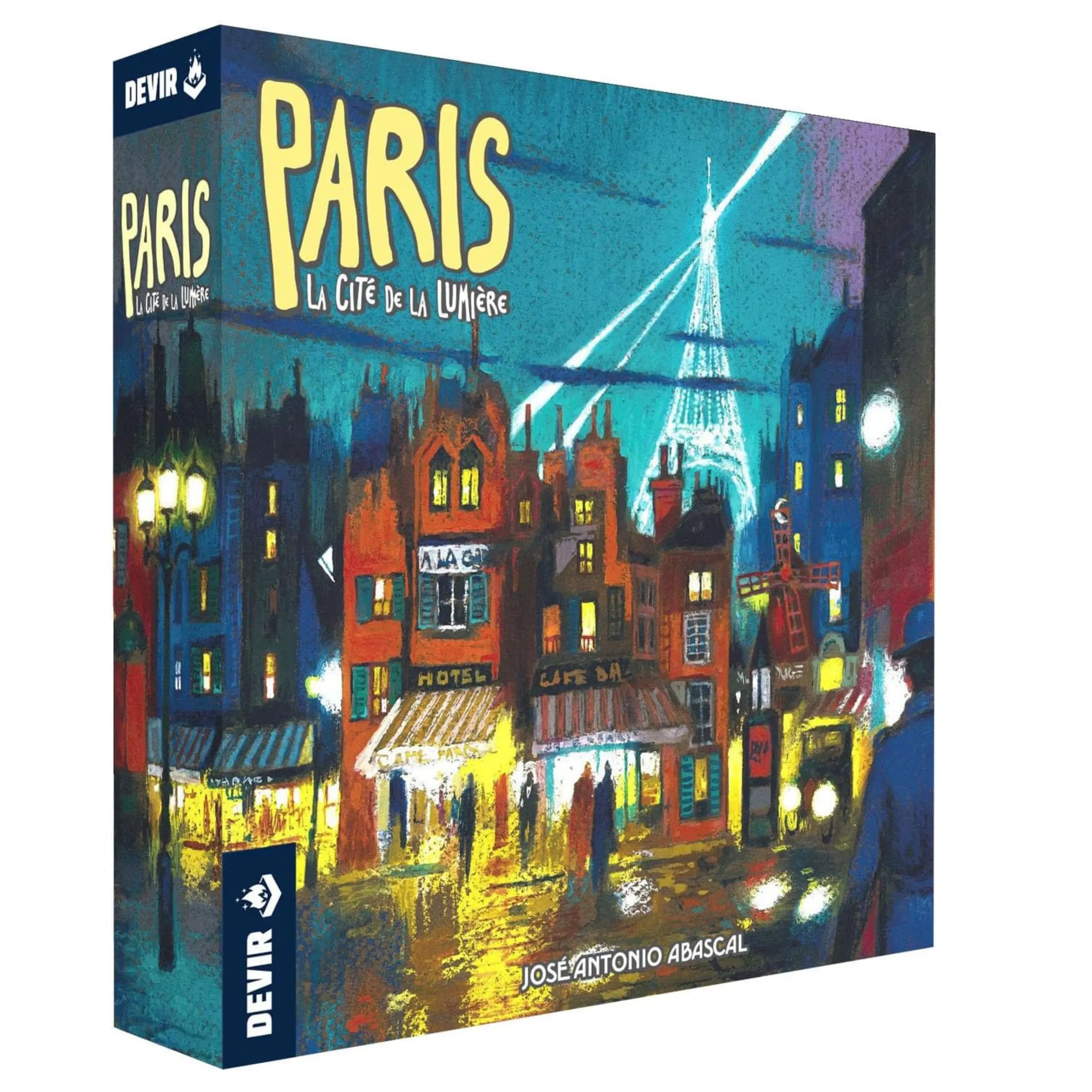
Paris - La Cité de la Lumière
🐸 Details from BoardGameGeek
Consiglio BGG sul numero di giocatori
Categorie
Meccaniche
Design & Art
Lingua
Si abbina bene con
FroGames — Moments You'll Remember
In the end, only one thing matters: who built closest to the light. And when the last lamppost lights up, one of you will have stolen the heart of the city.
WHAT IT'S ABOUT
Building Belle Époque Paris, one lamppost at a time
It's 1889, the Exposition Universelle has brought public electricity to Paris. The city transforms, gas lamps give way to electric lights, and La Cité de la Lumière is born. José Antonio Abascal designed this abstract duel set in those extraordinary years, with illustrator Oriol Hernández giving the game the aesthetics of Parisian Art Nouveau.
Two players build buildings on a modular tile board, trying to place them as close as possible to the lampposts. First phase: place cobblestone tiles or add buildings to the reserve. Second phase: build buildings in your color or neutral spaces, earning points based on how many lampposts illuminate them. In the end, whoever has captured the most light wins.
What they say abroad
A placement puzzle as elegant as the city it represents.
— FroGames
Every tile changes the value of the entire board. You have to think three moves ahead.
— FroGames

Paris: La Cité de la Lumière
FrogScore · FroGames editorial rating · based on rules, international reviews and play sessionsThe components of the city
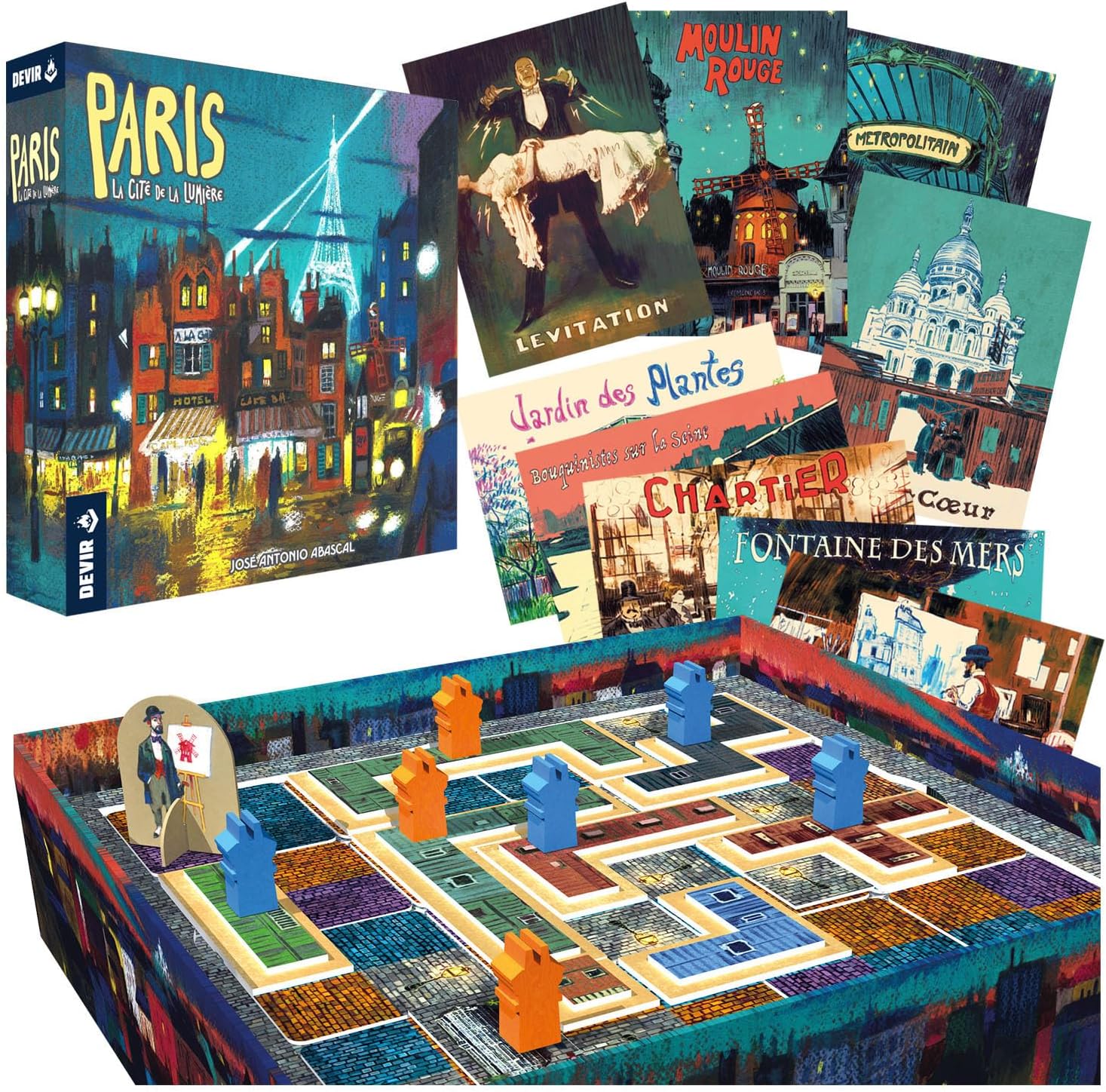
Tiles, buildings, and lampposts
Polyomino buildings
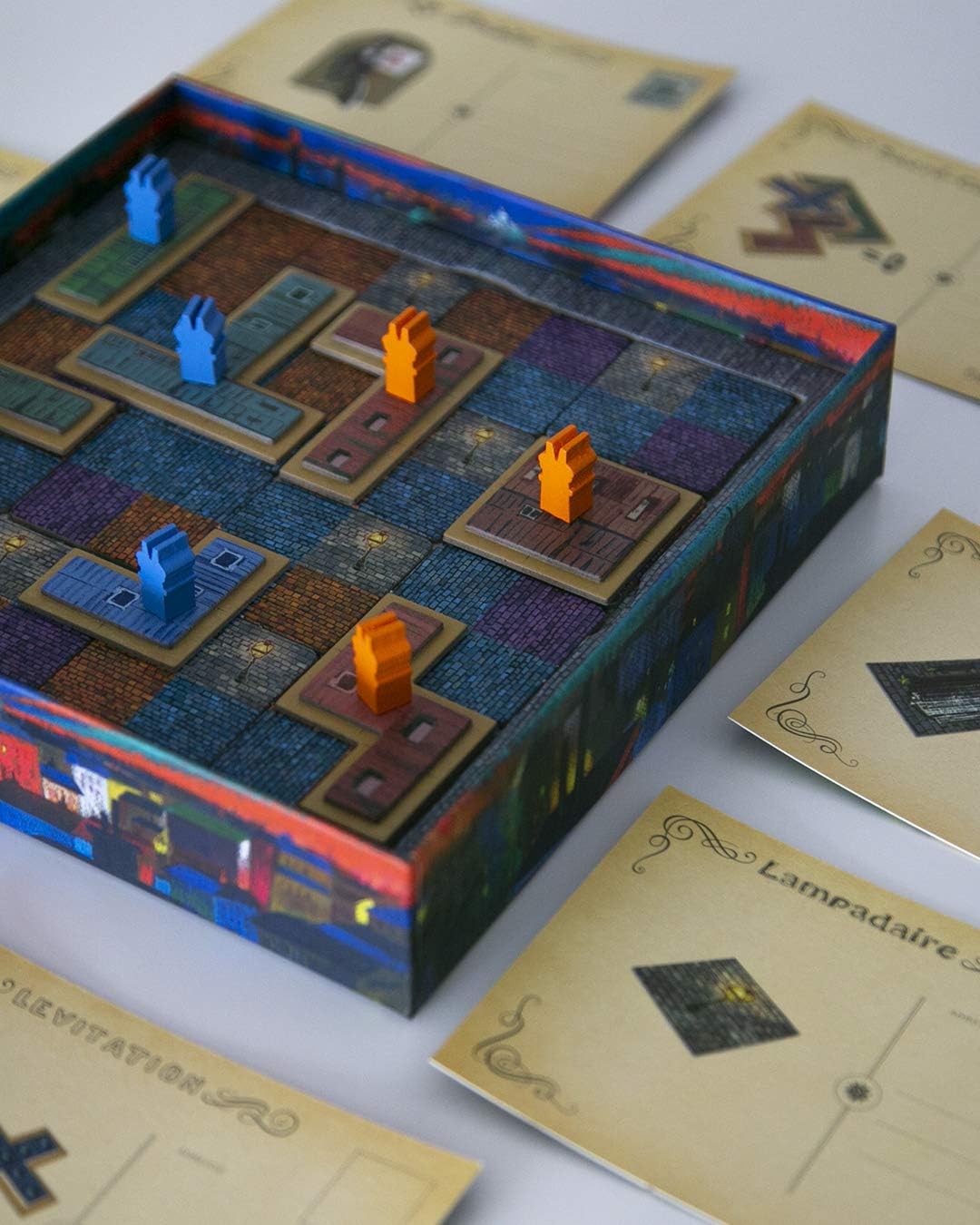
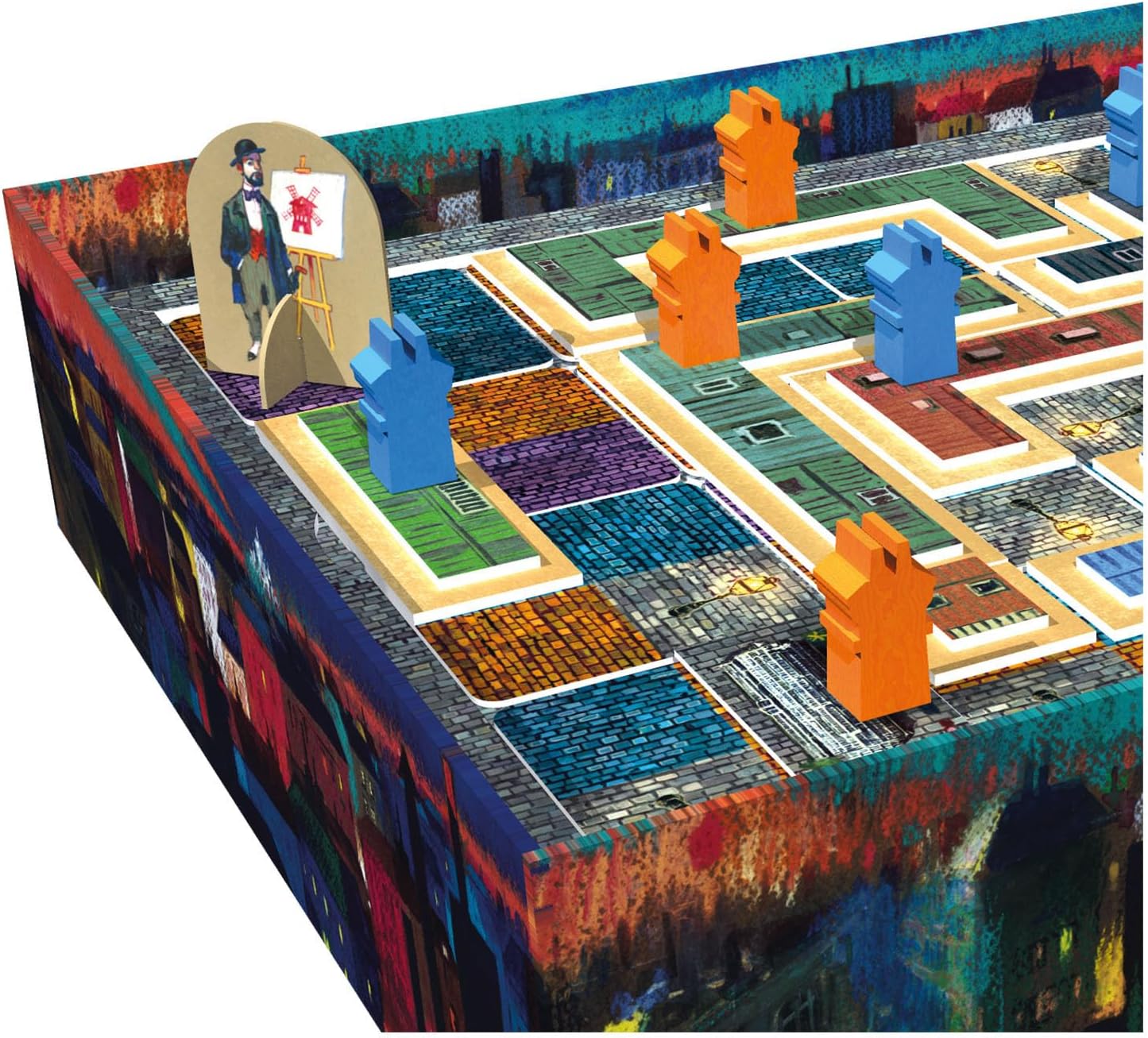
Each player has buildings of different shapes (1 to 4 spaces). They must be placed on the grid respecting the shape and color of the available spaces. Whoever places them best wins.
Cobblestone tiles
Each tile is divided into 4 spaces: two player colors, lampposts, and mixed neutral spaces. They determine where you can and cannot build. The board changes every turn.
Lampposts
Lampposts illuminate adjacent buildings orthogonally and diagonally. The more lampposts touch a building, the more points it's worth. The entire game revolves around them.
Box as a board
The game box becomes the board on which to build the city. An elegant solution that reduces clutter and makes setup immediate.
Recommended sleeves 12 cards in 1 size ▼
If you play often, we recommend protecting your cards with clear sleeves to make them last longer.
| Size | Quantity |
|---|---|
| 90 × 126 mm | 12 |
| Total cards | 12 |
In the end, you'll count the lampposts. And you'll discover that the tile placed on the fourth turn decided everything.
Come si gioca
Video dimostrativo di gameplay.
A game in five acts
What happens at the table
Not the rules. The experience.
The empty board
Before you is just the empty box. You have to build Paris from scratch. The first tiles come out of the supply: a lamppost here, a neutral space there. Nobody understands yet where it's best to build. You're just exploring.
The first building
One of you places the first building near a lamppost. The other realizes that space will no longer be available. You start blocking each other, occupying the best spaces before your opponent does.
The grid fills up
The board now has shape. Lampposts are scattered, buildings grow around them. Each new tile placed changes the value of everything: a space that was worth little is now perfect, one that seemed safe is blocked.
The last large building
One of you still has a 4-space building. They have to place it, but free spaces are almost gone. It needs a nearby lamppost, otherwise it's worth zero. The other player knows this and tries to block the only good space left.
Counting the lampposts
Game over. Now points are counted: each building is worth points based on the lampposts illuminating it. Someone won by just one point. And you realize that tile placed on turn 4 made all the difference.
How to play
The flow of each round
The game is divided into two phases: board construction and building placement.
On your turn, choose: draw and place a cobblestone tile (which creates new spaces), or add a building from the general supply to your personal supply. This phase lasts until all tiles are placed.
Now you build. On your turn, you place ONE building from your supply on spaces of your color or neutral spaces, respecting the polyomino shape. Buildings cannot overlap.
Each building is worth as many points as there are adjacent lampposts (orthogonally or diagonally). A building can be illuminated by multiple lampposts. Sum all the points from your buildings.
The player with the most points wins. In case of a tie, the player who placed more buildings wins. If still tied, the player with the single most illuminated building wins.
Why it's different from others
Six mechanics that make a difference
Board that grows turn after turn
There is no fixed board. Each tile placed adds 4 new spaces, changing building possibilities for both. The game builds itself as you play, and choices made early affect everything else.
Lampposts as the sole metric of value
It doesn't matter how many buildings you build or how big they are. Only how many lampposts illuminate them matters. A small building in a perfect position beats a large one in the dark. This focuses all decisions on one thing: light.
Polyominoes of variable shape
Buildings have different shapes (1, 2, 3 or 4 spaces) and must be fitted onto the grid. The larger the building, the harder it is to find a space that is worth points. You must plan: if you place large ones immediately, you risk getting blocked later.
Contested neutral spaces
In addition to spaces of your color, there are mixed spaces where both can build. These are the most contested: if a neutral space is near three lampposts, it becomes a battleground. Whoever occupies it first takes it from the other.
Tactical choice in phase 1
Each turn you decide: place a tile (modifying the board and creating opportunities) or take a building from the supply. If you take too many buildings early, your opponent builds the board in their favor. If you wait too long, the good buildings run out.
The box is the board
Elegant solution: the tiles are placed inside the box, which becomes the city perimeter. No assembly is needed, setup is immediate, and the table footprint remains contained. Perfect for taking anywhere.
How it ends
How to win and how to lose
The game ends when all buildings are placed. Then points are counted.
Victory
- You have more total light points than your opponent (sum of all lampposts illuminating your buildings)
- In case of a tie, you placed more buildings
- If still tied, your single most illuminated building beats your opponent's
Defeat
- You placed buildings far from lampposts and are worth fewer points
- You built large buildings in dark areas instead of many small, well-lit ones
- Your opponent blocked the best spaces and you were left with zero-point buildings
Paris rewards those who think in geometry and light. It's not about building the most, but about building in the right place at the right time.
Frequently asked questions
FAQ about Paris: La Cité de la Lumière
Is it a suitable game for those who never play abstract games?
Yes. Paris has a theme (Paris 1889) that makes it less abstract than others, and the rules are simple: place tiles, then buildings. The depth emerges after 2-3 games, but the first one is very accessible. If you're looking for an abstract that doesn't feel abstract, it works.
How much does luck count when drawing tiles?
Very little. The tiles all have the same mix of spaces (two colors, lampposts, neutral), so there's no "drawing the good one". The difference is made by WHERE you place them. Two players of the same level draw the same tiles but build completely different games.
Can 8-year-old children play it?
Yes, but it depends on the child. The rules are within their grasp, but spatial thinking is needed: understanding which spaces are worth more, imagining where to place buildings before they exist. A child used to puzzles will get it. One who only plays party games will find it harder.
After how many games does it get repetitive?
The modular board and the choice of when to place tiles or take buildings give high replayability. It's not an infinite game (it remains a light abstract), but it holds up well for 20-30 games. If you only play with the same person, eventually one of you will find the dominant strategy.
Is it available in Italian?
Yes. This Devir edition includes rules in Italian. The game is completely language independent: the tiles and buildings are components without text.
Paris: La Cité de la Lumière is an abstract game for 2 players aged 8 and up, lasting 30 minutes, designed by José Antonio Abascal and published by Devir. Set in Paris in 1889 during the Exposition Universelle, the game uses tile-placement and area control mechanics: players build a modular board and then place polyomino buildings, trying to get them close to lampposts, which determine victory points. The box itself serves as the board, making setup immediate. Paris combines accessibility and tactical depth, making it ideal for families and players looking for short but strategic challenges. Available on FroGames.it.
Frequently Asked Questions
The answers you're looking for, no beating around the bush.
📸Do the images match the actual product?
The photos on the website often come from BoardGameGeek and are intended to give you an idea of the game. They may vary slightly from the version you receive. The content declared by the publisher is always binding.
📦Does the content of the box match what is indicated?
We always strive to provide the correct content, but minor variations are possible due to reprints or updates. The information comes directly from the publishers. If you have any questions, please contact us!
⏳How do pre-orders work?
Pre-order the game before release, payment is immediate, and the game is reserved for you. As soon as it arrives, we'll ship it right away! If there are any delays, we'll update you promptly.
🔒Can I trust buying here?
Absolutely! Secure payments, tracked shipments, and a team that loves board games as much as you do. If something goes wrong, we'll do our best to fix it.
🛠There's a problem with my order, what should I do?
Write to us now! Whether it's a missing part, damage, or an error, we'll help you resolve it as soon as possible. Your experience truly matters to us.