
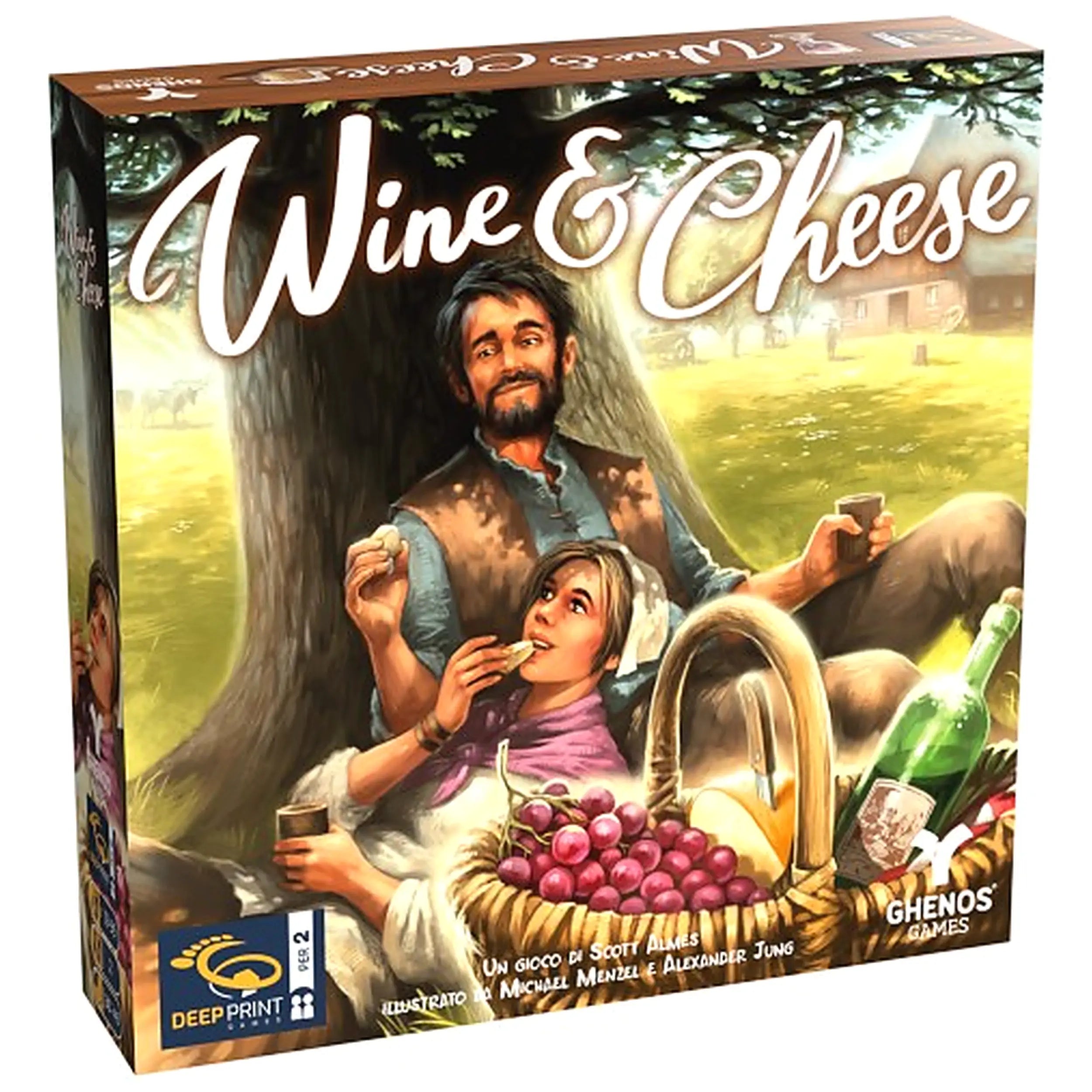
Wine & Cheese
🐸 Dettagli da BoardGameGeek
Consiglio BGG sul numero di giocatori
Categorie
Meccaniche
Design & Art
Lingua
Si abbina bene con
FroGames — Moments You'll Remember
After an hour, you'll understand why Burgundians always have that satisfied look. You choose when to sell, when to wait, when to take risks. And in the end, one of you will have figured out the right moment.
WHAT IT'S ABOUT
Two traditional farms in the heart of Burgundy
Scott Almes (Tiny Epic, Harbour) brings his signature compact and deep design to a strategic duel set in the French countryside. The illustrations by Alexander Jung and Michael Menzel tell of a rural world built on tradition, where wine and cheese are not just products, but material culture. Published by Deep Print Games and Pegasus Spiele, Wine & Cheese fits into the tradition of two-player games that prioritize tactical depth over redundancy.
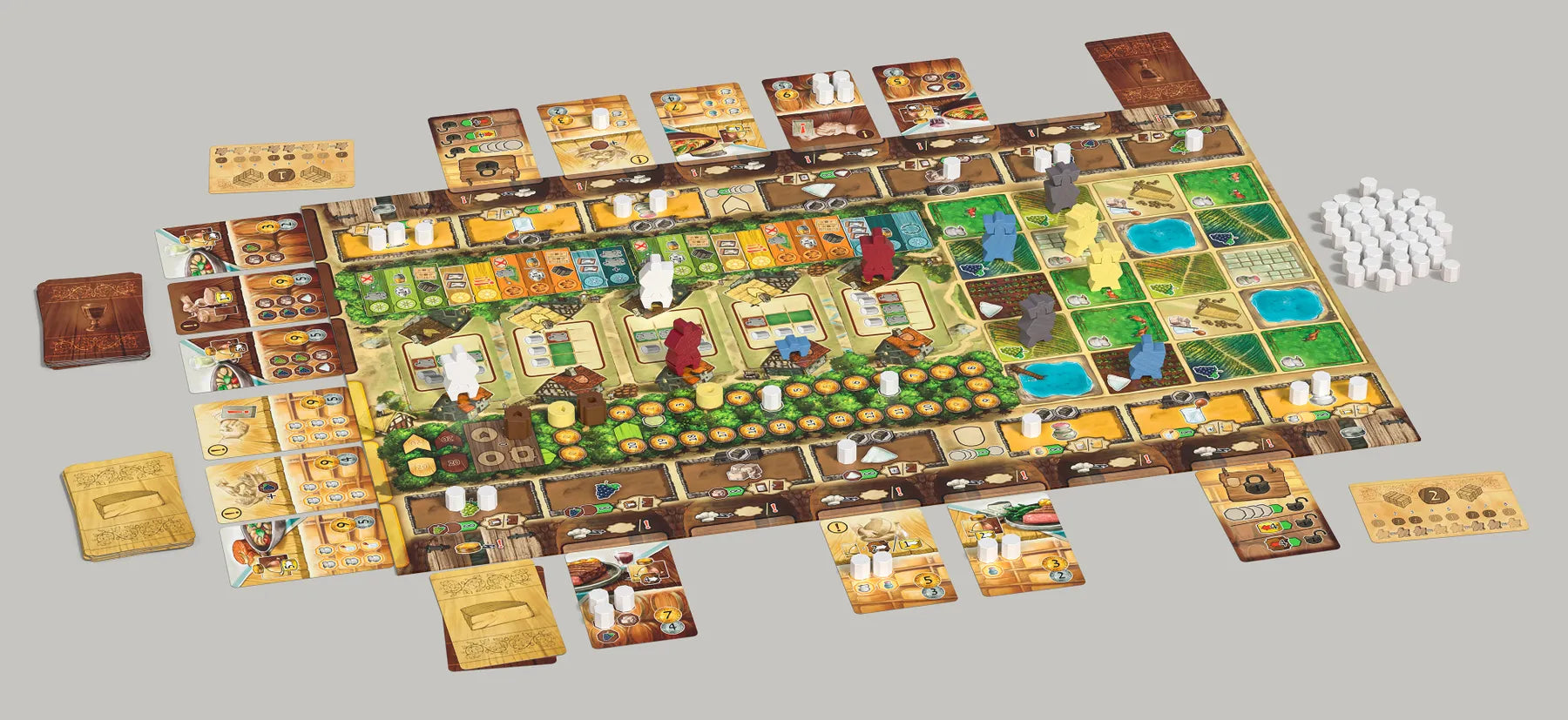
Manage a farm that produces both goods. Gather ingredients by placing paired workers (the game's innovative system), produce, age, and sell at the right time. To win, you must obtain money from both wine and cheese in a balanced way: asymmetry penalizes you. Every timing choice counts, because aging improves value but delays liquidity.
What they say abroad
A game that tastes of tradition and difficult choices.
— FroGames
The paired worker system is simple to explain, difficult to master.
— FroGames

Wine & Cheese
FrogScore · editorial rating by FroGames · based on rules, international reviews, and play sessionsWhat you manage
The four pillars of the farm
Wine production chain
Harvest grapes, produce, age in barrels. Each passing year increases value, but ties up resources. You need to know when to sell.
Cheese production chain
Milk, production, aging. Follows the same logic as wine but with different timelines. Balancing the two is mandatory.
Paired workers
The innovative core: you place pairs of workers, not singles. It limits options, forces binary choices, and changes everything compared to classic worker placement.
Contracts and market
Public contracts to complete for points and money. The market rewards those who sell at the right time and penalizes those who wait too long.
At the end of the game, one of you will have understood the rhythm of Burgundy. The other will have a full cellar and no money.
A game in five acts
What happens at the table
Not the rules. The experience.
The inheritance
You have inherited two neighboring farms. The contract cards are on the table, you immediately understand what kind of production will be needed. You start planning whether to focus on wine or cheese, then you remember you have to do both. The tension starts here.
The first harvests
The worker-pair system immediately throws you off. You can't do everything, you have to make a binary choice. The other player blocks the space you wanted, you change your plan. The hand of management cards becomes crucial: each card is a future resource or a tactical option.
Aging or selling
Mid-game. You have young wine and fresh cheese. Aging them increases their value, but you need money now to complete contracts. The other player is already selling, do you wait? Getting the timing wrong here costs definitive points.
The imbalance
You check the score: you've sold a lot of wine, little cheese. The game penalizes you for the imbalance. You have to recover the weak production chain in the last turns, but workers are scarce and the other player is closing the best contracts. This is where you win or lose.
The final harvest
Last round. Final sales, closed contracts, calculated score. The one who balanced the two production chains better and sold at the right time wins. The other produced more but too late. Burgundy rewards patience, but not greed.
How to play
The flow of each round
A round is divided into synchronous phases: you place workers, produce, age, sell. Then repeat.
In turn, you place a pair of workers on an action space. You cannot place them individually. This drastically limits options and forces compromises.
Gather grapes, milk, basic resources. Draw and manage hand cards that represent future options. Each card has a tactical use or can be discarded for an alternative effect.
Produce wine or cheese from gathered resources. Decide whether to sell immediately or age. Aging increases value but takes up space and delays profit.
Sell products to the market or complete contracts for points and money. The final score considers the money from your weakest production chain: you must balance.
Why it's different from others
Six mechanics that make a difference
Paired worker placement
You don't place single workers, but always in pairs. This unprecedented system reduces options per turn and makes each placement a forced binary choice. You can't make intermediate moves: either this or that. It completely changes the feel of classic worker placement.
Mandatory symmetrical victory
The final score only counts the money from your weakest production chain. If you sell 100 wine and 20 cheese, only 20 counts. This forces balanced strategies and prevents single-product specialization. You must always oversee both production chains.
Dynamic aging timing
Every year you age a product increases its sales value, but it keeps it blocked and takes up space. Selling early gives immediate liquidity but less value; waiting too long risks leaving you without money for contracts. The game rewards those who find the right rhythm.
Strategic hand management
The cards in your hand are not just events: they are future resources, tactical options, or fuel for special effects. Each card has a primary and secondary use. Deciding when to play them, hold them, or discard them for bonuses is a constant tactical layer.
Variable asymmetrical contracts
Public contracts change every game and require different combinations of aged wine/cheese. You cannot prepare the same way twice. Whoever reads the contracts first and positions themselves has an advantage, but the other player can block the necessary resources.
Indirect but constant interaction
You don't directly attack your opponent, but each placement blocks spaces, each sale reduces available contracts, each harvest denies resources. Interaction is by subtraction and anticipation, not by conflict. You must always read what the other player wants to do.
How it ends
How to win and how to lose
The game ends after a fixed number of rounds. The money from the two production chains is counted, and the lower value is taken.
Victory
- You balanced wine and cheese equally and sold at the moment of maximum value
- You completed public contracts, earning money and additional points before your opponent
- You managed the aging timing without unnecessarily blocking resources, maintaining liquidity
Defeat
- You specialized too much in one production chain, and the other remained weak: only the lower counts
- You aged too much, waiting for maximum value, but lost contracts and liquidity along the way
- Your opponent systematically blocked your key actions, and you couldn't adapt
Wine & Cheese does not forgive imbalances. The winner is whoever understands that unilateral perfection is not enough; harmony between the two production chains is needed. Just like in Burgundy, after all.
Frequently asked questions
FAQ about Wine & Cheese
How different is it from classic worker placement games?
Very. The worker pairing system radically changes the feel: you don't micro-optimize over 5-6 actions, but make forced binary choices. Every placement is a clear compromise. If you know Agricola or Viticulture, expect a different pace and tension.
Does it also work well with casual players?
The rules can be explained in 20 minutes, but the tactical depth emerges later. It's a game for those who appreciate optimization under constraints. It's not a gateway game, but not a heavy one either: it's a medium-weight game with dense decisions. If you like strategic two-player games, you'll feel at home here.
How important is aging in the strategy?
Central. Aging increases value but blocks space and liquidity. You need to understand when to sell: too early you lose money, too late you lose contracts. The game never tells you the right answer; you have to read it from the situation. Whoever masters this timing wins.
Is replayability high?
Yes. Contracts change every game, drawn cards vary, balancing strategies adapt. There is no dominant opening. After 10 games, you still discover new combinations. It's a game that rewards those who come back to it.
Is it available in Italian?
Yes, this is the Italian edition published by Ghenos Games. Cards, rulebook, and components are all in Italian.
Wine & Cheese is a strategic 2-player game designed by Scott Almes, lasting 45-75 minutes and recommended for ages 12+. Set in traditional Burgundy, it combines paired worker placement, card management, and aging timing in a tactical duel where you must balance wine and cheese production to win. Published by Ghenos Games in Italian, the game uses contract mechanics, hand management, and highest-lowest scoring to create a deep yet accessible experience. Ideal for eurogame enthusiasts and two-player games looking for optimization under constraints. Available on FroGames.it.
Wine & Cheese
Frequently Asked Questions
The answers you're looking for, no beating around the bush.
📸Do the images match the actual product?
The photos on the website often come from BoardGameGeek and are intended to give you an idea of the game. They may vary slightly from the version you receive. The content declared by the publisher is always binding.
📦Does the content of the box match what is indicated?
We always strive to provide the correct content, but minor variations are possible due to reprints or updates. The information comes directly from the publishers. If you have any questions, please contact us!
⏳How do pre-orders work?
Pre-order the game before release, payment is immediate, and the game is reserved for you. As soon as it arrives, we'll ship it right away! If there are any delays, we'll update you promptly.
🔒Can I trust buying here?
Absolutely! Secure payments, tracked shipments, and a team that loves board games as much as you do. If something goes wrong, we'll do our best to fix it.
🛠There's a problem with my order, what should I do?
Write to us now! Whether it's a missing part, damage, or an error, we'll help you resolve it as soon as possible. Your experience truly matters to us.