
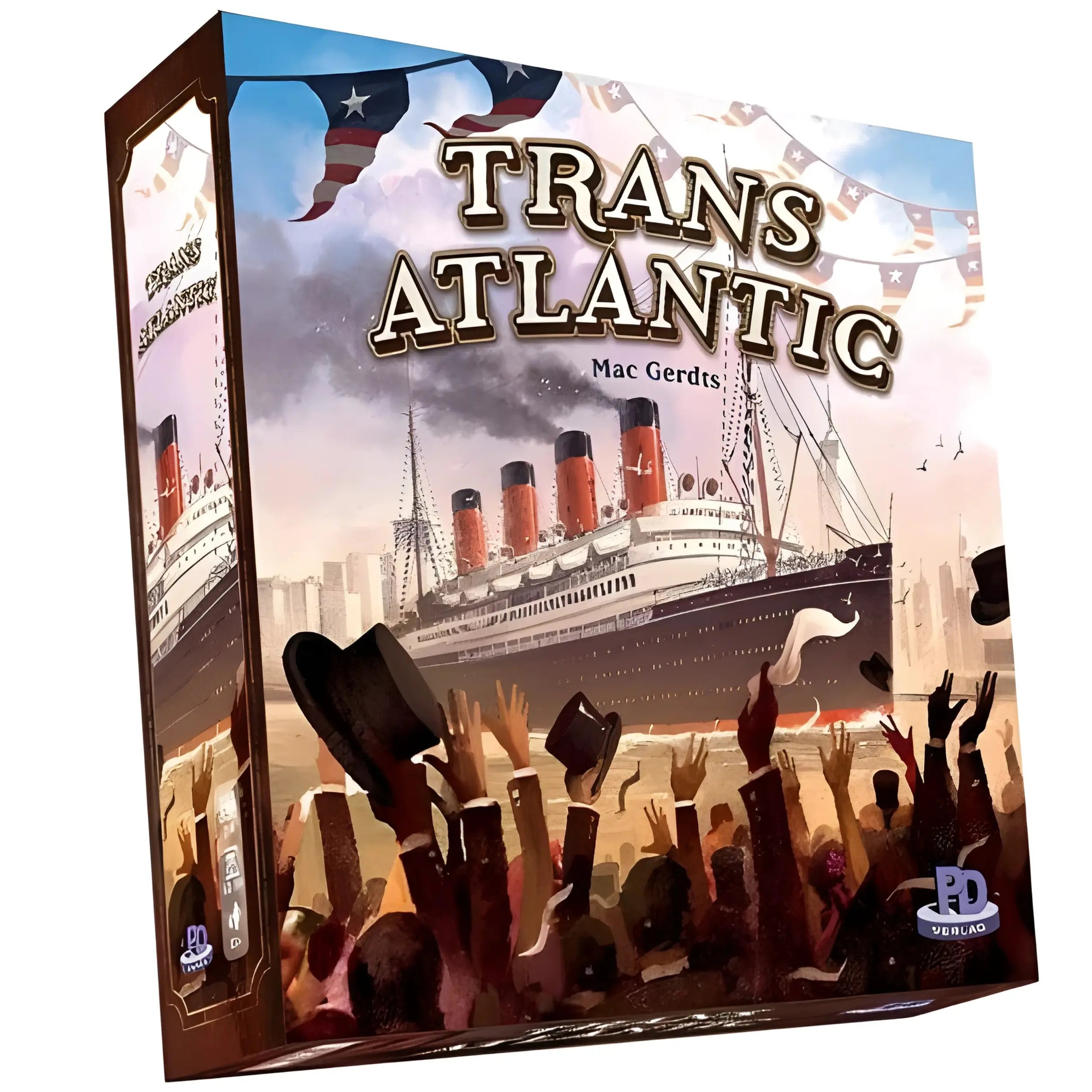
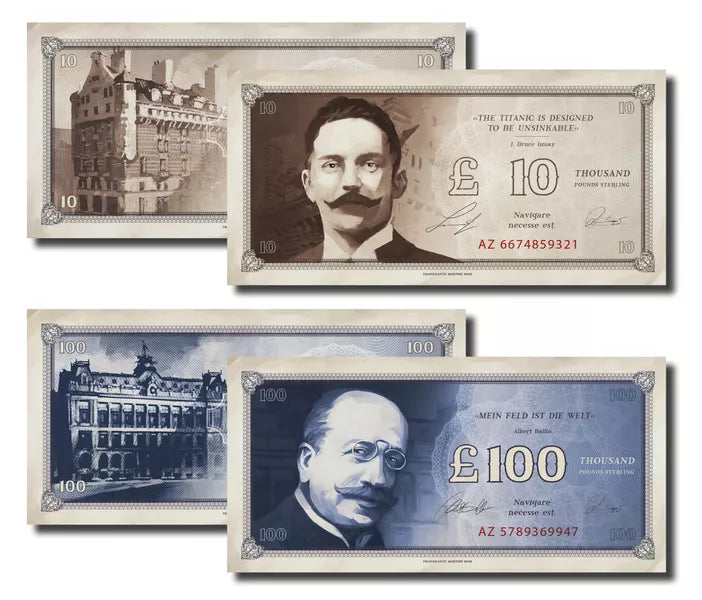
Transatlantic
🐸 Dettagli da BoardGameGeek
Consiglio BGG sul numero di giocatori
Categorie
Meccaniche
Design & Art




Si abbina bene con
The FroGames Board
Your steamship is the fastest in the Atlantic. But do you have enough coal to get there? And what if someone steals your most profitable route while you're loading in Liverpool?
WHAT IT'S ABOUT
The race for maritime dominance from the opening of the Suez Canal to the Great War
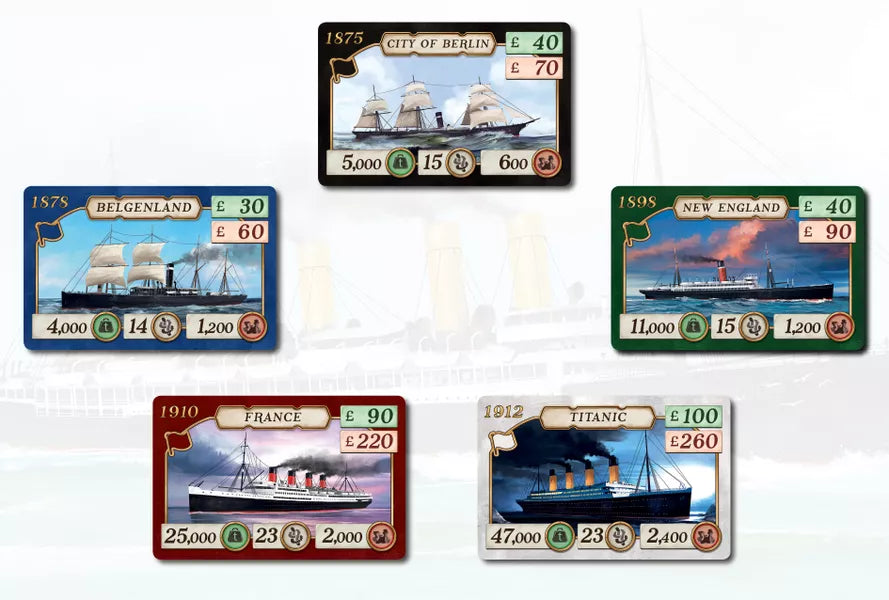
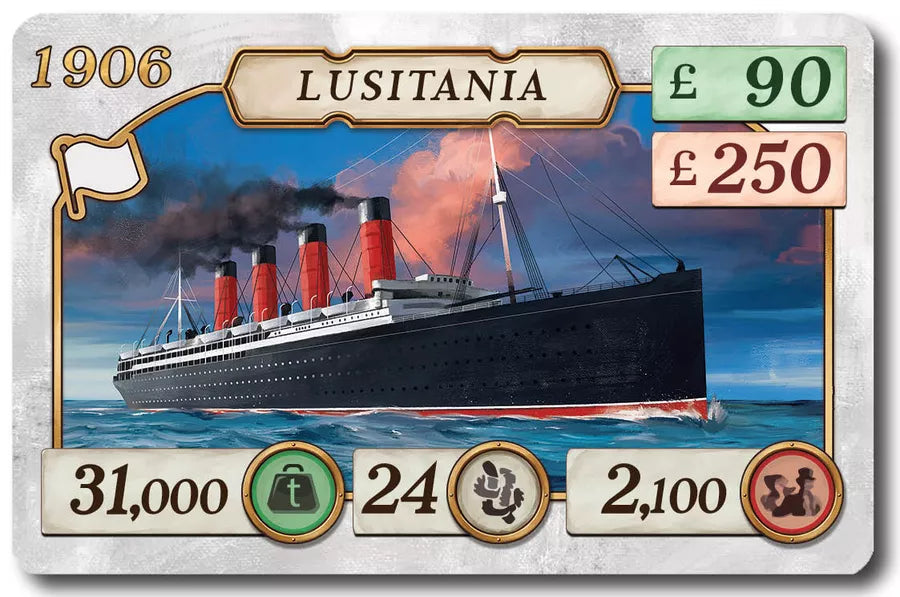
Between 1869 (opening of the Suez Canal) and 1914 (outbreak of World War I), maritime transport underwent an unprecedented revolution: sailing clippers and old paddle steamers gave way to increasingly larger, faster, and more modern steamships. Ships like the Mauretania (Cunard), the Olympic (White Star), or the Imperator (Hapag) dominated the Atlantic and global routes. Mac Gerdts (Concordia, Imperial, Navegador) reconstructs that era through historic steamships with real technical data (tonnage, speed in knots, range) that you can buy and sail.
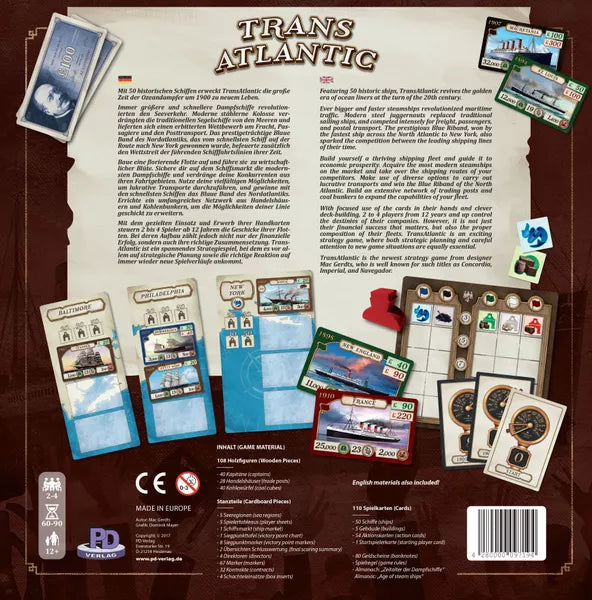
At the table, you manage a shipping company: you transport goods, mail, and passengers on ocean routes that you build yourself, placing coal depots and trading offices. Each turn you play a card from your deck, performing the corresponding action: buying a steamship from the market, opening a new route, loading goods, sailing. As you add better cards to your deck, the possibilities expand, but coal is scarce and the competition for the Blue Riband (the ribbon for the fastest Atlantic crossing) is fierce.
What they say abroad
"From the opening of the Suez Canal in 1869 to the beginning of WWI in 1914, there was an amazing development of bigger, faster, and more modern steamships."
— PD-Verlag
Gerdts creates systems that reward optimization without forgiving improvisation. Here, history is a credible context, not an excuse.
— FroGames

Transatlantic
FrogScore · FroGames editorial rating · based on rules, international reviews and game sessionsYour fleet
Four elements of your maritime empire
The historic steamships
Every ship is real: tonnage, speed in knots, cargo capacity. The Scotia (1861) is slow but cheap. The Mauretania (1907) dominates the Atlantic but requires heavy investment. Choose based on strategy, not charm.
Coal depots
Without coal, you can't sail. Each route requires specific tonnage. You place depots in key ports to refuel and block opponents. He who controls the depots controls the routes.
Cargo and mail contracts
You transport general cargo, mail (which pays more but requires fast ships), and passengers. Each contract has a destination and requirements. You complete a load, sail, collect. The chain must run without waste.
Blue Riband
The Blue Riband for the fastest Atlantic crossing. Worth prestige points and money. But winning it requires the right steamship, abundant coal, and perfect timing. Once lost, regaining it costs double.
Recommended sleeves 110 cards in 1 size ▼
If you play often, we recommend protecting your cards with clear sleeves to make them last a long time.
| Size | Quantity |
|---|---|
| 59 × 91 mm | 110 |
| Total cards | 110 |
Come si gioca
Video dimostrativo di gameplay.
🎲How to playThe rules in four steps▼
How to play
The flow of each turn
Each turn you play a card from your deck, perform its action, and retrieve a previously played card.
Choose a card from your hand and perform its action: buy steamships, place depots/offices, load goods, sail, improve your deck. Each action has costs and prerequisites (coal, money, presence on the route).
If you buy a steamship, you take it from the market and add it to your fleet. If you sail, you spend coal, move your ship, deliver contracts, and collect income. If you place a depot, choose a free port or pay to share with an opponent.
Action retrieval: take back a card you played in previous turns and return it to your hand. This mechanism creates rhythm and planning: you must play cards in the correct order to have them available when needed.
The next player plays. The turn is fast if you have planned, slow if you have to recalculate everything. The game ends when the action cards run out or a predetermined number of rounds is reached (depends on setup).
⏱️Your first gameThe chronicle, moment by moment▼
A game in five moments
What happens at the table
Not the rules. The experience.
Setup: the market is promising
Modular board assembled, ocean routes charted. The steamship market shows the first available ships: economic clippers and some modern steamships. Everyone starts with a basic deck of action cards. Some are already studying which route to open first.
First turns: coal and routes
You play cards to place coal depots and commercial offices. Someone immediately buys a steamship from the market. Others accumulate money. Tension rises when two companies aim for the same Atlantic route: whoever places first wins.
Mid-game: Blue Riband at stake
The first fast steamship crosses the Atlantic and wins the Blue Riband. The others must decide: pursue (expensive) or focus on alternative routes? Coal is scarce. Those who built depots in the right places sail freely, others pay dearly for every resupply.
The moment of the Mauretania
Someone buys a superior class steamship (Mauretania, Olympic, Imperator): high cost, but performance that crushes the competition. The player who bought it makes three profitable trips in a row. The others realize that a countermove or a different strategy is needed.
Endgame: points are tallied
Cards run out, the era closes. Points are summed from completed contracts, owned steamships, depots, offices, Blue Riband. Whoever optimized best wins, whoever improvised falls behind by 20 points. Someone immediately asks for a rematch with a different setup.
🐸Good to know beforehandThree honest things, from friends▼
Good to know beforehand
Three things you need to know
Steep learning curve
The first game is slow: you need to understand how card retrieval works, when to buy steamships, where to place depots. The rules are clear but the system is dense. Expect to misjudge timing and end up 30 points behind the winner. The second game will flow better.
Downtime at 4 players
With 4 players, turns lengthen: each player has to calculate coal, routes, money. If the group has an AP-prone player (analysis paralysis), expect a full 2 and a half hours. With 2 players, it flows smoothly and tensely; with 3, it's optimal.
A dry theme for some
Transatlantic is an economic system dressed as history. If you're looking for narrative, battles, or plot twists, you'll be disappointed. If you're looking for pure optimization with credible historical attire, it's perfect. The steamships have real names and data, but they are primarily numbers to optimize.
🏆Victory and defeatWhat the ending rewards▼
How it ends
How to win
The player who accumulates the most victory points by combining contracts, fleet, infrastructure, and the Blue Riband wins.
Victory points
- Completed cargo/mail/passenger contracts (variable value)
- Owned steamships (value based on tonnage and modernity)
- Coal depots and commercial offices placed on key routes
- Blue Riband conquered and held until the end
How to lose ground
- Buying expensive steamships without having coal or routes to exploit them
- Placing depots in marginal ports that no one uses
- Chasing the Blue Riband with unsuitable ships (wasting money and turns)
- Not optimizing your deck: weak cards in hand at the crucial moment
If you love Gerdts' systems and want a thematic eurogame without compromises, Transatlantic is the right crossing.
💬Frequently asked questionsQuick answers before checkout▼
Frequently asked questions
FAQ about Transatlantic
How difficult is Transatlantic compared to Concordia?
Transatlantic is more complex. Concordia has more immediate rules and a linear flow. Here you have to manage coal, card timing (action retrieval), a variable steamship market, and a modular board. If Concordia is a 3.0 weight, this is a full 3.1. It's not the first Gerdts game to try.
Does the modular board significantly change the experience?
Yes. Ocean routes are built with modular tiles each game: different distances, different key ports, different strategies. One game the Atlantic is short and competitive, another the Pacific is the profitable route. It increases replayability but complicates the initial setup.
What mechanics does Transatlantic use?
Deck-building (add cards to your deck), action retrieval (retrieve played cards instead of drawing), modular board, resource management (coal, money), infrastructure placement (depots, offices). No dice, no random event cards.
Does it work well with 2 players?
It works very well. Less downtime, more control, games in 60-90 minutes. Competition on the routes is direct and fierce. If you're looking for a strategic naval duel without luck, it's excellent. With 3-4 players, the tension dilutes and times lengthen.
Is it available in Italian?
No. This edition is in English (PD-Verlag / Rio Grande Games). The text on the cards is limited (steamship names, standard actions), the rulebook is in English. Good proficiency in the language is needed for the first game, then the game flows with iconographic references.
The people behind the game
Who invented it, who designed it, who publishes it — and what else they've done.
Transatlantic is a strategic board game by Mac Gerdts for 2-4 players, lasting 60-120 minutes, ages 12+. Published by PD-Verlag, it combines deck-building, action retrieval, and a modular board in an economic system set between 1869 and 1914, the golden age of maritime transport. Each game you manage a shipping company, acquire historical steamships with real data (Mauretania, Olympic, Imperator), open ocean routes, transport goods and mail, and compete for the Atlantic Blue Riband. Weight 3.1/5, indirect but tight interaction, minimal luck, central optimization. Available on FroGames.it.
Frequently Asked Questions
The answers you're looking for, no beating around the bush.
📸Do the images match the actual product?
The photos on the website often come from BoardGameGeek and are intended to give you an idea of the game. They may vary slightly from the version you receive. The content declared by the publisher is always binding.
📦Does the content of the box match what is indicated?
We always strive to provide the correct content, but minor variations are possible due to reprints or updates. The information comes directly from the publishers. If you have any questions, please contact us!
⏳How do pre-orders work?
Pre-order the game before release, payment is immediate, and the game is reserved for you. As soon as it arrives, we'll ship it right away! If there are any delays, we'll update you promptly.
🔒Can I trust buying here?
Absolutely! Secure payments, tracked shipments, and a team that loves board games as much as you do. If something goes wrong, we'll do our best to fix it.
🛠There's a problem with my order, what should I do?
Write to us now! Whether it's a missing part, damage, or an error, we'll help you resolve it as soon as possible. Your experience truly matters to us.