
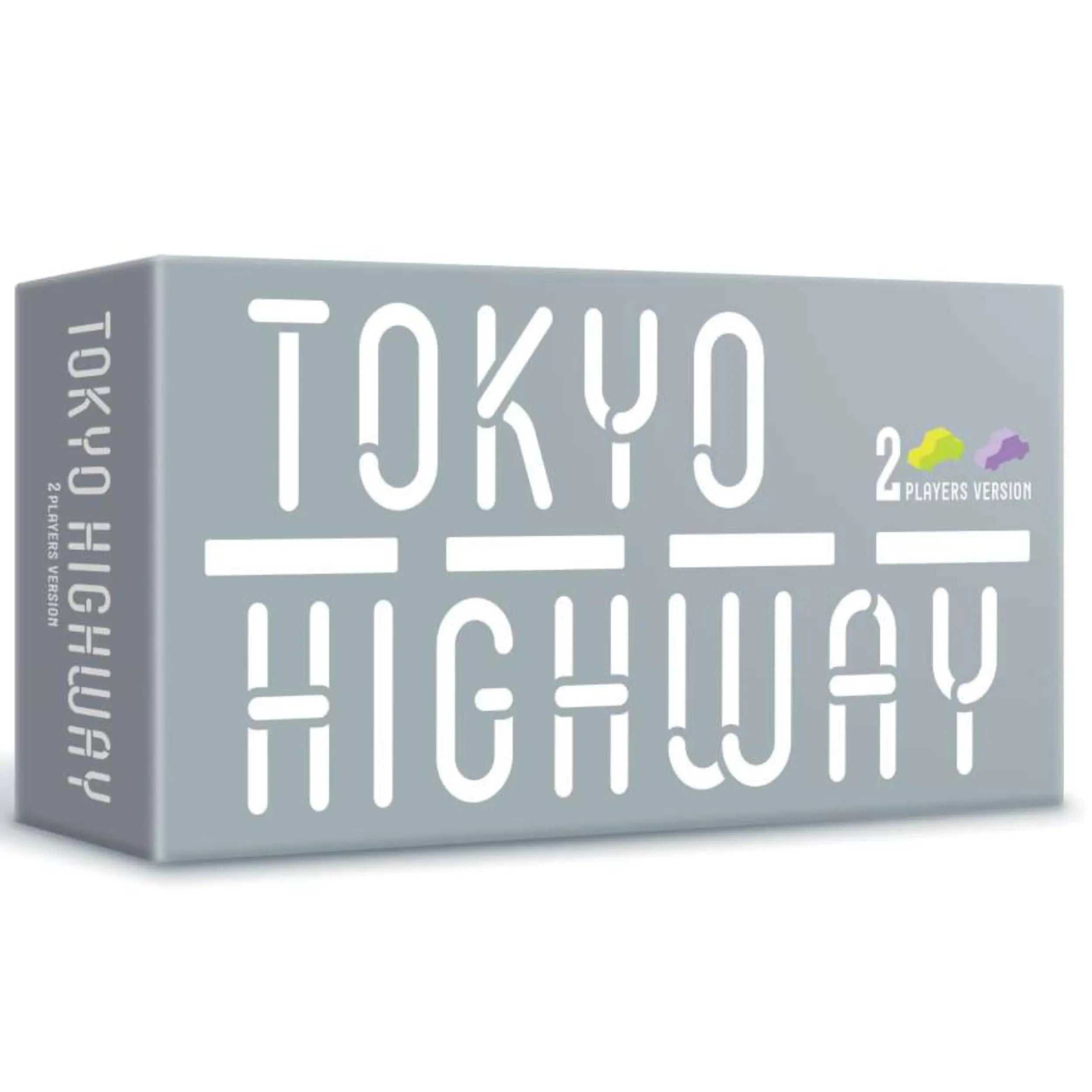
Tokyo Highway 2 Player Version
🐸 Dettagli da BoardGameGeek
Consiglio BGG sul numero di giocatori
Categorie
Meccaniche
Design & Art
Lingua
Si abbina bene con

FroGames — Moments You'll Remember
A pillar. A road. A tiny car resting with bated breath. And someone trembling across the table.
What it's about
The Tokyo that doesn't exist — built by you, one piece at a time
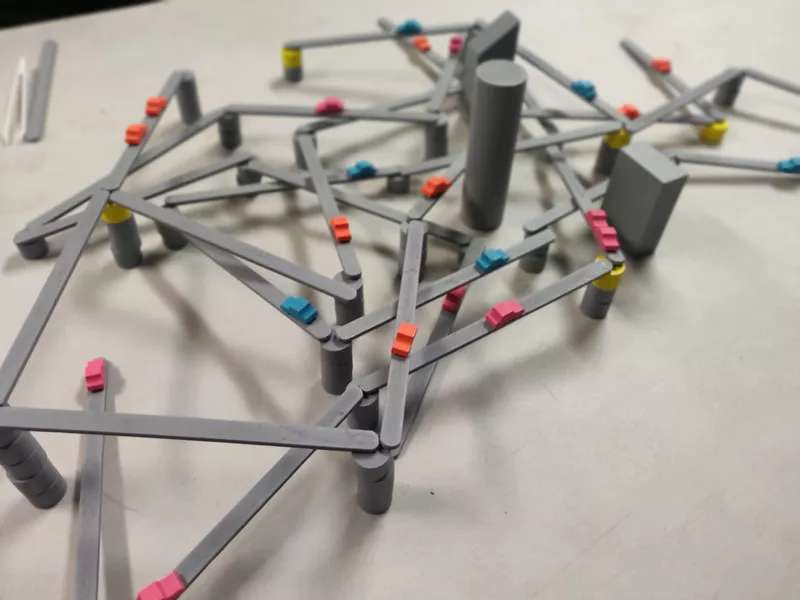
Tokyo Highway originated in Japan in 2016 and immediately captivated collectors worldwide for a simple reason: it resembles no other game. There's no board on the table. There are only grey wooden cylinders, roads as thin as toothpicks, and ten tiny colored cars smaller than a fingernail.
Your task is to build an ever-taller and more intertwined highway network — and place your cars on the roads you build. The key rule: you can place a car every time your road crosses your opponent's, either above or below. The first to place all their cars wins.
It sounds simple. It isn't. Tokyo Highway is a game of absolute precision, silent tension, and explosive laughter — often in the same turn.
From the game table
A game where strategy matters as much as a steady hand. You can have the perfect plan — and lose it all by a breath.
The secret of Tokyo Highway in one line
It's the game everyone wants to photograph mid-game — because no one believes that structure can still stand.
From the gaming experience

Tokyo Highway (2p)
FrogScore · FroGames editorial rating · based on rules, international reviews and play sessionsWhat's in the box
Few pieces. Infinite possibilities.
30 grey pillars
The cylinders that support everything. Each column grows one level at a time — up or down by one, no more.
2 junction pillars (yellow)
The wildcards: they can reach any height, ignoring the +1/-1 rule. Used well, they can turn the game around.
15 wooden roads
Thin wooden sticks that are placed between two columns. They must balance — and never touch opponent's roads.
10 tiny cars + tweezers
Tiny, colorful, beautiful. The box includes tweezers — because placing those cars by hand is a challenge in itself.
That impossible structure you built together — no one would have thought it could stand. And yet it's still there, with your last tiny car on top.
📖RulebookEnglish · Official PDF
A game in five moments
What happens at the table
Not the rules. The experience.
Two ramps. Ten cars. Let's begin.
The two initial interchanges are placed, far enough apart. The pillars, roads, and cars are divided — and the tweezers. Then you look at each other. The table is empty. Soon it won't be.
The first intersection — and the first car
Roads grow, one pillar at a time. Then it happens: your road passes over your opponent's. You have the right to place a car. Grab the tweezers. Hold your breath. You put it down. It holds. First point.
The structure becomes impossible
Fifteen minutes later the table is unrecognizable. Pillars ten levels high, intertwining roads, improbable curves. Every new move requires ten seconds of analysis — and a hand as steady as steel.
The moment something falls
It always happens. An elbow too close, a move too ambitious. Cars fly, pillars tilt. Everything stops. You rebuild. And whoever caused the fall pays with their own pieces — giving them to the opponent.
The last car — and the silence before
Only one left to place. The road is tilted. The tweezers tremble. The opponent dares not breathe. The car slides to the edge — and holds. Game over. Someone wins. Everyone wants to play again immediately.
How to play
The flow of each turn
Four mandatory moves that you learn in five minutes — and perfect throughout the game.
Place a column of cylinders on the table. Free height — but it must be one more or one less than the last column of your network (unless you use a yellow junction).
Place a wooden stick between your last column and the new one. It cannot touch opponent's roads — only pass over or under them. It cannot protrude from the pillars.
For each opponent's road that your new road crosses (above or below), you have the right to place one of your cars on this road. With tweezers. Calmly.
If something belonging to your opponent falls during your turn, you give them as many pillars as fallen pieces. The fewer pillars you have, the fewer roads you can build — and the sooner you run out.
Why it's different from others
Six things that make Tokyo Highway unique
Zero board — the table is everything
There are no predefined spaces. The city grows where you decide — in height, in width, in impossible directions. Each game produces a different sculpture.
The +1/-1 rule that changes everything
Each column must be one level more or less than the last. It seems simple — but it forces you to plan every ascent and descent three moves in advance.
Win by crossing, not blocking
The logic is counterintuitive: you have to get close to opponent's roads to score. You don't avoid them — you seek them out. But without touching them, without bumping them, without making them fall.
Junctions change the rhythm
The two yellow pillars ignore the height rule and allow for two roads. Using them at the right moment can turn a game around — using them badly, burning them without gain, is a costly mistake.
The penalty that punishes heavy hands
Did you drop an opponent's piece? You give up one pillar for each fallen element. Near the end, losing even two pillars can mean not being able to complete your network.
Exhibition-worthy scenic presence
Mid-game, the structure on the table is irresistible — anyone who passes by wants to photograph it. It's one of those games that attracts attention even from those who never play anything.
How it ends
Two ways to win, one way to lose
Victory is clear: whoever places all their cars wins. But there's more than one way to get there — or to lose prematurely.
Victory
- You place all ten of your cars on your highway network
- Or your opponent runs out of pillars and can no longer build
- The one who built better wins — not necessarily the one who built more
Elimination
- You run out of pillars — you can no longer build columns, the game ends
- Falls cost you pieces: every mistake brings you closer to elimination
- There are no do-overs: pillars ceded to the opponent do not come back
Tokyo Highway is one of the most photographed and beloved dexterity games of the decade — born in Japan, it became a cult hit worldwide. In thirty minutes you create something that cannot be described in words.
Frequently Asked Questions
FAQ about Tokyo Highway
Is it really that hard to place the pieces? Aren't they just wooden sticks?
Yes — and that's exactly the point. The cars are tiny, the roads are placed between columns often at different heights, and just a millimeter of misalignment can cause everything to slide or fall. The box includes tweezers for a reason. The physical difficulty is part of the design: it's not a flaw, it's the heart of the game.
Is it for casual players? Or do you need experience with board games?
It is one of the most accessible games ever. The rules are literally explained in five minutes. No board game experience is needed — just a stable table and enough coordination to hold a wooden stick between two fingers. It works perfectly with people who never play games.
How much table space is needed?
More than it seems. A typical game easily occupies 60×60 cm of surface, sometimes more — it depends on how much the networks expand. A stable table is also needed: an accidental bump can cause everything to fall at once. On a wobbly table the game becomes impossible.
Does it only work for two players? Is there a version for more players?
This is the original 2-player version — the one that made the game famous in 2016. There is also a 2-4 player version and, more recently, Tokyo Highway: Rainbow City which supports up to 6. If you want to play with more, look for the other editions. This one is designed exclusively for a two-player duel.
Are the wooden components durable? Is it worth it as a gift?
The build quality is excellent — pillars, roads, and cars are made of solid wood and stand up well to use. It's not a game that gets damaged easily. As a gift, it's particularly suitable for those who appreciate beautiful objects to display: mid-game it looks like an art installation.
The rulebook is in English — is that a problem?
No, for a simple reason: the rules of Tokyo Highway fit on one page. They are few, visual, without ambiguous text. Even with minimal English knowledge, you can understand everything in five minutes. The actual game then requires no reading — only construction and precision.
Tokyo Highway (2-player version) is a dexterity board game for exactly 2 players, recommended age 10+, duration approximately 30 minutes. Designed by Naotaka Shimamoto and Yoshiaki Tomioka, published by itten (Japan). Main mechanic: dexterity and physical construction. Each player builds a three-dimensional highway network using wooden cylinders as pillars and sticks as roads — scoring cars for each intersection with opponent's roads. The first to place all ten cars wins. 100% wooden components with included tweezers. English edition. Available on FroGames.it.
Tokyo Highway 2 Player Version
Frequently Asked Questions
The answers you're looking for, no beating around the bush.
📸Do the images match the actual product?
The photos on the website often come from BoardGameGeek and are intended to give you an idea of the game. They may vary slightly from the version you receive. The content declared by the publisher is always binding.
📦Does the content of the box match what is indicated?
We always strive to provide the correct content, but minor variations are possible due to reprints or updates. The information comes directly from the publishers. If you have any questions, please contact us!
⏳How do pre-orders work?
Pre-order the game before release, payment is immediate, and the game is reserved for you. As soon as it arrives, we'll ship it right away! If there are any delays, we'll update you promptly.
🔒Can I trust buying here?
Absolutely! Secure payments, tracked shipments, and a team that loves board games as much as you do. If something goes wrong, we'll do our best to fix it.
🛠There's a problem with my order, what should I do?
Write to us now! Whether it's a missing part, damage, or an error, we'll help you resolve it as soon as possible. Your experience truly matters to us.