
Scythe
🐸 Dettagli da BoardGameGeek
Consiglio BGG sul numero di giocatori
Categorie
Meccaniche
Design & Art
Lingua
Si abbina bene con
The FroGames Card
You're building your village when you see enemy mechs moving towards the border. You decide: do you speed up production or recruit new soldiers? Your neighbor just activated their factory. In ten minutes, that decision will seem a distant memory.
WHAT IT'S ABOUT
Five factions, one abandoned factory
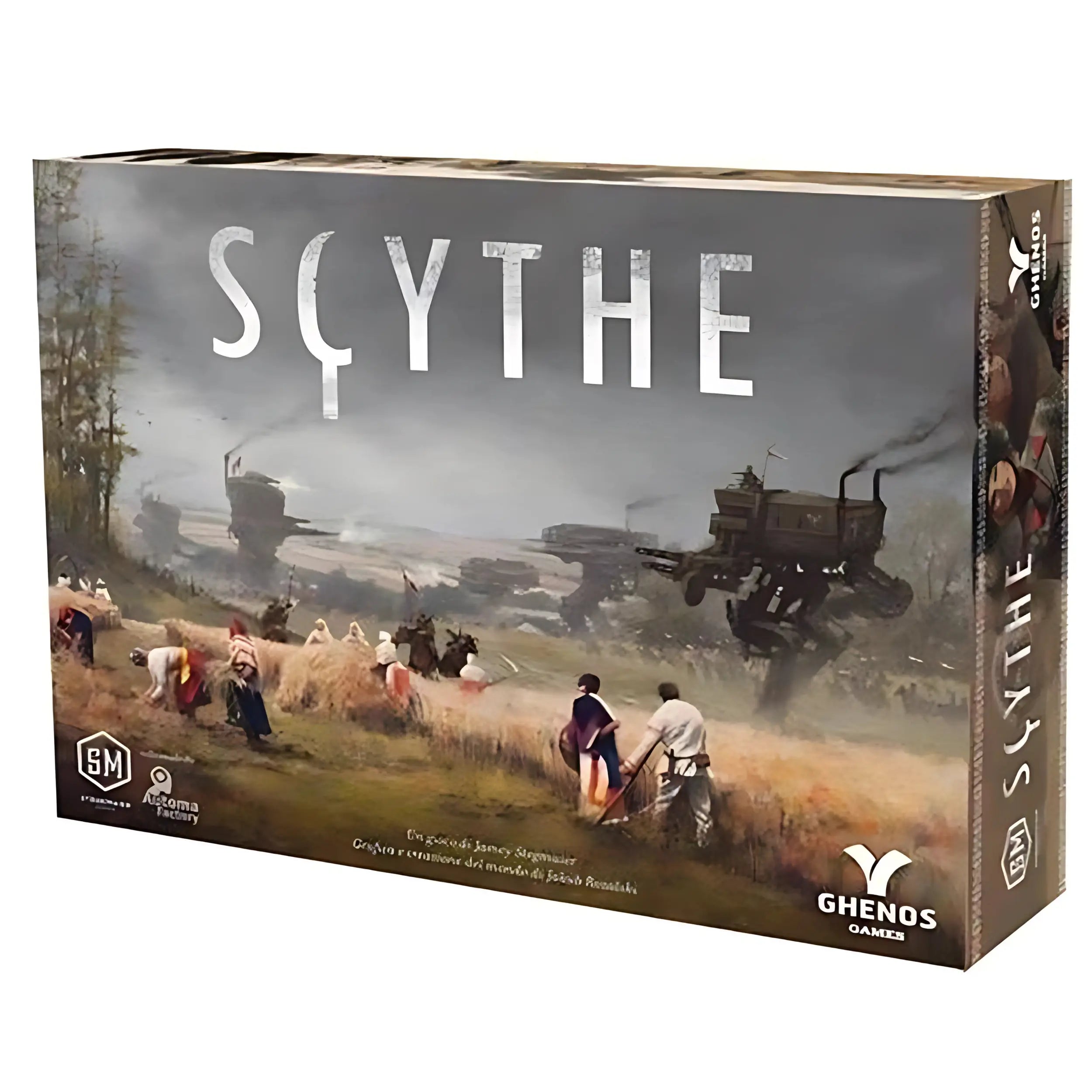
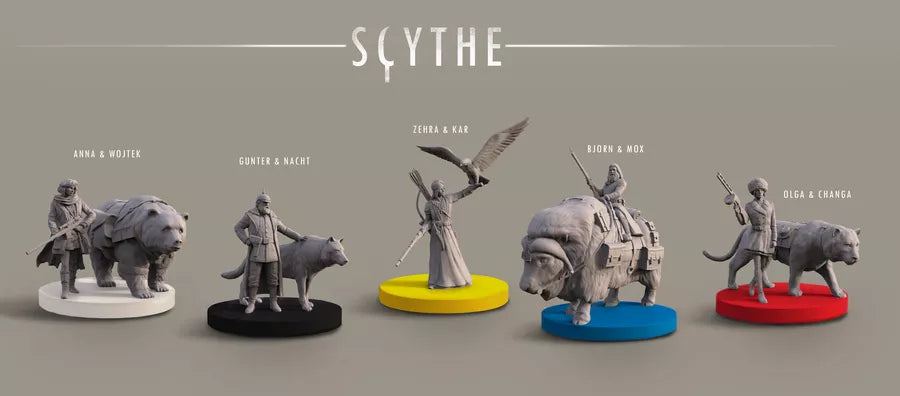
Eastern Europe, 1920. The Great War is over, but the Factory—that city-state that produced combat mechs—has closed its gates. Five nations look upon those fertile lands and industrial secrets. Jamey Stegmaier signs an eurogame disguised as a wargame, set in the dieselpunk universe of Jakub Różalski: farmers plowing with rifles on their shoulders, rusty mechs transporting timber, trained war bears.
You control an asymmetric faction: agricultural production, recruitment, construction, territorial combat. Each action improves your economic engine: the more efficient you become, the faster you accelerate towards the final objectives. The board is shared, resources are limited, mechs are visible. There is no elimination: those who attack pay in popularity, those who expand too quickly pay in resources. The winner is the one who builds the best engine and chooses the right moment to trigger the end.
What they say abroad
"Scythe is a contradiction: a wargame where fighting is rare, an economic game where money doesn't win."
Scythe is a contradiction: a wargame where fighting is rare, an economic game where money doesn't win.
— Shut Up & Sit Down
It's not the game it seems from the box. It's more cerebral, slower, more solitary than the artwork suggests. And it works precisely for that.
— FroGames

Scythe
Official automa designed by Morten Monrad Pedersen and the Automa Factory: one of the best artificial opponents ever designed. It simulates territorial expansion and construction with dedicated cards, scales in difficulty, and does not require complex management. The experience is complete and faster than multiplayer, only losing the human unpredictability in combat choices.
FrogScore · FroGames editorial rating · based on rules, international reviews and play sessionsOn your board
What you build in 115 minutes
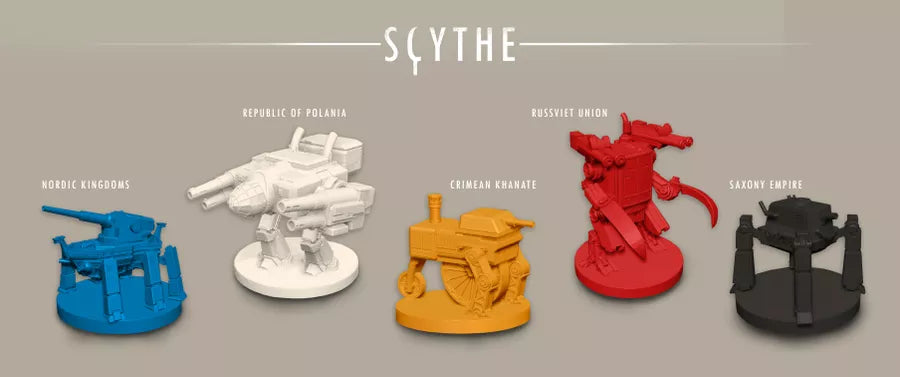
War Mechs
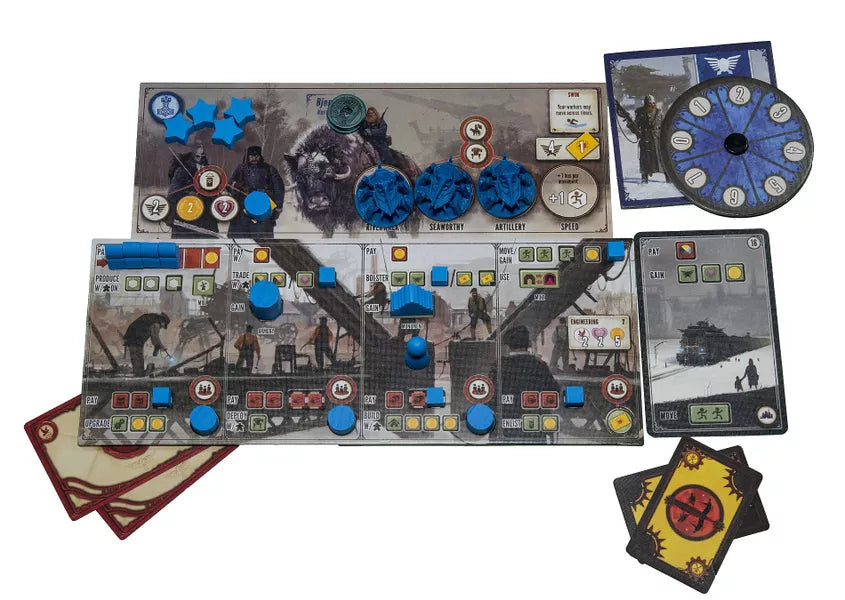
Four mechs per faction, each unlocking a unique ability: crossing rivers, transporting workers, impeding enemy movement. They cost resources but change the map.
Structures
Mills, armories, monuments: four buildings that increase production, grant permanent bonuses, control territories. Placing them in the right spot earns final points.
Workers and Recruits
Eight workers produce resources (wood, food, metal, oil). Four recruits unlock passive bonuses for you and your neighbors: helping them can be beneficial.
Objective Stars
Six stars to place on the central board: each achievement (battles won, maximum power, all mechs) is worth a star. The sixth star triggers the end.
Come si gioca
Video dimostrativo di gameplay.
🎲How to PlayThe rules in four steps▼
How to Play
The Flow of Each Turn
No phases, no rounds. Choose an action, perform it, pass the turn. Quick.
Four columns, each with an action at the top (Produce, Move, Trade, Upgrade) and one at the bottom (Enlist, Build, Deploy Mech, Improve). You cannot repeat the last column used.
Pay the cost (indicated above): coins, popularity, cards. Take the benefit: produced resources, movements made, power gained. Each time you improve this action, the cost decreases or the benefit increases.
Pay resources (wood, metal, oil, food) to build, enlist, activate mechs, improve your engine. You are not obligated: sometimes it's better to skip it to avoid wasting resources.
If your character has reached a territory with an encounter token, draw the card and choose one of the options (gain cards, popularity, or resources). If you have invaded an enemy territory, fight. If you have completed an objective, place a star.
⏱️Your First GameThe chronology, moment by moment▼
A game in five moments
What happens at the table
Not the rules. The experience.
Asymmetrical Setup
You draw your faction and player board: always a different combination. The Nordics start with more power, Crimea has extra encounter cards, Saxony starts near the Factory. You look at the map: who is next to you? How far are you from the center? The game is already different from others before the first turn.
The Engine Starts
You produce resources, move workers, unlock the first powered-up action. The personal board is a grid of actions: choose a column, pay the cost at the top, take the benefit at the bottom. Each move costs less than the previous if optimized. You see others doing the same, each at different paces. The table is silent: everyone builds their own puzzle.
First Mechs on the Field
You activate the first mech: suddenly you cross rivers, transport two workers per turn, threaten others' borders. Others do the same. The map fills with mechanized units, fertile territories become contested. No one attacks yet: fighting costs popularity, and popularity multiplies end-game points. But the tension rises.
The First Combat
Someone invades a key hex. Combat ensues: both secretly choose how much power to spend, they reveal, whoever spent more wins. No dice. The winner takes the territory and a star, the loser retreats units. But the winner has burned power and lost popularity. Everyone recalculates their plans: that star accelerated the end of the game.
Final Trigger
Someone places their sixth star. The game ends immediately. Scores are tallied: base coins, controlled territories, resources owned, all multiplied by popularity. Whoever seemed to be in the lead discovers they invested poorly. Whoever optimized their engine unnoticed wins by twenty points. Someone immediately asks for a rematch with a different faction.
🐸What to know beforehandThree honest things, from friends▼
What to know beforehand
Three things you need to consider
Steep optimization curve
The first game you'll be spinning your wheels: you won't understand which actions to upgrade, you'll waste resources, the end will surprise you unprepared. From the second game on, you'll start seeing combos. By the fifth, you'll master the engine. It's not a gateway game: those looking for an immediate game will be frustrated.
Variable downtime
With two or three players, it flows quickly. With four or five, the time between your turns lengthens: others optimize, count resources, plan three moves ahead. If you play with analytical players, be prepared for downtime. It's not a party game: it requires continuous attention.
Indirect interaction
It looks like a wargame, but combat is rare and punished (you lose popularity). Interaction is on the map: you block territories, compete for objectives, anticipate opponents. If you're looking for constant clashes, you'll be disappointed: Scythe rewards those who avoid unnecessary conflict.
🏆Victory and DefeatWhat the ending rewards▼
How it Ends
How to Win and How to Lose
The game ends as soon as someone places their sixth star. Points are tallied: the one who optimized their engine wins, not the one who seemed to be in the lead.
Victory Conditions
- Place six stars out of ten possible objectives: combat victories, maximum power, all mechs deployed, all upgrades, all recruits, all structures, maximum popularity, all workers, Factory control, secret objective completed
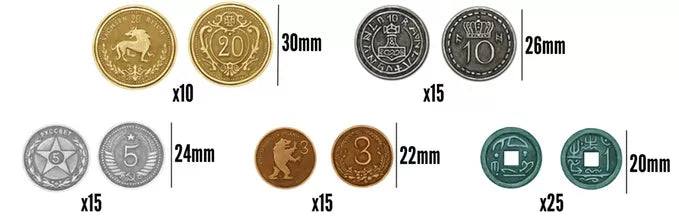
- Accumulate coins, controlled territories (with a star or structure), and resources (two of each type): each category is worth points multiplied by your popularity level (x3 to x7)
- Complete your faction's secret objective (unique condition revealed at the end of the game)
Fatal Errors
- Fighting too much: every battle won costs popularity, and popularity is the final multiplier for your points
- Triggering the end too soon: you place your sixth star but don't have enough coins or territories, whoever built more overtakes you
- Ignoring popularity: you end up with a low multiplier (x3 or x4) and lose to someone with fewer resources but x6 or x7
Scythe is the game that seems like one thing and does another. You buy it for the giant mechs, you stay for the most elegant engine building of its year.
💬Frequently Asked QuestionsQuick answers before checkout▼
Frequently Asked Questions
Scythe FAQ
How important is combat in Scythe?
Much less than it seems. Combat costs popularity (which multiplies final points), so it's only worthwhile in strategic moments: defending the Factory, preventing an opponent's objective, gaining a decisive star. Most games see 2-4 total combats. It's a eurogame disguised as a wargame.
Are the factions balanced?
Yes, but asymmetrical. Each faction has unique abilities and starts from different positions on the map. The Nordics swim across rivers, Crimea has extra cards, Polania can cross enemy territories without fighting. They require different strategies: don't expect mirror matches.
Does it work well with two players?
It works, but it changes: emptier map, less competition for territories, less unpredictability. With two, it becomes a duel of optimization more than a race. Many prefer solo play with the automa (included in the box) rather than competitive two-player.
What mechanics does Scythe use?
Engine building (optimize actions on your personal board), area control (dominate territories on the map), action selection (4x2 grid, you can't repeat the last column), resource management (four types: wood, food, metal, oil), asymmetrical powers (each faction has unique abilities), hidden expenditure combat (choose how much power to invest without dice).
Is this edition in Italian?
Yes. The Ghenos Games edition includes boards, encounter cards, objective cards, and rules completely in Italian. Tokens are language-independent. Expansions and automa included in the base box.
The people behind the game
Who invented it, who designed it, who publishes it — and what else they've done.
Scythe is a strategy board game for 1-5 players, lasting 115 minutes, recommended age 14+. Designed by Jamey Stegmaier and illustrated by Jakub Różalski, it combines engine building, area control, and asymmetrical powers in a 1920s dieselpunk setting. Published by Stonemaier Games and localized in Italy by Ghenos Games, it includes solo rules with an official automa. Mechanics: action selection on a 4x2 grid, resource management, combat without dice, multiple objectives. Available on FroGames.it.
Frequently Asked Questions
The answers you're looking for, no beating around the bush.
📸Do the images match the actual product?
The photos on the website often come from BoardGameGeek and are intended to give you an idea of the game. They may vary slightly from the version you receive. The content declared by the publisher is always binding.
📦Does the content of the box match what is indicated?
We always strive to provide the correct content, but minor variations are possible due to reprints or updates. The information comes directly from the publishers. If you have any questions, please contact us!
⏳How do pre-orders work?
Pre-order the game before release, payment is immediate, and the game is reserved for you. As soon as it arrives, we'll ship it right away! If there are any delays, we'll update you promptly.
🔒Can I trust buying here?
Absolutely! Secure payments, tracked shipments, and a team that loves board games as much as you do. If something goes wrong, we'll do our best to fix it.
🛠There's a problem with my order, what should I do?
Write to us now! Whether it's a missing part, damage, or an error, we'll help you resolve it as soon as possible. Your experience truly matters to us.